North Carolina: Emergencies and special situations — Part 3 Practice Test
Questions in this part include: “On which kind of road does the manual say to be especially cautious about wildlife?” · “What effect can high beams have on some animals?”
Independent educational site · not affiliated with any government agency or DMV
Ready? Test yourself
- Instant feedback with an explanation
- Every answer cites its source in the manual
- Your best score is saved on this device
Questions are original and based on the official manual "North Carolina Driver Handbook" (Revised May 2025), North Carolina Division of Motor Vehicles (NCDMV).
All 19 questions in this practice test
Take the test above first, then use this list to study. Tap “Show answer” to see the correct answer and explanation.
Show the questions and answersHide the questions
-
While scanning ahead for wildlife, what does the manual tell you to watch the road and road edges for?
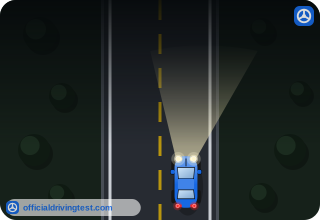
- Movement and eye shine
- Fresh tire marks and broken glass
- Litter and loose gravel
- Flashing lights and reflective signs
Show answer
Correct answer: Movement and eye shine
The manual says to watch the road and its edges for movement and eye shine.
Source: North Carolina Driver Handbook (Revised May 2025), page 74 · Open this page in the manual (Manual page 74)
-
On which kind of road does the manual say to be especially cautious about wildlife?
- Divided highways in cities
- Roads inside parking lots
- Rural, two-lane roads
- Multi-lane roads with many exits
Show answer
Correct answer: Rural, two-lane roads
The manual advises extra caution for wildlife on rural, two-lane roads.
Source: North Carolina Driver Handbook (Revised May 2025), page 74 · Open this page in the manual (Manual page 74)
-
When are wildlife most active, according to the manual?
- At noon and in the early afternoon hours of summer days
- At dawn, at dusk and in the first few hours after dark
- In the hours just before dawn only
- Only in the middle of the night
Show answer
Correct answer: At dawn, at dusk and in the first few hours after dark
The manual says wildlife are most active at dawn, dusk and in the first few hours after dark.
Source: North Carolina Driver Handbook (Revised May 2025), page 74 · Open this page in the manual (Manual page 74)
-
During which seasons should you stay especially alert for wildlife because of seasonal migrations?
- Summer and winter
- Winter only
- Summer only
- Spring and fall
Show answer
Correct answer: Spring and fall
The manual says to stay alert during seasonal migrations, especially in spring and fall.
Source: North Carolina Driver Handbook (Revised May 2025), page 74 · Open this page in the manual (Manual page 74)
-
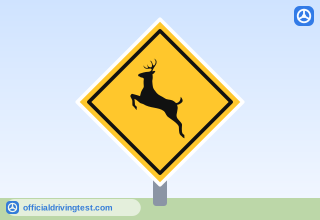
What color are the wildlife crossing signs the manual tells you to look for?
- Yellow
- Green
- White
- Blue
Show answer
Correct answer: Yellow
The manual tells drivers to look for the yellow wildlife crossing signs.
Source: North Carolina Driver Handbook (Revised May 2025), page 74 · Open this page in the manual (Manual page 74)
-
According to the manual, why is the placement of wildlife crossing signs purposeful?
- The signs mark the borders of state parks
- The signs show where hunting is allowed
- Certain areas are well-known hot spots for vehicle collisions
- The signs mark places where speed limits change often
Show answer
Correct answer: Certain areas are well-known hot spots for vehicle collisions
The manual says sign placement is purposeful because certain areas are well-known collision hot spots.
Source: North Carolina Driver Handbook (Revised May 2025), page 74 · Open this page in the manual (Manual page 74)
-
When should you use high beams, with wildlife in mind?
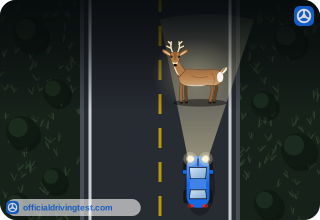
- Whenever you see a yellow wildlife crossing sign ahead
- Only when there is no oncoming traffic and no animals directly ahead
- Always, to make animals run away from the road ahead of you
- Only in the first hours after dark on rural roads
Show answer
Correct answer: Only when there is no oncoming traffic and no animals directly ahead
The manual says to use high beams only when no traffic is oncoming and no animals are directly ahead.
Source: North Carolina Driver Handbook (Revised May 2025), page 74 · Open this page in the manual (Manual page 74)
-
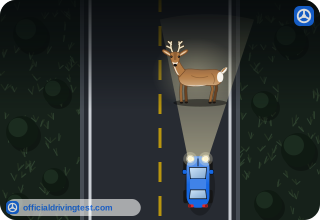
What effect can high beams have on some animals?
- They make the animals run away from the road
- They attract animals in groups
- They make animals move more slowly toward the road edge
- They can confuse or “freeze” them
Show answer
Correct answer: They can confuse or “freeze” them
The manual says high beams can confuse or “freeze” some animals, the familiar “deer in headlights” behavior.
Source: North Carolina Driver Handbook (Revised May 2025), page 74 · Open this page in the manual (Manual page 74)
-
What should you expect if you see one deer, elk or wild boar near the road?
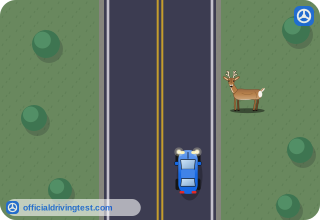
- Others may be close behind it
- It is probably alone
- It will stay off the road
- It will move away from your headlights
Show answer
Correct answer: Others may be close behind it
Many species travel in groups or family units, so others may be close behind.
Source: North Carolina Driver Handbook (Revised May 2025), page 74 · Open this page in the manual (Manual page 74)
-
Why does the manual say not to litter?
- Trash can clog the drains and flood the road
- Trash makes wildlife crossing signs harder to see
- Trash may attract wildlife closer to the road edges
- Trash can cause tire blowouts
Show answer
Correct answer: Trash may attract wildlife closer to the road edges
The manual says trash may attract wildlife and bring them closer to road edges.
Source: North Carolina Driver Handbook (Revised May 2025), page 74 · Open this page in the manual (Manual page 74)
-
If you see wildlife on the road, what does the manual tell you to do?
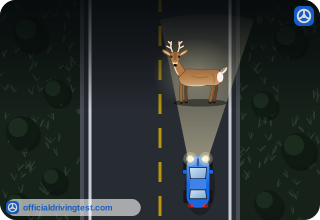
- Swerve into the next lane to avoid the animal
- Brake firmly, stay in your lane, and try to stop in time
- Speed up to get past the animal before it moves
- Stop in the middle of the road and get out of your car
Show answer
Correct answer: Brake firmly, stay in your lane, and try to stop in time
The manual says to brake firmly, stay in your lane and try to stop in time.
Source: North Carolina Driver Handbook (Revised May 2025), page 74 · Open this page in the manual (Manual page 74)
-
If you see wildlife on the road, what can you try with your horn?
- Holding it down until the animal leaves
- Not using it, since it always frightens animals
- Honking it only after a collision
- Honking it briefly
Show answer
Correct answer: Honking it briefly
The manual says you can try honking the horn briefly.
Source: North Carolina Driver Handbook (Revised May 2025), page 74 · Open this page in the manual (Manual page 74)
-
If you hit an animal or come across an injured one, what should you do after pulling off to the side of the road safely?
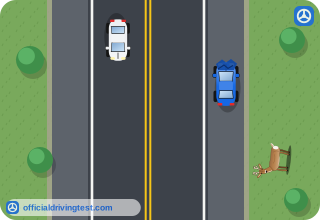
- Stay in your car, lock your doors, and turn on hazard lights
- Get out and move the animal off the road
- Get out and check whether it has young nearby
- Stay in the car with the doors unlocked and the engine off
Show answer
Correct answer: Stay in your car, lock your doors, and turn on hazard lights
The manual says to stay in the car, lock the doors and turn on hazard lights.
Source: North Carolina Driver Handbook (Revised May 2025), page 75 · Open this page in the manual (Manual page 75)
-
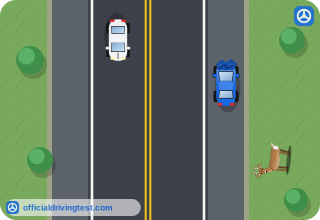
If you hit an animal or come across an injured one, why should you not approach it?
- It will always run away when approached
- It is illegal to touch any wild animal
- It may be dangerous
- It may leave a scent on your clothes
Show answer
Correct answer: It may be dangerous
The manual says not to approach the animal because it may be dangerous.
Source: North Carolina Driver Handbook (Revised May 2025), page 75 · Open this page in the manual (Manual page 75)
-
Why does the manual say to report a wildlife incident to your nearest wildlife rehabilitators?
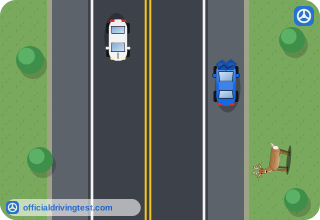
- They will remove your damaged vehicle
- They can check if the animal is alive or has young nearby
- They will file the insurance claim for you
- They decide whether your license will be suspended
Show answer
Correct answer: They can check if the animal is alive or has young nearby
Rehabilitators can check whether the animal is alive and whether it may have young nearby.
Source: North Carolina Driver Handbook (Revised May 2025), page 75 · Open this page in the manual (Manual page 75)
-
What does the manual say is most important in an emergency?
- Stop the vehicle at once, wherever you are
- Call for help before doing anything else
- Apply the brakes as hard as possible
- Do not panic, but react promptly and appropriately
Show answer
Correct answer: Do not panic, but react promptly and appropriately
The manual says that most importantly you should not panic but react promptly and appropriately.
Source: North Carolina Driver Handbook (Revised May 2025), page 75 · Open this page in the manual (Manual page 75)
-
If your brakes fail in a vehicle with a manual transmission, what should you do?
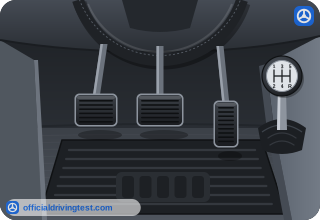
- Shift to a lower gear, release the clutch and apply the emergency brake
- Shift into neutral and press the clutch pedal all the way down
- Shift into a higher gear and pump the gas pedal
- Turn off the engine and coast to a stop
Show answer
Correct answer: Shift to a lower gear, release the clutch and apply the emergency brake
For brake failure with a manual transmission, the manual says to shift lower, release the clutch and apply the emergency brake.
Source: North Carolina Driver Handbook (Revised May 2025), page 75 · Open this page in the manual (Manual page 75)
-
If your brakes fail in a vehicle with an automatic transmission, what should you do?
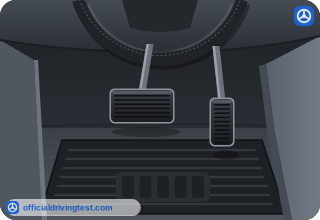
- Move the gear lever into park and steer to the shoulder
- Move the gear lever into neutral and pump the gas pedal
- Apply the emergency brake and shift the gear lever to low range
- Turn off the ignition and leave the gear lever in drive
Show answer
Correct answer: Apply the emergency brake and shift the gear lever to low range
The manual says to apply the emergency brake and move the gear lever into low range.
Source: North Carolina Driver Handbook (Revised May 2025), page 75 · Open this page in the manual (Manual page 75)
-
Why does the manual say to use the emergency brake when the regular brakes fail, even though it could cause damage?
- The emergency brake is designed to replace the regular brakes
- Under the circumstances of brake failure there is no better choice
- The transmission is not affected by the emergency brake
- Repair costs are paid by the state after a brake failure
Show answer
Correct answer: Under the circumstances of brake failure there is no better choice
The manual admits it may damage the brake and transmission, but there is no better choice in a brake failure.
Source: North Carolina Driver Handbook (Revised May 2025), page 75 · Open this page in the manual (Manual page 75)