North Carolina: Emergencies and special situations — Part 1 Practice Test
Questions in this part include: “How does the manual describe carbon monoxide?” · “In how much water can hydroplaning begin?”
Independent educational site · not affiliated with any government agency or DMV
Ready? Test yourself
- Instant feedback with an explanation
- Every answer cites its source in the manual
- Your best score is saved on this device
Questions are original and based on the official manual "North Carolina Driver Handbook" (Revised May 2025), North Carolina Division of Motor Vehicles (NCDMV).
All 19 questions in this practice test
Take the test above first, then use this list to study. Tap “Show answer” to see the correct answer and explanation.
Show the questions and answersHide the questions
-
Why does the manual warn against warming up a car when snow may be blocking its exhaust pipe?
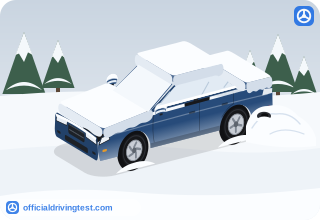
- The engine can freeze and stop
- The snow can melt and flood the engine
- The tires can freeze to the road
- Carbon monoxide can back up into the car
Show answer
Correct answer: Carbon monoxide can back up into the car
The manual says snow can block a car's exhaust pipe and warming up the car can cause carbon monoxide to back up into the car.
Source: North Carolina Driver Handbook (Revised May 2025), page 46 · Open this page in the manual (Manual page 46)
-
How does the manual describe carbon monoxide?
- An invisible gas with no smell, taste or color that is poisonous
- A gas with a strong smell that warns you of the danger
- A harmless gas that normally comes out of the exhaust pipe
- A gas that is visible as a gray cloud behind the vehicle
Show answer
Correct answer: An invisible gas with no smell, taste or color that is poisonous
The manual says carbon monoxide is an invisible gas that has no smell, taste or color but is poisonous, even deadly.
Source: North Carolina Driver Handbook (Revised May 2025), page 46 · Open this page in the manual (Manual page 46)
-
If a vehicle breakdown forces you to stop on an interstate, how should you signal for help?
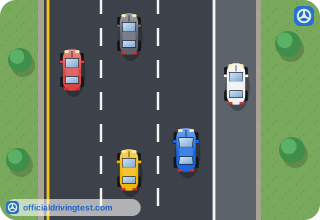
- Tie a white cloth on the radio aerial or left-door handle and raise the hood
- Tie a red flag to the rear bumper, open the trunk and stay in the vehicle
- Tie an orange cloth on the right-door handle and open all four doors
- Stand at the edge of the travel lane and wave down a passing driver
Show answer
Correct answer: Tie a white cloth on the radio aerial or left-door handle and raise the hood
The manual says to move far off the road, tie a white cloth on the radio aerial or left-door handle and raise the hood.
Source: North Carolina Driver Handbook (Revised May 2025), page 64 · Open this page in the manual (Manual page 64)
-
If a vehicle breakdown on an interstate occurs at night, what should you engage?
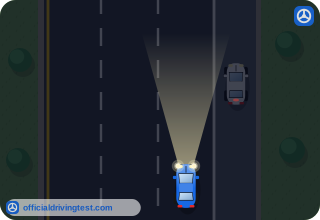
- The high-beam headlights and the horn until help arrives
- The interior dome light and the low-beam headlights only
- The vehicle's emergency flashers or parking lights
- The low-beam headlights only, with the hood closed
Show answer
Correct answer: The vehicle's emergency flashers or parking lights
The manual says to engage the emergency flashers or parking lights if the breakdown occurs at night.
Source: North Carolina Driver Handbook (Revised May 2025), page 64 · Open this page in the manual (Manual page 64)
-
If you are a driver who spots a vehicle breakdown on an interstate, what should you do?
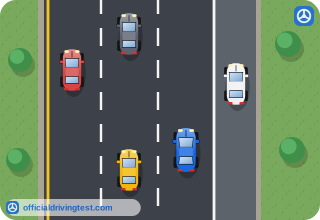
- Stop behind the vehicle and help push it back onto the road
- Immediately contact the State Highway Patrol or local law enforcement
- Stop and offer the driver a ride to the next exit
- Sound your horn until the driver moves the vehicle out of the lane
Show answer
Correct answer: Immediately contact the State Highway Patrol or local law enforcement
The manual says a driver who spots a breakdown should immediately contact the N.C. State Highway Patrol or local law enforcement.
Source: North Carolina Driver Handbook (Revised May 2025), page 64 · Open this page in the manual (Manual page 64)
-
When parking on or along a highway at night, what should you turn on?
- Your high-beam headlights
- Your emergency flashers
- Your low-beam headlights
- Your interior lights only
Show answer
Correct answer: Your emergency flashers
The manual says when parking on or along a highway, turn on your emergency flashers.
Source: North Carolina Driver Handbook (Revised May 2025), page 71 · Open this page in the manual (Manual page 71)
-
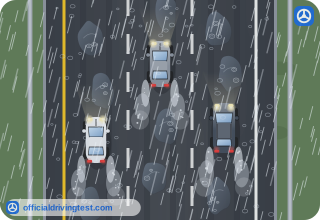
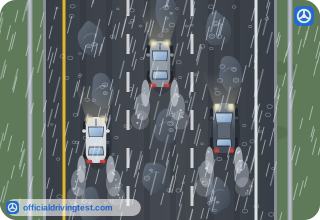
What is hydroplaning?
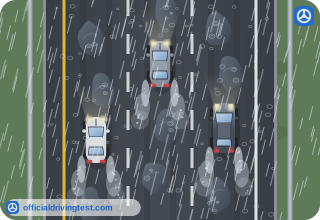
- A thin sheet of water gets between the road and the tires, so they lose contact
- The tires lock up because the brakes are pressed too hard on wet pavement
- The engine floods with water and stalls on the wet roadway
- The tires wear out quickly after driving on wet pavement for a long time
Show answer
Correct answer: A thin sheet of water gets between the road and the tires, so they lose contact
The manual says hydroplaning occurs when a thin sheet of water gets between the road surface and a vehicle's tires, causing them to lose contact with the road.
Source: North Carolina Driver Handbook (Revised May 2025), page 72 · Open this page in the manual (Manual page 72)
-
At what speed can hydroplaning start?
- As low as 10 miles per hour
- As low as 55 miles per hour
- As low as 30 miles per hour
- Only above 65 miles per hour
Show answer
Correct answer: As low as 30 miles per hour
The manual says hydroplaning can start at speeds as low as 30 miles per hour.
Source: North Carolina Driver Handbook (Revised May 2025), page 72 · Open this page in the manual (Manual page 72)
-
In how much water can hydroplaning begin?
- Water at least one foot deep
- Water little more than 1/8 inch deep
- Water at least six inches deep
- Water at least one inch deep
Show answer
Correct answer: Water little more than 1/8 inch deep
The manual says hydroplaning can start in water little more than 1/8 inch deep.
Source: North Carolina Driver Handbook (Revised May 2025), page 72 · Open this page in the manual (Manual page 72)
-
What happens to the chances of hydroplaning when your speed increases?
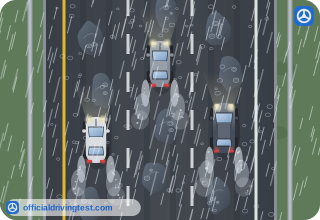
- They decrease
- They stay the same
- They disappear
- They increase
Show answer
Correct answer: They increase
The manual says when your speed increases, so do the chances of hydroplaning.
Source: North Carolina Driver Handbook (Revised May 2025), page 72 · Open this page in the manual (Manual page 72)
-
If you begin to hydroplane, what should you do first?
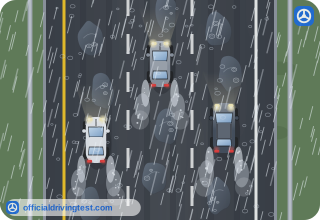
- Take your foot off the gas pedal
- Brake hard
- Jerk the steering wheel
- Accelerate to get out of the skid
Show answer
Correct answer: Take your foot off the gas pedal
The manual says if you begin to hydroplane, take your foot off the gas pedal.
Source: North Carolina Driver Handbook (Revised May 2025), page 72 · Open this page in the manual (Manual page 72)
-
If your vehicle hydroplanes, which instinct should you resist?
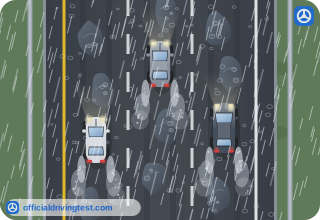
- Steering straight
- Taking your foot off the gas pedal
- Using the brakes
- Letting the car slow down
Show answer
Correct answer: Using the brakes
The manual says to resist your instinct to use the brakes if you hydroplane.
Source: North Carolina Driver Handbook (Revised May 2025), page 72 · Open this page in the manual (Manual page 72)
-
While hydroplaning, how should you handle the steering wheel?
- Turn it sharply to the side to try to regain traction quickly
- Keep it straight and let the car slow down until the tires grip the road
- Jerk it back and forth to try to regain grip on the road
- Hold it loosely and let the car drift across the lanes
Show answer
Correct answer: Keep it straight and let the car slow down until the tires grip the road
The manual says to keep the steering wheel straight and let the car's momentum decrease until the tires grip the road again.
Source: North Carolina Driver Handbook (Revised May 2025), page 72 · Open this page in the manual (Manual page 72)
-
What can send you into an uncontrollable skid once you begin to hydroplane?
- Turning on the windshield wipers while the road is wet
- Taking your foot off the gas pedal and keeping straight
- Keeping the steering wheel straight and steady the whole time
- Any sudden jerking of the steering wheel or a strong gust of wind
Show answer
Correct answer: Any sudden jerking of the steering wheel or a strong gust of wind
The manual says any sudden jerking of the steering wheel or even a strong gust of wind can send you into an uncontrollable skid.
Source: North Carolina Driver Handbook (Revised May 2025), page 72 · Open this page in the manual (Manual page 72)
-
Which tires help prevent hydroplaning at moderate speeds?
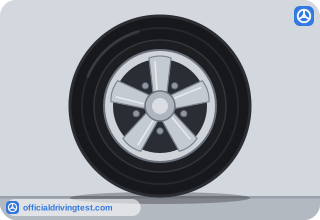
- Tires with deep, open treads that let water escape
- Tires with worn tread and low pressure
- Tires with smooth surfaces
- Tires that are over-inflated to the maximum
Show answer
Correct answer: Tires with deep, open treads that let water escape
The manual says tires with deep, open treads allow water to escape and help prevent hydroplaning at moderate speeds.
Source: North Carolina Driver Handbook (Revised May 2025), page 72 · Open this page in the manual (Manual page 72)
-
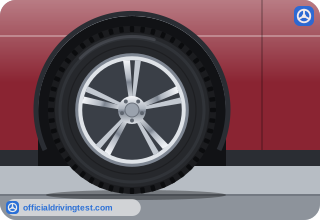
Which tires have less grip on the road and increase your chance of hydroplaning?
- Tires with deep, open treads
- Tires with pressure on the high side of specifications
- Tires with worn tread and those that are under-inflated
- Tires that were recently rotated
Show answer
Correct answer: Tires with worn tread and those that are under-inflated
The manual says tires with worn tread and those that are underinflated have less grip, increasing the chance of hydroplaning.
Source: North Carolina Driver Handbook (Revised May 2025), page 72 · Open this page in the manual (Manual page 72)
-
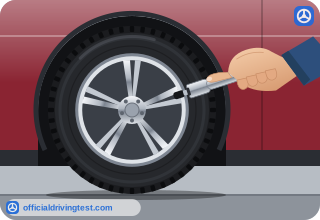
To properly handle skids, where should your tire pressure be relative to the manufacturer's specifications?
- On the low side rather than the high side
- On the high side rather than the low side
- Exactly in the middle
- It does not matter
Show answer
Correct answer: On the high side rather than the low side
The manual says it is better to have tire pressure on the high side, rather than the low side, of the manufacturer's specifications to handle skids.
Source: North Carolina Driver Handbook (Revised May 2025), page 72 · Open this page in the manual (Manual page 72)
-
Which is a warning sign of standing water that can lead to hydroplaning?
- A loud whistling sound coming from the engine compartment
- A vibrating brake pedal each time you slow down
- A fading of the headlights when you turn them on
- Visible reflections on the surface of the water
Show answer
Correct answer: Visible reflections on the surface of the water
The manual lists visible reflections on the water's surface, dimples from raindrops, a slushing sound from the tires and a loose feeling in the steering wheel.
Source: North Carolina Driver Handbook (Revised May 2025), page 72 · Open this page in the manual (Manual page 72)
-
Which sound made by your tires can warn of standing water?
- A "slushing" sound
- A squealing sound
- A humming sound
- A clicking sound
Show answer
Correct answer: A "slushing" sound
The manual says a slushing sound made by your tires is a warning sign of standing water.
Source: North Carolina Driver Handbook (Revised May 2025), page 72 · Open this page in the manual (Manual page 72)