New York: Traffic signals — Part 2 Practice Test
Questions in this part include: “Whose directions take precedence over signs, signals, or pavement markings?”
Independent educational site · not affiliated with any government agency or DMV
Ready? Test yourself
- Instant feedback with an explanation
- Every answer cites its source in the manual
- Your best score is saved on this device
Questions are original and based on the official manual "New York State Driver's Manual" (Form MV-21), New York State Department of Motor Vehicles (DMV).
All 17 questions in this practice test
Take the test above first, then use this list to study. Tap “Show answer” to see the correct answer and explanation.
Show the questions and answersHide the questions
-
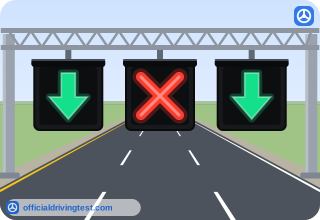
In a Lane Use Control system, what does a steady red X above a lane mean?
- You can use this lane
- Do not drive in this lane
- Move from this lane
- This lane is for left turns only
Show answer
Correct answer: Do not drive in this lane
A steady red X above a lane means do not drive in that lane.
Source: New York State Driver's Manual (Form MV-21), page 31 · Open this page in the manual (Manual page 31)
-
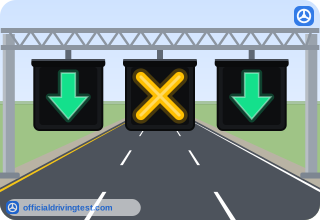
In a Lane Use Control system, what does a steady yellow X above a lane mean?
- Do not drive in this lane
- You can use this lane
- Move from this lane
- This lane is closed permanently
Show answer
Correct answer: Move from this lane
A steady yellow X above a lane means move out of that lane.
Source: New York State Driver's Manual (Form MV-21), page 31 · Open this page in the manual (Manual page 31)
-
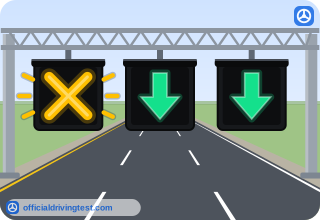
In a Lane Use Control system, what does a flashing yellow X above a lane mean?
- You can use this lane for any purpose
- Do not drive in this lane
- Move from this lane immediately
- This lane can only be used for a left turn
Show answer
Correct answer: This lane can only be used for a left turn
A flashing yellow X above a lane means that lane can only be used for a left turn.
Source: New York State Driver's Manual (Form MV-21), page 31 · Open this page in the manual (Manual page 31)
-
Whose directions take precedence over signs, signals, or pavement markings?
- A tow truck driver
- A parking attendant
- Another driver waving you through
- A traffic officer
Show answer
Correct answer: A traffic officer
Directions given by a traffic officer take precedence over signs, signals, or pavement markings.
Source: New York State Driver's Manual (Form MV-21), page 33 · Open this page in the manual (Manual page 33)
-
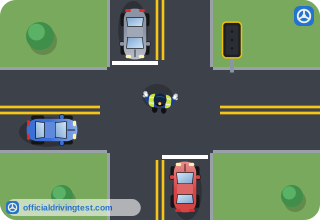
If a traffic officer signals you to stop at a green light, what must you do?
- You must stop
- Proceed through the green light, since it has the right-of-way
- Honk your horn and proceed anyway
- Wait for the light to turn red first
Show answer
Correct answer: You must stop
If a traffic officer signals you to stop at a green light, you must stop, even though the light is green.
Source: New York State Driver's Manual (Form MV-21), page 33 · Open this page in the manual (Manual page 33)
-
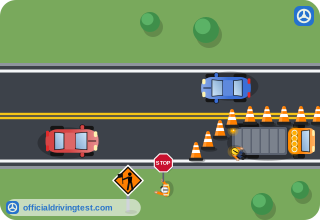
According to the manual, which of the following are among the persons authorized to direct traffic?
- Only police officers, never anyone else
- Police officers, fire police and school bus drivers
- Only school bus drivers, and only near schools
- Only flag persons at highway work areas
Show answer
Correct answer: Police officers, fire police and school bus drivers
Persons authorized to direct traffic include police officers, fire police, highway work area flag persons, school crossing persons, and school bus drivers.
Source: New York State Driver's Manual (Form MV-21), page 33 · Open this page in the manual (Manual page 33)
-
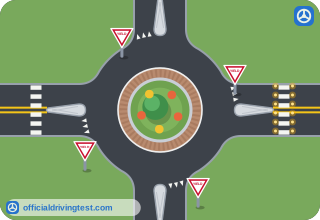
According to the manual, how does traffic move around the central island of a modern roundabout?
- Clockwise
- Counterclockwise
- In either direction, depending on the lane
- There is no set direction
Show answer
Correct answer: Counterclockwise
The manual describes the modern roundabout as a circular intersection where traffic moves counterclockwise around a central island.
Source: New York State Driver's Manual (Form MV-21), page 50 · Open this page in the manual (Manual page 50)
-
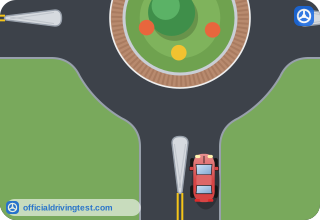
What rule governs vehicles entering a roundabout, according to the manual?
- First-come, first-served regardless of gaps
- The 'yield-at-entry' rule: wait for a gap in traffic
- Entering vehicles always have the right-of-way
- Vehicles must come to a full stop before every entry
Show answer
Correct answer: The 'yield-at-entry' rule: wait for a gap in traffic
The manual states roundabouts follow the 'yield-at-entry' rule, in which approaching vehicles must wait for a gap in the circulating flow before entering.
Source: New York State Driver's Manual (Form MV-21), page 50 · Open this page in the manual (Manual page 50)
-
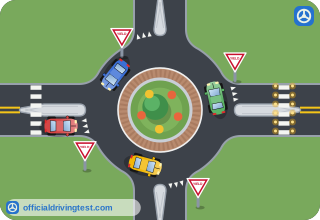
According to the manual, roundabouts are designed to restrict vehicle speed within the circle to:
- 15 mph or less
- 45 mph or less
- 60 mph or less
- 30 mph or less
Show answer
Correct answer: 30 mph or less
The manual states roundabouts are designed so that the speed of all vehicles is restricted to 30 mph (50 km/h) or less within the roundabout.
Source: New York State Driver's Manual (Form MV-21), page 50 · Open this page in the manual (Manual page 50)
-
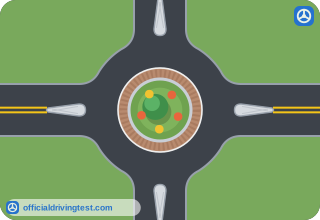
When approaching a roundabout, in which direction should you look for traffic that has the right-of-way?
- Right
- Left
- Straight ahead only
- Behind you
Show answer
Correct answer: Left
The manual instructs drivers to look to the left when approaching a roundabout, since traffic in the roundabout has the right-of-way.
Source: New York State Driver's Manual (Form MV-21), page 50 · Open this page in the manual (Manual page 50)
-
According to the manual, if another car is waiting at the yield line ahead of you at a roundabout, what should you do?
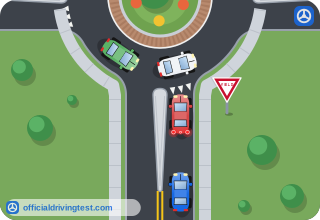
- Keep the crosswalk clear for pedestrians
- Stop in the crosswalk to wait your turn
- Honk to make the other car proceed faster
- Pass the waiting car and enter anyway
Show answer
Correct answer: Keep the crosswalk clear for pedestrians
The manual says if another car is waiting at the yield line ahead of you, do not stop in the crosswalk; keep the crosswalk clear for pedestrians.
Source: New York State Driver's Manual (Form MV-21), page 50 · Open this page in the manual (Manual page 50)
-
According to the manual, how should drivers treat bicyclists riding within a roundabout?
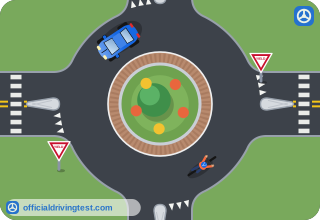
- Pass them as quickly as possible
- Force them to dismount and walk
- Do not pass them, as they ride in the lane
- Ignore them since bicycles are not allowed
Show answer
Correct answer: Do not pass them, as they ride in the lane
The manual says bicyclists are permitted to ride within the roundabout and will be riding in the lane just as other vehicles do; please do not pass a bicycle in the roundabout.
Source: New York State Driver's Manual (Form MV-21), page 50 · Open this page in the manual (Manual page 50)
-
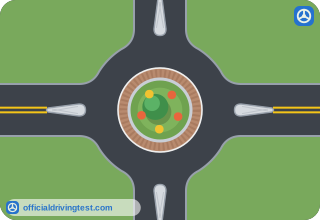
Once you have entered a roundabout, according to the manual, who has the right-of-way?
- Vehicles still waiting to enter
- Only emergency vehicles
- Pedestrians standing at the entrance
- You, the vehicle already circulating
Show answer
Correct answer: You, the vehicle already circulating
The manual states once you have entered the roundabout and proceed counterclockwise to your exit, you now have the right-of-way.
Source: New York State Driver's Manual (Form MV-21), page 51 · Open this page in the manual (Manual page 51)
-
As you approach your exit from a roundabout, what does the manual say you should do?
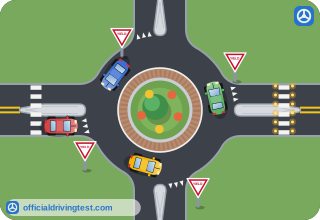
- Turn on your left turn signal
- Turn on your right turn signal
- Turn off all signals
- Sound your horn
Show answer
Correct answer: Turn on your right turn signal
The manual says as you approach your exit from a roundabout, turn on your right turn signal.
Source: New York State Driver's Manual (Form MV-21), page 51 · Open this page in the manual (Manual page 51)
-
According to the manual, where should pedestrians never cross at a roundabout?
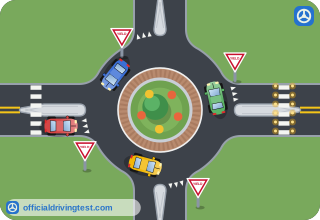
- The central island
- The designated crosswalk
- The splitter island
- The entry lane
Show answer
Correct answer: The central island
The manual instructs pedestrians to never cross to the central island of a roundabout.
Source: New York State Driver's Manual (Form MV-21), page 51 · Open this page in the manual (Manual page 51)
-
According to the manual, what should a pedestrian use as a refuge area when crossing a roundabout one lane at a time?
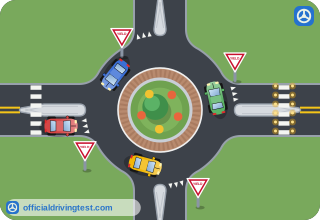
- The central island
- The bicycle lane
- The splitter island
- The parking lane
Show answer
Correct answer: The splitter island
The manual advises pedestrians to cross the crosswalk one lane at a time, using the splitter island as a refuge area before crossing the next lane.
Source: New York State Driver's Manual (Form MV-21), page 51 · Open this page in the manual (Manual page 51)
-
According to the manual, if a bicyclist is unsure about using a roundabout, what should they do?
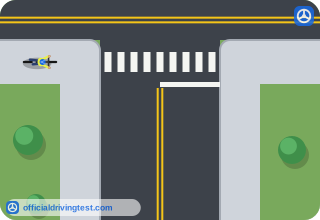
- Ride through the crosswalks as fast as possible
- Wait indefinitely on the shoulder
- Call the police for an escort
- Dismount and walk the bike at the crosswalks
Show answer
Correct answer: Dismount and walk the bike at the crosswalks
The manual advises that if a bicyclist is unsure about using the roundabout, they should dismount and walk their bike as a pedestrian at the designated crosswalks.
Source: New York State Driver's Manual (Form MV-21), page 51 · Open this page in the manual (Manual page 51)