Pavement markings in New Mexico
The New Mexico Driver Manual shows or names everything on this page: 17 in all, on pages 7–9, 14, 26.
Independent educational site · not affiliated with any government agency or DMV
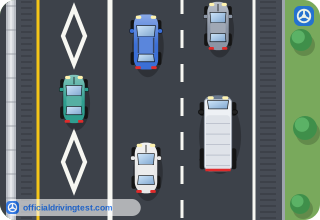
White Diamond (Reserved Lane Marking)
Reserved lanes are marked by signs stating that the lane is reserved for special use and often have a white diamond posted at the side of the road or painted on the road surface.
Manual page 9
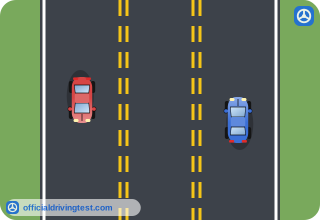
Reversible Lane (Double Dashed Yellow Lines)
Some travel lanes are designed to carry traffic in one direction at certain times and in the opposite direction at other times. These lanes are usually marked by double-dashed yellow lines. Before you start driving in them, check to see which lanes you can use at that time.
Manual page 9
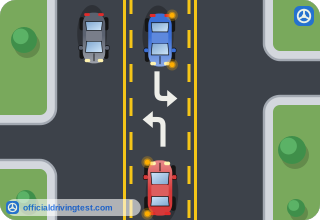
Center Left-Turn Lane
These center lanes are reserved for making left turns (or U-turns when they are permitted) but can be used by vehicles traveling in both directions. On the pavement, left-turn arrows for traffic in one direction alternate with left-turn arrows for traffic coming from the other direction. These lanes are marked on each side by a solid yellow and dashed yellow line.
Manual page 9
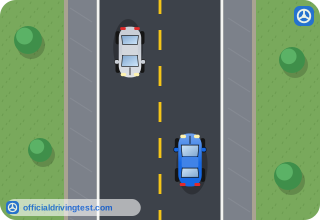
Solid White Edge Line
Solid lines along the side of the road show you where the edge of the road is located.
Manual page 8
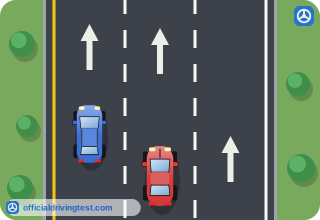
Dashed White Lane Line
A dashed white line between lanes of traffic means that you may cross it to change lanes if it is safe to do so.
Manual page 8
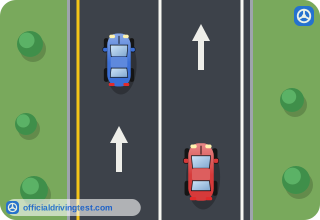
Solid White Lane Line
A solid white line between lanes of traffic means that you should stay in your lane unless a special situation requires you to change lanes.
Manual page 8
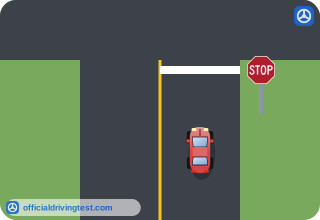
Stop Line
When required to stop because of a sign or signal, you must stop before your vehicle reaches the stop line or crosswalk.
Manual page 8
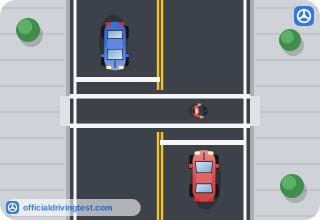
Marked Crosswalk
Crosswalks define the area where pedestrians may cross the roadway. You must yield to pedestrians in or about to enter a crosswalk. Not all crosswalks are marked.
Manual page 8
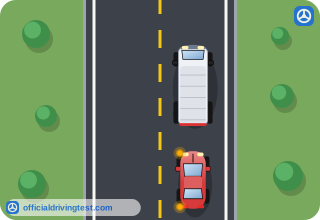
Dashed Yellow Center Line
A dashed yellow line between opposing lanes of traffic means that you may cross it to pass if it safe to do so.
Manual page 8
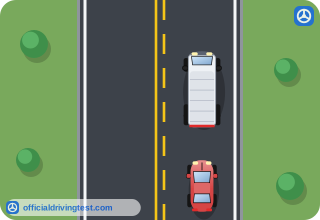
Solid and Dashed Yellow Lines
Where there is both a solid and a dashed yellow line between opposing lanes of traffic, you may not pass if the solid yellow line is on your side. If the dashed line is on your side, you may pass if it is safe to do so.
Manual page 8
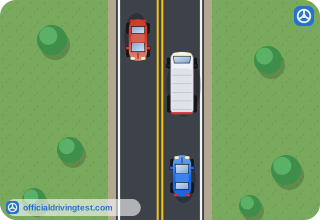
Two Solid Yellow Lines
Two solid yellow lines between lanes of traffic means neither side can pass. You may cross a solid yellow line to turn into a drive way if it safe to do so.
Manual page 8
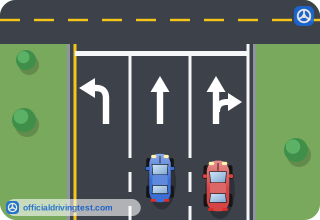
Lane-Use Pavement Arrows
Sometimes arrows may be painted on the road as a supplement to the signs.
Manual page 7
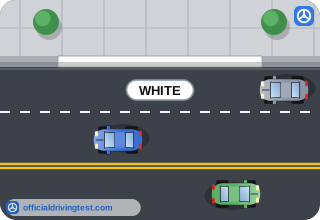
White Curb
white—indicates that only short stops are permitted
Manual page 14
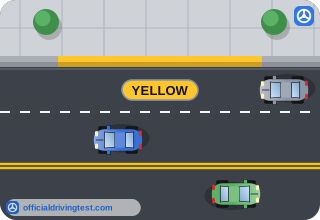
Yellow Curb
yellow—indicates a loading zone or some other restriction.
Manual page 14
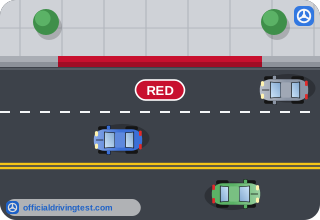
Red Curb
red—indicates a fire zone with no parking or standing permitted.
Manual page 14
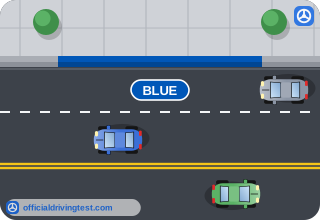
Blue Curb
blue—indicates handicap parking only.
Manual page 14
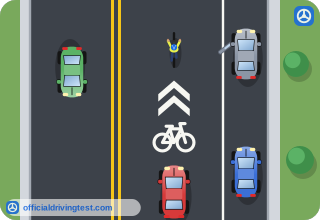
Shared Lane Marking (Sharrow)
“Sharrows” are “shared lane pavement markings.” They are painted on the pavement when a road is too narrow for side-by-side road sharing with slower vehicles. They indicate that bicyclists are encouraged to take the whole travel lane and that motorists shall yield to the bicyclist as needed.
Manual page 26