New Mexico: Pedestrians Practice Test
Yielding to pedestrians at crosswalks, driveways and sidewalks, the White Cane Law and watching for people near schools and busy roadsides.
Independent educational site · not affiliated with any government agency or DMV
Ready? Test yourself
- Instant feedback with an explanation
- Every answer cites its source in the manual
- Your best score is saved on this device
- Keyboard: press 1 to 4 to answer and Enter for the next question
Questions are original and based on the official manual "New Mexico Driver Manual" (Version 11.19.19), New Mexico Motor Vehicle Division (MVD).
All 9 questions in this practice test
Take the test above first, then use this list to study. Tap “Show answer” to see the correct answer and explanation.
Show the questions and answersHide the questions
-
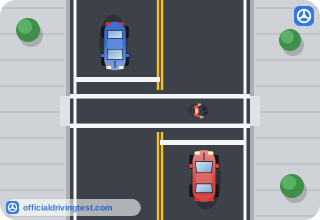
At a crosswalk, which pedestrians must you yield to?
- Only those who have a walk signal
- Only those who are already halfway across
- Those in the crosswalk or about to enter it
- Only those at a crosswalk with a posted sign
Show answer
Correct answer: Those in the crosswalk or about to enter it
You must yield to pedestrians in or about to enter a crosswalk.
Source: New Mexico Driver Manual (Version 11.19.19), page 8
-
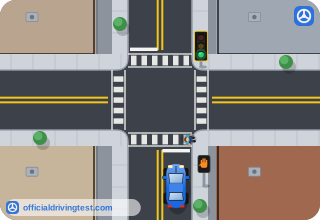
A pedestrian is crossing against the traffic signal. What must you do?
- Continue, since you have the right-of-way
- Yield to the pedestrian
- Sound your horn and drive through
- Speed up to pass in front of the pedestrian
Show answer
Correct answer: Yield to the pedestrian
You must always yield to a pedestrian, even if the pedestrian is not obeying traffic controls.
Source: New Mexico Driver Manual (Version 11.19.19), page 11
-
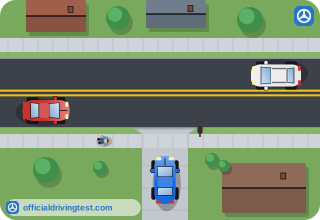
When you cross a sidewalk to enter or exit a driveway, alley or parking lot, who must you yield to?
- Bicyclists only
- Pedestrians
- Other vehicles only
- No one, unless a sign says to yield
Show answer
Correct answer: Pedestrians
Drivers crossing a sidewalk to enter or exit a driveway, alley or parking lot must yield to pedestrians.
Source: New Mexico Driver Manual (Version 11.19.19), page 11
-
When is it legal to drive on a sidewalk?
- When the road ahead is blocked
- To pass a slow vehicle
- To get around a stopped car in your lane
- Only to cross it
Show answer
Correct answer: Only to cross it
It is illegal to drive on a sidewalk except to cross it.
Source: New Mexico Driver Manual (Version 11.19.19), page 11
-
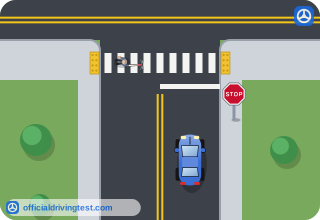
A pedestrian ahead is using a white cane or a guide dog. What must the driver do?
- Sound the horn to alert the pedestrian before passing
- Pass the pedestrian on the left at a normal speed
- Take all necessary precautions to avoid injury to the pedestrian
- Stop only if the pedestrian waves for the driver to stop
Show answer
Correct answer: Take all necessary precautions to avoid injury to the pedestrian
Under the White Cane Law, a driver approaching a blind pedestrian with a cane or guide dog must take all necessary precautions to avoid injury to that pedestrian.
Source: New Mexico Driver Manual (Version 11.19.19), page 11
-
Under the White Cane Law, what happens to a driver who fails to take precautions around a blind pedestrian and causes an injury?
- The driver is liable in damages for the injury
- The driver must retake the written test
- The driver's vehicle is impounded
- The driver is placed on probation
Show answer
Correct answer: The driver is liable in damages for the injury
A driver who fails to take the required precautions is liable in damages for any injury caused to the blind pedestrian.
Source: New Mexico Driver Manual (Version 11.19.19), page 11
-
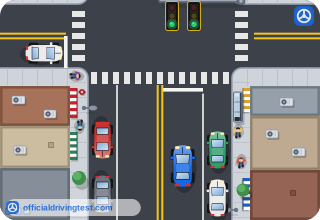
When there is a lot of activity along the side of the road, what is there a good chance of?
- That someone will cross or enter the road
- That the posted speed limit will change soon
- That a train is coming down the nearby tracks
- That the traffic signals will stop working
Show answer
Correct answer: That someone will cross or enter the road
The manual says that with a lot of activity along the side of the road, there is a good chance that someone will cross or enter the road.
Source: New Mexico Driver Manual (Version 11.19.19), page 16
-
Near which of these is it very important to look to the sides?
- Long, empty desert highways
- Roads with no side streets
- Busy sidewalks
- Open fields far from any road
Show answer
Correct answer: Busy sidewalks
The manual lists shopping centers and parking lots, construction areas, busy sidewalks, playgrounds and schoolyards as places where looking to the sides is very important.
Source: New Mexico Driver Manual (Version 11.19.19), page 16
-
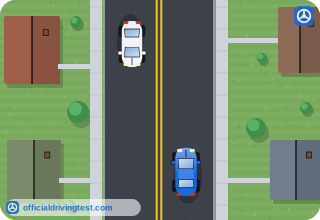
Why does the manual list schools, playgrounds and residential streets as places to slow down?
- Crossing guards control all the traffic there
- Children are often present there
- Roads there are often unpaved
- Parking is not allowed there
Show answer
Correct answer: Children are often present there
The manual says these areas often have children present, so you should always be alert for children crossing or running or riding into the street.
Source: New Mexico Driver Manual (Version 11.19.19), page 22