New Jersey: Sharing the road — Part 2 Practice Test
Questions in this part include: “In New Jersey, which traffic laws govern motorcycles?” · “According to the New Jersey Driver Manual, why should you anticipate a motorcycle rider's maneuvers?”
Independent educational site · not affiliated with any government agency or DMV
Ready? Test yourself
- Instant feedback with an explanation
- Every answer cites its source in the manual
- Your best score is saved on this device
Questions are original and based on the official manual "New Jersey Driver Manual" (2026), New Jersey Motor Vehicle Commission (MVC).
All 17 questions in this practice test
Take the test above first, then use this list to study. Tap “Show answer” to see the correct answer and explanation.
Show the questions and answersHide the questions
-
In New Jersey, which traffic laws govern motorcycles?
- Only speed limits, not other traffic laws
- A separate code that excludes car laws
- Only the rules for off-road vehicles
- The same laws that govern cars and trucks
Show answer
Correct answer: The same laws that govern cars and trucks
The laws governing four-wheeled vehicles such as cars and trucks also govern motorcycles.
Source: New Jersey Driver Manual (2026), page 146 · Open this page in the manual (Manual page 146)
-
According to the New Jersey Driver Manual, which roadway features present potential hazards for motorcycle riders?
- Grooves and gratings in the roadway
- Wide, straight travel lanes
- Dry, smooth and level pavement surfaces
- Freshly paved highway lanes
Show answer
Correct answer: Grooves and gratings in the roadway
Slippery, sloped or uneven surfaces, and grooves and gratings in the roadway present potential hazards for motorcycle riders.
Source: New Jersey Driver Manual (2026), page 146 · Open this page in the manual (Manual page 146)
-
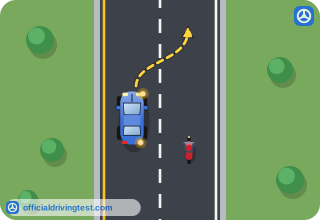
When sharing the road with motorcycles, how many times does the New Jersey Driver Manual say to check your blind spots before changing lanes or making turns?
- Three times
- Once
- Twice
- Four times
Show answer
Correct answer: Twice
The manual says to check blind spots twice before changing lanes or making turns, because motorcycles are easy to miss.
Source: New Jersey Driver Manual (2026), page 146 · Open this page in the manual (Manual page 146)
-
According to the New Jersey Driver Manual, when should you especially watch for motorcycles?
- Only after dark
- At intersections and when turning left
- Only when driving on multi-lane highways
- Only when it is raining
Show answer
Correct answer: At intersections and when turning left
The manual tells motorists to watch for motorcycles at intersections and when making a left turn.
Source: New Jersey Driver Manual (2026), page 146 · Open this page in the manual (Manual page 146)
-
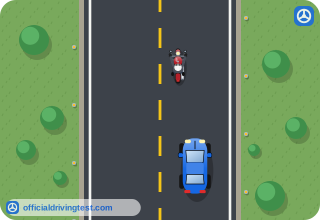
According to the New Jersey Driver Manual, why should you never follow a motorcycle too closely?
- Its exhaust can block your view
- It cannot brake at all in the rain
- It must always travel below the posted speed limit
- It may stop in a shorter distance than you can
Show answer
Correct answer: It may stop in a shorter distance than you can
Never follow a motorcycle too closely, because motorcycles could brake within shorter distances than other types of vehicles.
Source: New Jersey Driver Manual (2026), page 146 · Open this page in the manual (Manual page 146)
-
According to the New Jersey Driver Manual, why should you anticipate a motorcycle rider's maneuvers?
- Minor obstacles for a car can be dangerous to them
- Riders must travel on the shoulder
- Riders are not allowed to use hand or turn signals at all
- Riders are required to change lanes every mile
Show answer
Correct answer: Minor obstacles for a car can be dangerous to them
Anticipate a rider's maneuver to avoid obstructions that may be minimal to a car or truck but dangerous to a motorcycle.
Source: New Jersey Driver Manual (2026), page 146 · Open this page in the manual (Manual page 146)
-
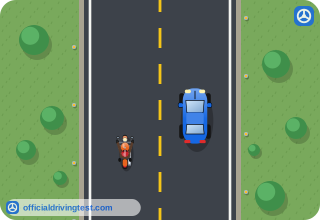
What should you do when you are being passed by a motorcycle?
- Brake hard to let it by
- Maintain your speed and position
- Move toward the motorcycle's side of the lane
- Speed up to stay beside it
Show answer
Correct answer: Maintain your speed and position
When passed by a motorcycle, maintain your speed and position and allow plenty of room for it to complete the pass.
Source: New Jersey Driver Manual (2026), page 147 · Open this page in the manual (Manual page 147)
-
According to the New Jersey Driver Manual, what is the most common cause of motorcycle crashes?
- Worn motorcycle tires and brakes
- Riders going well over the posted speed limit
- Potholes and poor road surfaces
- Drivers failing to notice motorcycles
Show answer
Correct answer: Drivers failing to notice motorcycles
A motorist's failure to detect and recognize motorcycles in traffic is the most common cause of motorcycle crashes.
Source: New Jersey Driver Manual (2026), page 147 · Open this page in the manual (Manual page 147)
-
According to the New Jersey Driver Manual, during bad weather a truck, tractor-trailer or bus can take as much as how much longer to stop?
- 75 percent
- 10 percent
- 25 percent
- 50 percent
Show answer
Correct answer: 25 percent
During bad weather, a truck, tractor-trailer or bus can take as much as 25 percent longer to stop.
Source: New Jersey Driver Manual (2026), page 147 · Open this page in the manual (Manual page 147)
-
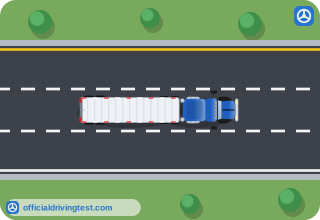
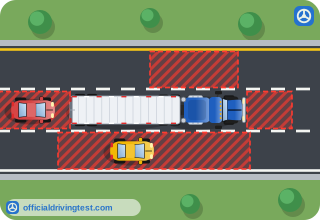
What are the "no-zones" around trucks, tractor-trailers and buses?
- Blind spots where the driver cannot see other vehicles
- Areas where passing is always illegal
- Zones where trucks may not park
- Lanes where trucks, tractor-trailers and buses may not drive
Show answer
Correct answer: Blind spots where the driver cannot see other vehicles
No-zones are blind spots in which the truck, tractor-trailer or bus driver cannot see other vehicles.
Source: New Jersey Driver Manual (2026), page 147 · Open this page in the manual (Manual page 147)
-
According to the New Jersey Driver Manual, why should you avoid moving too close to a truck or bus?
- It is the only way the truck driver will be able to see you
- It can restrict the driver's ability to stop or maneuver
- It lets you pass the truck faster
- It helps the truck save fuel
Show answer
Correct answer: It can restrict the driver's ability to stop or maneuver
Do not move so close to a truck or bus that the driver's ability to stop or maneuver is restricted; riding in the no-zone increases the potential for a crash.
Source: New Jersey Driver Manual (2026), page 147 · Open this page in the manual (Manual page 147)
-
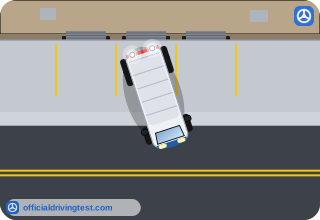
What should you do when a truck or tractor-trailer is preparing to back up or is backing up?
- Pass close behind it quickly
- Honk and pass behind it
- Pull right up so the driver sees you
- Stay far behind it
Show answer
Correct answer: Stay far behind it
Stay far behind a truck that is preparing to back up or is backing up, and never pass close behind it.
Source: New Jersey Driver Manual (2026), page 148 · Open this page in the manual (Manual page 148)
-
According to the New Jersey Driver Manual, the area behind a truck or tractor-trailer is a blind spot for whom?
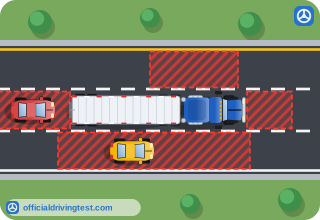
- The truck driver and other motorists
- Only motorists behind the truck
- Only the truck driver
- No one, if its mirrors are adjusted
Show answer
Correct answer: The truck driver and other motorists
The area behind a truck or tractor-trailer is a no-zone not only for its driver but for other motorists as well, because the truck's width hides objects.
Source: New Jersey Driver Manual (2026), page 148 · Open this page in the manual (Manual page 148)
-
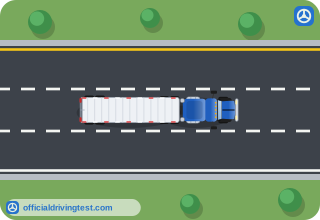
Why should you increase your following distance behind a truck, tractor-trailer or bus?
- So its driver can see you in the mirrors
- So you can read its rear plate
- So you can draft behind it to save fuel
- So you can pass it more quickly
Show answer
Correct answer: So its driver can see you in the mirrors
Increase your following distance so the truck or bus driver can spot your vehicle in the rearview mirrors.
Source: New Jersey Driver Manual (2026), page 149 · Open this page in the manual (Manual page 149)
-
According to the New Jersey Driver Manual, what should you never do around trucks, tractor-trailers or buses?
- Increase your following distance
- Remain sandwiched between them
- Keep a large space cushion
- Signal before changing lanes
Show answer
Correct answer: Remain sandwiched between them
Never tailgate or remain sandwiched between trucks, tractor-trailers or buses; keep a sizeable space cushion instead.
Source: New Jersey Driver Manual (2026), page 149 · Open this page in the manual (Manual page 149)
-
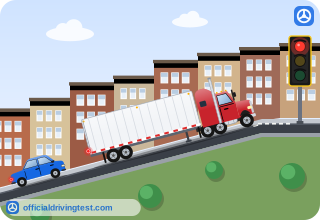
According to the New Jersey Driver Manual, why should you leave space when stopping behind a truck or bus at a light or sign, especially when facing uphill?
- It may release its air brakes loudly
- It may spray gravel from its tires
- Trucks must stop twice at every light
- It may roll back slightly as it starts
Show answer
Correct answer: It may roll back slightly as it starts
Leave space when stopping behind a truck, tractor-trailer or bus, especially uphill, because larger vehicles may roll backward slightly when starting.
Source: New Jersey Driver Manual (2026), page 149 · Open this page in the manual (Manual page 149)
-
According to the New Jersey Driver Manual, what may a truck have to do to make a right turn?
- Cut sharply across the right curb
- Wait for a green arrow only
- Swing wide to the left first
- Turn on its hazard lights
Show answer
Correct answer: Swing wide to the left first
Because trucks are large, their drivers may have to swing wide; for example, a truck may swing wide to the left to make a right turn, so give it more road space.
Source: New Jersey Driver Manual (2026), page 149 · Open this page in the manual (Manual page 149)