New Jersey: Right of way & turning — Part 2 Practice Test
Questions in this part include: “What makes an intersection "uncontrolled"?” · “How should you position your vehicle to make a right turn?”
Independent educational site · not affiliated with any government agency or DMV
Ready? Test yourself
- Instant feedback with an explanation
- Every answer cites its source in the manual
- Your best score is saved on this device
Questions are original and based on the official manual "New Jersey Driver Manual" (2026), New Jersey Motor Vehicle Commission (MVC).
All 17 questions in this practice test
Take the test above first, then use this list to study. Tap “Show answer” to see the correct answer and explanation.
Show the questions and answersHide the questions
-
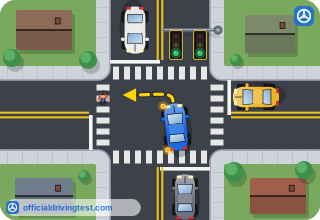
When making a left turn at an intersection, whom must you yield to or stop for?
- Only vehicles that are waiting on the cross street
- No one, as long as you signaled first
- Only the vehicles traveling behind you
- Oncoming traffic and pedestrians in a crosswalk
Show answer
Correct answer: Oncoming traffic and pedestrians in a crosswalk
When making a left turn, you must yield to oncoming traffic and stop for pedestrians within a crosswalk.
Source: New Jersey Driver Manual (2026), page 67 · Open this page in the manual (Manual page 67)
-
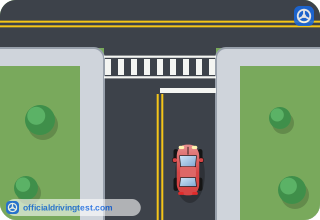
After stopping at a stop sign, when may you enter the intersection?
- Right away, because you already made a full stop
- Only once no other vehicle can be seen in any direction
- After yielding to pedestrians and close, hazardous traffic
- After you have waited a fixed three seconds at the stop line
Show answer
Correct answer: After yielding to pedestrians and close, hazardous traffic
You may enter only after yielding to any pedestrians and to any traffic close enough to be an immediate hazard.
Source: New Jersey Driver Manual (2026), page 67 · Open this page in the manual (Manual page 67)
-
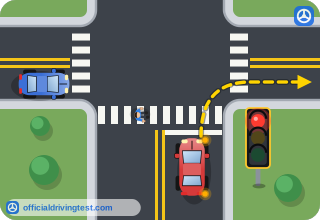
Before making any turn, especially a right turn on red, what must you do?
- Check only the inside rearview mirror once
- Scan left, right, and behind, including blind spots
- Tap the horn and turn without stopping
- Watch only the oncoming traffic that is ahead of you
Show answer
Correct answer: Scan left, right, and behind, including blind spots
Before any turn you must scan left, right, and behind, check mirrors and blind spots, and look carefully for bicyclists and pedestrians.
Source: New Jersey Driver Manual (2026), page 67 · Open this page in the manual (Manual page 67)
-
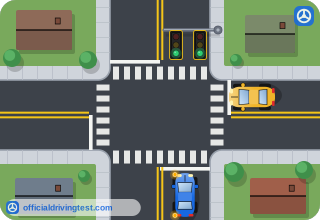
According to the New Jersey manual, why do many crashes happen during turns?
- Drivers keep too close to the right-hand curb
- Drivers switch on their turn signal much too far ahead
- Drivers watch only oncoming traffic and miss others
- Drivers move through their turns much too slowly
Show answer
Correct answer: Drivers watch only oncoming traffic and miss others
Many crashes occur during turns when drivers focus solely on oncoming traffic and fail to check for other vulnerable road users.
Source: New Jersey Driver Manual (2026), page 67 · Open this page in the manual (Manual page 67)
-
What makes an intersection "uncontrolled"?
- It has a flashing yellow signal
- A police officer directs traffic there
- It is regulated by nothing more than a yield sign
- It has no traffic signal or regulatory device
Show answer
Correct answer: It has no traffic signal or regulatory device
An intersection is uncontrolled when roads join and there is no traffic signal or regulatory device.
Source: New Jersey Driver Manual (2026), page 68 · Open this page in the manual (Manual page 68)
-
As you near a crossroad that is not controlled, what must you do?
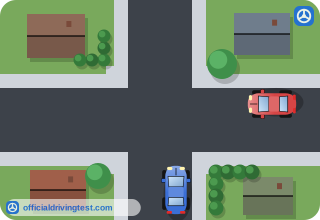
- Slow down and be ready to stop for cross traffic
- Keep your speed, because nobody there has to yield
- Speed up so you clear the crossing quickly
- Honk your horn and continue at the same speed
Show answer
Correct answer: Slow down and be ready to stop for cross traffic
Near an uncontrolled crossroad you must reduce speed and be ready to stop if traffic is coming from the right or left.
Source: New Jersey Driver Manual (2026), page 68 · Open this page in the manual (Manual page 68)
-
When you come out of a private road or driveway onto a main road, whom must you yield to?
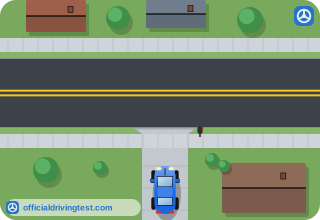
- Only vehicles coming from your right
- Only vehicles coming from your left
- All traffic on the main road
- No one, if you signal first
Show answer
Correct answer: All traffic on the main road
A motorist coming from a private road or driveway must yield to all traffic on the main road.
Source: New Jersey Driver Manual (2026), page 68 · Open this page in the manual (Manual page 68)
-
As a rule at an uncontrolled intersection, which vehicle should yield?
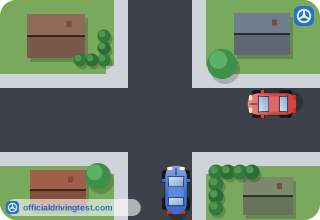
- The vehicle going straight yields to a turning one
- The slower vehicle yields to the faster one
- The one on the right yields to the one on the left
- The one on the left yields to the one on the right
Show answer
Correct answer: The one on the left yields to the one on the right
As a rule, the vehicle on the left should yield to the vehicle on the right.
Source: New Jersey Driver Manual (2026), page 68 · Open this page in the manual (Manual page 68)
-
Buildings, parked vehicles, or bushes block your view of cross traffic at an intersection. What should you do?
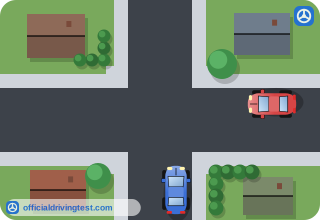
- Speed up so you are exposed for less time
- Keep your speed and just tap your horn as you go through
- Trust cross traffic to yield the right-of-way
- Slow down or stop fully to check for cross traffic
Show answer
Correct answer: Slow down or stop fully to check for cross traffic
When your line of sight is blocked, always slow down or stop completely to make sure there is no cross traffic before proceeding.
Source: New Jersey Driver Manual (2026), page 68 · Open this page in the manual (Manual page 68)
-
Are there set rules in New Jersey for driving into, around, and out of a traffic circle?
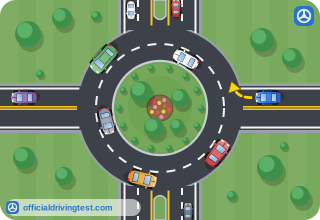
- No; common sense and caution must prevail
- Yes; traffic inside always has the right-of-way
- Yes; you must always stop before entering
- Yes; entering traffic always goes first
Show answer
Correct answer: No; common sense and caution must prevail
There are no set rules for traffic circles in New Jersey; common sense and caution must always prevail.
Source: New Jersey Driver Manual (2026), page 68 · Open this page in the manual (Manual page 68)
-
In most New Jersey traffic circles, what decides who has the right-of-way?
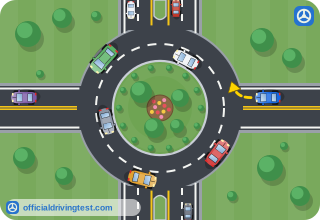
- Whichever vehicle is moving the fastest
- The circle's established traffic flow pattern
- Whichever vehicle is larger or heavier
- Whichever driver turned on a turn signal first
Show answer
Correct answer: The circle's established traffic flow pattern
In most cases, the circle's historically established traffic flow pattern dictates who has the right-of-way.
Source: New Jersey Driver Manual (2026), page 68 · Open this page in the manual (Manual page 68)
-
When a major highway flows into and through a New Jersey traffic circle, what usually happens?
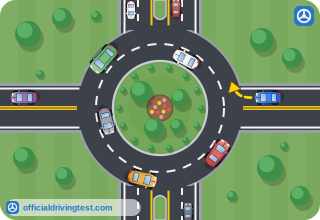
- It must stop at the circle entrance
- It gives way to the side streets
- It commands the right-of-way
- It must yield to all circle traffic
Show answer
Correct answer: It commands the right-of-way
A major highway flowing through a circle usually dominates the traffic flow pattern and commands the right-of-way.
Source: New Jersey Driver Manual (2026), page 68 · Open this page in the manual (Manual page 68)
-
Besides the traffic flow pattern, what also governs right-of-way at the entrances to a traffic circle?
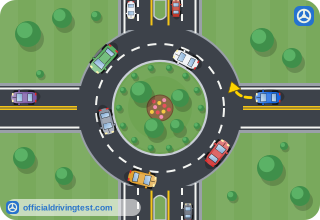
- The color of the pavement
- The time of day
- The number of lanes that the circle has
- Stop or yield signs at the entrances
Show answer
Correct answer: Stop or yield signs at the entrances
Traffic control signs such as stop or yield signs at the entrances also govern who has the right-of-way.
Source: New Jersey Driver Manual (2026), page 68 · Open this page in the manual (Manual page 68)
-
What should you do before entering a traffic circle?
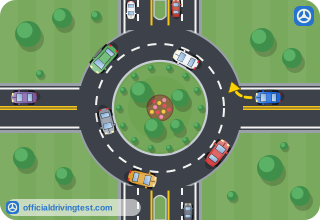
- Sound your horn to warn drivers already inside
- Speed up to match the traffic already inside
- Check the signs and what drivers inside intend
- Stop fully even where the sign only says yield
Show answer
Correct answer: Check the signs and what drivers inside intend
Never enter a traffic circle without checking all signs and determining the intentions of the motorists already in it.
Source: New Jersey Driver Manual (2026), page 68 · Open this page in the manual (Manual page 68)
-
How should you position your vehicle to make a right turn?
- Straddling the lane line on your left
- In the left lane for more room
- Swing out to the left first to widen the turn
- As far right as possible, near the curb
Show answer
Correct answer: As far right as possible, near the curb
Approach a right turn as far to the right as possible, keeping near the curb or parked vehicles, and do not swing outward.
Source: New Jersey Driver Manual (2026), page 72 · Open this page in the manual (Manual page 72)
-
Why does keeping close to the right curb before a right turn help?
- It means you need not use your turn signal
- It leaves less room for a vehicle on your right
- It gives oncoming traffic more room to pass
- It lets you take the turn at a much higher speed
Show answer
Correct answer: It leaves less room for a vehicle on your right
Proper positioning before a right turn reduces the chance of another vehicle being in the space on your right as you turn.
Source: New Jersey Driver Manual (2026), page 72 · Open this page in the manual (Manual page 72)
-
Two vehicles meet at an intersection and both have signaled to turn left. How should each driver turn, when safe?
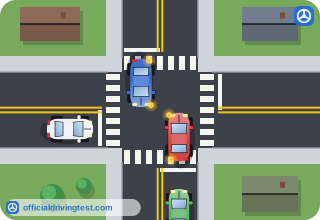
- To the left of the center of the intersection
- Straight through the center point of the intersection
- By swinging wide into the far lane
- After backing up to make more room
Show answer
Correct answer: To the left of the center of the intersection
When two vehicles meet and both are turning left, each should turn to the left of the center of the intersection when safe, using extra caution.
Source: New Jersey Driver Manual (2026), page 73 · Open this page in the manual (Manual page 73)