New Jersey: Parking rules
Parallel parking, parking on hills, and where you may not stop or park. Split into 2 shorter tests so you're not stuck in one long quiz.
Independent educational site · not affiliated with any government agency or DMV
Choose a part
Parking rules — Part 1
Questions in this part include: “Where is angle parking often used, according to the New Jersey Driver Manual?”
StartParking rules — Part 2
Questions in this part include: “According to the New Jersey Driver Manual, where should a new motorist first practice parallel parking?”
StartAll 47 Parking rules questions with answers
Choose a part above to take a practice test, or study every question and answer here.
Show the questions and answersHide the questions
-
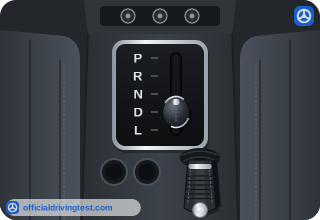
When you park a vehicle with an automatic transmission, what should you always do?
- Set the brake and leave it in neutral
- Set the brake and put the vehicle in park
- Leave it in neutral with the brake released
- Leave it in drive with the engine running
Show answer
Correct answer: Set the brake and put the vehicle in park
When parking, always set the brake and put the vehicle in park (or, with a manual transmission, in reverse or low gear).
Source: New Jersey Driver Manual (2026), page 57 · Open this page in the manual (Manual page 57)
-
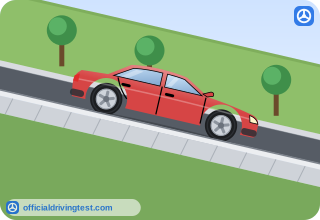
When parking facing downhill on a street with a curb, which way should you turn your front wheels?
- Straight ahead
- Away from the curb
- Toward the curb
- It does not matter if the brake is set
Show answer
Correct answer: Toward the curb
When parking facing downhill, set the hand brake and turn the wheels toward the curb.
Source: New Jersey Driver Manual (2026), page 57 · Open this page in the manual (Manual page 57)
-
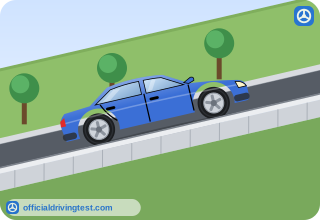
When parking facing uphill on a street with a curb, which way should you turn your front wheels?
- Toward the curb
- It does not matter if the brake is set
- Away from the curb
- Straight ahead
Show answer
Correct answer: Away from the curb
When parking facing uphill, set the hand brake and turn the wheels away from the curb.
Source: New Jersey Driver Manual (2026), page 57 · Open this page in the manual (Manual page 57)
-
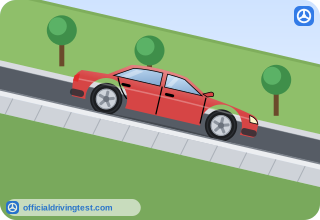
You park a manual-transmission vehicle facing downhill at a curb. What gear should it be left in?
- Third gear
- Neutral
- Low
- Reverse
Show answer
Correct answer: Reverse
Facing downhill, the vehicle should be in park or, with a manual transmission, in reverse.
Source: New Jersey Driver Manual (2026), page 57 · Open this page in the manual (Manual page 57)
-
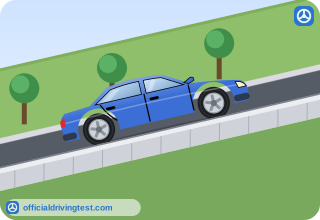
You park a manual-transmission vehicle facing uphill at a curb. What gear should it be left in?
- Third gear
- Low
- Reverse
- Neutral
Show answer
Correct answer: Low
Facing uphill, the vehicle should be in park or, with a manual transmission, in low.
Source: New Jersey Driver Manual (2026), page 57 · Open this page in the manual (Manual page 57)
-
Where is angle parking often used, according to the New Jersey Driver Manual?
- In shopping center parking lots
- On highway shoulders
- In school bus loading and unloading zones
- On bridges and overpasses
Show answer
Correct answer: In shopping center parking lots
Angle parking is often used in parking lots of shopping centers and sometimes at curbs.
Source: New Jersey Driver Manual (2026), page 57 · Open this page in the manual (Manual page 57)
-
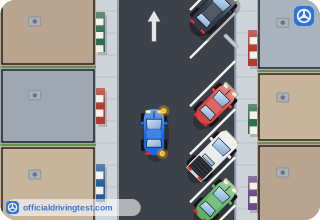
When entering an angle parking space on your right, what should you make sure of before steering in?
- That your hazard warning lights are flashing the whole time
- That the rear of your vehicle will clear the parked vehicles
- That your front bumper will gently touch the curb ahead
- That the vehicle is in reverse gear
Show answer
Correct answer: That the rear of your vehicle will clear the parked vehicles
When entering an angle space, watch traffic, signal and slow down, and make sure the rear of the vehicle will clear the parked vehicles.
Source: New Jersey Driver Manual (2026), page 57 · Open this page in the manual (Manual page 57)
-
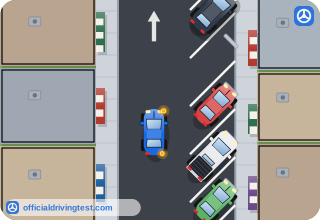
How should you steer into an angle parking space?
- Steer gently in and leave the wheels turned
- Pull past the space and back into it at an angle
- Pull in straight, then turn the wheels toward the curb
- Steer sharply in, then straighten the wheels
Show answer
Correct answer: Steer sharply in, then straighten the wheels
Steer sharply into the parking space, then straighten the wheels so the vehicle is centered in the space.
Source: New Jersey Driver Manual (2026), page 57 · Open this page in the manual (Manual page 57)
-
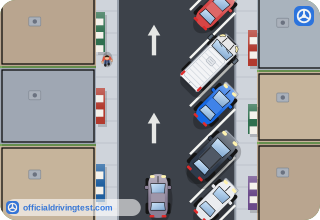
Before backing out of an angle parking space, what does the New Jersey Driver Manual say to do first?
- Back out quickly to keep traffic moving
- Turn the wheels fully to the left before shifting
- Walk around to make sure nothing is in the way
- Flash your headlights to warn other drivers
Show answer
Correct answer: Walk around to make sure nothing is in the way
Before backing out of an angle space, walk around the vehicle to make sure nothing is in its way.
Source: New Jersey Driver Manual (2026), page 57 · Open this page in the manual (Manual page 57)
-
When backing out of an angle parking space, how does the manual say to warn nearby pedestrians?
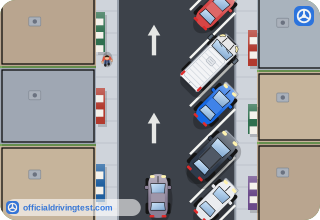
- Tap the horn
- Rev the engine
- Shout out the window
- Flash the high beams
Show answer
Correct answer: Tap the horn
While slowly backing out of an angle space, tap the horn to warn nearby pedestrians.
Source: New Jersey Driver Manual (2026), page 57 · Open this page in the manual (Manual page 57)
-
While backing out of an angle parking space, what should you do once you can see past the tops of the vehicles parked beside you?
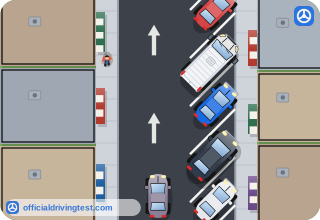
- Turn the wheel fully and keep going
- Stop and look again
- Speed up to clear the lane quickly
- Shift into drive immediately
Show answer
Correct answer: Stop and look again
When you are able to see past the tops of the vehicles parked next to you, stop and look again.
Source: New Jersey Driver Manual (2026), page 57 · Open this page in the manual (Manual page 57)
-
When entering an angle parking space to your right, where should you watch for traffic?
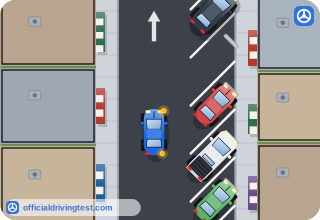
- Both ahead and behind
- Only on your right side
- Only behind you
- Only ahead of you
Show answer
Correct answer: Both ahead and behind
The first rule for entering an angle parking space to your right is to watch for traffic both ahead and behind, then signal and begin to slow down.
Source: New Jersey Driver Manual (2026), page 57 · Open this page in the manual (Manual page 57)
-
When backing out of an angle parking space, how far should you back up while turning?
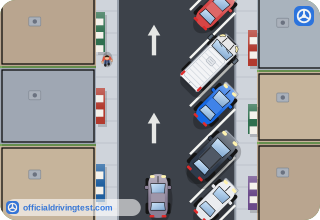
- Until your right front wheel passes the front bumper of the car parked on your right
- Until your whole vehicle is inside the lane for oncoming traffic
- Until your rear wheels reach the far edge of the traffic lane behind you
- Until your left front wheel passes the rear bumper of the car on your left
Show answer
Correct answer: Until your left front wheel passes the rear bumper of the car on your left
Back up slowly while turning until the vehicle's left front wheel passes the rear bumper of the vehicle parked on the left, then straighten the wheels.
Source: New Jersey Driver Manual (2026), page 58 · Open this page in the manual (Manual page 58)
-
What is the most common type of parking on city streets?
- Perpendicular parking
- Angle parking
- Parallel parking
- Double parking
Show answer
Correct answer: Parallel parking
The manual says parallel parking is the most common type of parking on city streets.
Source: New Jersey Driver Manual (2026), page 58 · Open this page in the manual (Manual page 58)
-
When practicing parallel parking, how far apart may flags or markers be placed to show where other vehicles would be?
- 15 feet
- 40 feet
- 25 feet
- 10 feet
Show answer
Correct answer: 25 feet
New motorists can practice in an empty lot using flags or markers 25 feet apart to show where the other vehicles would be.
Source: New Jersey Driver Manual (2026), page 58 · Open this page in the manual (Manual page 58)
-
If you hit the flags or markers while practicing parallel parking, what does the New Jersey Driver Manual say it means?
- You are not ready to park between real vehicles yet
- The markers should be moved closer together next time
- You are ready for the road test
- You should move on to practicing on a busy street
Show answer
Correct answer: You are not ready to park between real vehicles yet
If a motorist hits the flags or markers, they are not ready for parking between real vehicles and should keep practicing.
Source: New Jersey Driver Manual (2026), page 58 · Open this page in the manual (Manual page 58)
-
According to the New Jersey Driver Manual, what makes it easier to back into a parking space?
- Turning the wheel before the car moves
- Backing in slower and smoother
- Pulling in forward first, then backing
- Backing in quickly in one motion
Show answer
Correct answer: Backing in slower and smoother
The manual says the slower and smoother a motorist backs into a parking space, the easier it is to park.
Source: New Jersey Driver Manual (2026), page 58 · Open this page in the manual (Manual page 58)
-
Before backing into a parallel parking space, what signals does the New Jersey Driver Manual say to give?
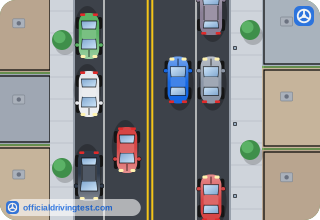
- Sound the horn twice, then signal left
- Signal for a stop and signal to the right
- Signal left and turn on the hazard lights
- No signal is needed when parking
Show answer
Correct answer: Signal for a stop and signal to the right
Signal for a stop and signal to the right to alert motorists that the vehicle will back up to the right.
Source: New Jersey Driver Manual (2026), page 58 · Open this page in the manual (Manual page 58)
-
To begin parallel parking, how far from the vehicle in front of the space should you pull up alongside?
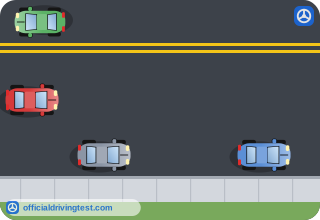
- About two to four feet
- About six inches
- About eight to ten feet
- Close enough to almost touch it
Show answer
Correct answer: About two to four feet
Pull up alongside (parallel to) the vehicle in front, about two to four feet from it.
Source: New Jersey Driver Manual (2026), page 58 · Open this page in the manual (Manual page 58)
-
When parallel parking, after backing up slowly for about two feet, how should you turn the steering wheel?
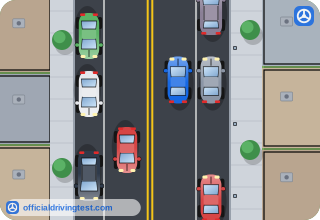
- Halfway to the left
- All the way to the left
- Keep it pointed straight ahead
- All the way to the right
Show answer
Correct answer: All the way to the right
Look out the rear window, begin backing slowly for about two feet and turn the steering wheel all the way to the right.
Source: New Jersey Driver Manual (2026), page 58 · Open this page in the manual (Manual page 58)
-
While parallel parking, when should you stop and check your angle?
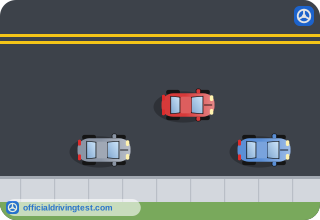
- When your front wheels touch the curb
- As soon as you start backing up into the space
- When your front clears the rear bumper of the car ahead
- When your rear tires first touch the curb behind you
Show answer
Correct answer: When your front clears the rear bumper of the car ahead
When the front of the vehicle has cleared the rear bumper of the vehicle in front, stop and check the angle.
Source: New Jersey Driver Manual (2026), page 58 · Open this page in the manual (Manual page 58)
-
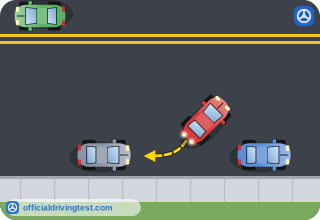
While parallel parking, what should you check after stopping to check your angle?
- That the right back wheel has not hit the curb
- That the hazard lights are switched on
- That the left front wheel is touching the curb
- That the parking brake is already set
Show answer
Correct answer: That the right back wheel has not hit the curb
After checking the angle, make sure the right back wheel has not hit the curb before turning the wheel to the left.
Source: New Jersey Driver Manual (2026), page 58 · Open this page in the manual (Manual page 58)
-
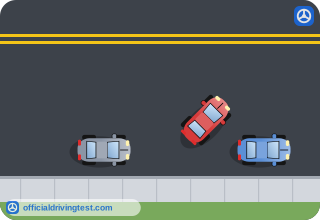
In parallel parking, after your front clears the car ahead and you check the angle, how do you continue?
- Drive forward and start over from the beginning
- Turn the wheel all the way left while backing slowly
- Keep the wheel straight and back up to the curb
- Turn the wheel all the way right and back up quickly
Show answer
Correct answer: Turn the wheel all the way left while backing slowly
The next step is to turn the steering wheel all the way to the left while beginning to back up slowly.
Source: New Jersey Driver Manual (2026), page 58 · Open this page in the manual (Manual page 58)
-
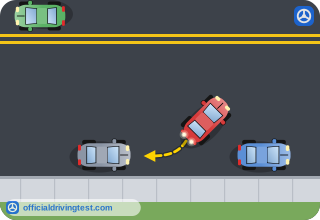
When your vehicle is lined up in the space while parallel parking, what are the last steps?
- Keep backing until you touch the car behind
- Leave the wheels turned left and set the brake
- Pull forward until you touch the car in front
- Stop, straighten the wheels and center the car
Show answer
Correct answer: Stop, straighten the wheels and center the car
When the vehicle is in line, stop without hitting the vehicle behind, turn the wheels straight and drive to the center of the parking space.
Source: New Jersey Driver Manual (2026), page 58 · Open this page in the manual (Manual page 58)
-
According to the New Jersey Driver Manual, where should a new motorist first practice parallel parking?
- In an empty parking lot
- Between two real parked cars
- On a busy city street
- Along the road test route
Show answer
Correct answer: In an empty parking lot
Parallel parking takes the most practice for a new motorist, who should practice often, in an empty parking lot at first.
Source: New Jersey Driver Manual (2026), page 58 · Open this page in the manual (Manual page 58)
-
In New Jersey, where are parking lights required on parked vehicles?
- Only on streets that have parking meters or time limits
- Only in business zones
- In areas other than business or residential zones
- Only in residential zones
Show answer
Correct answer: In areas other than business or residential zones
Parking lights are required on vehicles parked in areas other than business or residential zones.
Source: New Jersey Driver Manual (2026), page 83 · Open this page in the manual (Manual page 83)
-
Before opening the driver-side door after parking, what should you check for in addition to traffic?
- Whether your headlights have been turned off
- Bicycles or mopeds, which can be hard to see
- Whether the curb next to you is painted yellow
- Whether the parking meter still has time left
Show answer
Correct answer: Bicycles or mopeds, which can be hard to see
Before opening the driver-side door and getting out, check for traffic and also for bicycles or mopeds, which are sometimes difficult to see.
Source: New Jersey Driver Manual (2026), page 84 · Open this page in the manual (Manual page 84)
-
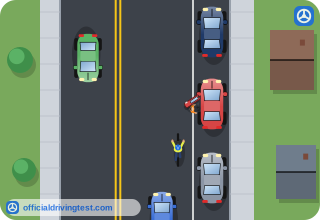
If you open your car door into traffic and a moving vehicle hits it, who may be liable for the crash?
- No one, because your car was parked
- The owner of the parking space
- Only the driver of the moving vehicle
- You, the motorist who opened the door
Show answer
Correct answer: You, the motorist who opened the door
A motorist who opens a door into traffic may be liable for any crash with a moving vehicle.
Source: New Jersey Driver Manual (2026), page 84 · Open this page in the manual (Manual page 84)
-
According to the New Jersey Driver Manual, which side is safer for passengers to get out of a parked vehicle?
- The curbside
- Whichever side is nearer
- The side with more room
- The street side
Show answer
Correct answer: The curbside
It is safer for passengers to exit a parked vehicle from the curbside, away from traffic.
Source: New Jersey Driver Manual (2026), page 84 · Open this page in the manual (Manual page 84)
-
In New Jersey, it is illegal to park a vehicle more than how far from the curb?
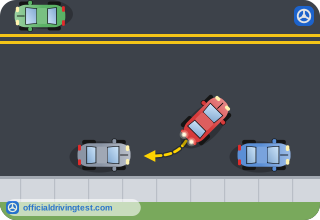
- 12 inches
- 18 inches
- Six inches
- Two feet
Show answer
Correct answer: Six inches
It is illegal in New Jersey for a vehicle to be parked more than six inches from the curb.
Source: New Jersey Driver Manual (2026), page 84 · Open this page in the manual (Manual page 84)
-
According to the New Jersey Driver Manual, why should you read the parking signs before parking on a city street?
- To see where the nearest bus route is
- To find out the speed limit on that street
- To be aware of any restrictions or time limits
- To learn which way the street runs
Show answer
Correct answer: To be aware of any restrictions or time limits
A motorist should read parking signs before parking on a city street to be aware of restrictions or time limits.
Source: New Jersey Driver Manual (2026), page 84 · Open this page in the manual (Manual page 84)
-
In New Jersey, when may you stop or park in a place where stopping and parking are otherwise banned, such as a crosswalk or a bus stop zone?
- When you will be parked for less than five minutes
- When your hazard flashers are turned on
- When you stay in the vehicle with the engine running
- When a police officer directs you, or to avoid a crash
Show answer
Correct answer: When a police officer directs you, or to avoid a crash
Unless directed to by a police officer or to avoid a crash, a motorist should never stop or park at any of the listed places.
Source: New Jersey Driver Manual (2026), page 85 · Open this page in the manual (Manual page 85)
-
In New Jersey, you may not park within how many feet of a fire hydrant?
- 10 feet
- 5 feet
- 25 feet
- 15 feet
Show answer
Correct answer: 10 feet
New Jersey law prohibits stopping or parking within 10 feet of a fire hydrant.
Source: New Jersey Driver Manual (2026), page 85 · Open this page in the manual (Manual page 85)
-
In New Jersey, you may not park within how many feet of a crosswalk at an intersection?
- 15 feet
- 25 feet
- 10 feet
- 50 feet
Show answer
Correct answer: 25 feet
You may not stop or park within 25 feet of a crosswalk at an intersection, except at alleys.
Source: New Jersey Driver Manual (2026), page 85 · Open this page in the manual (Manual page 85)
-
In New Jersey, you may not park within how many feet of a railroad crossing?
- 100 feet
- 50 feet
- 25 feet
- 15 feet
Show answer
Correct answer: 50 feet
New Jersey prohibits stopping or parking within 50 feet of a railroad crossing.
Source: New Jersey Driver Manual (2026), page 85 · Open this page in the manual (Manual page 85)
-
In New Jersey, you may not park within how many feet of a stop sign?
- 30 feet
- 25 feet
- 50 feet
- 10 feet
Show answer
Correct answer: 50 feet
New Jersey prohibits stopping or parking within 50 feet of a stop sign.
Source: New Jersey Driver Manual (2026), page 85 · Open this page in the manual (Manual page 85)
-
In New Jersey, you may not park within how many feet of the driveway entrance to a fire station?
- 50 feet
- 10 feet
- 75 feet
- 20 feet
Show answer
Correct answer: 20 feet
You may not stop or park within 20 feet of the driveway entrance to any fire station.
Source: New Jersey Driver Manual (2026), page 85 · Open this page in the manual (Manual page 85)
-
In New Jersey, on the side of the street opposite a fire station entrance, you may not park within how many feet?
- 75 feet
- 100 feet
- 50 feet
- 20 feet
Show answer
Correct answer: 75 feet
You may not stop or park within 75 feet on the street opposite a fire station entrance.
Source: New Jersey Driver Manual (2026), page 85 · Open this page in the manual (Manual page 85)
-
In New Jersey, you may not park between a pedestrian safety zone and the adjacent curb, or within how many feet of the end of the safety zone?
- 10 feet
- 20 feet
- 5 feet
- 50 feet
Show answer
Correct answer: 20 feet
You may not stop or park between a safety zone for pedestrians and the adjacent curb, or within 20 feet of the end of the safety zone.
Source: New Jersey Driver Manual (2026), page 85 · Open this page in the manual (Manual page 85)
-
Which of these is a place where New Jersey law says you must never stop or park?
- 30 feet away from a fire hydrant
- A spot 60 feet away from the nearest railroad crossing
- 100 feet away from a stop sign
- On any bridge, elevated roadway, or in a tunnel
Show answer
Correct answer: On any bridge, elevated roadway, or in a tunnel
You may never stop or park on any bridge or elevated roadway or in any tunnel; the other distances are beyond the 10-foot hydrant and 50-foot stop sign and railroad limits.
Source: New Jersey Driver Manual (2026), page 85 · Open this page in the manual (Manual page 85)
-
Which of these is a place where New Jersey law says you must never stop or park?
- In a bus stop zone
- 15 feet from a fire hydrant
- 40 feet from a crosswalk at an intersection
- 80 feet from a stop sign
Show answer
Correct answer: In a bus stop zone
Parking in a bus stop zone is prohibited; the other spots are beyond the 10-foot hydrant, 25-foot crosswalk and 50-foot stop sign limits.
Source: New Jersey Driver Manual (2026), page 85 · Open this page in the manual (Manual page 85)
-
In New Jersey, which of these roads is listed as a place where you must never stop or park?
- A one-way business street
- A rural two-lane road
- An interstate highway
- A residential side street
Show answer
Correct answer: An interstate highway
New Jersey's list of places where you must never stop or park includes an interstate highway.
Source: New Jersey Driver Manual (2026), page 85 · Open this page in the manual (Manual page 85)
-
Which of these is a place where New Jersey law says you must never stop or park?
- 20 feet from a fire hydrant
- 30 feet from a crosswalk at an intersection
- Near properly marked street construction
- 60 feet from a stop sign
Show answer
Correct answer: Near properly marked street construction
Stopping or parking near properly marked street construction is prohibited; the other spots are beyond the 50-foot stop sign, 10-foot hydrant and 25-foot crosswalk limits.
Source: New Jersey Driver Manual (2026), page 85 · Open this page in the manual (Manual page 85)
-
What is "double parking," which New Jersey law prohibits?
- Parking in the same spot for two days
- Parking next to another vehicle parked at the curb
- Parking two vehicles in one driveway
- Parking a vehicle across two marked parking spaces at once
Show answer
Correct answer: Parking next to another vehicle parked at the curb
Double parking means stopping or parking next to another vehicle that is parked at the curb, and it is prohibited.
Source: New Jersey Driver Manual (2026), page 85 · Open this page in the manual (Manual page 85)
-
In New Jersey, who may park in a space marked for vehicle parking for persons with a disability?
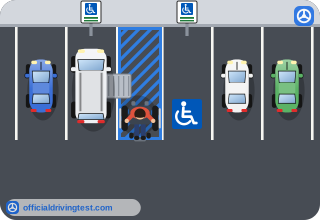
- Any motorist who stays inside the vehicle
- Any motorist, if all other spaces are full
- Only a motorist legally authorized to park there
- Any motorist, for up to 15 minutes
Show answer
Correct answer: Only a motorist legally authorized to park there
New Jersey law lists a space on public or private property marked for parking for persons with a disability as a place you may not stop or park unless legally authorized.
Source: New Jersey Driver Manual (2026), page 85 · Open this page in the manual (Manual page 85)
-
In New Jersey, motorists are prohibited from letting their vehicle idle for more than how many consecutive minutes?
- Ten minutes
- Three minutes
- One minute
- Five minutes
Show answer
Correct answer: Three minutes
New Jersey prohibits motorists from allowing their motor vehicle to idle for more than three consecutive minutes, with some exceptions.
Source: New Jersey Driver Manual (2026), page 99 · Open this page in the manual (Manual page 99)
-
Which of these is an exception to New Jersey's limit on vehicle idling?
- A car parked while the driver waits for a friend
- A car left running in a driveway
- A vehicle stopped in traffic
- A car parked outside a store with the air on
Show answer
Correct answer: A vehicle stopped in traffic
Exceptions to the idling limit include vehicles stopped in traffic, vehicles being repaired or waiting to be inspected, emergency vehicles in emergencies, and buses picking up or discharging passengers.
Source: New Jersey Driver Manual (2026), page 99 · Open this page in the manual (Manual page 99)