New Jersey: Parking rules — Part 2 Practice Test
Questions in this part include: “According to the New Jersey Driver Manual, where should a new motorist first practice parallel parking?” · “In New Jersey, you may not park within how many feet of a railroad crossing?”
Independent educational site · not affiliated with any government agency or DMV
Ready? Test yourself
- Instant feedback with an explanation
- Every answer cites its source in the manual
- Your best score is saved on this device
Questions are original and based on the official manual "New Jersey Driver Manual" (2026), New Jersey Motor Vehicle Commission (MVC).
All 23 questions in this practice test
Take the test above first, then use this list to study. Tap “Show answer” to see the correct answer and explanation.
Show the questions and answersHide the questions
-
According to the New Jersey Driver Manual, where should a new motorist first practice parallel parking?
- In an empty parking lot
- Between two real parked cars
- On a busy city street
- Along the road test route
Show answer
Correct answer: In an empty parking lot
Parallel parking takes the most practice for a new motorist, who should practice often, in an empty parking lot at first.
Source: New Jersey Driver Manual (2026), page 58 · Open this page in the manual (Manual page 58)
-
In New Jersey, where are parking lights required on parked vehicles?
- Only on streets that have parking meters or time limits
- Only in business zones
- In areas other than business or residential zones
- Only in residential zones
Show answer
Correct answer: In areas other than business or residential zones
Parking lights are required on vehicles parked in areas other than business or residential zones.
Source: New Jersey Driver Manual (2026), page 83 · Open this page in the manual (Manual page 83)
-
Before opening the driver-side door after parking, what should you check for in addition to traffic?
- Whether your headlights have been turned off
- Bicycles or mopeds, which can be hard to see
- Whether the curb next to you is painted yellow
- Whether the parking meter still has time left
Show answer
Correct answer: Bicycles or mopeds, which can be hard to see
Before opening the driver-side door and getting out, check for traffic and also for bicycles or mopeds, which are sometimes difficult to see.
Source: New Jersey Driver Manual (2026), page 84 · Open this page in the manual (Manual page 84)
-
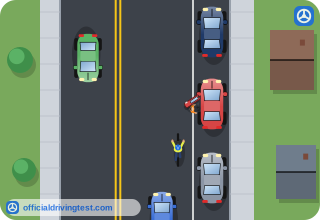
If you open your car door into traffic and a moving vehicle hits it, who may be liable for the crash?
- No one, because your car was parked
- The owner of the parking space
- Only the driver of the moving vehicle
- You, the motorist who opened the door
Show answer
Correct answer: You, the motorist who opened the door
A motorist who opens a door into traffic may be liable for any crash with a moving vehicle.
Source: New Jersey Driver Manual (2026), page 84 · Open this page in the manual (Manual page 84)
-
According to the New Jersey Driver Manual, which side is safer for passengers to get out of a parked vehicle?
- The curbside
- Whichever side is nearer
- The side with more room
- The street side
Show answer
Correct answer: The curbside
It is safer for passengers to exit a parked vehicle from the curbside, away from traffic.
Source: New Jersey Driver Manual (2026), page 84 · Open this page in the manual (Manual page 84)
-
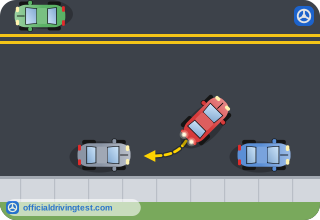
In New Jersey, it is illegal to park a vehicle more than how far from the curb?
- 12 inches
- 18 inches
- Six inches
- Two feet
Show answer
Correct answer: Six inches
It is illegal in New Jersey for a vehicle to be parked more than six inches from the curb.
Source: New Jersey Driver Manual (2026), page 84 · Open this page in the manual (Manual page 84)
-
According to the New Jersey Driver Manual, why should you read the parking signs before parking on a city street?
- To see where the nearest bus route is
- To find out the speed limit on that street
- To be aware of any restrictions or time limits
- To learn which way the street runs
Show answer
Correct answer: To be aware of any restrictions or time limits
A motorist should read parking signs before parking on a city street to be aware of restrictions or time limits.
Source: New Jersey Driver Manual (2026), page 84 · Open this page in the manual (Manual page 84)
-
In New Jersey, when may you stop or park in a place where stopping and parking are otherwise banned, such as a crosswalk or a bus stop zone?
- When you will be parked for less than five minutes
- When your hazard flashers are turned on
- When you stay in the vehicle with the engine running
- When a police officer directs you, or to avoid a crash
Show answer
Correct answer: When a police officer directs you, or to avoid a crash
Unless directed to by a police officer or to avoid a crash, a motorist should never stop or park at any of the listed places.
Source: New Jersey Driver Manual (2026), page 85 · Open this page in the manual (Manual page 85)
-
In New Jersey, you may not park within how many feet of a fire hydrant?
- 10 feet
- 5 feet
- 25 feet
- 15 feet
Show answer
Correct answer: 10 feet
New Jersey law prohibits stopping or parking within 10 feet of a fire hydrant.
Source: New Jersey Driver Manual (2026), page 85 · Open this page in the manual (Manual page 85)
-
In New Jersey, you may not park within how many feet of a crosswalk at an intersection?
- 15 feet
- 25 feet
- 10 feet
- 50 feet
Show answer
Correct answer: 25 feet
You may not stop or park within 25 feet of a crosswalk at an intersection, except at alleys.
Source: New Jersey Driver Manual (2026), page 85 · Open this page in the manual (Manual page 85)
-
In New Jersey, you may not park within how many feet of a railroad crossing?
- 100 feet
- 50 feet
- 25 feet
- 15 feet
Show answer
Correct answer: 50 feet
New Jersey prohibits stopping or parking within 50 feet of a railroad crossing.
Source: New Jersey Driver Manual (2026), page 85 · Open this page in the manual (Manual page 85)
-
In New Jersey, you may not park within how many feet of a stop sign?
- 30 feet
- 25 feet
- 50 feet
- 10 feet
Show answer
Correct answer: 50 feet
New Jersey prohibits stopping or parking within 50 feet of a stop sign.
Source: New Jersey Driver Manual (2026), page 85 · Open this page in the manual (Manual page 85)
-
In New Jersey, you may not park within how many feet of the driveway entrance to a fire station?
- 50 feet
- 10 feet
- 75 feet
- 20 feet
Show answer
Correct answer: 20 feet
You may not stop or park within 20 feet of the driveway entrance to any fire station.
Source: New Jersey Driver Manual (2026), page 85 · Open this page in the manual (Manual page 85)
-
In New Jersey, on the side of the street opposite a fire station entrance, you may not park within how many feet?
- 75 feet
- 100 feet
- 50 feet
- 20 feet
Show answer
Correct answer: 75 feet
You may not stop or park within 75 feet on the street opposite a fire station entrance.
Source: New Jersey Driver Manual (2026), page 85 · Open this page in the manual (Manual page 85)
-
In New Jersey, you may not park between a pedestrian safety zone and the adjacent curb, or within how many feet of the end of the safety zone?
- 10 feet
- 20 feet
- 5 feet
- 50 feet
Show answer
Correct answer: 20 feet
You may not stop or park between a safety zone for pedestrians and the adjacent curb, or within 20 feet of the end of the safety zone.
Source: New Jersey Driver Manual (2026), page 85 · Open this page in the manual (Manual page 85)
-
Which of these is a place where New Jersey law says you must never stop or park?
- 30 feet away from a fire hydrant
- A spot 60 feet away from the nearest railroad crossing
- 100 feet away from a stop sign
- On any bridge, elevated roadway, or in a tunnel
Show answer
Correct answer: On any bridge, elevated roadway, or in a tunnel
You may never stop or park on any bridge or elevated roadway or in any tunnel; the other distances are beyond the 10-foot hydrant and 50-foot stop sign and railroad limits.
Source: New Jersey Driver Manual (2026), page 85 · Open this page in the manual (Manual page 85)
-
Which of these is a place where New Jersey law says you must never stop or park?
- In a bus stop zone
- 15 feet from a fire hydrant
- 40 feet from a crosswalk at an intersection
- 80 feet from a stop sign
Show answer
Correct answer: In a bus stop zone
Parking in a bus stop zone is prohibited; the other spots are beyond the 10-foot hydrant, 25-foot crosswalk and 50-foot stop sign limits.
Source: New Jersey Driver Manual (2026), page 85 · Open this page in the manual (Manual page 85)
-
In New Jersey, which of these roads is listed as a place where you must never stop or park?
- A one-way business street
- A rural two-lane road
- An interstate highway
- A residential side street
Show answer
Correct answer: An interstate highway
New Jersey's list of places where you must never stop or park includes an interstate highway.
Source: New Jersey Driver Manual (2026), page 85 · Open this page in the manual (Manual page 85)
-
Which of these is a place where New Jersey law says you must never stop or park?
- 20 feet from a fire hydrant
- 30 feet from a crosswalk at an intersection
- Near properly marked street construction
- 60 feet from a stop sign
Show answer
Correct answer: Near properly marked street construction
Stopping or parking near properly marked street construction is prohibited; the other spots are beyond the 50-foot stop sign, 10-foot hydrant and 25-foot crosswalk limits.
Source: New Jersey Driver Manual (2026), page 85 · Open this page in the manual (Manual page 85)
-
What is "double parking," which New Jersey law prohibits?
- Parking in the same spot for two days
- Parking next to another vehicle parked at the curb
- Parking two vehicles in one driveway
- Parking a vehicle across two marked parking spaces at once
Show answer
Correct answer: Parking next to another vehicle parked at the curb
Double parking means stopping or parking next to another vehicle that is parked at the curb, and it is prohibited.
Source: New Jersey Driver Manual (2026), page 85 · Open this page in the manual (Manual page 85)
-
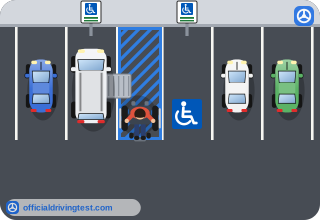
In New Jersey, who may park in a space marked for vehicle parking for persons with a disability?
- Any motorist who stays inside the vehicle
- Any motorist, if all other spaces are full
- Only a motorist legally authorized to park there
- Any motorist, for up to 15 minutes
Show answer
Correct answer: Only a motorist legally authorized to park there
New Jersey law lists a space on public or private property marked for parking for persons with a disability as a place you may not stop or park unless legally authorized.
Source: New Jersey Driver Manual (2026), page 85 · Open this page in the manual (Manual page 85)
-
In New Jersey, motorists are prohibited from letting their vehicle idle for more than how many consecutive minutes?
- Ten minutes
- Three minutes
- One minute
- Five minutes
Show answer
Correct answer: Three minutes
New Jersey prohibits motorists from allowing their motor vehicle to idle for more than three consecutive minutes, with some exceptions.
Source: New Jersey Driver Manual (2026), page 99 · Open this page in the manual (Manual page 99)
-
Which of these is an exception to New Jersey's limit on vehicle idling?
- A car parked while the driver waits for a friend
- A car left running in a driveway
- A vehicle stopped in traffic
- A car parked outside a store with the air on
Show answer
Correct answer: A vehicle stopped in traffic
Exceptions to the idling limit include vehicles stopped in traffic, vehicles being repaired or waiting to be inspected, emergency vehicles in emergencies, and buses picking up or discharging passengers.
Source: New Jersey Driver Manual (2026), page 99 · Open this page in the manual (Manual page 99)