New Jersey: Freeway driving
Entering, exiting, merging and lane use on highways. Split into 2 shorter tests so you're not stuck in one long quiz.
Independent educational site · not affiliated with any government agency or DMV
All 45 Freeway driving questions with answers
Choose a part above to take a practice test, or study every question and answer here.
Show the questions and answersHide the questions
-
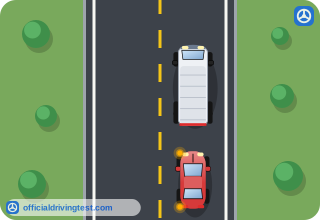
According to the New Jersey manual, when is passing safe?
- Whenever you can accelerate past it quickly
- Whenever the center line is yellow
- Any time the car ahead is slower
- Only when there is no oncoming traffic
Show answer
Correct answer: Only when there is no oncoming traffic
Stay to the right of the center lines; passing is only safe when there is no oncoming traffic.
Source: New Jersey Driver Manual (2026), page 64 · Open this page in the manual (Manual page 64)
-
On which side should most passing be done?
- On the left
- On either side equally
- On the right
- On the right shoulder
Show answer
Correct answer: On the left
Most passing should be on the left.
Source: New Jersey Driver Manual (2026), page 65 · Open this page in the manual (Manual page 65)
-
In New Jersey, which of these is a situation where you may pass another vehicle on the right?
- You are on a two-lane road with a broken line
- The paved right shoulder is wide and clear of traffic
- The vehicle ahead is going below the limit
- The driver ahead is turning left and there is room
Show answer
Correct answer: The driver ahead is turning left and there is room
Passing on the right is allowed only on roads with more than one lane in the same direction when traffic moves in continuous lines, or when the motorist ahead is turning left and there is room to pass.
Source: New Jersey Driver Manual (2026), page 65 · Open this page in the manual (Manual page 65)
-
Is it legal in New Jersey to pass another vehicle by driving on the right shoulder?
- Yes, but only in heavy traffic
- No, it is against the law
- Yes, if the shoulder is paved
- Yes, if you signal first
Show answer
Correct answer: No, it is against the law
Never pass on the right shoulder of the road; it is against the law.
Source: New Jersey Driver Manual (2026), page 65 · Open this page in the manual (Manual page 65)
-
According to the New Jersey manual, where should you not pass?
- On a straight, clear road with a broken center line
- Where both center lines are broken and no one is coming
- On a hill or curve where you cannot see far ahead
- On the left side of a multi-lane highway
Show answer
Correct answer: On a hill or curve where you cannot see far ahead
You should not pass on a hill or curve, or any time you cannot see far enough ahead.
Source: New Jersey Driver Manual (2026), page 65 · Open this page in the manual (Manual page 65)
-
Which of these is a place where the New Jersey manual says you should not pass?
- In the left lane of a multi-lane highway
- On a narrow bridge or in a tunnel
- On a two-lane road with broken lines
- On a one-way street with two open lanes
Show answer
Correct answer: On a narrow bridge or in a tunnel
The manual says not to pass on narrow bridges or in underpasses or tunnels.
Source: New Jersey Driver Manual (2026), page 65 · Open this page in the manual (Manual page 65)
-
Should you pass another vehicle at a street crossing or intersection?
- Yes, if your light is green
- Yes, if you tap your horn first
- No, you should not pass there
- Yes, if the car ahead turns right
Show answer
Correct answer: No, you should not pass there
The manual lists a street crossing or intersection as a place where a motorist should not pass.
Source: New Jersey Driver Manual (2026), page 65 · Open this page in the manual (Manual page 65)
-
In New Jersey, on which part of the roadway must you drive, unless you are on a one-way street?
- The right half
- Either half, if it is clear
- Straddling the center line
- The left half
Show answer
Correct answer: The right half
New Jersey law requires motorists to drive on the right half of the roadway unless driving on a one-way street.
Source: New Jersey Driver Manual (2026), page 65 · Open this page in the manual (Manual page 65)
-
Except when overtaking and passing, how close to the right-hand edge or curb must you drive in New Jersey?
- As close as possible
- At least 3 feet away from it
- In the center of the road
- At least one lane width away
Show answer
Correct answer: As close as possible
Motorists must drive as close as possible to the right-hand edge or curb, except when overtaking and passing another vehicle.
Source: New Jersey Driver Manual (2026), page 65 · Open this page in the manual (Manual page 65)
-
On a multi-lane road in New Jersey, which lane must you use when it is available, unless you are passing or preparing to turn left?
- The far left lane
- The lane nearest the right edge or curb
- Whichever lane you prefer
- The lane closest to the center line of the road
Show answer
Correct answer: The lane nearest the right edge or curb
On a multi-lane roadway you must drive in the lane nearest the right-hand edge or curb when it is available, except when overtaking or preparing for a left turn.
Source: New Jersey Driver Manual (2026), page 65 · Open this page in the manual (Manual page 65)
-
How does the New Jersey manual describe highways, parkways, and turnpikes?
- Local streets with a 35 mph limit
- High-speed divided roads with no direct intersections
- Undivided roads with traffic in both directions
- Two-lane roads with frequent traffic lights and stop signs
Show answer
Correct answer: High-speed divided roads with no direct intersections
Highways, parkways, and turnpikes are high-speed divided roadways, usually with multiple lanes, one-way traffic on each side, and no direct intersections.
Source: New Jersey Driver Manual (2026), page 68 · Open this page in the manual (Manual page 68)
-
What is an acceleration lane?
- An entry lane used to speed up and join traffic
- A shoulder lane kept for emergency vehicles
- An extra lane at an exit that is used to slow down
- A left-hand lane used only for passing
Show answer
Correct answer: An entry lane used to speed up and join traffic
Acceleration lanes are extra lanes at highway entrances that motorists use to speed up and join the flow of traffic.
Source: New Jersey Driver Manual (2026), page 68 · Open this page in the manual (Manual page 68)
-
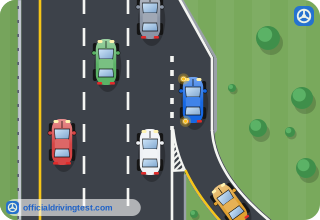
When you enter a highway, parkway, or turnpike, who has the right-of-way?
- Only trucks and buses
- The vehicle entering from the ramp
- Whichever vehicle is going faster
- Traffic already on the main road
Show answer
Correct answer: Traffic already on the main road
You must yield to traffic already traveling on the main road before moving into the proper lane.
Source: New Jersey Driver Manual (2026), page 68 · Open this page in the manual (Manual page 68)
-
An entrance ramp to a highway has a posted advisory speed limit. What should you do?
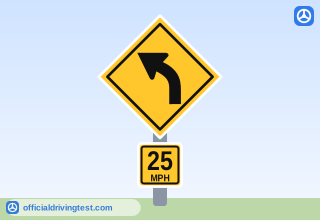
- Obey it
- Ignore it, since it is only advice
- Follow it only at night
- Go 10 mph over it to merge
Show answer
Correct answer: Obey it
When entering a highway, parkway, or turnpike, obey any posted advisory speed limits at the entrance ramp.
Source: New Jersey Driver Manual (2026), page 69 · Open this page in the manual (Manual page 69)
-
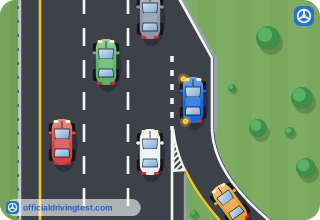
When entering a highway, when should you speed up to the flow of traffic?
- Only after you pass the next exit
- Only after you are in the left lane
- When leaving the acceleration lane
- Before you reach the entrance ramp
Show answer
Correct answer: When leaving the acceleration lane
Speed up to the flow of traffic when leaving the acceleration lane.
Source: New Jersey Driver Manual (2026), page 69 · Open this page in the manual (Manual page 69)
-
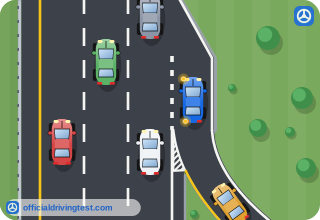
What does the New Jersey manual advise about stopping in an acceleration lane?
- Stop there if you want to read signs
- Stop there whenever a truck is beside you
- Avoid coming to a complete stop there
- Always stop at its end before merging
Show answer
Correct answer: Avoid coming to a complete stop there
When entering a highway, avoid coming to a complete stop in the acceleration lane.
Source: New Jersey Driver Manual (2026), page 69 · Open this page in the manual (Manual page 69)
-
When you merge from an acceleration lane, which lane should you enter?
- The center lane in every case
- The right-hand lane, when safe
- Whichever lane has the least traffic
- The left-hand passing lane
Show answer
Correct answer: The right-hand lane, when safe
Yield to traffic and enter the right-hand lane when it is safe.
Source: New Jersey Driver Manual (2026), page 69 · Open this page in the manual (Manual page 69)
-
In most cases, where are exit ramps and deceleration lanes located?
- Just before every toll booth
- In the center median
- On the left-hand side of the roadway
- On the right-hand side of the roadway
Show answer
Correct answer: On the right-hand side of the roadway
In most cases, exit ramps or deceleration lanes are located on the right-hand side of the roadway.
Source: New Jersey Driver Manual (2026), page 69 · Open this page in the manual (Manual page 69)
-
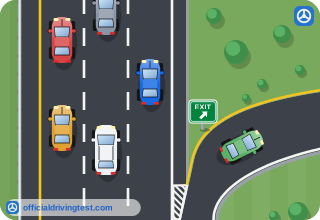
You miss your exit on a New Jersey highway, parkway, or turnpike. What should you do?
- Go on to the next exit
- Back up along the shoulder
- Stop and wait for a gap to reverse
- Make a U-turn across the median
Show answer
Correct answer: Go on to the next exit
If you miss an exit ramp, go on to the next exit.
Source: New Jersey Driver Manual (2026), page 69 · Open this page in the manual (Manual page 69)
-
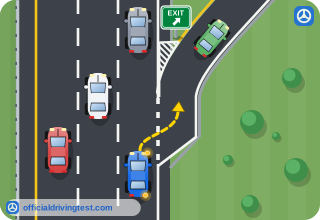
When leaving a highway, when should you start slowing down?
- When you enter the deceleration lane
- Only once you reach the end of the ramp
- In the left lane, before changing lanes
- A mile before the exit, in the travel lane
Show answer
Correct answer: When you enter the deceleration lane
Start slowing down when you enter a deceleration lane.
Source: New Jersey Driver Manual (2026), page 69 · Open this page in the manual (Manual page 69)
-
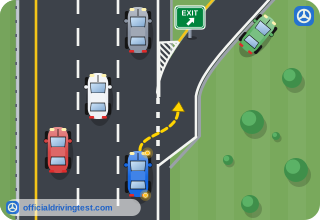
What speed should you follow in a deceleration lane?
- The main highway's speed limit
- The lane's posted advisory speed limit
- At least 10 mph over the advisory speed
- Whatever speed feels comfortable
Show answer
Correct answer: The lane's posted advisory speed limit
Obey the posted advisory speed limit of the deceleration lane.
Source: New Jersey Driver Manual (2026), page 69 · Open this page in the manual (Manual page 69)
-
When a highway exit is on the left side of the roadway, what should you do?
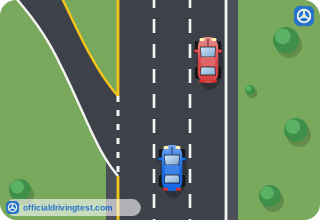
- Cross all lanes at the last moment
- Exit from the right lane anyway
- Use the right shoulder to get over to it
- Look for signs to the proper exit lane
Show answer
Correct answer: Look for signs to the proper exit lane
When the exit is on the left, look for signs that direct traffic to the proper lane for exiting.
Source: New Jersey Driver Manual (2026), page 69 · Open this page in the manual (Manual page 69)
-
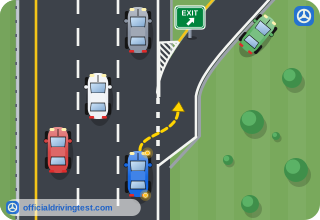
Which of these must you never do on an exit ramp or deceleration lane?
- Slow down
- Use a turn signal
- Back up
- Obey advisory speed signs
Show answer
Correct answer: Back up
Never back up on an exit ramp or deceleration lane.
Source: New Jersey Driver Manual (2026), page 69 · Open this page in the manual (Manual page 69)
-
What is a weave lane?
- A lane that ends at a toll booth
- A lane used only for passing slower traffic
- A lane that is both an entrance and an exit
- A lane reserved for buses and carpools
Show answer
Correct answer: A lane that is both an entrance and an exit
A weave lane is both an entrance and an exit for an expressway, so traffic comes on and leaves at the same place.
Source: New Jersey Driver Manual (2026), page 70 · Open this page in the manual (Manual page 70)
-
In a weave lane, who must yield the right-of-way?
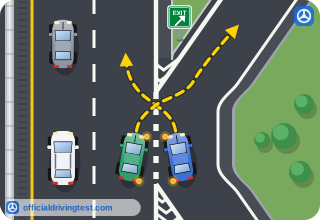
- Drivers entering yield to drivers leaving
- The slower of the two drivers yields
- Neither; both merge at the same time
- Drivers leaving yield to drivers entering
Show answer
Correct answer: Drivers entering yield to drivers leaving
The motorist entering from the entrance ramp must yield the right-of-way to the motorist leaving the expressway.
Source: New Jersey Driver Manual (2026), page 70 · Open this page in the manual (Manual page 70)
-
On a highway through a city during rush hour, which lanes does the New Jersey manual suggest to avoid merge conflicts?
- The exit-only lanes
- The left or center lane
- The right-hand lane near the ramps
- The right shoulder
Show answer
Correct answer: The left or center lane
On highways through cities, drive in the left or center lane to avoid merge conflicts during rush hour.
Source: New Jersey Driver Manual (2026), page 71 · Open this page in the manual (Manual page 71)
-
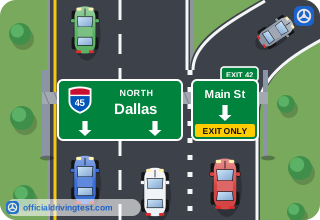
On a busy highway through a city, how should you prepare for your exit?
- Wait until you pass it, then back up
- Slow down sharply in the travel lane
- Stay left until the exit, then cut across
- Look for it early and adjust your position
Show answer
Correct answer: Look for it early and adjust your position
A motorist should search for exits early and adjust position for the exit.
Source: New Jersey Driver Manual (2026), page 71 · Open this page in the manual (Manual page 71)
-
Why should you begin slowing down early when approaching a toll booth?
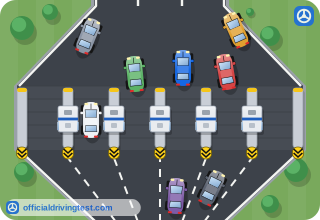
- All EZ Pass lanes need a full stop
- Traffic may be backed up at the booth
- Arriving slowly lowers the toll you pay
- Every booth has its own speed camera
Show answer
Correct answer: Traffic may be backed up at the booth
Begin reducing speed early for toll booths, because traffic may be backed up at the booth.
Source: New Jersey Driver Manual (2026), page 71 · Open this page in the manual (Manual page 71)
-
At a toll plaza, what shows you which booths are open?
- Green lights or signals
- Rows of orange cones
- Red flashing lights
- Yellow flags on the booth
Show answer
Correct answer: Green lights or signals
Green lights or signals highlight open toll booths.
Source: New Jersey Driver Manual (2026), page 71 · Open this page in the manual (Manual page 71)
-
After you pass through a toll booth, what should you do?
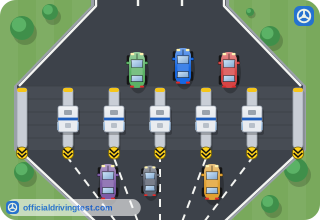
- Stop just past the booth to put away your change
- Check both sides for merging and speed up smoothly
- Keep straight and ignore the traffic beside you
- Speed up hard so you get ahead of all the other drivers
Show answer
Correct answer: Check both sides for merging and speed up smoothly
When exiting toll booths, search traffic on both sides for merging, accelerate smoothly, and adjust speed.
Source: New Jersey Driver Manual (2026), page 71 · Open this page in the manual (Manual page 71)
-
At an interchange, what type of turn is often needed to enter or exit an expressway?
- A cloverleaf turn
- A three-point turn
- A left turn across the median
- A U-turn
Show answer
Correct answer: A cloverleaf turn
To enter or exit an expressway, a cloverleaf turn is often necessary.
Source: New Jersey Driver Manual (2026), page 72 · Open this page in the manual (Manual page 72)
-
How should you drive through the circle of a cloverleaf interchange?
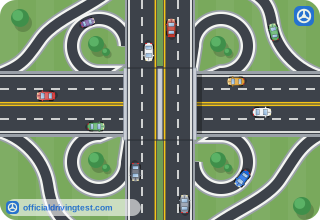
- In the left lane of the circle only
- Faster than the posted limit, to merge sooner
- Slowly, obeying the posted speed limit
- At the full speed of the highway
Show answer
Correct answer: Slowly, obeying the posted speed limit
Watch for entrance and exit signs and drive slowly in the circle, obeying the posted speed limit.
Source: New Jersey Driver Manual (2026), page 72 · Open this page in the manual (Manual page 72)
-
When changing lanes, what does the New Jersey Driver Manual say is imperative?
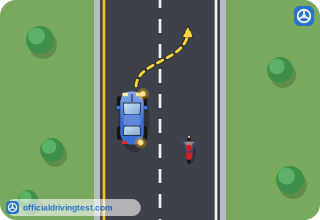
- Sound the horn briefly before moving into the new lane
- Flash your high beams at vehicles in the new lane
- Use your mirrors and turn signals, and give ample warning
- Speed up so the change takes as little time as possible
Show answer
Correct answer: Use your mirrors and turn signals, and give ample warning
When changing lanes, the rear- and side-view mirrors must be used, turn signals used properly, and other drivers given ample warning before the change.
Source: New Jersey Driver Manual (2026), page 90 · Open this page in the manual (Manual page 90)
-
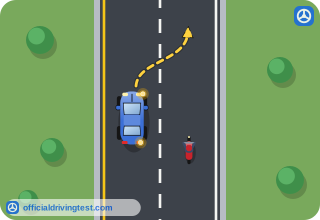
When a lane change must be made, what does the New Jersey Driver Manual say to do in addition to looking in the rearview mirror?
- Speed up before checking anything
- Honk to warn the drivers behind you
- Glance behind to check blind spots
- Rely on the mirror alone
Show answer
Correct answer: Glance behind to check blind spots
Before a lane change, look in the rearview mirror, glance behind to check blind spots, and always signal.
Source: New Jersey Driver Manual (2026), page 96 · Open this page in the manual (Manual page 96)
-
Which of the following does the New Jersey Driver Manual warn against as part of using the proper lane?
- Checking traffic behind you
- Glancing back to check blind spots
- Signaling every lane change
- Straddling a lane
Show answer
Correct answer: Straddling a lane
Using the proper lane is an important part of defensive driving, and the manual says not to straddle a lane.
Source: New Jersey Driver Manual (2026), page 96 · Open this page in the manual (Manual page 96)
-
According to the New Jersey Driver Manual, you should only pass or change lanes if which condition is met?
- You exceed the limit by no more than 10 mph
- No police vehicles are in sight
- The change can be completed without speeding
- The vehicle ahead is below the speed limit
Show answer
Correct answer: The change can be completed without speeding
The passing checklist says to pass or change lanes only when necessary and only if the change can be completed without speeding.
Source: New Jersey Driver Manual (2026), page 96 · Open this page in the manual (Manual page 96)
-
When may you pass, according to the New Jersey Driver Manual's passing checklist?
- Only when signs and pavement markings permit
- Whenever there is a gap in oncoming traffic
- Whenever the vehicle ahead is going slower
- Only on the right side of the vehicle ahead
Show answer
Correct answer: Only when signs and pavement markings permit
Before passing, keep in mind that you should only pass when signs and pavement markings permit.
Source: New Jersey Driver Manual (2026), page 96 · Open this page in the manual (Manual page 96)
-
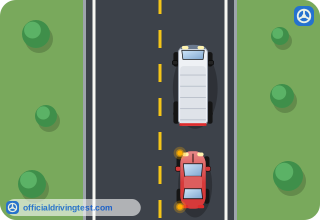
After passing a vehicle, what is a good indication that it is safe to return to the right lane?
- The passed vehicle sounds its horn at you
- You can see it in your rearview mirror
- Its front bumper is even with your driver's door
- You are one car length ahead of the vehicle
Show answer
Correct answer: You can see it in your rearview mirror
Return to the right lane when well ahead of the vehicle you passed; a good indication is when you can see that vehicle in your rearview mirror.
Source: New Jersey Driver Manual (2026), page 96 · Open this page in the manual (Manual page 96)
-
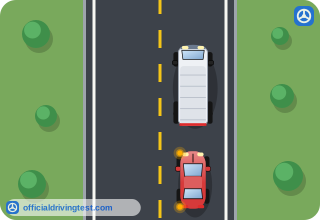
According to the New Jersey Driver Manual, what should you do when you move back into the right lane after passing?
- Brake firmly before moving back over
- Return without a signal, since you already signaled
- Return as soon as your rear bumper clears
- Signal your return to the right lane
Show answer
Correct answer: Signal your return to the right lane
The passing checklist says to signal every lane change, including your return to the right lane.
Source: New Jersey Driver Manual (2026), page 96 · Open this page in the manual (Manual page 96)
-
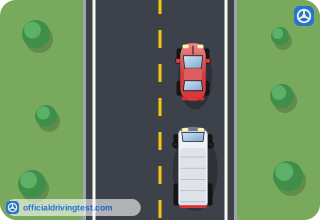
After you pass a vehicle and move back into the right lane, what does the New Jersey Driver Manual's passing checklist remind you to do?
- Flash your hazard lights
- Speed up to the limit
- Sound the horn once
- Cancel the turn signal
Show answer
Correct answer: Cancel the turn signal
The passing checklist says to signal your return to the right lane when well ahead of the vehicle you passed, and then to cancel the turn signal.
Source: New Jersey Driver Manual (2026), page 96 · Open this page in the manual (Manual page 96)
-
According to the New Jersey Driver Manual's passing checklist, when should you pass or change lanes?
- Every time traffic ahead slows
- Whenever you want to go faster
- Only when necessary
- Whenever the next lane is open
Show answer
Correct answer: Only when necessary
Before passing a vehicle or changing lanes, keep in mind that you should only pass or change lanes when necessary.
Source: New Jersey Driver Manual (2026), page 96 · Open this page in the manual (Manual page 96)
-
Why does the manual say it is important to stay alert on major highways?
- Highways always have traffic signals at every single crossroad
- Wide-open spaces can make you feel you can relax your attention
- Major highways are usually in poor condition, with many potholes
- Crashes on highways happen only in bad weather or at night
Show answer
Correct answer: Wide-open spaces can make you feel you can relax your attention
Wide-open spaces on highways often make motorists feel they can relax their attention, so it is important to stay alert.
Source: New Jersey Driver Manual (2026), page 102 · Open this page in the manual (Manual page 102)
-
According to the manual, traffic crashes and deaths on highways:
- Happen only at crossroads that have no signals
- Are rare on highways that have four or more lanes
- Can happen even in good weather on dry roads
- Happen almost only when it is raining or snowing
Show answer
Correct answer: Can happen even in good weather on dry roads
The manual warns that highway crashes and deaths can happen when the weather is good and the roads are dry.
Source: New Jersey Driver Manual (2026), page 102 · Open this page in the manual (Manual page 102)
-
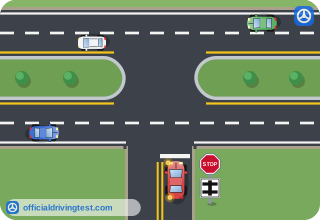
Some highways may not have traffic signals at crossroads. According to the manual, what does this mean for you?
- You may go faster than the posted speed limit
- You always have the right of way at crossroads
- Drive defensively and stay within the limit
- Cross traffic must always yield to your vehicle
Show answer
Correct answer: Drive defensively and stay within the limit
Because some highways may not have traffic signals at crossroads, a motorist must drive defensively and stay within the speed limit.
Source: New Jersey Driver Manual (2026), page 102 · Open this page in the manual (Manual page 102)
-
Who may use a high occupancy vehicle (HOV) lane?
- Any vehicle, as long as it keeps to the speed limit
- Only drivers who have paid an extra toll for the lane
- Vehicles with multiple riders, or types named on signs
- Only drivers who hold a commercial driver license
Show answer
Correct answer: Vehicles with multiple riders, or types named on signs
HOV lanes are reserved for a particular vehicle type or for vehicles carrying multiple riders, as identified by posted regulatory signs.
Source: New Jersey Driver Manual (2026), page 217 · Open this page in the manual (Manual page 217)