New Jersey: Freeway driving — Part 1 Practice Test
Questions in this part include: “On which side should most passing be done?” · “In New Jersey, on which part of the roadway must you drive, unless you are on a one-way street?”
Independent educational site · not affiliated with any government agency or DMV
Ready? Test yourself
- Instant feedback with an explanation
- Every answer cites its source in the manual
- Your best score is saved on this device
Questions are original and based on the official manual "New Jersey Driver Manual" (2026), New Jersey Motor Vehicle Commission (MVC).
All 23 questions in this practice test
Take the test above first, then use this list to study. Tap “Show answer” to see the correct answer and explanation.
Show the questions and answersHide the questions
-
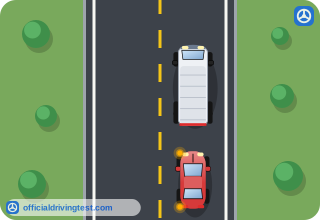
According to the New Jersey manual, when is passing safe?
- Whenever you can accelerate past it quickly
- Whenever the center line is yellow
- Any time the car ahead is slower
- Only when there is no oncoming traffic
Show answer
Correct answer: Only when there is no oncoming traffic
Stay to the right of the center lines; passing is only safe when there is no oncoming traffic.
Source: New Jersey Driver Manual (2026), page 64 · Open this page in the manual (Manual page 64)
-
On which side should most passing be done?
- On the left
- On either side equally
- On the right
- On the right shoulder
Show answer
Correct answer: On the left
Most passing should be on the left.
Source: New Jersey Driver Manual (2026), page 65 · Open this page in the manual (Manual page 65)
-
In New Jersey, which of these is a situation where you may pass another vehicle on the right?
- You are on a two-lane road with a broken line
- The paved right shoulder is wide and clear of traffic
- The vehicle ahead is going below the limit
- The driver ahead is turning left and there is room
Show answer
Correct answer: The driver ahead is turning left and there is room
Passing on the right is allowed only on roads with more than one lane in the same direction when traffic moves in continuous lines, or when the motorist ahead is turning left and there is room to pass.
Source: New Jersey Driver Manual (2026), page 65 · Open this page in the manual (Manual page 65)
-
Is it legal in New Jersey to pass another vehicle by driving on the right shoulder?
- Yes, but only in heavy traffic
- No, it is against the law
- Yes, if the shoulder is paved
- Yes, if you signal first
Show answer
Correct answer: No, it is against the law
Never pass on the right shoulder of the road; it is against the law.
Source: New Jersey Driver Manual (2026), page 65 · Open this page in the manual (Manual page 65)
-
According to the New Jersey manual, where should you not pass?
- On a straight, clear road with a broken center line
- Where both center lines are broken and no one is coming
- On a hill or curve where you cannot see far ahead
- On the left side of a multi-lane highway
Show answer
Correct answer: On a hill or curve where you cannot see far ahead
You should not pass on a hill or curve, or any time you cannot see far enough ahead.
Source: New Jersey Driver Manual (2026), page 65 · Open this page in the manual (Manual page 65)
-
Which of these is a place where the New Jersey manual says you should not pass?
- In the left lane of a multi-lane highway
- On a narrow bridge or in a tunnel
- On a two-lane road with broken lines
- On a one-way street with two open lanes
Show answer
Correct answer: On a narrow bridge or in a tunnel
The manual says not to pass on narrow bridges or in underpasses or tunnels.
Source: New Jersey Driver Manual (2026), page 65 · Open this page in the manual (Manual page 65)
-
Should you pass another vehicle at a street crossing or intersection?
- Yes, if your light is green
- Yes, if you tap your horn first
- No, you should not pass there
- Yes, if the car ahead turns right
Show answer
Correct answer: No, you should not pass there
The manual lists a street crossing or intersection as a place where a motorist should not pass.
Source: New Jersey Driver Manual (2026), page 65 · Open this page in the manual (Manual page 65)
-
In New Jersey, on which part of the roadway must you drive, unless you are on a one-way street?
- The right half
- Either half, if it is clear
- Straddling the center line
- The left half
Show answer
Correct answer: The right half
New Jersey law requires motorists to drive on the right half of the roadway unless driving on a one-way street.
Source: New Jersey Driver Manual (2026), page 65 · Open this page in the manual (Manual page 65)
-
Except when overtaking and passing, how close to the right-hand edge or curb must you drive in New Jersey?
- As close as possible
- At least 3 feet away from it
- In the center of the road
- At least one lane width away
Show answer
Correct answer: As close as possible
Motorists must drive as close as possible to the right-hand edge or curb, except when overtaking and passing another vehicle.
Source: New Jersey Driver Manual (2026), page 65 · Open this page in the manual (Manual page 65)
-
On a multi-lane road in New Jersey, which lane must you use when it is available, unless you are passing or preparing to turn left?
- The far left lane
- The lane nearest the right edge or curb
- Whichever lane you prefer
- The lane closest to the center line of the road
Show answer
Correct answer: The lane nearest the right edge or curb
On a multi-lane roadway you must drive in the lane nearest the right-hand edge or curb when it is available, except when overtaking or preparing for a left turn.
Source: New Jersey Driver Manual (2026), page 65 · Open this page in the manual (Manual page 65)
-
How does the New Jersey manual describe highways, parkways, and turnpikes?
- Local streets with a 35 mph limit
- High-speed divided roads with no direct intersections
- Undivided roads with traffic in both directions
- Two-lane roads with frequent traffic lights and stop signs
Show answer
Correct answer: High-speed divided roads with no direct intersections
Highways, parkways, and turnpikes are high-speed divided roadways, usually with multiple lanes, one-way traffic on each side, and no direct intersections.
Source: New Jersey Driver Manual (2026), page 68 · Open this page in the manual (Manual page 68)
-
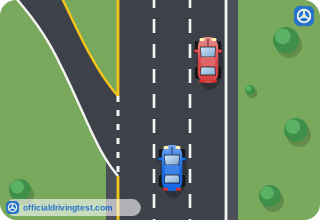
What is an acceleration lane?
- An entry lane used to speed up and join traffic
- A shoulder lane kept for emergency vehicles
- An extra lane at an exit that is used to slow down
- A left-hand lane used only for passing
Show answer
Correct answer: An entry lane used to speed up and join traffic
Acceleration lanes are extra lanes at highway entrances that motorists use to speed up and join the flow of traffic.
Source: New Jersey Driver Manual (2026), page 68 · Open this page in the manual (Manual page 68)
-
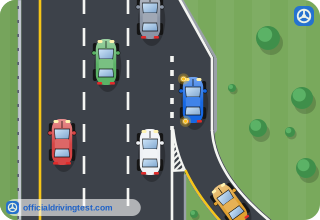
When you enter a highway, parkway, or turnpike, who has the right-of-way?
- Only trucks and buses
- The vehicle entering from the ramp
- Whichever vehicle is going faster
- Traffic already on the main road
Show answer
Correct answer: Traffic already on the main road
You must yield to traffic already traveling on the main road before moving into the proper lane.
Source: New Jersey Driver Manual (2026), page 68 · Open this page in the manual (Manual page 68)
-
An entrance ramp to a highway has a posted advisory speed limit. What should you do?
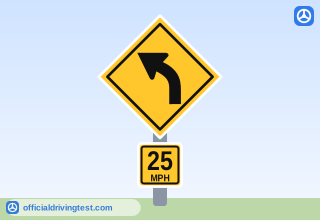
- Obey it
- Ignore it, since it is only advice
- Follow it only at night
- Go 10 mph over it to merge
Show answer
Correct answer: Obey it
When entering a highway, parkway, or turnpike, obey any posted advisory speed limits at the entrance ramp.
Source: New Jersey Driver Manual (2026), page 69 · Open this page in the manual (Manual page 69)
-
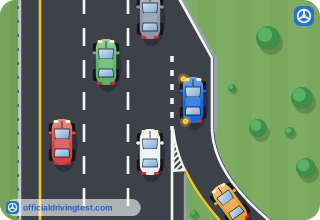
When entering a highway, when should you speed up to the flow of traffic?
- Only after you pass the next exit
- Only after you are in the left lane
- When leaving the acceleration lane
- Before you reach the entrance ramp
Show answer
Correct answer: When leaving the acceleration lane
Speed up to the flow of traffic when leaving the acceleration lane.
Source: New Jersey Driver Manual (2026), page 69 · Open this page in the manual (Manual page 69)
-
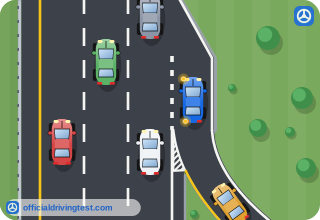
What does the New Jersey manual advise about stopping in an acceleration lane?
- Stop there if you want to read signs
- Stop there whenever a truck is beside you
- Avoid coming to a complete stop there
- Always stop at its end before merging
Show answer
Correct answer: Avoid coming to a complete stop there
When entering a highway, avoid coming to a complete stop in the acceleration lane.
Source: New Jersey Driver Manual (2026), page 69 · Open this page in the manual (Manual page 69)
-
When you merge from an acceleration lane, which lane should you enter?
- The center lane in every case
- The right-hand lane, when safe
- Whichever lane has the least traffic
- The left-hand passing lane
Show answer
Correct answer: The right-hand lane, when safe
Yield to traffic and enter the right-hand lane when it is safe.
Source: New Jersey Driver Manual (2026), page 69 · Open this page in the manual (Manual page 69)
-
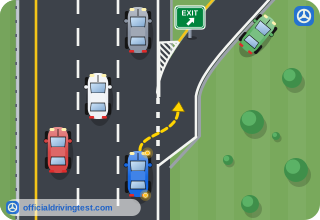
In most cases, where are exit ramps and deceleration lanes located?
- Just before every toll booth
- In the center median
- On the left-hand side of the roadway
- On the right-hand side of the roadway
Show answer
Correct answer: On the right-hand side of the roadway
In most cases, exit ramps or deceleration lanes are located on the right-hand side of the roadway.
Source: New Jersey Driver Manual (2026), page 69 · Open this page in the manual (Manual page 69)
-
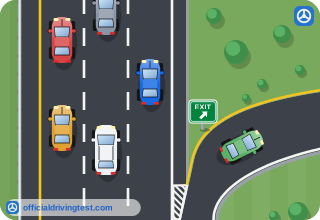
You miss your exit on a New Jersey highway, parkway, or turnpike. What should you do?
- Go on to the next exit
- Back up along the shoulder
- Stop and wait for a gap to reverse
- Make a U-turn across the median
Show answer
Correct answer: Go on to the next exit
If you miss an exit ramp, go on to the next exit.
Source: New Jersey Driver Manual (2026), page 69 · Open this page in the manual (Manual page 69)
-
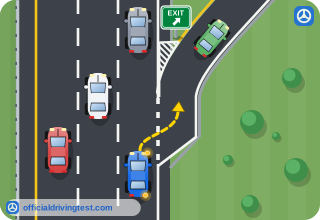
When leaving a highway, when should you start slowing down?
- When you enter the deceleration lane
- Only once you reach the end of the ramp
- In the left lane, before changing lanes
- A mile before the exit, in the travel lane
Show answer
Correct answer: When you enter the deceleration lane
Start slowing down when you enter a deceleration lane.
Source: New Jersey Driver Manual (2026), page 69 · Open this page in the manual (Manual page 69)
-
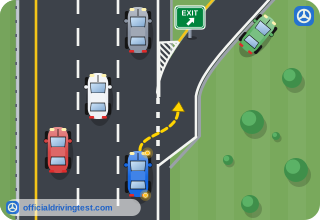
What speed should you follow in a deceleration lane?
- The main highway's speed limit
- The lane's posted advisory speed limit
- At least 10 mph over the advisory speed
- Whatever speed feels comfortable
Show answer
Correct answer: The lane's posted advisory speed limit
Obey the posted advisory speed limit of the deceleration lane.
Source: New Jersey Driver Manual (2026), page 69 · Open this page in the manual (Manual page 69)
-
When a highway exit is on the left side of the roadway, what should you do?
- Cross all lanes at the last moment
- Exit from the right lane anyway
- Use the right shoulder to get over to it
- Look for signs to the proper exit lane
Show answer
Correct answer: Look for signs to the proper exit lane
When the exit is on the left, look for signs that direct traffic to the proper lane for exiting.
Source: New Jersey Driver Manual (2026), page 69 · Open this page in the manual (Manual page 69)
-
Which of these must you never do on an exit ramp or deceleration lane?
- Slow down
- Use a turn signal
- Back up
- Obey advisory speed signs
Show answer
Correct answer: Back up
Never back up on an exit ramp or deceleration lane.
Source: New Jersey Driver Manual (2026), page 69 · Open this page in the manual (Manual page 69)