New Jersey: Emergencies and special situations — Part 4 Practice Test
Skids, breakdowns, crashes, bad weather, night driving and traffic stops. — Part 4
Independent educational site · not affiliated with any government agency or DMV
Ready? Test yourself
- Instant feedback with an explanation
- Every answer cites its source in the manual
- Your best score is saved on this device
Questions are original and based on the official manual "New Jersey Driver Manual" (2026), New Jersey Motor Vehicle Commission (MVC).
All 35 questions in this practice test
Take the test above first, then use this list to study. Tap “Show answer” to see the correct answer and explanation.
Show the questions and answersHide the questions
-
With your view blocked by a hood that has flown up, what can guide you as you pull off the road?
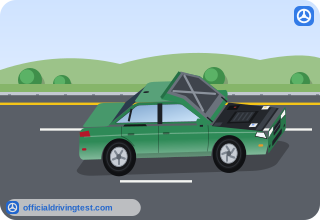
- The vehicle directly behind you
- The center line or lane markings
- Your rear-view mirror only
- The sound of the traffic around you
Show answer
Correct answer: The center line or lane markings
Using the center line or lane markings as a guide, pull to a safe area off the roadway as soon as possible.
Source: New Jersey Driver Manual (2026), page 108 · Open this page in the manual (Manual page 108)
-
If your windshield wipers stop suddenly during rain or snow, you should:
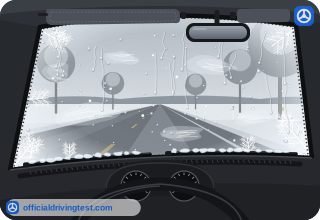
- Keep driving with your side window open to see better
- Follow the taillights of the vehicle ahead more closely
- Speed up so the wind helps clear the windshield glass
- Slow down, pull off the road and turn on your flashers
Show answer
Correct answer: Slow down, pull off the road and turn on your flashers
Slow down, pull to a safe area off the roadway and turn on your emergency flashers, calling for help if necessary.
Source: New Jersey Driver Manual (2026), page 108 · Open this page in the manual (Manual page 108)
-
If you see that your vehicle may hit something, which three actions does the manual say you can take?
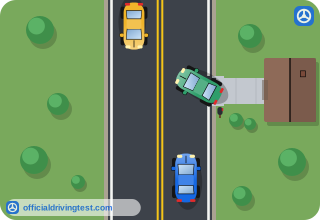
- Stop, honk, or wait
- Reverse, honk, or swerve
- Stop, turn, or speed up
- Honk, flash your lights, or stop
Show answer
Correct answer: Stop, turn, or speed up
The manual says that if your vehicle may hit something, you can stop, turn, or speed up.
Source: New Jersey Driver Manual (2026), page 108 · Open this page in the manual (Manual page 108)
-
To stop quickly in a vehicle with conventional disc and drum brakes, what should you do?
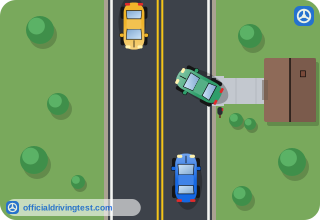
- Pump the brakes to keep better steering control
- Shift into neutral and let the vehicle coast
- Use only the parking brake to avoid a skid
- Brake hard and hold the pedal all the way down
Show answer
Correct answer: Pump the brakes to keep better steering control
With conventional brakes, pump the brakes to gain better steering control; braking too hard and holding them down locks the wheels and causes skidding.
Source: New Jersey Driver Manual (2026), page 108 · Open this page in the manual (Manual page 108)
-
In a vehicle with anti-lock brakes (ABS), how should you brake to stop quickly?
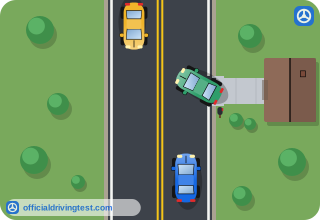
- Use only the parking brake to avoid locking
- Apply full pressure without pumping the pedal
- Pump the brake pedal rapidly several times
- Brake lightly, then shift into neutral to coast
Show answer
Correct answer: Apply full pressure without pumping the pedal
ABS adjusts automatically if a wheel begins to lock, so you can put maximum pressure on the brakes and keep steering control without pumping.
Source: New Jersey Driver Manual (2026), page 108 · Open this page in the manual (Manual page 108)
-
When turning quickly to avoid a crash, how can you lessen the chance of a skid?
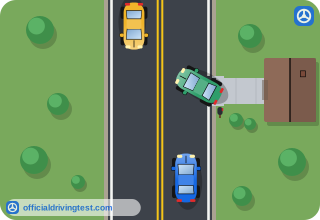
- Shift into a higher gear
- Turn the wheel as far as it will go
- Brake hard while turning
- Avoid using the brakes while turning
Show answer
Correct answer: Avoid using the brakes while turning
If you can keep from using the brakes while turning, you lessen the chances of a skid.
Source: New Jersey Driver Manual (2026), page 108 · Open this page in the manual (Manual page 108)
-
When might speeding up be the best way to avoid a crash?
- When the vehicle directly ahead of you stops suddenly in your lane
- When the road ahead is icy and you need to stop within a short distance
- When you may be hit from the side or behind and there is room ahead
- When you are approaching a red light at a busy city intersection
Show answer
Correct answer: When you may be hit from the side or behind and there is room ahead
Speeding up may be best when another vehicle is about to hit you from the side or from behind and there is room to the front to get out of danger.
Source: New Jersey Driver Manual (2026), page 109 · Open this page in the manual (Manual page 109)
-
If you must speed up to escape a crash, the manual says you should:
- Floor the gas pedal, then slow down once the danger has passed
- Flash your headlights first so the other driver can react
- Press the gas gently so that the tires do not start to skid
- Shift into neutral first, then press the gas pedal firmly
Show answer
Correct answer: Floor the gas pedal, then slow down once the danger has passed
Push the gas pedal to the floor and decide quickly, since there may be only seconds; once the danger has passed, slow down.
Source: New Jersey Driver Manual (2026), page 109 · Open this page in the manual (Manual page 109)
-
If a crash looks possible, which way should you turn?
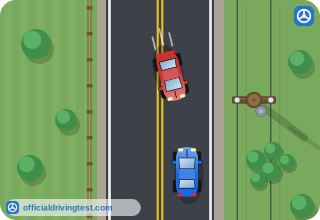
- Toward the center line so you stay on the pavement
- Away from oncoming traffic, even off the road
- Into the oncoming lane, where there is more open room
- Straight toward the object, so you hit it squarely
Show answer
Correct answer: Away from oncoming traffic, even off the road
If a crash looks possible, turn away from oncoming traffic, even if it means leaving the road.
Source: New Jersey Driver Manual (2026), page 109 · Open this page in the manual (Manual page 109)
-
According to the manual, why is driving off the road better than skidding when a crash is possible?
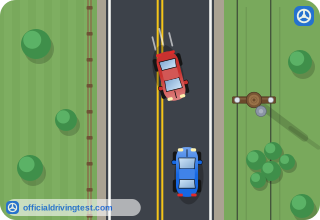
- It keeps the air bags from deploying in the crash
- Road shoulders are always paved and level
- It is the only choice allowed by law
- It gives you more control over the vehicle
Show answer
Correct answer: It gives you more control over the vehicle
Driving off the road, rather than skidding, gives the motorist more control over the vehicle.
Source: New Jersey Driver Manual (2026), page 109 · Open this page in the manual (Manual page 109)
-
If you cannot avoid hitting something, what should you choose to hit?
- A large truck parked at the side of the road
- A tree or a utility pole beside the road
- Something that will give way, such as bushes
- A concrete barrier along the shoulder
Show answer
Correct answer: Something that will give way, such as bushes
Choose to hit something that will give way, such as a bush or shrubs, rather than something hard.
Source: New Jersey Driver Manual (2026), page 109 · Open this page in the manual (Manual page 109)
-
If a collision cannot be avoided, the manual says it is better to hit something:
- Not moving rather than something moving in the same direction
- Hard rather than something that will give way
- Coming straight at you rather than something not moving
- Moving in the same direction rather than something not moving
Show answer
Correct answer: Moving in the same direction rather than something not moving
The manual says to choose to hit something moving in the same direction, rather than something that is not moving.
Source: New Jersey Driver Manual (2026), page 109 · Open this page in the manual (Manual page 109)
-
If your only choices are hitting a stationary object or a vehicle coming straight at you, what does the manual say to choose?
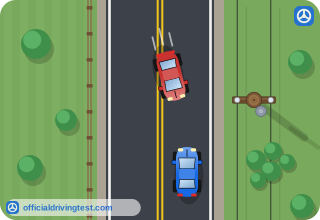
- The vehicle coming straight at you
- Whichever one is closer
- The stationary object
- Whichever one is larger
Show answer
Correct answer: The stationary object
The manual says to choose to hit something not moving, rather than something coming straight on.
Source: New Jersey Driver Manual (2026), page 109 · Open this page in the manual (Manual page 109)
-
If hitting something is unavoidable, what kind of impact should you try for?
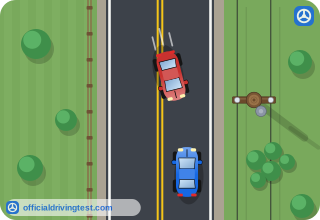
- A glancing blow, such as a sideswipe
- A hit with your rear bumper first
- A direct hit at a right angle to the object
- A head-on impact at a lower speed
Show answer
Correct answer: A glancing blow, such as a sideswipe
Try to make it a glancing blow; a sideswipe, for example, helps slow the vehicle. Try never to hit anything head-on.
Source: New Jersey Driver Manual (2026), page 109 · Open this page in the manual (Manual page 109)
-
Why does it help to steer even a few inches away from the center of an oncoming object?
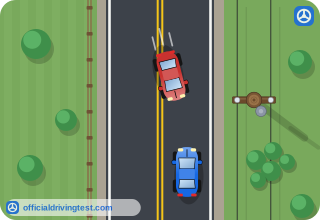
- Your wheels are less likely to lock during the impact
- The crash energy dissipates, reducing injury and damage
- The other driver will see you and have time to brake
- The air bags will inflate sooner and protect you better
Show answer
Correct answer: The crash energy dissipates, reducing injury and damage
For every inch you steer away between the center of your front end and the center of the oncoming object, the crash energy dissipates and injury and damage are reduced.
Source: New Jersey Driver Manual (2026), page 109 · Open this page in the manual (Manual page 109)
-
If your vehicle is about to be hit from the rear, you must be ready to:
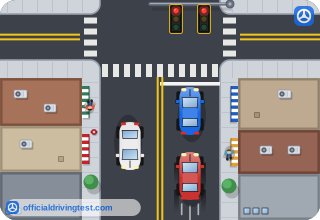
- Apply the brakes to avoid being pushed into a vehicle ahead
- Release the brakes and let your vehicle roll forward with the hit
- Unbuckle your seat belt so you can get out quickly
- Turn the wheel sharply to the left to get out of the way
Show answer
Correct answer: Apply the brakes to avoid being pushed into a vehicle ahead
Be ready to apply the brakes to avoid being pushed into a vehicle ahead.
Source: New Jersey Driver Manual (2026), page 109 · Open this page in the manual (Manual page 109)
-
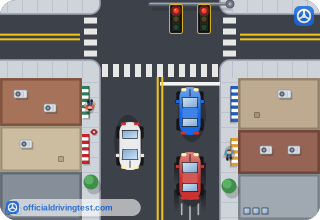
How should you brace yourself when your vehicle is about to be hit from the rear?
- Throw yourself across the seat to stay below the windows
- Turn around in your seat to watch the vehicle coming behind
- Brace between wheel and seat back, head against the headrest
- Lean forward toward the steering wheel and hold on tightly
Show answer
Correct answer: Brace between wheel and seat back, head against the headrest
Brace your body between the steering wheel and the seat back, pressing the back of your head firmly against the headrest if there is one.
Source: New Jersey Driver Manual (2026), page 109 · Open this page in the manual (Manual page 109)
-
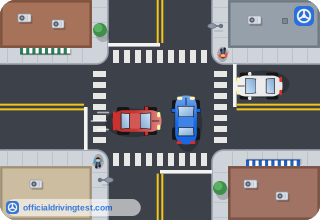
If your vehicle is about to be hit from the side, what should you do?
- Throw yourself across the seat
- Press the back of your head against the headrest
- Let go of the wheel and brace against the door
- Keep a tight grip on the steering wheel
Show answer
Correct answer: Keep a tight grip on the steering wheel
Keep a tight grip on the steering wheel; this may keep you from being thrown against the side of the vehicle.
Source: New Jersey Driver Manual (2026), page 110 · Open this page in the manual (Manual page 110)
-
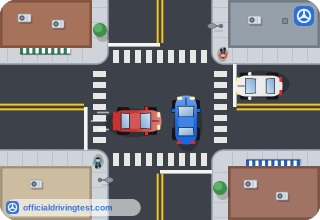
In a side crash, why should you be ready to turn fast?
- So you can get out of the vehicle more quickly
- To try to control the vehicle if it spins around
- So the air bags do not deploy during the crash
- So you can move into the oncoming lane for room
Show answer
Correct answer: To try to control the vehicle if it spins around
Be ready to turn fast so that if the vehicle spins around, you can try to control it.
Source: New Jersey Driver Manual (2026), page 110 · Open this page in the manual (Manual page 110)
-
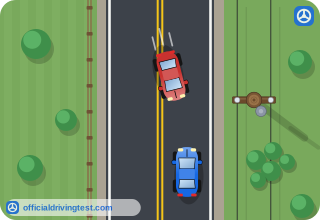
You are wearing a shoulder strap in a vehicle with air bags and are about to be hit head-on. What should you do?
- Throw yourself across the seat toward the passenger side
- Unbuckle your seat belt so you can move
- Duck down low below the level of the dashboard
- Use your arms and hands to protect your face
Show answer
Correct answer: Use your arms and hands to protect your face
If you are wearing a shoulder strap and the vehicle has air bags, use your arms and hands to protect your face.
Source: New Jersey Driver Manual (2026), page 110 · Open this page in the manual (Manual page 110)
-
If you are about to be hit head-on in a vehicle with no shoulder strap or air bags, what should you do?
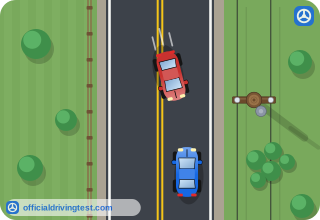
- Throw yourself across the seat
- Brace your arms straight against the steering wheel
- Sit up straight and protect your face
- Press your head back against the headrest
Show answer
Correct answer: Throw yourself across the seat
Without a shoulder strap or air bags, throw yourself across the seat to keep from hitting the steering wheel or windshield.
Source: New Jersey Driver Manual (2026), page 110 · Open this page in the manual (Manual page 110)
-
If you hit a parked vehicle, what should you do?
- Notify only your own insurance company
- Notify the police and try to find the owner
- Report it to the MVC within 30 days
- Leave a note on the windshield and drive on
Show answer
Correct answer: Notify the police and try to find the owner
If a motorist hits a parked vehicle, the police must be notified, and the driver should also try to find the owner.
Source: New Jersey Driver Manual (2026), page 110 · Open this page in the manual (Manual page 110)
-
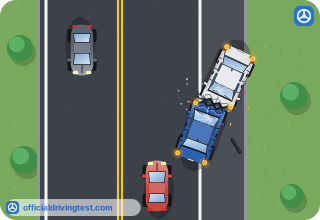
If you witness or are involved in a crash, the manual says you should:
- Move the injured into your own car
- Park in a travel lane to shield the crash scene
- Wait at the scene but try not to block traffic
- Leave once you have called the police
Show answer
Correct answer: Wait at the scene but try not to block traffic
Among the manual's tips: stop, remain calm, get help, and wait at the scene but try not to block traffic.
Source: New Jersey Driver Manual (2026), page 110 · Open this page in the manual (Manual page 110)
-
At a crash scene, the manual tells you to "assume the worst" and:
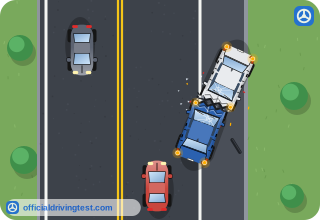
- Get help by notifying the police and calling an ambulance
- Exchange insurance information and then leave the scene
- Wait for someone else at the scene to call for help first
- Move the vehicles out of the way before the police arrive
Show answer
Correct answer: Get help by notifying the police and calling an ambulance
The manual says to assume the worst and get help: notify the police and call an ambulance.
Source: New Jersey Driver Manual (2026), page 110 · Open this page in the manual (Manual page 110)
-
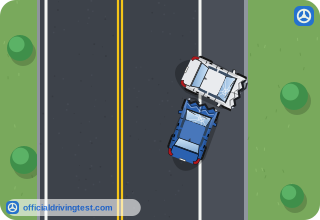
Depending on where a crash happens (a local road, a highway or a busy city intersection), what does the manual say you should do?
- Leave the scene to find a phone
- Warn oncoming traffic
- Direct traffic through the intersection yourself
- Push the damaged vehicles into the nearest lane
Show answer
Correct answer: Warn oncoming traffic
Depending on the location of the crash, you should warn oncoming traffic.
Source: New Jersey Driver Manual (2026), page 110 · Open this page in the manual (Manual page 110)
-
At a crash scene, if help is needed, whom does the manual say you can ask for assistance?
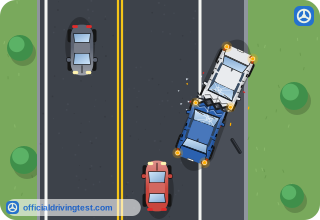
- No one; you must wait for the police
- Only the other drivers in the crash
- Passing motorists, bikers or joggers
- Only a licensed tow truck operator
Show answer
Correct answer: Passing motorists, bikers or joggers
Among the manual's tips for a crash scene: ask for assistance from passing motorists, bikers, or joggers, if needed.
Source: New Jersey Driver Manual (2026), page 110 · Open this page in the manual (Manual page 110)
-
New Jersey law requires you to notify the police of a crash when there is:
- Only an injury that needs a hospital stay
- Only a death
- Only damage over $5,000
- Injury, death, or vehicle or property damage
Show answer
Correct answer: Injury, death, or vehicle or property damage
New Jersey law (N.J.S.A. 39:4-129 to 39:4-131) requires motorists to notify the police of crashes involving injury, death, or vehicle or property damage.
Source: New Jersey Driver Manual (2026), page 111 · Open this page in the manual (Manual page 111)
-
If someone has been killed in a crash, what does the manual say to do?
- Place the person in a nearby vehicle while you wait for help
- Cover the body and then leave the scene to find the police
- Leave the body in place until police or an ambulance arrives
- Move the body off the roadway so that traffic can get through
Show answer
Correct answer: Leave the body in place until police or an ambulance arrives
Do not move the body or permit anyone to move it until the police or ambulance arrives.
Source: New Jersey Driver Manual (2026), page 111 · Open this page in the manual (Manual page 111)
-
How can a motorist involved in a crash help the police?
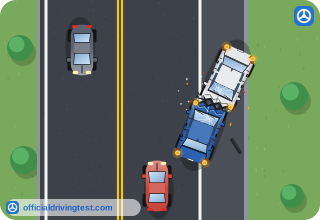
- By writing their own version of the police crash report
- By answering questions and giving as many facts as possible
- By moving the vehicles to the side before officers arrive
- By staying in the vehicle until an officer asks them out
Show answer
Correct answer: By answering questions and giving as many facts as possible
A motorist involved in a crash can help the police by answering as many questions as possible and giving as many facts about the crash as possible.
Source: New Jersey Driver Manual (2026), page 111 · Open this page in the manual (Manual page 111)
-
In New Jersey, the crash-reporting duties (written report, insurance notice) apply when there is personal injury or property damage of more than:
- $2,500
- $1,000
- $250
- $500
Show answer
Correct answer: $500
When property damage is more than $500 or there is personal injury, the motorist must file a written report (if police don't) and notify their insurer.
Source: New Jersey Driver Manual (2026), page 111 · Open this page in the manual (Manual page 111)
-
In New Jersey, after a crash with injury or property damage over $500, if no police report is filed you must send a written report to the MVC within:
- 10 days
- 5 days
- 24 hours
- 30 days
Show answer
Correct answer: 10 days
You must send a written report to the MVC within 10 days if no police report is filed.
Source: New Jersey Driver Manual (2026), page 111 · Open this page in the manual (Manual page 111)
-
In New Jersey, when is a written crash report to the MVC NOT required?
- When you notify your insurer the same day
- When a report is filed by the police
- When the other driver admits fault
- When both drivers have the same insurer
Show answer
Correct answer: When a report is filed by the police
A written report is not required if a report is filed by the police; you can get a copy of the police report.
Source: New Jersey Driver Manual (2026), page 111 · Open this page in the manual (Manual page 111)
-
If you are shaken up after a crash, what does the manual advise?
- See a doctor as soon as possible
- Go back to the scene the next day
- Drive yourself home and rest
- Wait a week to see whether symptoms appear
Show answer
Correct answer: See a doctor as soon as possible
If the motorist is shaken up, they should see a doctor as soon as possible.
Source: New Jersey Driver Manual (2026), page 111 · Open this page in the manual (Manual page 111)
-
In New Jersey, if the police file a report on your crash, how can you get a copy of it?
- Only from the other driver
- Reports are never given to motorists
- Only through your insurance company
- From the police
Show answer
Correct answer: From the police
A written report to the MVC is not required if the police file one, and a motorist can get a copy of that report from the police.
Source: New Jersey Driver Manual (2026), page 111 · Open this page in the manual (Manual page 111)
-
In New Jersey, a motorist who is stopped and does not comply with a police officer's request to light up the driver's compartment faces a fine of:
- $100
- $250
- $500
- $50
Show answer
Correct answer: $50
Motorists face a $50 fine if they fail to comply with an officer's request to illuminate the driver's compartment when stopped.
Source: New Jersey Driver Manual (2026), page 129 · Open this page in the manual (Manual page 129)