Nebraska: Speed and following distance
Nebraska speed limits, speeding fines, school and work zones, the three-second rule and adjusting speed to the weather. Split into 2 shorter tests so you're not stuck in one long quiz.
Independent educational site · not affiliated with any government agency or DMV
All 47 Speed and following distance questions with answers
Choose a part above to take a practice test, or study every question and answer here.
Show the questions and answersHide the questions
-
A vehicle that is moving slower than the normal speed of traffic must be driven where, when it is available?
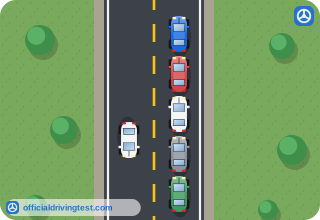
- In the right lane, or as close as practicable to the right edge
- In the left lane, close to the center line of the road
- In the center of the roadway between the two lanes of travel
- In whichever lane has the least traffic at that time
Show answer
Correct answer: In the right lane, or as close as practicable to the right edge
A vehicle going slower than the normal speed of traffic must be driven in the right lane when one is available, or as close as practicable to the right curb or edge of the roadway.
Source: Nebraska Driver's Manual (January 2025), page 48 · Open this page in the manual (Manual page 48)
-
A driver going slower than the normal speed of traffic may leave the right lane when preparing for which maneuver?
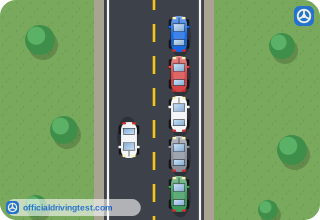
- A right turn onto an entrance ramp of a freeway
- Parking along the left edge of a two-way road in a business area
- A left turn at an intersection or into a private road or driveway
- Slowing down for a yellow signal at a busy intersection
Show answer
Correct answer: A left turn at an intersection or into a private road or driveway
Besides overtaking and passing, slower vehicles may leave the right lane when preparing for a left turn at an intersection or into a private road or driveway.
Source: Nebraska Driver's Manual (January 2025), page 48 · Open this page in the manual (Manual page 48)
-
What does Nebraska's speed law require?
- Driving at the maximum speed limit allowed for the type of road
- Driving at a speed that is reasonable and safe under existing conditions
- Driving at the speed of the fastest traffic on the roadway
- Driving at the same speed in all weather and road conditions
Show answer
Correct answer: Driving at a speed that is reasonable and safe under existing conditions
Nebraska's speed law requires driving at a speed that is reasonable and safe under existing conditions.
Source: Nebraska Driver's Manual (January 2025), page 52 · Open this page in the manual (Manual page 52)
-
Unless otherwise posted, what is the maximum speed limit in business districts?
- 15 MPH
- 30 MPH
- 35 MPH
- 20 MPH
Show answer
Correct answer: 20 MPH
The maximum speed limit in business districts, unless otherwise posted, is 20 MPH.
Source: Nebraska Driver's Manual (January 2025), page 52 · Open this page in the manual (Manual page 52)
-
Unless otherwise posted, what is the maximum speed limit in residential districts?
- 25 MPH
- 20 MPH
- 30 MPH
- 35 MPH
Show answer
Correct answer: 25 MPH
The maximum speed limit in residential districts, unless otherwise posted, is 25 MPH.
Source: Nebraska Driver's Manual (January 2025), page 52 · Open this page in the manual (Manual page 52)
-
Unless otherwise posted, what is the maximum speed limit on any roadway that is gravel or not dustless?
- 40 MPH
- 45 MPH
- 50 MPH
- 55 MPH
Show answer
Correct answer: 50 MPH
On a gravel or not dustless roadway, the maximum speed limit unless otherwise posted is 50 MPH.
Source: Nebraska Driver's Manual (January 2025), page 52 · Open this page in the manual (Manual page 52)
-
Unless otherwise posted, what is the maximum speed limit on a dustless (paved) roadway that is not part of the state highway system?
- 45 MPH
- 55 MPH
- 60 MPH
- 65 MPH
Show answer
Correct answer: 55 MPH
On a dustless or paved roadway outside the state highway system, the maximum speed limit unless otherwise posted is 55 MPH.
Source: Nebraska Driver's Manual (January 2025), page 52 · Open this page in the manual (Manual page 52)
-
Unless otherwise posted, what is the maximum speed limit on a four-lane divided highway that is not part of the state highway system?
- 55 MPH
- 60 MPH
- 70 MPH
- 65 MPH
Show answer
Correct answer: 65 MPH
A four-lane divided highway that is not part of the state highway system has a maximum speed limit of 65 MPH unless otherwise posted.
Source: Nebraska Driver's Manual (January 2025), page 52 · Open this page in the manual (Manual page 52)
-
Unless otherwise posted, what is the maximum speed limit on the state highway system, other than an expressway, super-two highway or freeway?
- 65 MPH
- 55 MPH
- 60 MPH
- 70 MPH
Show answer
Correct answer: 65 MPH
On the state highway system other than an expressway, super-two highway or freeway, the maximum speed limit unless otherwise posted is 65 MPH.
Source: Nebraska Driver's Manual (January 2025), page 52 · Open this page in the manual (Manual page 52)
-
Unless otherwise posted, what is the maximum speed limit on expressways, super-two highways and freeways that are part of the state highway system?
- 60 MPH
- 65 MPH
- 70 MPH
- 75 MPH
Show answer
Correct answer: 70 MPH
Expressways, super-two highways and freeways on the state highway system have a maximum speed limit of 70 MPH unless otherwise posted.
Source: Nebraska Driver's Manual (January 2025), page 52 · Open this page in the manual (Manual page 52)
-
Unless otherwise posted, what is the maximum speed limit on rural interstate highways?
- 65 MPH
- 75 MPH
- 70 MPH
- 80 MPH
Show answer
Correct answer: 75 MPH
The maximum speed limit on rural interstate highways, unless otherwise posted, is 75 MPH.
Source: Nebraska Driver's Manual (January 2025), page 52 · Open this page in the manual (Manual page 52)
-
Why does the manual say to generally drive at the same speed as the main stream of traffic?
- To avoid having to use your turn signals when you change lanes
- To make it easier for emergency vehicles to pass you safely
- To keep a larger following distance from the vehicles ahead
- To avoid frequent passing and be able to adjust to slower moving vehicles
Show answer
Correct answer: To avoid frequent passing and be able to adjust to slower moving vehicles
Driving at the same speed as the main stream of traffic avoids frequent passing and lets you adjust to slower moving vehicles.
Source: Nebraska Driver's Manual (January 2025), page 52 · Open this page in the manual (Manual page 52)
-
When may you drive slow enough to impede or block the normal and reasonable flow of traffic?
- When safety, an emergency, or the law requires it
- When you are unsure of your route or the road
- When the road is dry and the weather is clear
- When you want more room in front of your vehicle
Show answer
Correct answer: When safety, an emergency, or the law requires it
You must not drive slow enough to impede or block the normal and reasonable flow of traffic unless safety, an emergency, or the law requires otherwise.
Source: Nebraska Driver's Manual (January 2025), page 53 · Open this page in the manual (Manual page 53)
-
What should you do in a school zone?
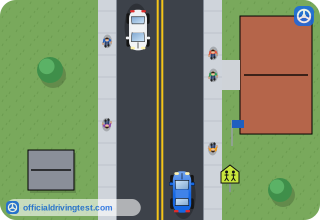
- Keep your speed and watch for children only at crosswalks
- Reduce speed, obey all signs and be prepared to stop anytime
- Drive at the posted limit and stop only for a flagger
- Reduce speed only while children are on the roadway
Show answer
Correct answer: Reduce speed, obey all signs and be prepared to stop anytime
In a school zone you reduce speed, obey all signs and are prepared to stop anytime.
Source: Nebraska Driver's Manual (January 2025), page 53 · Open this page in the manual (Manual page 53)
-
What happens to speeding fines in school zones and when workers are present in work zones?
- They are reduced by half
- They are the same as normal
- They are tripled
- They are doubled
Show answer
Correct answer: They are doubled
Fines are doubled in school zones and in work zones when workers are present.
Source: Nebraska Driver's Manual (January 2025), page 53 · Open this page in the manual (Manual page 53)
-
Under the speeding fine schedule, what is the normal fine for driving 1-5 MPH over the limit?
- $10
- $5
- $20
- $25
Show answer
Correct answer: $10
The normal fine for 1-5 MPH over the limit is $10, plus court costs.
Source: Nebraska Driver's Manual (January 2025), page 53 · Open this page in the manual (Manual page 53)
-
Under the speeding fine schedule, what is the normal fine for driving 16-20 MPH over the limit?
- $75
- $175
- $250
- $125
Show answer
Correct answer: $125
The normal fine for 16-20 MPH over the limit is $125, plus court costs.
Source: Nebraska Driver's Manual (January 2025), page 53 · Open this page in the manual (Manual page 53)
-
Under the speeding fine schedule, what is the normal fine for driving more than 35 MPH over the limit?
- $200
- $400
- $300
- $600
Show answer
Correct answer: $300
The normal fine for driving more than 35 MPH over the limit is $300, plus court costs.
Source: Nebraska Driver's Manual (January 2025), page 53 · Open this page in the manual (Manual page 53)
-
Under the speeding fine schedule, what is the fine in a school zone or work zone for driving 11-15 MPH over the limit?
- $150
- $75
- $100
- $250
Show answer
Correct answer: $150
In school zones and work zones with workers present, the fine for 11-15 MPH over the limit is $150, plus court costs.
Source: Nebraska Driver's Manual (January 2025), page 53 · Open this page in the manual (Manual page 53)
-
What is added to the speeding fines in the manual's fine schedule?
- Court costs, in all cases
- Nothing, the fine is the total
- Court costs, only for fines over $200
- Court costs, only in work and school zones
Show answer
Correct answer: Court costs, in all cases
The fine schedule states that court costs are added in all cases.
Source: Nebraska Driver's Manual (January 2025), page 53 · Open this page in the manual (Manual page 53)
-
Within how close to an intersection is it unlawful to pass?
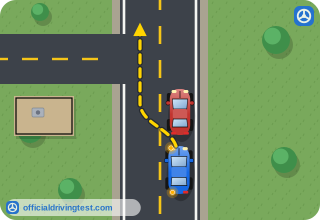
- Within 50 feet
- Within 150 feet
- Within 100 feet
- Within 300 feet
Show answer
Correct answer: Within 100 feet
It is unlawful to pass within 100 feet of any intersection.
Source: Nebraska Driver's Manual (January 2025), page 53 · Open this page in the manual (Manual page 53)
-
Within how close to a railroad crossing is it unlawful to pass?
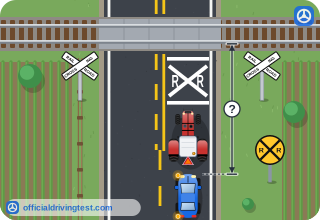
- Within 25 feet
- Within 100 feet
- Within 200 feet
- Within 300 feet
Show answer
Correct answer: Within 100 feet
It is unlawful to pass within 100 feet of any railroad crossing.
Source: Nebraska Driver's Manual (January 2025), page 53 · Open this page in the manual (Manual page 53)
-
Which of these is unlawful when passing another vehicle?
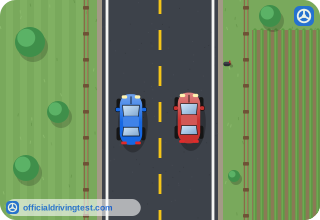
- Signaling before moving into the passing lane
- Increasing your speed to pull into the passing lane
- Checking all around your vehicle before passing
- Exceeding the posted speed limit
Show answer
Correct answer: Exceeding the posted speed limit
It is unlawful to exceed the posted speed limit when passing.
Source: Nebraska Driver's Manual (January 2025), page 53 · Open this page in the manual (Manual page 53)
-
Where is it unlawful to pass?
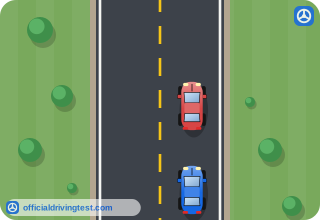
- On any hill, curve or bridge where vision is obstructed
- On any straight and level roadway in clear daylight
- On any roadway that has more than two lanes of traffic
- In any residential district at any time of day
Show answer
Correct answer: On any hill, curve or bridge where vision is obstructed
It is unlawful to pass on any hill, curve or bridge where vision is obstructed.
Source: Nebraska Driver's Manual (January 2025), page 53 · Open this page in the manual (Manual page 53)
-
In which of these places is it unlawful to pass?
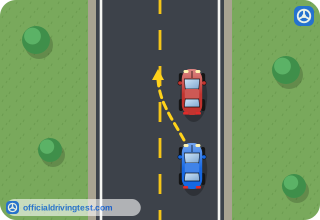
- Any two-lane road
- Any road with a posted speed limit
- Any marked no-passing zone
- Any road with a paved shoulder
Show answer
Correct answer: Any marked no-passing zone
It is unlawful to pass in any marked no-passing zone.
Source: Nebraska Driver's Manual (January 2025), page 53 · Open this page in the manual (Manual page 53)
-
What is the first step in the manual's list for how to pass?
- Sound your horn to warn the driver ahead
- Move to the left edge of your lane
- Flash your headlights at the driver ahead
- Decide if it is necessary to pass
Show answer
Correct answer: Decide if it is necessary to pass
The first step in passing is to decide if it is necessary to pass.
Source: Nebraska Driver's Manual (January 2025), page 53 · Open this page in the manual (Manual page 53)
-
How far behind the vehicle ahead should you stay before you pass?
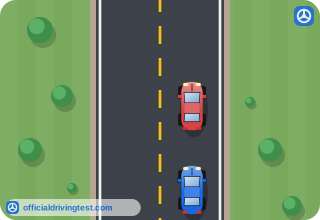
- At least three seconds
- At least one second
- At least five seconds
- At least ten seconds
Show answer
Correct answer: At least three seconds
Before passing you stay at least three seconds behind the vehicle ahead.
Source: Nebraska Driver's Manual (January 2025), page 53 · Open this page in the manual (Manual page 53)
-
What should you do before you pass another vehicle?
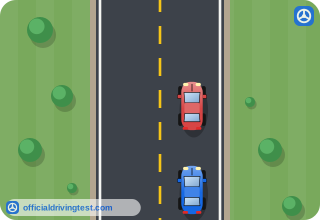
- Flash your headlights and sound your horn
- Move onto the left shoulder
- Signal and check all around your vehicle
- Brake to match the other vehicle's speed
Show answer
Correct answer: Signal and check all around your vehicle
Before passing you signal and check all around your vehicle.
Source: Nebraska Driver's Manual (January 2025), page 53 · Open this page in the manual (Manual page 53)
-
When may you signal and move back into the right lane after passing?
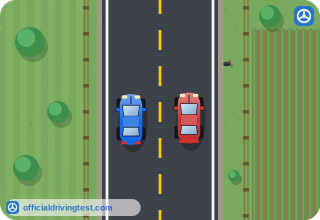
- As soon as your front bumper is beside the rear of the passed vehicle
- When the front of the passed vehicle or its headlights show in your mirror
- As soon as you have increased your speed to the posted speed limit
- After you have driven a quarter mile past the passed vehicle in the lane
Show answer
Correct answer: When the front of the passed vehicle or its headlights show in your mirror
After passing you signal and move back into the right lane once you see the front of the passed vehicle or its headlights in the rear view mirror.
Source: Nebraska Driver's Manual (January 2025), page 53 · Open this page in the manual (Manual page 53)
-
At night, how should you adjust your speed?
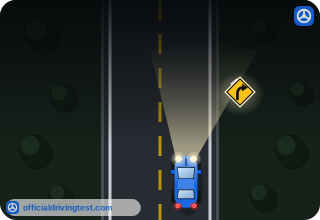
- So you can keep pace with the fastest traffic on the road
- So you stay within 10 MPH of the posted speed limit
- So you can reach the next sign before it gets dark
- So you can safely stop within the area lit by your headlights
Show answer
Correct answer: So you can safely stop within the area lit by your headlights
At night your speed should let you safely stop within the area your headlights illuminate.
Source: Nebraska Driver's Manual (January 2025), page 61 · Open this page in the manual (Manual page 61)
-
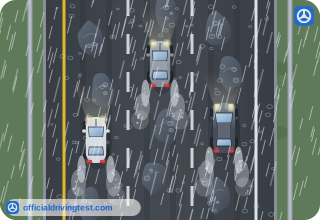
What is hydroplaning?
- The tires losing air pressure and sliding on wet roads
- A vehicle sliding sideways when the road is icy
- Tires riding on a thin film of water instead of the road
- Water entering the engine and stalling it
Show answer
Correct answer: Tires riding on a thin film of water instead of the road
Hydroplaning occurs when the tires ride on a thin film of water instead of on the road.
Source: Nebraska Driver's Manual (January 2025), page 62 · Open this page in the manual (Manual page 62)
-
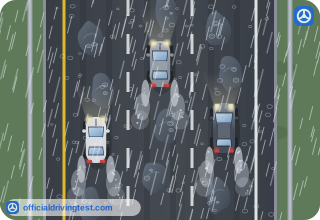
How can you prevent hydroplaning?
- Use cruise control
- Slow down
- Speed up to lift the tires out of the water
- Turn on your high beams
Show answer
Correct answer: Slow down
The manual says that to prevent hydroplaning you slow down.
Source: Nebraska Driver's Manual (January 2025), page 62 · Open this page in the manual (Manual page 62)
-
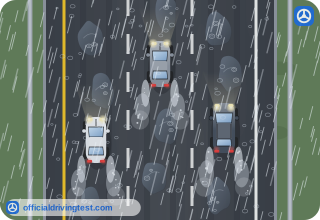
When driving in rain, what may be necessary with your cruise control?
- Set it to the posted speed limit
- Keep it on to hold a steady speed
- Use it only on the interstate
- Disengage it
Show answer
Correct answer: Disengage it
In rain it may be necessary to disengage cruise control.
Source: Nebraska Driver's Manual (January 2025), page 62 · Open this page in the manual (Manual page 62)
-
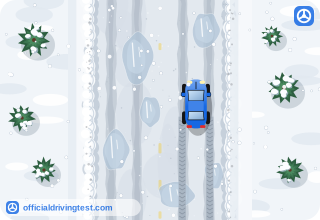
On snow and ice, how should you make speed and directional changes?
- Quickly, to keep the tires moving
- Suddenly, to avoid sliding
- One at a time, only at stop signs
- Gradually
Show answer
Correct answer: Gradually
On snow and ice, speed and directional changes should be made gradually.
Source: Nebraska Driver's Manual (January 2025), page 62 · Open this page in the manual (Manual page 62)
-
On snow and ice, what should you do about cruise control?
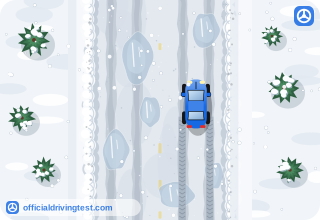
- Use it to keep your speed steady
- Do not use it
- Set it 5 MPH below the limit
- Use it only on the interstate
Show answer
Correct answer: Do not use it
The manual says not to use cruise control on snow and ice.
Source: Nebraska Driver's Manual (January 2025), page 62 · Open this page in the manual (Manual page 62)
-
On snow or ice, how much power should you apply when going uphill?
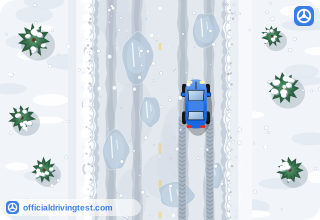
- As much as possible, to reach the top of the hill quickly
- Just enough to maintain speed but not enough to make the wheels spin
- None; let the vehicle roll up the hill
- Enough to speed up so the wheels keep grip
Show answer
Correct answer: Just enough to maintain speed but not enough to make the wheels spin
Going uphill on snow and ice, you apply just enough power to maintain speed without making the wheels spin.
Source: Nebraska Driver's Manual (January 2025), page 63 · Open this page in the manual (Manual page 63)
-
What does the manual say defensive driving means?
- Driving slowly enough to avoid all traffic
- Driving only in the right lane
- Driving with the horn ready at all times
- Driving alertly to prevent crashes
Show answer
Correct answer: Driving alertly to prevent crashes
Simply put, defensive driving means driving alertly to prevent crashes.
Source: Nebraska Driver's Manual (January 2025), page 66 · Open this page in the manual (Manual page 66)
-
How far ahead should you take in the situation on the road?
- About 3-5 seconds ahead
- At least 10-15 seconds ahead
- About 1-2 seconds ahead
- At least 30-40 seconds ahead
Show answer
Correct answer: At least 10-15 seconds ahead
Defensive drivers take in the situation on the road at least 10-15 seconds ahead.
Source: Nebraska Driver's Manual (January 2025), page 66 · Open this page in the manual (Manual page 66)
-
At places where other cars, people or animals may cross your path, what should you do?
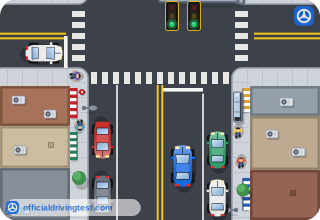
- Look to both sides and be sure the way is clear
- Rely on the green light and keep going at speed
- Sound the horn and keep going at the same speed
- Flash your headlights and keep going at speed
Show answer
Correct answer: Look to both sides and be sure the way is clear
At places where others may cross your path, you look to both sides and make sure the way is clear.
Source: Nebraska Driver's Manual (January 2025), page 66 · Open this page in the manual (Manual page 66)
-
How often should you check the traffic behind you, at a minimum?
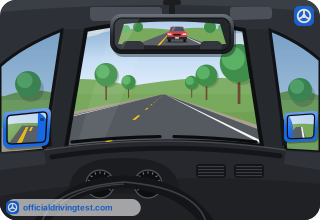
- At least every 20 seconds
- At least every 10 seconds
- At least every 30 seconds
- At least every minute
Show answer
Correct answer: At least every 10 seconds
The manual says to check the traffic behind at least every 10 seconds, and also when changing lanes, backing up, slowing or driving down steep hills.
Source: Nebraska Driver's Manual (January 2025), page 66 · Open this page in the manual (Manual page 66)
-
Why should you keep a cushion of space from other vehicles?
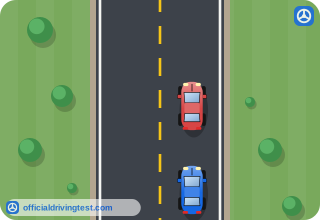
- To have time to react to emergencies and avoid collisions
- To make room for other drivers to merge in front of you
- To stay in the left lane longer
- To make it easier to pass slower vehicles
Show answer
Correct answer: To have time to react to emergencies and avoid collisions
A cushion of space gives you time to react to emergencies and avoid collisions.
Source: Nebraska Driver's Manual (January 2025), page 66 · Open this page in the manual (Manual page 66)
-
Where should you stay within your lane to keep a cushion of space?
- Toward the right edge of the lane
- Toward the left edge of the lane
- In the middle of the lane
- On the lane line
Show answer
Correct answer: In the middle of the lane
You stay in the middle of the lane, with enough room ahead and behind to pass or stop safely.
Source: Nebraska Driver's Manual (January 2025), page 66 · Open this page in the manual (Manual page 66)
-
In the three-second rule, what do you count?
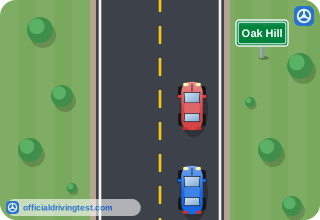
- The seconds the vehicle ahead takes to brake
- The seconds it takes you to reach the spot the vehicle ahead passed
- The number of vehicles that pass you
- The seconds between your turn signal and your lane change
Show answer
Correct answer: The seconds it takes you to reach the spot the vehicle ahead passed
You count the seconds it takes you to reach the same spot in the roadway that the vehicle ahead passed.
Source: Nebraska Driver's Manual (January 2025), page 66 · Open this page in the manual (Manual page 66)
-
What should you do if you reach the fixed mark before three seconds pass?
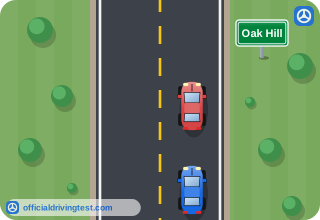
- Keep the same speed and watch the vehicle ahead
- Move to the left lane and pass
- Sound your horn to warn the vehicle ahead
- Slow down and increase your following distance
Show answer
Correct answer: Slow down and increase your following distance
Reaching the mark before three seconds pass means you are following too closely, so you slow down and increase your following distance.
Source: Nebraska Driver's Manual (January 2025), page 66 · Open this page in the manual (Manual page 66)
-
By how much should the three-second rule be increased for each adversity factor, such as rain or heavy traffic?
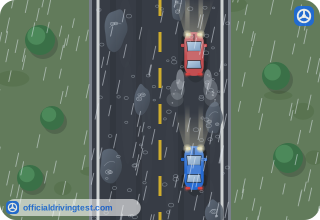
- Two seconds
- Half a second
- One second
- Three seconds
Show answer
Correct answer: One second
The three-second rule is a minimum and is increased by one second for each adversity factor encountered.
Source: Nebraska Driver's Manual (January 2025), page 67 · Open this page in the manual (Manual page 67)
-
Besides space ahead and behind, what space does the manual say to keep on two-way streets?
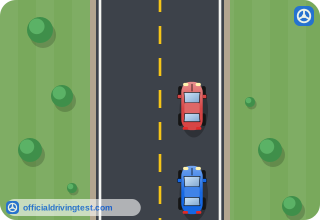
- Oncoming traffic and parked cars
- Parked cars and the curb
- Your vehicle and the center line
- The vehicle ahead and the vehicle behind it
Show answer
Correct answer: Oncoming traffic and parked cars
On two-way streets, it is equally important to leave room between oncoming traffic and parked cars.
Source: Nebraska Driver's Manual (January 2025), page 67 · Open this page in the manual (Manual page 67)
-
How do you keep space behind your vehicle?
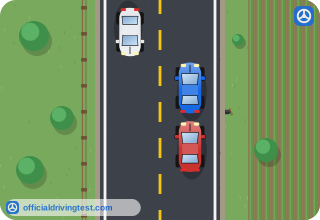
- Drive close to the vehicle ahead so others cannot cut in
- Tap the horn when a driver follows closely
- Speed up whenever a vehicle gets close behind
- Keep a steady speed and signal in advance when slowing or stopping
Show answer
Correct answer: Keep a steady speed and signal in advance when slowing or stopping
You keep space behind by keeping a steady speed and signaling in advance whenever slowing or stopping.
Source: Nebraska Driver's Manual (January 2025), page 67 · Open this page in the manual (Manual page 67)