Nebraska: Right-of-way, turning and passing — Part 2 Practice Test
Questions in this part include: “Where does the manual say you must not change lanes?” · “If a center lane is not marked, how should a left turn be made?”
Independent educational site · not affiliated with any government agency or DMV
Ready? Test yourself
- Instant feedback with an explanation
- Every answer cites its source in the manual
- Your best score is saved on this device
- Keyboard: press 1 to 4 to answer and Enter for the next question
Questions are original and based on the official manual "Nebraska Driver's Manual" (January 2025), Nebraska Department of Motor Vehicles.
All 21 questions in this practice test
Take the test above first, then use this list to study. Tap “Show answer” to see the correct answer and explanation.
Show the questions and answersHide the questions
-
When entering a roundabout, whom must you yield to?
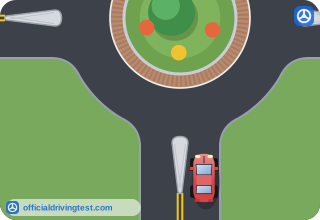
- Traffic entering the roundabout from your right side
- Vehicles waiting behind you at the entrance
- No one, if you arrived at the entrance first
- Traffic approaching on your left already in the roundabout
Show answer
Correct answer: Traffic approaching on your left already in the roundabout
You yield to traffic approaching on your left that is already in the roundabout.
Source: Nebraska Driver's Manual (January 2025), page 49 · Open this page in the manual (Manual page 49)
-
When may you enter the circle of a roundabout?
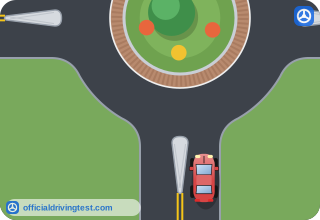
- When there is a safe gap in traffic
- As soon as you reach the entrance
- Only when the roundabout is completely empty
- As soon as you have slowed to the advisory speed
Show answer
Correct answer: When there is a safe gap in traffic
You enter the roundabout circle when there is a safe gap in traffic.
Source: Nebraska Driver's Manual (January 2025), page 49 · Open this page in the manual (Manual page 49)
-
As you approach your exit in a roundabout, which signal should you turn on?
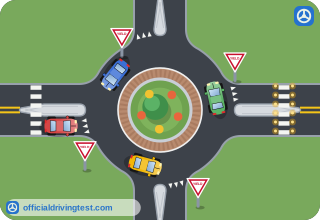
- The left-turn signal
- The hazard flashers
- The right-turn signal
- None, because the exit is on the right
Show answer
Correct answer: The right-turn signal
As you approach your exit from a roundabout, you turn on your right-turn signal.
Source: Nebraska Driver's Manual (January 2025), page 49 · Open this page in the manual (Manual page 49)
-
In a dual-lane roundabout, which lane should you choose to make a left turn?
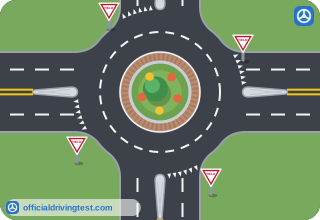
- The shared through/right-turn lane
- The shared through/left-turn lane
- Whichever lane is closer to the truck apron
- Any lane, as long as you signal
Show answer
Correct answer: The shared through/left-turn lane
In a dual-lane roundabout you choose the shared through/left-turn lane to turn left.
Source: Nebraska Driver's Manual (January 2025), page 49 · Open this page in the manual (Manual page 49)
-
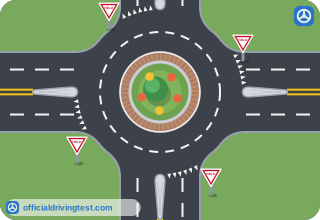
In a dual-lane roundabout, which lane should you choose to make a right turn?
- The shared through/left-turn lane
- The lane next to the center island
- A separate lane on the truck apron
- The shared through/right-turn lane
Show answer
Correct answer: The shared through/right-turn lane
In a dual-lane roundabout you choose the shared through/right-turn lane to turn right.
Source: Nebraska Driver's Manual (January 2025), page 49 · Open this page in the manual (Manual page 49)
-
Before entering a dual-lane roundabout, which traffic must you yield to?
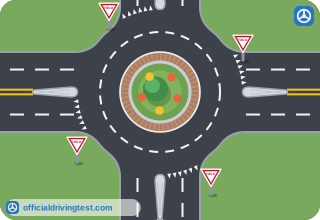
- All traffic on your left already in the roundabout
- Only traffic in the lane you intend to use
- Only traffic in the outside lane
- Only traffic in the inside lane
Show answer
Correct answer: All traffic on your left already in the roundabout
In a dual-lane roundabout you yield to all traffic on your left that is already in the roundabout before entering.
Source: Nebraska Driver's Manual (January 2025), page 49 · Open this page in the manual (Manual page 49)
-
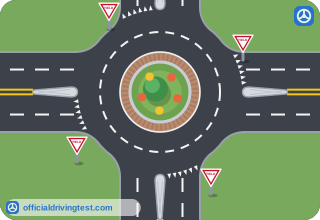
When must you determine the proper lane to use in a dual-lane roundabout?
- After entering the circular roadway
- When you reach the splitter island
- Before entering the circular roadway
- Once you pass the first exit
Show answer
Correct answer: Before entering the circular roadway
You observe the signs and arrows to determine the proper lane before entering the circular roadway.
Source: Nebraska Driver's Manual (January 2025), page 49 · Open this page in the manual (Manual page 49)
-
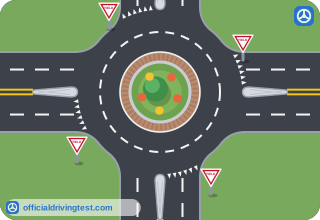
Once you are in a dual-lane roundabout, what should you do about your lane?
- Change lanes freely to pass slower vehicles
- Stay in your designated lane
- Move to the inside lane at each exit
- Use the truck apron if the lane is crowded
Show answer
Correct answer: Stay in your designated lane
In a dual-lane roundabout you stay in your designated lane.
Source: Nebraska Driver's Manual (January 2025), page 49 · Open this page in the manual (Manual page 49)
-
Why should you avoid driving next to or passing large trucks in a roundabout?
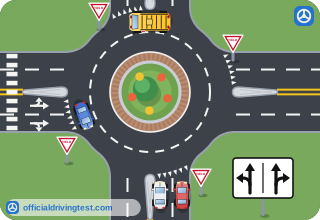
- Large trucks always have the right-of-way over all other road users
- Large trucks are not allowed to use the circular roadway
- Large trucks travel in the opposite direction around the circle
- The trucks might cross into other lanes or onto the truck apron when turning
Show answer
Correct answer: The trucks might cross into other lanes or onto the truck apron when turning
Trucks maneuvering through a roundabout might cross into other lanes or onto the truck apron, so you avoid driving next to or passing them.
Source: Nebraska Driver's Manual (January 2025), page 49 · Open this page in the manual (Manual page 49)
-
What must you do when leaving an alley, driveway or parking lot to enter a roadway?
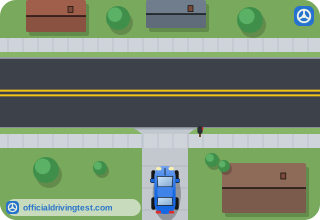
- Honk twice and enter the roadway
- Proceed slowly without stopping if no pedestrian or vehicle is in sight
- Stop before driving onto the sidewalk or sidewalk area and proceed slowly
- Stop only if a vehicle is approaching
Show answer
Correct answer: Stop before driving onto the sidewalk or sidewalk area and proceed slowly
When leaving alleys, driveways or parking lots to enter a roadway you stop before the sidewalk area and then proceed slowly.
Source: Nebraska Driver's Manual (January 2025), page 51 · Open this page in the manual (Manual page 51)
-
When leaving an alley, driveway or parking lot to enter a roadway, whom must you yield the right-of-way to?
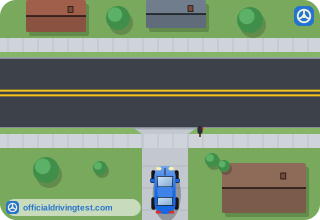
- Only pedestrians
- Any pedestrian and approaching vehicles
- Only approaching vehicles
- Only vehicles coming from the left
Show answer
Correct answer: Any pedestrian and approaching vehicles
You yield the right-of-way to any pedestrian and to approaching vehicles.
Source: Nebraska Driver's Manual (January 2025), page 51 · Open this page in the manual (Manual page 51)
-
What must you do when a police officer is directing traffic?
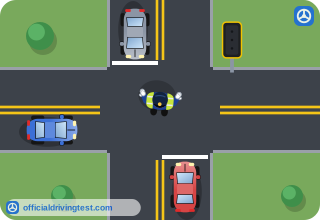
- Follow the traffic signals instead
- Obey the officer only if the signals are not working
- Always obey the officer
- Obey the officer only on a two-lane road
Show answer
Correct answer: Always obey the officer
The manual says to always obey a police officer who is directing traffic.
Source: Nebraska Driver's Manual (January 2025), page 52 · Open this page in the manual (Manual page 52)
-
Besides using your mirrors, what should you do before changing lanes to check your blind spots?
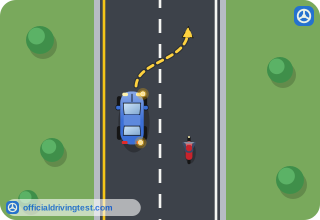
- Flash your headlights at the traffic behind you
- Sound your horn to warn nearby drivers
- Check over your left or right shoulder
- Brake lightly to see who is behind you
Show answer
Correct answer: Check over your left or right shoulder
The lane-change steps include checking over your left or right shoulder to check blind spots.
Source: Nebraska Driver's Manual (January 2025), page 55 · Open this page in the manual (Manual page 55)
-
Before changing lanes, what else should you check for?
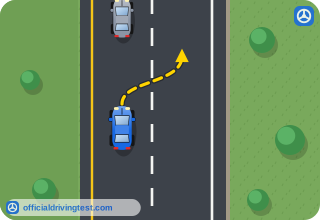
- Whether the vehicle behind you has its headlights on
- Other drivers who may also be moving into the same lane
- Whether the vehicle ahead has its brake lights on
- Whether the next intersection has a crosswalk
Show answer
Correct answer: Other drivers who may also be moving into the same lane
The manual tells drivers to check for other drivers who may also be moving into the same lane.
Source: Nebraska Driver's Manual (January 2025), page 55 · Open this page in the manual (Manual page 55)
-
Where does the manual say you must not change lanes?
- On a one-way street
- On a road with two lanes
- Next to a curb
- In an intersection
Show answer
Correct answer: In an intersection
Do not change lanes in an intersection.
Source: Nebraska Driver's Manual (January 2025), page 55 · Open this page in the manual (Manual page 55)
-
According to the manual, how should a right turn be made?
- As close as practical to the right side of the road or street
- From the center of the road, to leave room for other cars
- From the lane farthest from the curb, then into any lane
- As far from the curb as practical, so you can swing wide
Show answer
Correct answer: As close as practical to the right side of the road or street
A right turn shall be made as close as practical to the right side of the road or street.
Source: Nebraska Driver's Manual (January 2025), page 55 · Open this page in the manual (Manual page 55)
-
If a center lane is not marked, how should a left turn be made?
- From the right lane lawfully available into the right lane lawfully available
- From the left lane lawfully available into the right lane lawfully available
- From the left lane lawfully available into the left lane lawfully available
- From the center of the road, then into whichever lane is open first
Show answer
Correct answer: From the left lane lawfully available into the left lane lawfully available
With no marked center lane, the left turn is made from the left lane lawfully available into the left lane that is lawfully available.
Source: Nebraska Driver's Manual (January 2025), page 55 · Open this page in the manual (Manual page 55)
-
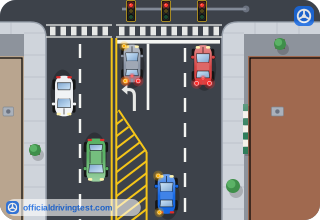
When should you be in the proper lane for an intended turn?
- Only after you reach the intersection
- Well in advance of the turn
- As you begin the turn
- Right after you start to slow
Show answer
Correct answer: Well in advance of the turn
The turning steps say to be in the proper lane well in advance of the intended turn.
Source: Nebraska Driver's Manual (January 2025), page 55 · Open this page in the manual (Manual page 55)
-
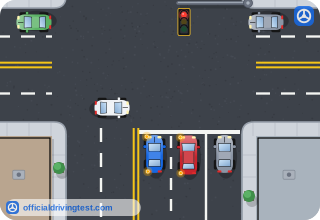
What indicates double turning lanes?
- Warning signs and flashing lights
- Guide signs and curb colors
- Overhead signals alone
- Regulatory signs and lane markings
Show answer
Correct answer: Regulatory signs and lane markings
Double turning lanes are indicated by regulatory signs and lane markings.
Source: Nebraska Driver's Manual (January 2025), page 56 · Open this page in the manual (Manual page 56)
-
In double turning lanes, where should traffic in the lane nearest the curb turn?
- Into the traffic lane nearest the curb
- Into the lane farthest from the curb
- Into whichever lane is open
- Into the lane marked by a center line
Show answer
Correct answer: Into the traffic lane nearest the curb
Traffic in the lane nearest the curb should turn into the traffic lane nearest the curb.
Source: Nebraska Driver's Manual (January 2025), page 56 · Open this page in the manual (Manual page 56)
-
In double turning lanes, what should traffic in the second lane from the curb do?
- Cross the lane line and then turn into the lane nearest the curb
- Stop in the intersection and wait for the curb lane to finish turning
- Follow the lane line into the nearest lane as indicated by the lane line
- Turn wide into the lane farthest from the curb on the new road
Show answer
Correct answer: Follow the lane line into the nearest lane as indicated by the lane line
The second lane from the curb should follow the lane line into the nearest lane as indicated by the lane line.
Source: Nebraska Driver's Manual (January 2025), page 56 · Open this page in the manual (Manual page 56)