Nebraska: Right-of-way, turning and passing — Part 1 Practice Test
Questions in this part include: “When is a left turn at a circular red light allowed after stopping?” · “Why should you drive defensively even when you have the right-of-way?”
Independent educational site · not affiliated with any government agency or DMV
Ready? Test yourself
- Instant feedback with an explanation
- Every answer cites its source in the manual
- Your best score is saved on this device
- Keyboard: press 1 to 4 to answer and Enter for the next question
Questions are original and based on the official manual "Nebraska Driver's Manual" (January 2025), Nebraska Department of Motor Vehicles.
All 21 questions in this practice test
Take the test above first, then use this list to study. Tap “Show answer” to see the correct answer and explanation.
Show the questions and answersHide the questions
-
What must a driver do before turning at a red light where a turn on red is allowed?
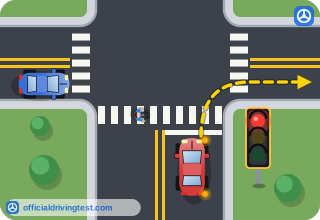
- Slow down and turn if no other vehicle is in sight at the intersection
- Stop only if pedestrians are waiting in the crosswalk ahead of you
- Stop completely, look both ways and yield to pedestrians and other traffic
- Honk the horn and then turn when the way looks clear to you
Show answer
Correct answer: Stop completely, look both ways and yield to pedestrians and other traffic
Before a turn on red, the driver must stop completely, look both ways and yield to pedestrians and other traffic.
Source: Nebraska Driver's Manual (January 2025), page 32 · Open this page in the manual (Manual page 32)
-
When is a right turn at a circular red light allowed after stopping?
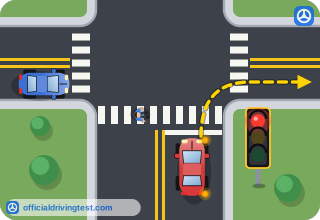
- Only on a one-way street
- Unless signs prohibiting it are posted at the intersection
- Only when no pedestrians are nearby
- Only at intersections that have a painted stop line
Show answer
Correct answer: Unless signs prohibiting it are posted at the intersection
Turning right at a circular red light after stopping is allowed unless signs prohibiting it are posted.
Source: Nebraska Driver's Manual (January 2025), page 32 · Open this page in the manual (Manual page 32)
-
When is a left turn at a circular red light allowed after stopping?
- Whenever no traffic is coming from the other direction
- Only from the left lane of any two-way street intersection
- Only when a sign posted at the intersection allows it
- Only on a one-way street, turning onto another one-way street
Show answer
Correct answer: Only on a one-way street, turning onto another one-way street
A left turn on a circular red light is allowed only from a one-way street onto another one-way street, and may be prohibited at some locations.
Source: Nebraska Driver's Manual (January 2025), page 32 · Open this page in the manual (Manual page 32)
-
A yellow diamond sign shows three arrows forming a circle. When you reach the roundabout ahead, whom must you yield to?
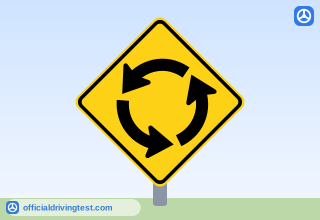
- All vehicles approaching on your left already in the roundabout
- Only the vehicles that are about to leave the roundabout
- Only vehicles entering from your right
- No one, because vehicles inside the circle yield
Show answer
Correct answer: All vehicles approaching on your left already in the roundabout
The Roundabout sign tells you to slow down and yield to all vehicles approaching on your left already in the roundabout.
Source: Nebraska Driver's Manual (January 2025), page 41 · Open this page in the manual (Manual page 41)
-
At an uncontrolled intersection where vehicles approach at about the same time and no signs or signals are used, you should watch for vehicles coming from which direction and yield to them?
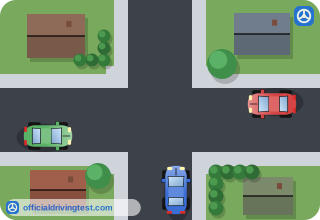
- From the left
- From the right
- From straight ahead
- From behind
Show answer
Correct answer: From the right
Where no signs or signals are used, you watch for vehicles coming from the right and yield the right-of-way to them.
Source: Nebraska Driver's Manual (January 2025), page 48 · Open this page in the manual (Manual page 48)
-
At an uncontrolled intersection, car A is turning left, car B approaches from A's right, and car C approaches from the opposite direction. Who must yield?
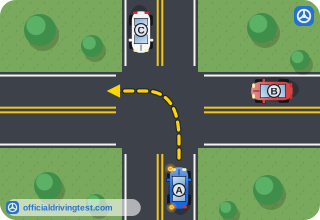
- Car A yields only to car B
- Car A yields only to car C
- Car A has the right-of-way over both cars
- Car A yields to both car B and car C
Show answer
Correct answer: Car A yields to both car B and car C
A car turning left at an uncontrolled intersection yields to both the car on its right and the car coming from the opposite direction.
Source: Nebraska Driver's Manual (January 2025), page 48 · Open this page in the manual (Manual page 48)
-
Why should you drive defensively even when you have the right-of-way?
- Other drivers may not stop for you
- Other drivers will always yield to you
- You are required to stop for every other vehicle
- The right-of-way ends once you enter the intersection
Show answer
Correct answer: Other drivers may not stop for you
The manual says other drivers may not stop even if you have the right-of-way, so you drive defensively.
Source: Nebraska Driver's Manual (January 2025), page 48 · Open this page in the manual (Manual page 48)
-
At an intersection with a Yield sign, whom must you yield the right-of-way to?
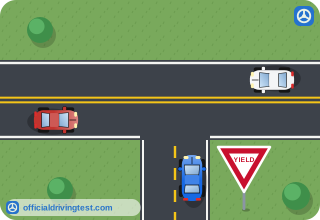
- Only vehicles coming from your left side
- Only large trucks and buses at the junction
- Any cross traffic close enough to cause conflict
- No one, if you are going straight ahead
Show answer
Correct answer: Any cross traffic close enough to cause conflict
At a Yield sign you check for cross traffic and yield to any cross traffic close enough to cause conflict.
Source: Nebraska Driver's Manual (January 2025), page 48 · Open this page in the manual (Manual page 48)
-
At an intersection with a Yield sign, what should you do to enter the flow of traffic?
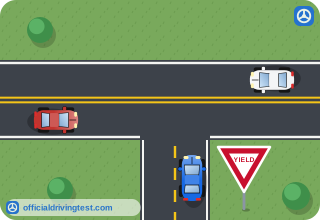
- Wait for a green signal before entering
- Check for a gap in traffic, merge, and adjust your speed
- Sound your horn and enter ahead of other vehicles
- Drive onto the shoulder until the road is clear
Show answer
Correct answer: Check for a gap in traffic, merge, and adjust your speed
At a Yield sign you check for a gap in traffic, merge, and adjust your speed.
Source: Nebraska Driver's Manual (January 2025), page 48 · Open this page in the manual (Manual page 48)
-
At an intersection with two-way stops, what must you do before entering it from a stop sign?
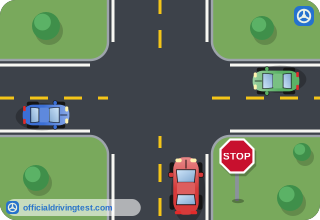
- Slow down and enter if no traffic is visible
- Stop only if other vehicles are present
- Stop only if a pedestrian is crossing
- Come to a full stop
Show answer
Correct answer: Come to a full stop
At an intersection with two-way stops, you come to a full stop before entering the intersection from the stop signs.
Source: Nebraska Driver's Manual (January 2025), page 48 · Open this page in the manual (Manual page 48)
-
At an intersection with two-way stops, what should you look for before you go?
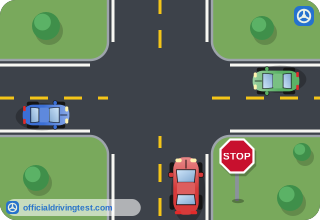
- Approaching pedestrians and vehicles in all directions
- Only vehicles approaching from your left side
- Only vehicles that are turning at the junction
- Only pedestrians in the crosswalk ahead of you
Show answer
Correct answer: Approaching pedestrians and vehicles in all directions
At two-way stops you look in all directions for approaching pedestrians and vehicles.
Source: Nebraska Driver's Manual (January 2025), page 49 · Open this page in the manual (Manual page 49)
-
At an intersection with two-way stops, when may you proceed into the intersection?
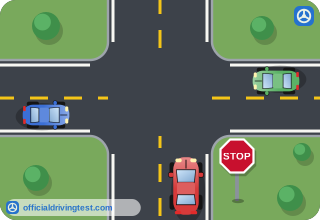
- As soon as you have stopped for a moment
- As soon as one other vehicle has gone through the intersection
- After all conflicting pedestrians and vehicles have cleared
- Once you have sounded your horn to warn others
Show answer
Correct answer: After all conflicting pedestrians and vehicles have cleared
You wait until all conflicting pedestrians and vehicles have cleared before proceeding into the intersection.
Source: Nebraska Driver's Manual (January 2025), page 49 · Open this page in the manual (Manual page 49)
-
At a four-way stop, whom should you yield to if you are in doubt?
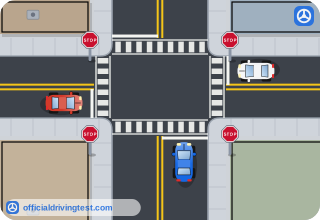
- The driver on your left
- The driver on your right
- The driver in the largest vehicle
- The driver who is going straight
Show answer
Correct answer: The driver on your right
At a four-way stop, if in doubt, you yield to the driver on your right.
Source: Nebraska Driver's Manual (January 2025), page 49 · Open this page in the manual (Manual page 49)
-
At a four-way stop, who should be permitted to go first as a matter of common courtesy?
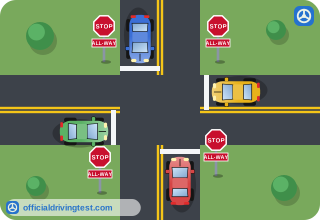
- The driver on the left
- The driver who is going straight
- The driver in the largest vehicle
- The driver who stops first
Show answer
Correct answer: The driver who stops first
The manual says common courtesy is that the driver who stops first should be permitted to go first.
Source: Nebraska Driver's Manual (January 2025), page 49 · Open this page in the manual (Manual page 49)
-
What duties do all drivers have at an intersection with four-way stops?
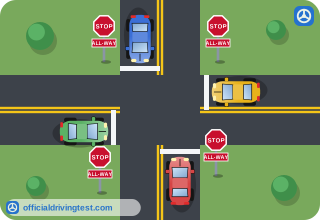
- A duty to stop, followed by a duty to use ordinary care as they proceed
- A duty to stop only if another vehicle is at the intersection
- A duty to slow down, then proceed if the intersection looks clear
- A duty to stop only after the driver on the right has stopped
Show answer
Correct answer: A duty to stop, followed by a duty to use ordinary care as they proceed
All drivers must stop and then use ordinary care as they go through a four-way stop intersection.
Source: Nebraska Driver's Manual (January 2025), page 49 · Open this page in the manual (Manual page 49)
-
At a four-way stop, what does the manual say you should NEVER do?
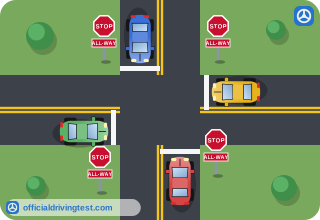
- Yield to the driver on your right
- Let the driver who stopped first go first
- Insist on the right-of-way and risk a collision
- Stop before entering the intersection
Show answer
Correct answer: Insist on the right-of-way and risk a collision
The manual says never to insist on the right-of-way and risk a collision.
Source: Nebraska Driver's Manual (January 2025), page 49 · Open this page in the manual (Manual page 49)
-
In which direction does traffic flow in a roundabout?
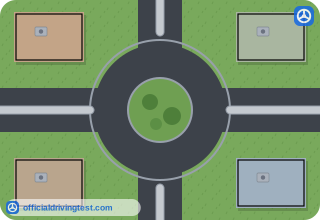
- Clockwise around the center island
- Counter-clockwise around the center island
- Either direction, depending on the lane
- Straight through the center island
Show answer
Correct answer: Counter-clockwise around the center island
Traffic in a roundabout flows one-way in a counter-clockwise direction around the center island.
Source: Nebraska Driver's Manual (January 2025), page 49 · Open this page in the manual (Manual page 49)
-
What is a truck apron at a roundabout?
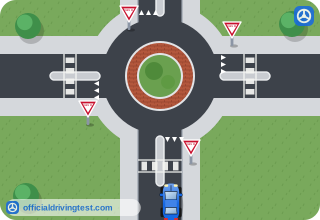
- A painted lane next to the circle reserved for bicyclists and pedestrians
- A paved path where pedestrians cross the roadway to the center island
- A raised island that separates entering and exiting traffic at each approach
- A raised paved area next to the circle for the rear wheels of large trucks
Show answer
Correct answer: A raised paved area next to the circle for the rear wheels of large trucks
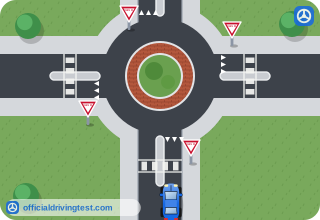
Truck aprons are raised paved areas next to the circular roadway that the rear wheels of large trucks use when turning.
Source: Nebraska Driver's Manual (January 2025), page 49 · Open this page in the manual (Manual page 49)
-
Which of these may use the truck apron of a roundabout?
- A large truck turning in the roundabout
- A car avoiding traffic
- A bicyclist riding around the circle
- A pedestrian crossing the roundabout
Show answer
Correct answer: A large truck turning in the roundabout
Truck aprons are for the rear wheels of large trucks; cars, SUVs, pickup trucks, bicyclists and pedestrians must not use them.
Source: Nebraska Driver's Manual (January 2025), page 49 · Open this page in the manual (Manual page 49)
-
As you approach a roundabout, what should you do with your speed?
- Stop completely before the circle every time
- Speed up to merge with traffic in the circle
- Slow down to the posted advisory speed
- Keep the speed you had on the approach road
Show answer
Correct answer: Slow down to the posted advisory speed
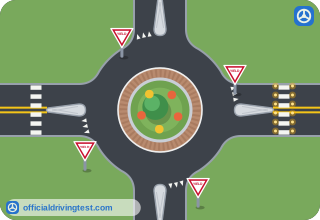
When driving a roundabout you slow down to the posted advisory speed.
Source: Nebraska Driver's Manual (January 2025), page 49 · Open this page in the manual (Manual page 49)
-
When driving a roundabout, when must you yield to pedestrians and bicyclists in the crosswalk?
- Only as you approach the roundabout from the street
- Both as you approach the roundabout and as you exit
- Only as you exit the roundabout onto the street
- Only when they are already in your lane of travel
Show answer
Correct answer: Both as you approach the roundabout and as you exit
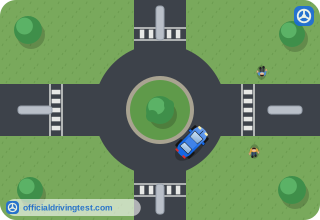
You yield to pedestrians and bicyclists in the crosswalk as you approach the roundabout and again as you exit.
Source: Nebraska Driver's Manual (January 2025), page 49 · Open this page in the manual (Manual page 49)