Nebraska: Pedestrians Practice Test
Yielding to pedestrians, crosswalks, blind pedestrians with a white cane or guide dog, and Walk and Don’t Walk signals.
Independent educational site · not affiliated with any government agency or DMV
Ready? Test yourself
- Instant feedback with an explanation
- Every answer cites its source in the manual
- Your best score is saved on this device
- Keyboard: press 1 to 4 to answer and Enter for the next question
Questions are original and based on the official manual "Nebraska Driver's Manual" (January 2025), Nebraska Department of Motor Vehicles.
All 13 questions in this practice test
Take the test above first, then use this list to study. Tap “Show answer” to see the correct answer and explanation.
Show the questions and answersHide the questions
-
You see a yellow diamond sign showing a walking person. What should you do?
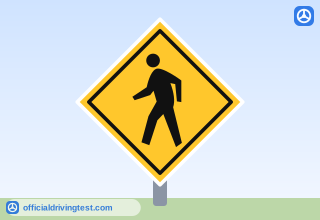
- Slow down, yield right of way to pedestrians, or stop if necessary
- Sound your horn to warn pedestrians that you are coming
- Keep your speed and expect pedestrians to wait
- Stop for at least ten seconds at every crossing
Show answer
Correct answer: Slow down, yield right of way to pedestrians, or stop if necessary
The Pedestrian Crossing sign tells you to be alert for people crossing, slow down, yield right of way to pedestrians, or stop if necessary.
Source: Nebraska Driver's Manual (January 2025), page 40 · Open this page in the manual (Manual page 40)
-
Who has the right of way when pedestrians are in a crosswalk marked with painted lines?
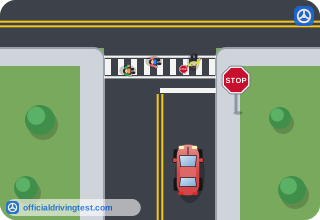
- The pedestrians
- The driver closest to the crosswalk
- The driver who arrived first
- The driver on the main road
Show answer
Correct answer: The pedestrians
Pedestrians have the right of way when pedestrians are in painted crosswalks.
Source: Nebraska Driver's Manual (January 2025), page 46 · Open this page in the manual (Manual page 46)
-
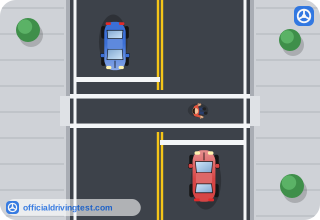
In which areas are crosswalks sometimes located in the middle of the block?
- Freeway entrances and exits
- Railroad crossings
- Residential areas and school areas
- Rural interstate highway shoulders
Show answer
Correct answer: Residential areas and school areas
Crosswalks are sometimes in the middle of the block in residential areas and school areas.
Source: Nebraska Driver's Manual (January 2025), page 46 · Open this page in the manual (Manual page 46)
-
What does the manual say about the paint on crosswalk areas?
- All crosswalks are painted with white lines.
- Crosswalk areas may also be unpainted.
- Crosswalks exist only at signaled intersections.
- Crosswalks are only found at street corners.
Show answer
Correct answer: Crosswalk areas may also be unpainted.
The manual says crosswalk areas may also be unpainted.
Source: Nebraska Driver's Manual (January 2025), page 46 · Open this page in the manual (Manual page 46)
-
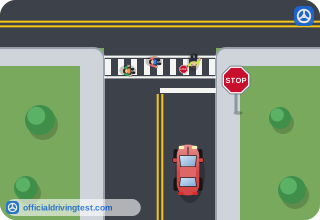
What must you do for pedestrians within crosswalks?
- Yield only to those who have a walk signal
- Yield to all of them, slow down, and be ready to stop if needed
- Sound your horn and keep moving slowly
- Yield only to those crossing in front of your vehicle
Show answer
Correct answer: Yield to all of them, slow down, and be ready to stop if needed
You yield to all pedestrians within crosswalks and slow down, ready to stop if needed.
Source: Nebraska Driver's Manual (January 2025), page 52 · Open this page in the manual (Manual page 52)
-
What is the safe distance the manual says motorists should leave to avoid colliding with any pedestrian upon any roadway?
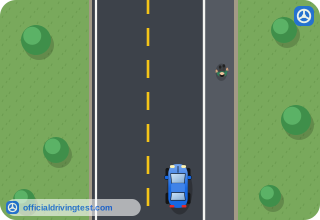
- No less than one foot of clearance
- No less than five feet of clearance
- No less than ten feet of clearance
- No less than three feet of clearance
Show answer
Correct answer: No less than three feet of clearance
Motorists should leave no less than three feet of clearance to avoid colliding with any pedestrian upon any roadway.
Source: Nebraska Driver's Manual (January 2025), page 52 · Open this page in the manual (Manual page 52)
-
What should you do when approaching someone using a white cane or guide dog?
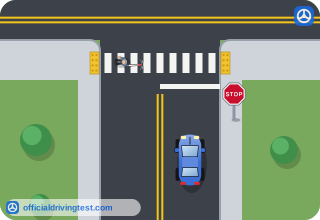
- Stop until the person is well away from the roadway or path of travel
- Slow down and sound your horn to let the person know you are there
- Slow down and drive around the person on the left side of the road
- Stop only if the person steps off the curb into your lane of travel
Show answer
Correct answer: Stop until the person is well away from the roadway or path of travel
When approaching a person with a white cane or guide dog, you stop until the person is well away from the roadway or path of travel.
Source: Nebraska Driver's Manual (January 2025), page 52 · Open this page in the manual (Manual page 52)
-
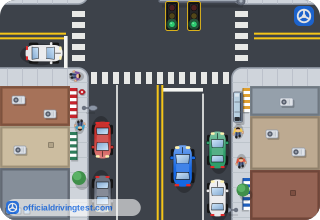
How should a driver regard pedestrians on the road?
- Expect them only at marked crosswalks and traffic signals
- Expect them anywhere at any time and always yield to them
- Expect them only on sidewalks and never in the roadway
- Yield to them only when they have a WALK signal
Show answer
Correct answer: Expect them anywhere at any time and always yield to them
Drivers should expect pedestrians anywhere at anytime and always yield to them.
Source: Nebraska Driver's Manual (January 2025), page 69 · Open this page in the manual (Manual page 69)
-
Where should you be especially alert for pedestrians crossing in the middle of the street?
- Only in downtown business districts
- On rural highways away from any buildings
- Near freeway entrance ramps
- Near schools, parks, and residential areas
Show answer
Correct answer: Near schools, parks, and residential areas
Be alert for pedestrians crossing in the middle of the street especially near schools, parks, and residential areas.
Source: Nebraska Driver's Manual (January 2025), page 69 · Open this page in the manual (Manual page 69)
-
At which kind of location should you be especially alert for pedestrians who may be crossing?
- Where right or left turn on red lights are allowed
- On a long, straight rural road with no intersections
- In the left lane of a multi-lane freeway
- On a one-lane freeway ramp
Show answer
Correct answer: Where right or left turn on red lights are allowed
Be especially alert where right or left turn on red lights are allowed.
Source: Nebraska Driver's Manual (January 2025), page 69 · Open this page in the manual (Manual page 69)
-
At a stop sign or red light, where should you come to a complete stop in relation to a crosswalk?
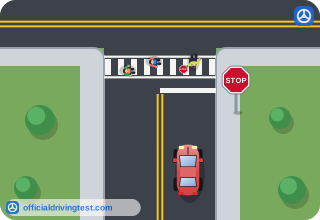
- Halfway into the crosswalk so you can see cross traffic
- In the crosswalk, but only if it is marked
- Behind the crosswalk, whether it is marked or unmarked
- Past the crosswalk, as soon as no pedestrian is in sight
Show answer
Correct answer: Behind the crosswalk, whether it is marked or unmarked
Come to a complete stop behind crosswalks, marked and unmarked, at stop signs or red lights.
Source: Nebraska Driver's Manual (January 2025), page 69 · Open this page in the manual (Manual page 69)
-
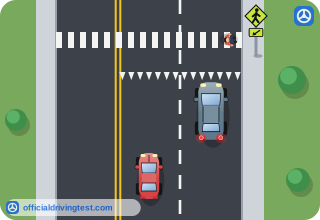
Why should you not pass a vehicle that has stopped for a pedestrian?
- The pedestrian will have the right-of-way over only the first vehicle
- Passing a stopped vehicle always requires three feet of clearance
- The stopped vehicle may block your view of the pedestrian in the street
- Its driver has the right to proceed before any passing vehicle
Show answer
Correct answer: The stopped vehicle may block your view of the pedestrian in the street
The stopped vehicle may block the view of the pedestrian in the street.
Source: Nebraska Driver's Manual (January 2025), page 69 · Open this page in the manual (Manual page 69)
-
How must you give the right-of-way to a blind or visually impaired person using a white cane or service dog?
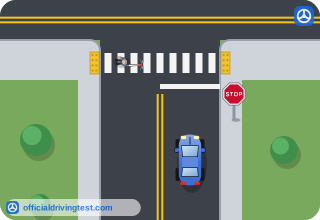
- Stop and remain stopped until the person is clear of the roadway
- Slow down and drive around the person with extra care
- Stop briefly, then continue once the person has seen you
- Stop and wait only until the person is out of your lane
Show answer
Correct answer: Stop and remain stopped until the person is clear of the roadway
Always give the right-of-way to a blind or visually impaired person by stopping and remaining stopped until the person is clear of the roadway.
Source: Nebraska Driver's Manual (January 2025), page 69 · Open this page in the manual (Manual page 69)