Montana: Emergency vehicles, work zones and traffic stops — Part 1 Practice Test
Questions in this part include: “What shape are most signs in work areas?” · “Which of these may set the speed limit for a specific construction or work zone?”
Independent educational site · not affiliated with any government agency or DMV
Ready? Test yourself
- Instant feedback with an explanation
- Every answer cites its source in the manual
- Your best score is saved on this device
- Keyboard: press 1 to 4 to answer and Enter for the next question
Questions are original and based on the official manual "Montana Driver Manual" (Revised April 2024), Montana Department of Justice, Motor Vehicle Division.
All 17 questions in this practice test
Take the test above first, then use this list to study. Tap “Show answer” to see the correct answer and explanation.
Show the questions and answersHide the questions
-
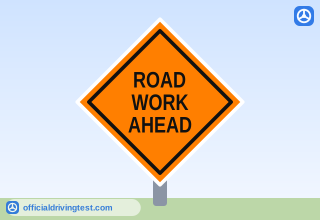
What shape are most signs in work areas?
- Diamond
- Round
- Triangle
- Octagon
Show answer
Correct answer: Diamond
Most signs in work areas are diamond shaped, and a few are rectangular.
Source: Montana Driver Manual (Revised April 2024), page 27
-
What do construction and maintenance signs notify drivers of?
- Locations of rest areas, fuel stations, and food stops ahead
- Where school zones begin and where they end along the road
- Which lanes are reserved for buses
- Unusual or potentially dangerous conditions in or near work areas
Show answer
Correct answer: Unusual or potentially dangerous conditions in or near work areas
Construction and maintenance signs notify drivers of unusual or potentially dangerous conditions in or near work areas.
Source: Montana Driver Manual (Revised April 2024), page 27
-
A person who knowingly or negligently drives in a highway construction zone so as to endanger persons or property is guilty of what?
- A felony that always carries a mandatory prison term
- A misdemeanor, with the same penalty as reckless driving
- A civil infraction that carries no penalty at all
- A parking violation with a small fine only
Show answer
Correct answer: A misdemeanor, with the same penalty as reckless driving
Such a person is guilty of a misdemeanor, and the penalty is the same as reckless driving.
Source: Montana Driver Manual (Revised April 2024), page 27
-
At night, how are barricades, vertical panels, drums, cones, and tubes often equipped?
- With bright red reflectors, never lights
- With flashing or steady burning lights
- With sirens that warn drivers
- With a white flag on top
Show answer
Correct answer: With flashing or steady burning lights
At night these devices are often equipped with flashing or steady burning lights.
Source: Montana Driver Manual (Revised April 2024), page 27
-
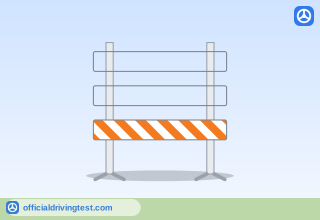
The diagonal stripes on a barricade slope downward to the right. What should the driver do?
- Bear to the left
- Stop and wait for a flagger
- Turn around
- Bear to the right
Show answer
Correct answer: Bear to the right
Stripes sloping downward to the right mean the driver should bear to the right.
Source: Montana Driver Manual (Revised April 2024), page 27
-
What are large flashing or sequencing arrow panels used for in work zones?
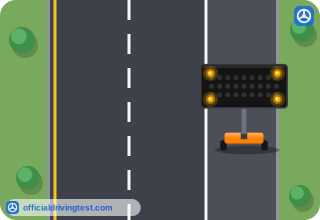
- To guide drivers into certain lanes and show that part of the road is closed
- To mark the point where the work zone speed limit ends and normal speed resumes
- To show how many feet remain before a detour
- To tell drivers a school zone is ahead
Show answer
Correct answer: To guide drivers into certain lanes and show that part of the road is closed
Arrow panels guide drivers into certain traffic lanes and inform them that part of the road or street ahead is closed.
Source: Montana Driver Manual (Revised April 2024), page 28
-
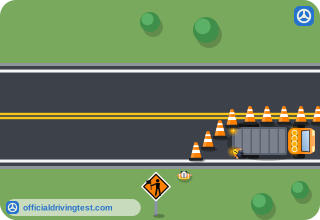
What do flaggers do in highway and street work zones?
- Collect tolls from passing drivers
- Issue citations for speeding
- Stop, slow down, or guide traffic through the area
- Park vehicles that are left in the work area
Show answer
Correct answer: Stop, slow down, or guide traffic through the area
Flaggers are often provided in work zones to stop, slow down, or guide traffic through the area.
Source: Montana Driver Manual (Revised April 2024), page 28
-
What happens to traffic fines in work zones?
- They are halved
- They are doubled
- They are tripled
- They stay the same
Show answer
Correct answer: They are doubled
Traffic fines double in work zones.
Source: Montana Driver Manual (Revised April 2024), page 28
-
Which of these may set the speed limit for a specific construction or work zone?
- A private contractor
- The county school board
- The driver’s insurance company
- The Motor Vehicle Division
Show answer
Correct answer: A private contractor
The Department of Transportation, local authority, utility company, or private contractor sets a speed limit specific to each zone.
Source: Montana Driver Manual (Revised April 2024), page 28
-
Which action can lead to a charge of Reckless Endangerment of a Highway Worker?
- Knowingly or negligently driving in a construction zone in a way that endangers persons or property
- Stopping for a flagger who is holding up a stop paddle, even when the zone looks empty
- Driving through the work zone at the speed limit that has been posted for that zone
- Slowing down and moving over as a flashing arrow panel directs you into another lane
Show answer
Correct answer: Knowingly or negligently driving in a construction zone in a way that endangers persons or property
You may be charged with Reckless Endangerment of a Highway Worker if you knowingly or negligently drive in a highway construction zone in a way that endangers persons or property.
Source: Montana Driver Manual (Revised April 2024), page 28
-
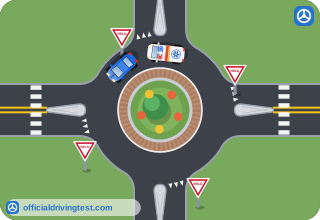
An emergency vehicle approaches while you are already inside a roundabout. What should you do?
- Stop at once, wherever you are inside the roundabout, and stay put
- Pull to the left inside the circle to let it pass on the right
- Continue and exit as normal, then pull to the right where there is room
- Stay in the circle and keep going around until it has passed
Show answer
Correct answer: Continue and exit as normal, then pull to the right where there is room
Do not pull over or stop in the roundabout; continue and exit as normal, then pull to the right where there is room for the emergency vehicle to pass.
Source: Montana Driver Manual (Revised April 2024), page 32
-
An emergency vehicle approaches while you are approaching a roundabout, and there is no room for it to get by. What should you do?
- Stop at the entrance and wait for the vehicle to pass
- Continue through the roundabout and pull over after exiting
- Stop inside the roundabout so the vehicle can get by
- Back up away from the entrance until the vehicle passes
Show answer
Correct answer: Continue through the roundabout and pull over after exiting
If there is room for the emergency vehicle to get by, you pull over; if there is not, you continue through the roundabout and pull over after exiting.
Source: Montana Driver Manual (Revised April 2024), page 32
-
The manual calls the first rule of the road "OBEY." Whose orders does it say you must obey?
- Only police officers in marked patrol cars
- Only flaggers inside marked work zones
- Any other driver who waves you through
- Highway patrol, police officers, and flaggers
Show answer
Correct answer: Highway patrol, police officers, and flaggers
The first rule of the road is to obey the orders of highway patrol, police officers, and flaggers, along with all traffic control devices and traffic laws.
Source: Montana Driver Manual (Revised April 2024), page 37
-
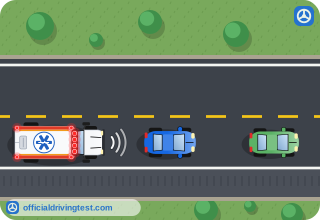
From which direction must an emergency vehicle be approaching for you to pull over to the right edge of the road?
- Only from behind you
- Only from ahead of you
- From any direction
- Only in your own lane
Show answer
Correct answer: From any direction
Pull over to the right edge of the road, or as near to the right as possible, when you see or hear an emergency vehicle approaching from any direction.
Source: Montana Driver Manual (Revised April 2024), page 40
-
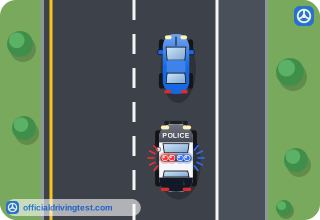
What should you do about instructions given over an emergency vehicle's loudspeaker?
- Ignore them; they are for its crew
- Follow them only if a siren is on
- Wait for an officer to repeat them
- Follow them
Show answer
Correct answer: Follow them
The manual says to follow any instructions given over the emergency vehicle's loudspeaker.
Source: Montana Driver Manual (Revised April 2024), page 40
-
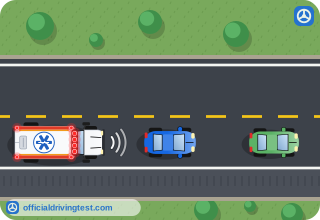
After you pull over and stop for an emergency vehicle, how long should you remain stopped?
- Until the siren can no longer be heard
- Until the emergency vehicle has passed
- Until the lights are out of sight
- Until another driver starts moving
Show answer
Correct answer: Until the emergency vehicle has passed
Stop and remain stopped until the emergency vehicle has passed.
Source: Montana Driver Manual (Revised April 2024), page 40
-
You are in an intersection when an emergency vehicle approaches. What should you do?
- Stop at once in the intersection
- Back up out of the intersection
- Drive through it, then pull over and stop
- Turn right there, then stop at the curb
Show answer
Correct answer: Drive through it, then pull over and stop
If you are in an intersection, drive through the intersection before you pull over and stop.
Source: Montana Driver Manual (Revised April 2024), page 40