Montana: Emergency vehicles, work zones and traffic stops
Yielding to emergency vehicles, slowing for stopped emergency vehicles, work zones and flaggers, and what to do when stopped by law enforcement. Split into 2 shorter tests so you're not stuck in one long quiz.
Independent educational site · not affiliated with any government agency or DMV
Choose a part
Emergency vehicles, work zones and traffic stops — Part 1
Questions in this part include: “What shape are most signs in work areas?”
StartEmergency vehicles, work zones and traffic stops — Part 2
Questions in this part include: “What does the manual say about following police vehicles, ambulances and fire trucks?”
StartAll 34 Emergency vehicles, work zones and traffic stops questions with answers
Choose a part above to take a practice test, or study every question and answer here.
Show the questions and answersHide the questions
-
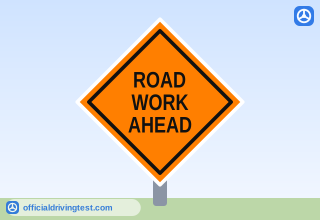
What shape are most signs in work areas?
- Diamond
- Round
- Triangle
- Octagon
Show answer
Correct answer: Diamond
Most signs in work areas are diamond shaped, and a few are rectangular.
Source: Montana Driver Manual (Revised April 2024), page 27
-
What do construction and maintenance signs notify drivers of?
- Locations of rest areas, fuel stations, and food stops ahead
- Where school zones begin and where they end along the road
- Which lanes are reserved for buses
- Unusual or potentially dangerous conditions in or near work areas
Show answer
Correct answer: Unusual or potentially dangerous conditions in or near work areas
Construction and maintenance signs notify drivers of unusual or potentially dangerous conditions in or near work areas.
Source: Montana Driver Manual (Revised April 2024), page 27
-
A person who knowingly or negligently drives in a highway construction zone so as to endanger persons or property is guilty of what?
- A felony that always carries a mandatory prison term
- A misdemeanor, with the same penalty as reckless driving
- A civil infraction that carries no penalty at all
- A parking violation with a small fine only
Show answer
Correct answer: A misdemeanor, with the same penalty as reckless driving
Such a person is guilty of a misdemeanor, and the penalty is the same as reckless driving.
Source: Montana Driver Manual (Revised April 2024), page 27
-
At night, how are barricades, vertical panels, drums, cones, and tubes often equipped?
- With bright red reflectors, never lights
- With flashing or steady burning lights
- With sirens that warn drivers
- With a white flag on top
Show answer
Correct answer: With flashing or steady burning lights
At night these devices are often equipped with flashing or steady burning lights.
Source: Montana Driver Manual (Revised April 2024), page 27
-
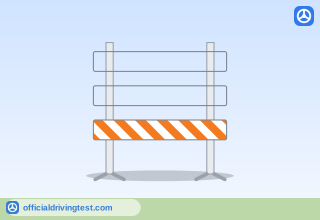
The diagonal stripes on a barricade slope downward to the right. What should the driver do?
- Bear to the left
- Stop and wait for a flagger
- Turn around
- Bear to the right
Show answer
Correct answer: Bear to the right
Stripes sloping downward to the right mean the driver should bear to the right.
Source: Montana Driver Manual (Revised April 2024), page 27
-
What are large flashing or sequencing arrow panels used for in work zones?
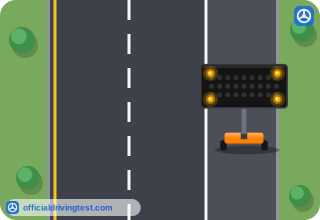
- To guide drivers into certain lanes and show that part of the road is closed
- To mark the point where the work zone speed limit ends and normal speed resumes
- To show how many feet remain before a detour
- To tell drivers a school zone is ahead
Show answer
Correct answer: To guide drivers into certain lanes and show that part of the road is closed
Arrow panels guide drivers into certain traffic lanes and inform them that part of the road or street ahead is closed.
Source: Montana Driver Manual (Revised April 2024), page 28
-
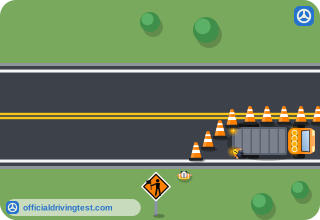
What do flaggers do in highway and street work zones?
- Collect tolls from passing drivers
- Issue citations for speeding
- Stop, slow down, or guide traffic through the area
- Park vehicles that are left in the work area
Show answer
Correct answer: Stop, slow down, or guide traffic through the area
Flaggers are often provided in work zones to stop, slow down, or guide traffic through the area.
Source: Montana Driver Manual (Revised April 2024), page 28
-
What happens to traffic fines in work zones?
- They are halved
- They are doubled
- They are tripled
- They stay the same
Show answer
Correct answer: They are doubled
Traffic fines double in work zones.
Source: Montana Driver Manual (Revised April 2024), page 28
-
Which of these may set the speed limit for a specific construction or work zone?
- A private contractor
- The county school board
- The driver’s insurance company
- The Motor Vehicle Division
Show answer
Correct answer: A private contractor
The Department of Transportation, local authority, utility company, or private contractor sets a speed limit specific to each zone.
Source: Montana Driver Manual (Revised April 2024), page 28
-
Which action can lead to a charge of Reckless Endangerment of a Highway Worker?
- Knowingly or negligently driving in a construction zone in a way that endangers persons or property
- Stopping for a flagger who is holding up a stop paddle, even when the zone looks empty
- Driving through the work zone at the speed limit that has been posted for that zone
- Slowing down and moving over as a flashing arrow panel directs you into another lane
Show answer
Correct answer: Knowingly or negligently driving in a construction zone in a way that endangers persons or property
You may be charged with Reckless Endangerment of a Highway Worker if you knowingly or negligently drive in a highway construction zone in a way that endangers persons or property.
Source: Montana Driver Manual (Revised April 2024), page 28
-
An emergency vehicle approaches while you are already inside a roundabout. What should you do?
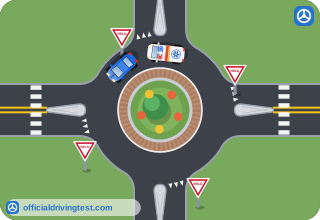
- Stop at once, wherever you are inside the roundabout, and stay put
- Pull to the left inside the circle to let it pass on the right
- Continue and exit as normal, then pull to the right where there is room
- Stay in the circle and keep going around until it has passed
Show answer
Correct answer: Continue and exit as normal, then pull to the right where there is room
Do not pull over or stop in the roundabout; continue and exit as normal, then pull to the right where there is room for the emergency vehicle to pass.
Source: Montana Driver Manual (Revised April 2024), page 32
-
An emergency vehicle approaches while you are approaching a roundabout, and there is no room for it to get by. What should you do?
- Stop at the entrance and wait for the vehicle to pass
- Continue through the roundabout and pull over after exiting
- Stop inside the roundabout so the vehicle can get by
- Back up away from the entrance until the vehicle passes
Show answer
Correct answer: Continue through the roundabout and pull over after exiting
If there is room for the emergency vehicle to get by, you pull over; if there is not, you continue through the roundabout and pull over after exiting.
Source: Montana Driver Manual (Revised April 2024), page 32
-
The manual calls the first rule of the road "OBEY." Whose orders does it say you must obey?
- Only police officers in marked patrol cars
- Only flaggers inside marked work zones
- Any other driver who waves you through
- Highway patrol, police officers, and flaggers
Show answer
Correct answer: Highway patrol, police officers, and flaggers
The first rule of the road is to obey the orders of highway patrol, police officers, and flaggers, along with all traffic control devices and traffic laws.
Source: Montana Driver Manual (Revised April 2024), page 37
-
From which direction must an emergency vehicle be approaching for you to pull over to the right edge of the road?
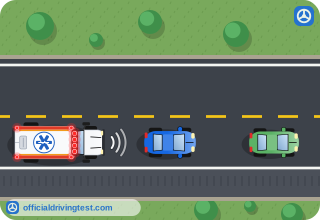
- Only from behind you
- Only from ahead of you
- From any direction
- Only in your own lane
Show answer
Correct answer: From any direction
Pull over to the right edge of the road, or as near to the right as possible, when you see or hear an emergency vehicle approaching from any direction.
Source: Montana Driver Manual (Revised April 2024), page 40
-
What should you do about instructions given over an emergency vehicle's loudspeaker?
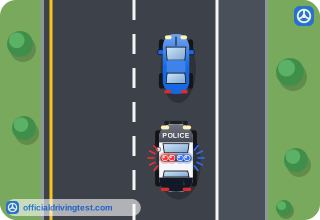
- Ignore them; they are for its crew
- Follow them only if a siren is on
- Wait for an officer to repeat them
- Follow them
Show answer
Correct answer: Follow them
The manual says to follow any instructions given over the emergency vehicle's loudspeaker.
Source: Montana Driver Manual (Revised April 2024), page 40
-
After you pull over and stop for an emergency vehicle, how long should you remain stopped?
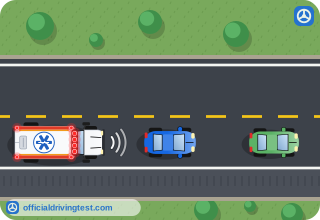
- Until the siren can no longer be heard
- Until the emergency vehicle has passed
- Until the lights are out of sight
- Until another driver starts moving
Show answer
Correct answer: Until the emergency vehicle has passed
Stop and remain stopped until the emergency vehicle has passed.
Source: Montana Driver Manual (Revised April 2024), page 40
-
You are in an intersection when an emergency vehicle approaches. What should you do?
- Stop at once in the intersection
- Back up out of the intersection
- Drive through it, then pull over and stop
- Turn right there, then stop at the curb
Show answer
Correct answer: Drive through it, then pull over and stop
If you are in an intersection, drive through the intersection before you pull over and stop.
Source: Montana Driver Manual (Revised April 2024), page 40
-
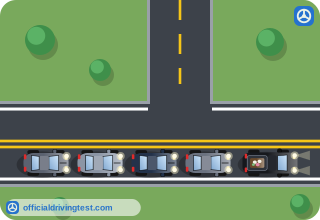
A driver in a funeral procession must yield the right-of-way to what?
- Vehicles entering from driveways and alleys
- Any vehicle with a green light at an intersection
- An approaching emergency vehicle giving a signal
- Pedestrians walking on the sidewalk only
Show answer
Correct answer: An approaching emergency vehicle giving a signal
A driver in a funeral procession must yield the right-of-way to an approaching authorized emergency vehicle giving an audible or visual signal.
Source: Montana Driver Manual (Revised April 2024), page 42
-
What does the manual say about following police vehicles, ambulances and fire trucks?
- They need no extra room because other traffic moves aside
- They should be followed as closely as traffic allows
- They should be followed at a one-second gap so you can keep up
- They need more room to operate, so leave extra space
Show answer
Correct answer: They need more room to operate, so leave extra space
Police vehicles, ambulances and fire trucks need more room to operate, so you leave extra space when following them.
Source: Montana Driver Manual (Revised April 2024), page 65
-
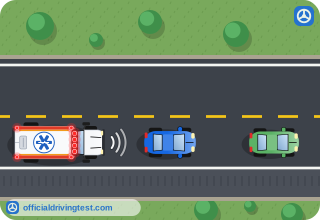
When drivers of other vehicles see or hear an emergency vehicle approaching from any direction, where must they pull over and stop when possible and safe?
- At the left edge of the road
- In the center of the road
- In the lane next to the center line
- At the right edge of the road
Show answer
Correct answer: At the right edge of the road
They must yield the right-of-way and, when possible and safe, pull over and stop at the right edge of the road.
Source: Montana Driver Manual (Revised April 2024), page 80
-
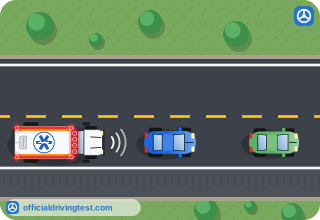
With an emergency vehicle using audio and visual signals nearby, how must non-emergency vehicles drive according to Montana state law?
- Parallel to and as close as possible to the right-hand edge or curb
- Diagonal to the right-hand edge, leaving room to move again
- Parallel to and about one lane away from the left-hand edge
- Parallel to and as close as possible to the center line
Show answer
Correct answer: Parallel to and as close as possible to the right-hand edge or curb
They must yield the right-of-way and immediately drive to a position parallel and as close as possible to the right-hand edge or curb of the road.
Source: Montana Driver Manual (Revised April 2024), page 80
-
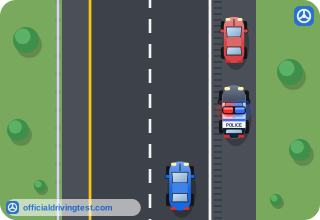
On highways with a posted speed limit of 50 MPH or more, how far below the posted speed limit must vehicles slow down when in a lane directly next to a stationary emergency or police vehicle displaying emergency signals?
- At least 5 miles
- At least 10 miles
- At least 20 miles
- At least 15 miles
Show answer
Correct answer: At least 20 miles
They must slow down to a speed of at least 20 miles below the posted speed limit.
Source: Montana Driver Manual (Revised April 2024), page 80
-
Vehicles in a lane directly next to a stationary emergency vehicle displaying emergency signals must slow down on highways with what posted speed limit?
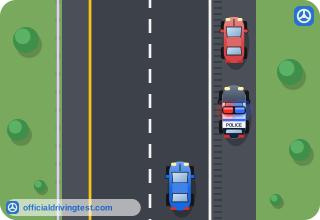
- 35 MPH or more
- 50 MPH or more
- 45 MPH or more
- 60 MPH or more
Show answer
Correct answer: 50 MPH or more
The slow-down rule applies on highways with a posted speed limit of 50 MPH or more.
Source: Montana Driver Manual (Revised April 2024), page 80
-
When possible, what should vehicles do about their lane when passing a stationary emergency vehicle that is displaying emergency signals?
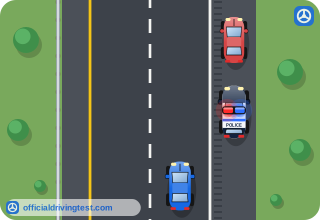
- Switch to a lane farther away from the stationary vehicle
- Stay in the lane directly next to it
- Switch to the lane directly next to it
- Stop behind the stationary vehicle until it leaves
Show answer
Correct answer: Switch to a lane farther away from the stationary vehicle
When possible, vehicles should switch to a lane farther away from the lane that the stationary vehicle is in.
Source: Montana Driver Manual (Revised April 2024), page 80
-
A law enforcement officer pulls you over. How does the manual say to acknowledge the officer’s presence?
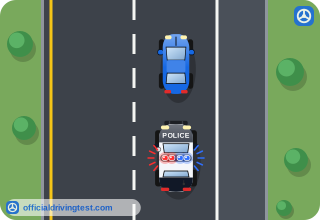
- Turn on your left turn signal
- Flash your headlights
- Sound your horn
- Turn on your right turn signal
Show answer
Correct answer: Turn on your right turn signal
You acknowledge the officer’s presence by turning on your right turn signal.
Source: Montana Driver Manual (Revised April 2024), page 81
-
Why does the manual say you should turn on your right turn signal when an officer pulls you over?
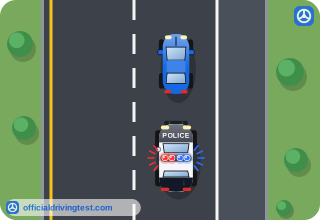
- It tells the officer you plan to pull onto the left shoulder
- It lets the officer know you are not carrying passengers
- It lets the officer know that you recognize his or her presence
- It shows the officer you will stop at the next exit
Show answer
Correct answer: It lets the officer know that you recognize his or her presence
The signal lets the officer know you recognize the officer’s presence; an officer may become alarmed if you fail to.
Source: Montana Driver Manual (Revised April 2024), page 81
-
Where should you move your vehicle when a law enforcement officer pulls you over?
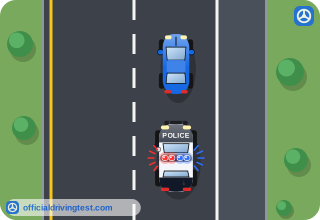
- Onto the right shoulder of the road
- Onto the center median
- Onto the opposite side of a two-lane road
- Into the left lane next to the median
Show answer
Correct answer: Onto the right shoulder of the road
You move your vehicle onto the right shoulder of the road.
Source: Montana Driver Manual (Revised April 2024), page 81
-
Why should you not stop in the center median of the interstate or on the opposite side of a two-lane road during an enforcement stop?
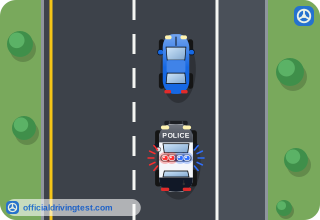
- It blocks the officer’s view of your license plate
- It makes it harder for other drivers to see the patrol vehicle
- It prevents the officer from reaching your window
- It places both you and the officer in danger of oncoming traffic
Show answer
Correct answer: It places both you and the officer in danger of oncoming traffic
Stopping in the median or on the opposite side of a two-lane road places both the driver and the officer in danger of being hit by oncoming traffic.
Source: Montana Driver Manual (Revised April 2024), page 81
-
When it is dark and an officer pulls you over, where does the manual say to look for a place to stop?
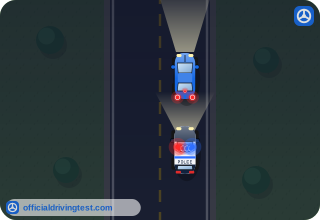
- A remote area where no other traffic will be affected
- A dark shoulder where you are hidden from other traffic
- Places with more light, such as streetlights or service stations
- The center median where the patrol vehicle can see you
Show answer
Correct answer: Places with more light, such as streetlights or service stations
The manual says to stop in well-lit areas when possible, looking for places with more light such as streetlights, restaurants, or service stations.
Source: Montana Driver Manual (Revised April 2024), page 81
-
How far off the road should you pull your vehicle during an enforcement stop?
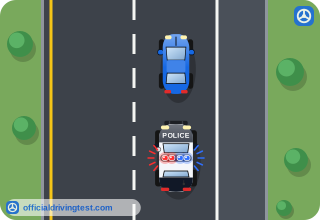
- Just far enough for the officer to see you
- As far off the road as possible
- Only until your left wheels are on the shoulder
- Only far enough to leave one lane open
Show answer
Correct answer: As far off the road as possible
The manual says to pull your vehicle as far off the road as possible.
Source: Montana Driver Manual (Revised April 2024), page 81
-
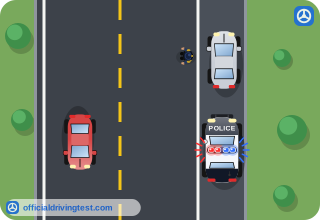
What should you do with a cell phone conversation and the radio during an enforcement stop?
- Keep the call going and turn the radio down
- End the call and turn off the radio
- Put the call on speaker and lower the radio
- Leave the radio on to stay calm
Show answer
Correct answer: End the call and turn off the radio
You end your cell phone conversation and turn off your radio so the officer has your full attention.
Source: Montana Driver Manual (Revised April 2024), page 81
-
During an enforcement stop, when should you step out of your vehicle?
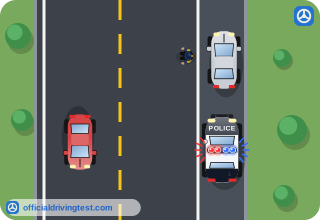
- Only if the officer directs you to
- As soon as you stop, to meet the officer
- When the officer approaches your window
- Whenever you want to find your documents
Show answer
Correct answer: Only if the officer directs you to
You remain inside your vehicle and never step out unless an officer directs you to do so.
Source: Montana Driver Manual (Revised April 2024), page 81
-
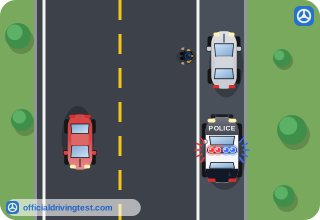
During an enforcement stop, where should the driver and passengers place their hands?
- Out of sight, in your pockets or under the vehicle seat
- Behind the head restraints, out of the officer’s way
- Inside the glove box with the vehicle documents and registration
- In clear view, such as on the steering wheel or on top of the lap
Show answer
Correct answer: In clear view, such as on the steering wheel or on top of the lap
Driver and passengers should place their hands in clear view, for example on the steering wheel or on top of the lap.
Source: Montana Driver Manual (Revised April 2024), page 81
-
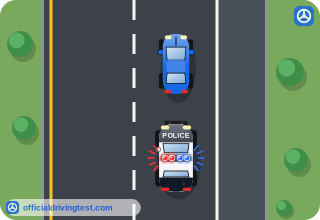
If your windows are tinted, what does the manual recommend during an enforcement stop?
- Keep them up until the officer knocks on the glass
- Roll them down only after the officer asks you to step out
- Roll them down after you stop and before the officer makes contact
- Turn on your emergency flashers and keep them up
Show answer
Correct answer: Roll them down after you stop and before the officer makes contact
If your windows are tinted, it is recommended that you roll them down after stopping on the right shoulder and before the officer makes contact with you.
Source: Montana Driver Manual (Revised April 2024), page 81