Montana: Distracted driving — Part 1 Practice Test
Questions in this part include: “How does the manual describe distracted driving?” · “What does the manual say about talking on a phone or radio with hands-free equipment while driving?”
Independent educational site · not affiliated with any government agency or DMV
Ready? Test yourself
- Instant feedback with an explanation
- Every answer cites its source in the manual
- Your best score is saved on this device
- Keyboard: press 1 to 4 to answer and Enter for the next question
Questions are original and based on the official manual "Montana Driver Manual" (Revised April 2024), Montana Department of Justice, Motor Vehicle Division.
All 19 questions in this practice test
Take the test above first, then use this list to study. Tap “Show answer” to see the correct answer and explanation.
Show the questions and answersHide the questions
-
How does the manual describe distracted driving?
- Taking your eyes off the road, your hands off the wheel, and your mind off driving
- Only the time you spend using a cell phone while the vehicle is moving on a road
- Only driving while you are drowsy or after you have been drinking alcohol
- Any time a passenger talks to you, even while the vehicle is stopped
Show answer
Correct answer: Taking your eyes off the road, your hands off the wheel, and your mind off driving
The manual defines distracted driving as taking your eyes off the road, your hands off the wheel, and your mind off your primary task of driving safely.
Source: Montana Driver Manual (Revised April 2024), page 49
-
Why does the manual call texting the most alarming distraction?
- It is the only distraction that takes your hands off the wheel
- It involves manual, visual, and cognitive distraction all at once
- It is the only distraction that is against the law in every city
- It takes your eyes off the road for longer than any other distraction
Show answer
Correct answer: It involves manual, visual, and cognitive distraction all at once
Texting involves simultaneous manual, visual, and cognitive distraction, which is why the manual calls it the most alarming distraction.
Source: Montana Driver Manual (Revised April 2024), page 49
-
For how long does sending or reading a text take your eyes off the road, according to the manual?
- 2 seconds
- 10 seconds
- 15 seconds
- 5 seconds
Show answer
Correct answer: 5 seconds
The manual says sending or reading a text takes your eyes off the road for 5 seconds.
Source: Montana Driver Manual (Revised April 2024), page 49
-
Which of these does the manual list as a distraction while driving?
- Using a navigation system
- Checking your mirrors before changing lanes
- Scanning the road 10 seconds ahead
- Looking over your shoulder before a lane change
Show answer
Correct answer: Using a navigation system
Using a navigation system is on the manual's list of distractions, along with texting, eating and drinking, grooming, and reading.
Source: Montana Driver Manual (Revised April 2024), page 49
-
What does the manual say your brain is really doing when you try to "multi-task"?
- Handling two or three tasks at once, but at a somewhat slower speed
- Splitting its attention equally among all the tasks at once
- Dealing with one task at a time but shifting between tasks very quickly
- Handling routine tasks automatically without any attention
Show answer
Correct answer: Dealing with one task at a time but shifting between tasks very quickly
The manual says multi-tasking is not real: the brain handles one task at a time and shifts between tasks very quickly.
Source: Montana Driver Manual (Revised April 2024), page 49
-
What does the manual say to do if you think you need to take care of something while you are behind the wheel?
- Do it with one hand while keeping your eyes mostly on the road
- Wait until you can safely pull over to the side of the road and stop
- Do it quickly at the next stop sign or red light
- Do it while driving more slowly than the speed limit
Show answer
Correct answer: Wait until you can safely pull over to the side of the road and stop
The manual says to wait until you can safely pull over to the side of the road and stop.
Source: Montana Driver Manual (Revised April 2024), page 49
-
What does the manual say about local laws on texting and talking on cell phones while driving?
- No Montana city has passed laws against either
- Only a few Montana cities have passed laws against them
- Only cities along interstate highways have passed such laws
- Most Montana cities have passed laws against both
Show answer
Correct answer: Most Montana cities have passed laws against both
The manual states that most Montana cities have passed laws against texting and talking on cell phones while driving.
Source: Montana Driver Manual (Revised April 2024), page 49
-
What does the manual say a good passenger should do when the driver of the car is distracted?
- Buckle the seatbelt and speak up
- Stay quiet so the driver is not distracted further
- Take the driver's phone and use it instead
- Ask the driver to pull over only after the trip ends
Show answer
Correct answer: Buckle the seatbelt and speak up
A good passenger buckles the seatbelt and speaks up if the driver is distracted.
Source: Montana Driver Manual (Revised April 2024), page 49
-
If you need to look at a map, what does the manual say to do?
- Glance at it for a few seconds at a time while driving
- Read it only while driving at a low speed
- Hold it up near the windshield and glance at it
- Pull safely off the road before you try to look at it
Show answer
Correct answer: Pull safely off the road before you try to look at it
The manual says to pull safely off the road before looking at a map, and not to read a map while driving.
Source: Montana Driver Manual (Revised April 2024), page 51
-
What does the manual say about talking on a phone or radio with hands-free equipment while driving?
- It still takes your attention from driving and makes hazards harder to notice
- It is safe because both of your hands stay on the steering wheel at all times
- It is safe as long as you keep your eyes on the road at all times
- It is a problem only when the vehicle is moving at night or in rain
Show answer
Correct answer: It still takes your attention from driving and makes hazards harder to notice
Even with hands-free equipment, talking on a phone or radio takes your attention away from driving and can make you less likely to notice hazardous situations.
Source: Montana Driver Manual (Revised April 2024), page 51
-
Why does the manual say not to drive with headphones or earbuds?
- They can slide off and fall under the pedals while driving
- They are likely to damage your hearing over a long trip
- They make it too hard to hear emergency horns and sirens
- They make it hard to hear your own horn when needed
Show answer
Correct answer: They make it too hard to hear emergency horns and sirens
The manual says headphones and earbuds make it too hard to hear emergency horns and sirens.
Source: Montana Driver Manual (Revised April 2024), page 51
-
What does the manual say to do when you pass a crash or other roadside activity?
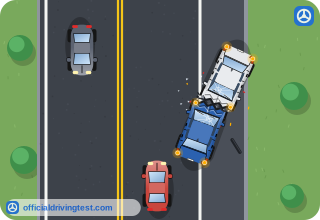
- Slow down so that you can get a clear look at what has happened
- Keep your eyes on the road and get past as soon as you safely can
- Slow down and take a good look to learn from the crash site
- Stop for a moment to see whether anyone needs help there
Show answer
Correct answer: Keep your eyes on the road and get past as soon as you safely can
The manual says not to slow down to stare ("rubbernecking"); keep your eyes on the road and get past roadside incidents as safely and as soon as you can.
Source: Montana Driver Manual (Revised April 2024), page 51
-
When you are fatigued while driving, how often does the manual say to stop for a short break?
- At least every two hours
- At least every 30 minutes
- At least every four hours
- At least every six hours
Show answer
Correct answer: At least every two hours
When you are fatigued, stop at least every two hours for a short break.
Source: Montana Driver Manual (Revised April 2024), page 55
-
Which of these does the manual suggest when you are fatigued while driving?
- Turn the heater up high to keep the cabin warm and cozy
- Close all the windows and use recirculated air only
- Open the window or a cold air vent to let fresh air circulate
- Drive faster to arrive at your destination sooner
Show answer
Correct answer: Open the window or a cold air vent to let fresh air circulate
When you are fatigued, open the window or cold air vent to allow fresh air to circulate, or sing or play the radio.
Source: Montana Driver Manual (Revised April 2024), page 55
-
If you become drowsy while driving, what does the manual say to do?
- Drive a little faster so that you reach your destination sooner
- Pull off the road and take a nap, or better yet find a room for the night
- Keep driving and rely on the radio to help you stay awake
- Slow down and keep driving in the right lane of the road
Show answer
Correct answer: Pull off the road and take a nap, or better yet find a room for the night
If you become drowsy, pull off the road and take a nap, or better yet, find a room for the night.
Source: Montana Driver Manual (Revised April 2024), page 55
-
Why does the manual advise you to avoid dark glasses or tinted contact lenses at night?
- They make glare from oncoming headlights stronger
- They cut too much of the light you need to see clearly
- They make it harder to judge your own speed
- They are not allowed on a Montana driver license
Show answer
Correct answer: They cut too much of the light you need to see clearly
Avoid using dark glasses or tinted contact lenses at night, even if it helps with glare. The problem is that they cut too much light - light that you need to see clearly.
Source: Montana Driver Manual (Revised April 2024), page 70
-
What does the manual suggest you keep in your vehicle if you wear glasses for driving?
- A prescription card from your eye doctor
- A small flashlight for reading road signs
- A spare set of contact lens solution
- An extra pair of glasses
Show answer
Correct answer: An extra pair of glasses
Try to keep an extra pair of glasses in your vehicle.
Source: Montana Driver Manual (Revised April 2024), page 70
-
How often does the manual say you should have your eyes checked by an eye specialist?
- Every year or two
- Every five years
- Only when your license is renewed
- Only when you notice vision problems
Show answer
Correct answer: Every year or two
Because seeing well is so important for safe driving, you should have your eyes checked every year or two by an eye specialist.
Source: Montana Driver Manual (Revised April 2024), page 70
-
Why must you use your side mirrors and glance to the side, even though you have side vision?
- Because side vision only works in the daytime
- Because side vision is weaker when you wear glasses
- Because you cannot focus on things to the side
- Because the law requires a mirror check every ten seconds
Show answer
Correct answer: Because you cannot focus on things to the side
Because you cannot focus on things to the side, you also must use your side mirrors and glance to the side if necessary.
Source: Montana Driver Manual (Revised April 2024), page 70