Montana: Distracted driving
Distractions behind the wheel, fatigue and drowsy driving, vision and hearing, health and emotions. Split into 2 shorter tests so you're not stuck in one long quiz.
Independent educational site · not affiliated with any government agency or DMV
Choose a part
All 38 Distracted driving questions with answers
Choose a part above to take a practice test, or study every question and answer here.
Show the questions and answersHide the questions
-
How does the manual describe distracted driving?
- Taking your eyes off the road, your hands off the wheel, and your mind off driving
- Only the time you spend using a cell phone while the vehicle is moving on a road
- Only driving while you are drowsy or after you have been drinking alcohol
- Any time a passenger talks to you, even while the vehicle is stopped
Show answer
Correct answer: Taking your eyes off the road, your hands off the wheel, and your mind off driving
The manual defines distracted driving as taking your eyes off the road, your hands off the wheel, and your mind off your primary task of driving safely.
Source: Montana Driver Manual (Revised April 2024), page 49
-
Why does the manual call texting the most alarming distraction?
- It is the only distraction that takes your hands off the wheel
- It involves manual, visual, and cognitive distraction all at once
- It is the only distraction that is against the law in every city
- It takes your eyes off the road for longer than any other distraction
Show answer
Correct answer: It involves manual, visual, and cognitive distraction all at once
Texting involves simultaneous manual, visual, and cognitive distraction, which is why the manual calls it the most alarming distraction.
Source: Montana Driver Manual (Revised April 2024), page 49
-
For how long does sending or reading a text take your eyes off the road, according to the manual?
- 2 seconds
- 10 seconds
- 15 seconds
- 5 seconds
Show answer
Correct answer: 5 seconds
The manual says sending or reading a text takes your eyes off the road for 5 seconds.
Source: Montana Driver Manual (Revised April 2024), page 49
-
Which of these does the manual list as a distraction while driving?
- Using a navigation system
- Checking your mirrors before changing lanes
- Scanning the road 10 seconds ahead
- Looking over your shoulder before a lane change
Show answer
Correct answer: Using a navigation system
Using a navigation system is on the manual's list of distractions, along with texting, eating and drinking, grooming, and reading.
Source: Montana Driver Manual (Revised April 2024), page 49
-
What does the manual say your brain is really doing when you try to "multi-task"?
- Handling two or three tasks at once, but at a somewhat slower speed
- Splitting its attention equally among all the tasks at once
- Dealing with one task at a time but shifting between tasks very quickly
- Handling routine tasks automatically without any attention
Show answer
Correct answer: Dealing with one task at a time but shifting between tasks very quickly
The manual says multi-tasking is not real: the brain handles one task at a time and shifts between tasks very quickly.
Source: Montana Driver Manual (Revised April 2024), page 49
-
What does the manual say to do if you think you need to take care of something while you are behind the wheel?
- Do it with one hand while keeping your eyes mostly on the road
- Wait until you can safely pull over to the side of the road and stop
- Do it quickly at the next stop sign or red light
- Do it while driving more slowly than the speed limit
Show answer
Correct answer: Wait until you can safely pull over to the side of the road and stop
The manual says to wait until you can safely pull over to the side of the road and stop.
Source: Montana Driver Manual (Revised April 2024), page 49
-
What does the manual say about local laws on texting and talking on cell phones while driving?
- No Montana city has passed laws against either
- Only a few Montana cities have passed laws against them
- Only cities along interstate highways have passed such laws
- Most Montana cities have passed laws against both
Show answer
Correct answer: Most Montana cities have passed laws against both
The manual states that most Montana cities have passed laws against texting and talking on cell phones while driving.
Source: Montana Driver Manual (Revised April 2024), page 49
-
What does the manual say a good passenger should do when the driver of the car is distracted?
- Buckle the seatbelt and speak up
- Stay quiet so the driver is not distracted further
- Take the driver's phone and use it instead
- Ask the driver to pull over only after the trip ends
Show answer
Correct answer: Buckle the seatbelt and speak up
A good passenger buckles the seatbelt and speaks up if the driver is distracted.
Source: Montana Driver Manual (Revised April 2024), page 49
-
If you need to look at a map, what does the manual say to do?
- Glance at it for a few seconds at a time while driving
- Read it only while driving at a low speed
- Hold it up near the windshield and glance at it
- Pull safely off the road before you try to look at it
Show answer
Correct answer: Pull safely off the road before you try to look at it
The manual says to pull safely off the road before looking at a map, and not to read a map while driving.
Source: Montana Driver Manual (Revised April 2024), page 51
-
What does the manual say about talking on a phone or radio with hands-free equipment while driving?
- It still takes your attention from driving and makes hazards harder to notice
- It is safe because both of your hands stay on the steering wheel at all times
- It is safe as long as you keep your eyes on the road at all times
- It is a problem only when the vehicle is moving at night or in rain
Show answer
Correct answer: It still takes your attention from driving and makes hazards harder to notice
Even with hands-free equipment, talking on a phone or radio takes your attention away from driving and can make you less likely to notice hazardous situations.
Source: Montana Driver Manual (Revised April 2024), page 51
-
Why does the manual say not to drive with headphones or earbuds?
- They can slide off and fall under the pedals while driving
- They are likely to damage your hearing over a long trip
- They make it too hard to hear emergency horns and sirens
- They make it hard to hear your own horn when needed
Show answer
Correct answer: They make it too hard to hear emergency horns and sirens
The manual says headphones and earbuds make it too hard to hear emergency horns and sirens.
Source: Montana Driver Manual (Revised April 2024), page 51
-
What does the manual say to do when you pass a crash or other roadside activity?
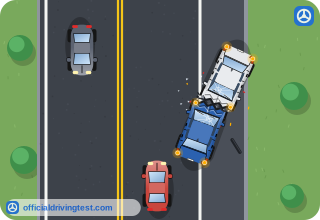
- Slow down so that you can get a clear look at what has happened
- Keep your eyes on the road and get past as soon as you safely can
- Slow down and take a good look to learn from the crash site
- Stop for a moment to see whether anyone needs help there
Show answer
Correct answer: Keep your eyes on the road and get past as soon as you safely can
The manual says not to slow down to stare ("rubbernecking"); keep your eyes on the road and get past roadside incidents as safely and as soon as you can.
Source: Montana Driver Manual (Revised April 2024), page 51
-
When you are fatigued while driving, how often does the manual say to stop for a short break?
- At least every two hours
- At least every 30 minutes
- At least every four hours
- At least every six hours
Show answer
Correct answer: At least every two hours
When you are fatigued, stop at least every two hours for a short break.
Source: Montana Driver Manual (Revised April 2024), page 55
-
Which of these does the manual suggest when you are fatigued while driving?
- Turn the heater up high to keep the cabin warm and cozy
- Close all the windows and use recirculated air only
- Open the window or a cold air vent to let fresh air circulate
- Drive faster to arrive at your destination sooner
Show answer
Correct answer: Open the window or a cold air vent to let fresh air circulate
When you are fatigued, open the window or cold air vent to allow fresh air to circulate, or sing or play the radio.
Source: Montana Driver Manual (Revised April 2024), page 55
-
If you become drowsy while driving, what does the manual say to do?
- Drive a little faster so that you reach your destination sooner
- Pull off the road and take a nap, or better yet find a room for the night
- Keep driving and rely on the radio to help you stay awake
- Slow down and keep driving in the right lane of the road
Show answer
Correct answer: Pull off the road and take a nap, or better yet find a room for the night
If you become drowsy, pull off the road and take a nap, or better yet, find a room for the night.
Source: Montana Driver Manual (Revised April 2024), page 55
-
Why does the manual advise you to avoid dark glasses or tinted contact lenses at night?
- They make glare from oncoming headlights stronger
- They cut too much of the light you need to see clearly
- They make it harder to judge your own speed
- They are not allowed on a Montana driver license
Show answer
Correct answer: They cut too much of the light you need to see clearly
Avoid using dark glasses or tinted contact lenses at night, even if it helps with glare. The problem is that they cut too much light - light that you need to see clearly.
Source: Montana Driver Manual (Revised April 2024), page 70
-
What does the manual suggest you keep in your vehicle if you wear glasses for driving?
- A prescription card from your eye doctor
- A small flashlight for reading road signs
- A spare set of contact lens solution
- An extra pair of glasses
Show answer
Correct answer: An extra pair of glasses
Try to keep an extra pair of glasses in your vehicle.
Source: Montana Driver Manual (Revised April 2024), page 70
-
How often does the manual say you should have your eyes checked by an eye specialist?
- Every year or two
- Every five years
- Only when your license is renewed
- Only when you notice vision problems
Show answer
Correct answer: Every year or two
Because seeing well is so important for safe driving, you should have your eyes checked every year or two by an eye specialist.
Source: Montana Driver Manual (Revised April 2024), page 70
-
Why must you use your side mirrors and glance to the side, even though you have side vision?
- Because side vision only works in the daytime
- Because side vision is weaker when you wear glasses
- Because you cannot focus on things to the side
- Because the law requires a mirror check every ten seconds
Show answer
Correct answer: Because you cannot focus on things to the side
Because you cannot focus on things to the side, you also must use your side mirrors and glance to the side if necessary.
Source: Montana Driver Manual (Revised April 2024), page 70
-
According to the manual, judging distances and speeds is especially important in which of these situations?
- Parking in a garage and backing out of a driveway
- Judging safe gaps when merging and passing on two lane roads
- Driving through a tunnel and crossing a railroad track
- Stopping at a red light and turning at a stop sign
Show answer
Correct answer: Judging safe gaps when merging and passing on two lane roads
Judging distances and speeds is especially important in knowing how far you are from other vehicles, in judging safe gaps when merging, and when passing on two lane roads.
Source: Montana Driver Manual (Revised April 2024), page 70
-
If you have problems seeing at night, what does the manual say you should do?
- Wear dark glasses to cut the glare of headlights
- Drive only on freeways where the road is well lit
- Drive faster so you spend less time on the road
- Not drive more than necessary, and be very careful
Show answer
Correct answer: Not drive more than necessary, and be very careful
If you have problems seeing at night, don’t drive more than is necessary, and when you do, be very careful.
Source: Montana Driver Manual (Revised April 2024), page 70
-
How do drivers who know they have hearing problems adjust, according to the manual?
- They rely more on their vision and stay alert
- They keep the car radio on to stay awake
- They drive only during the daytime
- They avoid using a horn or a turn signal
Show answer
Correct answer: They rely more on their vision and stay alert
Drivers who know they have hearing problems can adjust and be safe drivers by relying more on their vision and staying alert.
Source: Montana Driver Manual (Revised April 2024), page 70
-
What does the manual say is better than taking a chance that you will stay awake when you are sleepy?
- Opening the windows and turning up the radio
- Stopping and sleeping for a few hours
- Drinking a large cup of coffee and driving on
- Driving faster to get to your destination sooner
Show answer
Correct answer: Stopping and sleeping for a few hours
It is better to stop and sleep for a few hours than to take a chance you will stay awake.
Source: Montana Driver Manual (Revised April 2024), page 71
-
What does the manual advise about eating before you leave on a long trip?
- Eat a large meal so you will not get hungry on the road
- Skip eating completely until you arrive
- Eat only sweet snacks while you are driving
- Eat lightly, because some people get sleepy after a big meal
Show answer
Correct answer: Eat lightly, because some people get sleepy after a big meal
Eat lightly. Do not eat a large meal before you leave. Some people get sleepy after they eat a big meal.
Source: Montana Driver Manual (Revised April 2024), page 71
-
Why does the manual say to try not to drive late at night when you are normally asleep?
- Your body thinks it is time to go to sleep
- Other drivers are more likely to be drinking at that hour
- Headlights are always dimmer after midnight than before it
- Many roads are closed to traffic at that late hour
Show answer
Correct answer: Your body thinks it is time to go to sleep
Try not to drive late at night when you are normally asleep. Your body thinks it is time to go to sleep and will try to do so.
Source: Montana Driver Manual (Revised April 2024), page 71
-
What does the manual say tiredness does to your decisions?
- It makes your decisions faster but less careful
- It has no effect on decisions, only on eyesight
- It takes you more time to make decisions
- It improves your decisions because you drive slower
Show answer
Correct answer: It takes you more time to make decisions
It takes you more time to make decisions and you do not always make good decisions.
Source: Montana Driver Manual (Revised April 2024), page 71
-
When should diabetics who take insulin not drive, according to the manual?
- Only during the hours after the evening meal
- Only when driving more than one hour at a time
- Only when driving on a freeway or in heavy traffic
- When there is any chance of going into shock
Show answer
Correct answer: When there is any chance of going into shock
Diabetics who take insulin should not drive when there is any chance of going into shock.
Source: Montana Driver Manual (Revised April 2024), page 73
-
Which of these could cause a diabetic who takes insulin to go into shock, according to the manual?
- Skipping a meal or snack, or taking the wrong amount of insulin
- Driving for more than one hour without taking a rest break
- Wearing dark glasses while driving at night or at dusk
- Driving at night when the roads are not well lit
Show answer
Correct answer: Skipping a meal or snack, or taking the wrong amount of insulin
Skipping a meal or snack, or taking the wrong amount of insulin, could put a diabetic who takes insulin into shock.
Source: Montana Driver Manual (Revised April 2024), page 73
-
Why does the manual say a person with diabetes should have their eyes checked regularly?
- To keep their insulin dosage steady from week to week
- To avoid needing to renew their license by mail
- For possible night blindness and other vision problems
- To renew their license without a vision test
Show answer
Correct answer: For possible night blindness and other vision problems
A person with diabetes should have their eyes checked regularly for possible night blindness and other vision problems.
Source: Montana Driver Manual (Revised April 2024), page 73
-
What does the manual say about people with heart diseases, high blood pressure, or circulation problems whose condition is untreated?
- They may drive only in the daytime
- They should not drive a motor vehicle
- They may drive with a passenger beside them
- They may drive if they feel well
Show answer
Correct answer: They should not drive a motor vehicle
People with heart diseases, high blood pressure, or circulation problems may be in danger of a blackout, fainting, or a heart attack; and, if the condition is untreated, should not drive a motor vehicle.
Source: Montana Driver Manual (Revised April 2024), page 73
-
What does the manual say you should do if you are not feeling well and need to go somewhere?
- Drive slowly and keep to the right lane
- Take a short drive to see if you feel better
- Drive only during the daytime
- Let someone else drive
Show answer
Correct answer: Let someone else drive
If you are not feeling well and need to go somewhere, let someone else drive.
Source: Montana Driver Manual (Revised April 2024), page 73
-
If you are angry or excited, what does the manual advise before driving?
- Give yourself time to cool off and stay off the road until calm
- Drive a little faster than usual to burn off the extra energy
- Drive to a quiet road and keep driving until you feel calm
- Drive with the windows open until you have calmed down
Show answer
Correct answer: Give yourself time to cool off and stay off the road until calm
If you are angry or excited, give yourself time to cool off. If necessary, take a short walk, but stay off the road until you have calmed down.
Source: Montana Driver Manual (Revised April 2024), page 73
-
What does the manual advise if you are impatient?
- Use the left lane to get ahead of slower traffic
- Take a route with fewer stop signs
- Give yourself extra time and leave a few minutes early
- Drive without stopping until you arrive
Show answer
Correct answer: Give yourself extra time and leave a few minutes early
If you are impatient, give yourself extra time for your driving trip. Leave a few minutes early.
Source: Montana Driver Manual (Revised April 2024), page 73
-
According to the manual, driving while drowsy can have the same consequences as driving while doing what?
- Using a mobile phone while driving
- Without a safety belt on a highway
- Above the speed limit on a highway
- Under the influence of drugs or alcohol
Show answer
Correct answer: Under the influence of drugs or alcohol
Driving while drowsy can have the same consequences as driving while under the influence of drugs or alcohol.
Source: Montana Driver Manual (Revised April 2024), page 86
-
When can drowsiness impair your ability to drive safely?
- Even if the driver does not fall asleep
- Only if the driver falls asleep
- Only after midnight, on a night drive
- Only on very long highway trips
Show answer
Correct answer: Even if the driver does not fall asleep
Drowsiness can impair the ability to drive safely, even if the driver does not fall asleep.
Source: Montana Driver Manual (Revised April 2024), page 86
-
Why is it difficult to avoid a crash caused by drowsy driving, according to the manual?
- Drowsy driving usually occurs on narrow roads
- Drowsy driving usually occurs at high speeds
- Drowsy driving usually occurs in heavy traffic
- Drowsy driving usually occurs on unlit roads
Show answer
Correct answer: Drowsy driving usually occurs at high speeds
The manual says drowsy driving usually occurs at high speeds, making it difficult to avoid a crash.
Source: Montana Driver Manual (Revised April 2024), page 86
-
After being awake for how many hours straight are your driving skills the same as those of someone under the influence of drugs or alcohol?
- 8 hours
- 12 hours
- 18 hours
- 24 hours
Show answer
Correct answer: 18 hours
After being awake for 18 hours straight, driving skills are the same as someone under the influence of drugs or alcohol.
Source: Montana Driver Manual (Revised April 2024), page 86
-
Which can happen if you drive while drowsy?
- You may become quicker to react to road and traffic conditions
- You may find it easier to process information from many places
- You may become more careful in making driving decisions
- You may become slower to respond to road and traffic conditions
Show answer
Correct answer: You may become slower to respond to road and traffic conditions
If you drive while drowsy, you may become slower to respond to road and traffic conditions.
Source: Montana Driver Manual (Revised April 2024), page 86