Missouri: Emergency vehicles, work zones and traffic stops
Yielding to emergency vehicles, Missouri’s move-over law, work zones and flaggers, and what to do when stopped by law enforcement. Split into 2 shorter tests so you're not stuck in one long quiz.
Independent educational site · not affiliated with any government agency or DMV
Choose a part
Emergency vehicles, work zones and traffic stops — Part 1
Questions in this part include: “What is the minimum fine for a first offense of speeding or passing in a work zone on Missouri state roadways?”
StartEmergency vehicles, work zones and traffic stops — Part 2
Questions in this part include: “What should you expect to see when approaching a mobile work zone?”
StartAll 42 Emergency vehicles, work zones and traffic stops questions with answers
Choose a part above to take a practice test, or study every question and answer here.
Show the questions and answersHide the questions
-
What is the minimum fine for a first offense of speeding or passing in a work zone on Missouri state roadways?
- $100
- $150
- $500
- $250
Show answer
Correct answer: $250
A driver caught speeding or passing in a construction or work zone on Missouri state roadways could be fined a minimum of $250 for the first offense.
Source: Missouri Driver Guide (Revised August 2026), page 22 · Open this page in the manual (Manual page 22)
-
What is the minimum fine for a second or subsequent offense of speeding or passing in a work zone on Missouri state roadways?
- $250
- $300
- $350
- $500
Show answer
Correct answer: $300
The minimum fine rises to $300 for a second or subsequent offense, in addition to any other fine authorized by law.
Source: Missouri Driver Guide (Revised August 2026), page 22 · Open this page in the manual (Manual page 22)
-
Which emergency vehicle signals mean you must yield the right-of-way?
- A siren or air horn and a red or blue flashing light
- A siren or air horn and a green or white flashing light
- Only a yellow flashing light on its roof
- Flashing headlights and a steady horn
Show answer
Correct answer: A siren or air horn and a red or blue flashing light
You must yield to police, fire, ambulance, or any other emergency vehicle using a siren or air horn and a red or blue flashing light.
Source: Missouri Driver Guide (Revised August 2026), page 23 · Open this page in the manual (Manual page 23)
-
What should you do when you see or hear an emergency vehicle approaching from any direction?
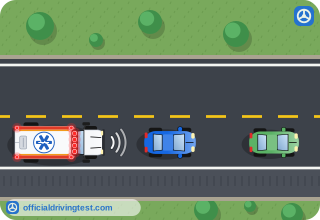
- Pull over to the nearest edge of the road, whichever side it is
- Slow down and keep driving in your lane until it passes
- Pull over to the right edge of the road or as near as possible
- Stop in the middle of your lane and wait for it to pass
Show answer
Correct answer: Pull over to the right edge of the road or as near as possible
The manual says to pull over to the right edge of the road, or as near to the right as possible, when an emergency vehicle approaches from any direction.
Source: Missouri Driver Guide (Revised August 2026), page 23 · Open this page in the manual (Manual page 23)
-
If you are in an intersection when an emergency vehicle approaches, what should you do?
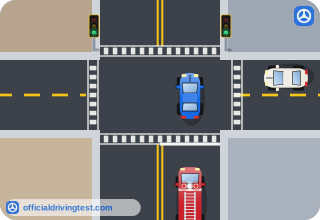
- Stop immediately where you are, even in the intersection
- Drive through the intersection before you pull over
- Back up out of the intersection and pull over
- Turn left at once and pull over to the left side
Show answer
Correct answer: Drive through the intersection before you pull over
The manual says that if you are in an intersection, you should drive through it before pulling over.
Source: Missouri Driver Guide (Revised August 2026), page 23 · Open this page in the manual (Manual page 23)
-
After you pull over for an emergency vehicle, how long should you remain stopped?
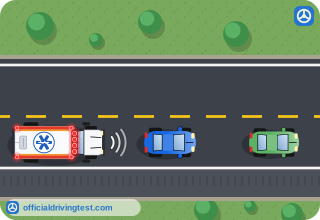
- For at least one minute after it passes
- Until your lane is clear of traffic
- Until another driver goes ahead of you
- Until the emergency vehicle passes
Show answer
Correct answer: Until the emergency vehicle passes
You must remain stopped until the emergency vehicle passes.
Source: Missouri Driver Guide (Revised August 2026), page 23 · Open this page in the manual (Manual page 23)
-
What should you do about instructions given over an emergency vehicle's loudspeaker?
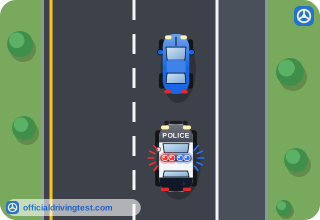
- Ignore them unless a police officer waves you on
- Keep driving unless the siren is also sounding
- Follow them only if you are in an intersection
- Follow any instructions given
Show answer
Correct answer: Follow any instructions given
The manual says to follow any instructions given over the emergency vehicle's loudspeaker.
Source: Missouri Driver Guide (Revised August 2026), page 23 · Open this page in the manual (Manual page 23)
-
After one emergency vehicle has passed, what should you remember?
- You may pull out as soon as the first vehicle has passed
- Others may follow, so proceed only when the way is clear
- You should follow the first vehicle until it turns off
- Others never follow, so you may continue at once
Show answer
Correct answer: Others may follow, so proceed only when the way is clear
Emergency vehicles may follow each other, so you should proceed only when the way is clear.
Source: Missouri Driver Guide (Revised August 2026), page 23 · Open this page in the manual (Manual page 23)
-
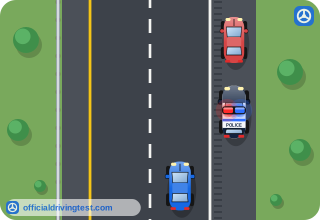
On a roadway with at least four lanes and at least two lanes in your direction, what should you do if it is safe when approaching a stationary emergency vehicle displaying lighted red or red and blue lights?
- Stop behind the stationary vehicle until it leaves
- Change into the lane next to the stationary vehicle
- Change into a lane not adjacent to the stationary vehicle
- Sound your horn and keep driving in the same lane
Show answer
Correct answer: Change into a lane not adjacent to the stationary vehicle
You must proceed with caution and, if it is safe, change into a lane not adjacent to the stationary emergency vehicle.
Source: Missouri Driver Guide (Revised August 2026), page 23 · Open this page in the manual (Manual page 23)
-
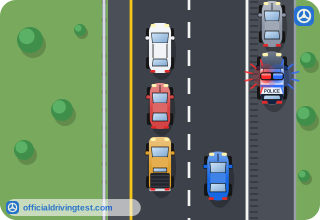
When approaching a stationary emergency vehicle displaying lighted red or red and blue lights, what must you do if changing lanes would be unsafe or impossible?
- Proceed with due caution and reduce speed
- Speed up to get past the vehicle quickly
- Maintain your speed and move to the shoulder
- Stop completely until the vehicle leaves
Show answer
Correct answer: Proceed with due caution and reduce speed
If changing lanes would be unsafe or impossible, you must proceed with due caution and reduce your speed, maintaining a safe speed for road conditions.
Source: Missouri Driver Guide (Revised August 2026), page 23 · Open this page in the manual (Manual page 23)
-
What should you do if an emergency vehicle is approaching as you reach a roundabout?
- Enter quickly and clear the circle ahead of it
- Enter and stop inside the circle
- Enter and move to the center of the circle
- Do not enter the roundabout
Show answer
Correct answer: Do not enter the roundabout
The manual says not to enter a roundabout if an emergency vehicle is approaching.
Source: Missouri Driver Guide (Revised August 2026), page 27 · Open this page in the manual (Manual page 27)
-
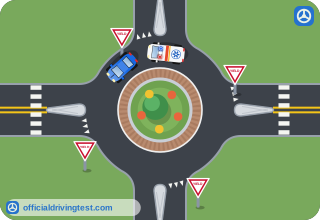
If an emergency vehicle approaches while you are in a roundabout, what should you do?
- Stop where you are inside the circle
- Exit immediately and pull to the right
- Circle once more and pull to the left
- Speed up and stay ahead of it until it passes
Show answer
Correct answer: Exit immediately and pull to the right
If an emergency vehicle approaches while you are in the roundabout, exit immediately and pull to the right.
Source: Missouri Driver Guide (Revised August 2026), page 27 · Open this page in the manual (Manual page 27)
-
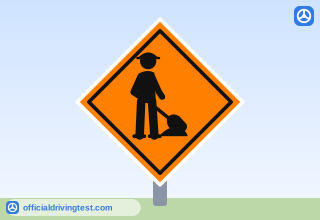
What do work zone signs indicate?
- The location of services such as rest areas and hospitals
- Direction and distance to the next city
- A railroad crossing is ahead
- Some type of work is being performed on or alongside the roadway
Show answer
Correct answer: Some type of work is being performed on or alongside the roadway
Work zone signs indicate that some type of work is being performed on or alongside the roadway.
Source: Missouri Driver Guide (Revised August 2026), page 51 · Open this page in the manual (Manual page 51)
-
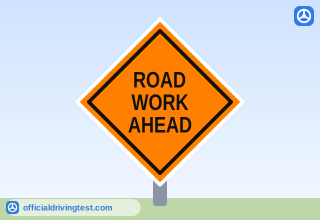
When driving through work zones, what does the manual tell you to look for?
- Increased speed limits, wider lanes, and fewer workers
- Reduced speed limits, narrow driving lanes, and highway workers
- Only lane closures marked by flaggers
- Only vehicles that are stopped on the shoulder
Show answer
Correct answer: Reduced speed limits, narrow driving lanes, and highway workers
The manual says to stay alert and look for reduced speed limits, narrow driving lanes, and highway workers.
Source: Missouri Driver Guide (Revised August 2026), page 52 · Open this page in the manual (Manual page 52)
-
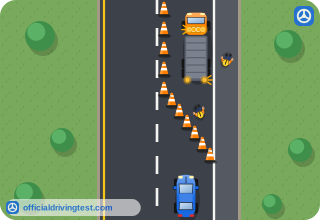
Which precaution does the manual list for driving through work zones?
- Speed up to clear the work zone quickly
- Follow other vehicles closely to stay in line
- Ignore the signs if no workers are in sight
- Watch for vehicles entering and exiting the work zone
Show answer
Correct answer: Watch for vehicles entering and exiting the work zone
Among the precautions for driving through work zones, the manual lists watching for vehicles entering and exiting the work zone.
Source: Missouri Driver Guide (Revised August 2026), page 52 · Open this page in the manual (Manual page 52)
-
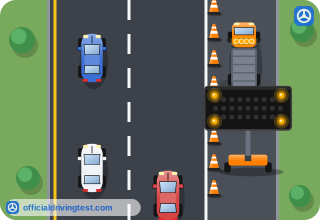
What is a shoulder work zone?
- Work that takes place on the shoulder or beyond the shoulder
- Work in a travel lane that closes it to traffic
- Work on a two-lane, two-way roadway with one lane closed
- Work in a travel lane where slow vehicles move with the workers
Show answer
Correct answer: Work that takes place on the shoulder or beyond the shoulder
A shoulder work zone is work that takes place on the shoulder or beyond the shoulder.
Source: Missouri Driver Guide (Revised August 2026), page 52 · Open this page in the manual (Manual page 52)
-
What should you do when approaching a shoulder work zone?
- Speed up to pass the workers quickly
- Move onto the shoulder to pass
- Reduce speed
- Stop and wait for the workers to leave
Show answer
Correct answer: Reduce speed
For a shoulder work zone, the manual tells you to use caution and reduce speed when approaching the work zone.
Source: Missouri Driver Guide (Revised August 2026), page 52 · Open this page in the manual (Manual page 52)
-
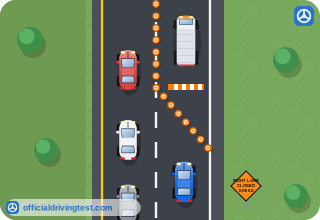
What does the manual tell you to do as you approach a lane closure work zone?
- Stay in the closed lane until workers wave you over
- Merge to a designated lane or one where no work is being done
- Stop in the travel lane and wait for the workers to finish
- Pass the work zone by driving on the shoulder
Show answer
Correct answer: Merge to a designated lane or one where no work is being done
For a lane closure, you merge to the designated lane or a lane that work is not being performed in.
Source: Missouri Driver Guide (Revised August 2026), page 52 · Open this page in the manual (Manual page 52)
-
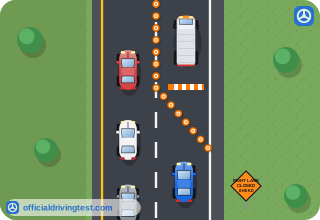
In a lane closure work zone, to what speed does the manual tell you to reduce?
- The speed of the slowest vehicle ahead
- Exactly 10 mph
- The regular posted speed minus 5 mph
- The designated work zone speed limit
Show answer
Correct answer: The designated work zone speed limit
In a lane closure you reduce speed to the designated work zone speed limit.
Source: Missouri Driver Guide (Revised August 2026), page 52 · Open this page in the manual (Manual page 52)
-
On what kind of roadway does a flagging operation take place?
- A two-lane, two-way roadway with one lane closed
- A multi-lane interstate with two lanes closed
- A one-way roadway with the shoulder closed
- A freeway ramp with no lanes closed
Show answer
Correct answer: A two-lane, two-way roadway with one lane closed
A flagging operation takes place on a two-lane, two-way roadway with one lane closed.
Source: Missouri Driver Guide (Revised August 2026), page 53 · Open this page in the manual (Manual page 53)
-
Where are flaggers present in a flagging operation?
- Only at the middle point of the work zone
- Only at the beginning point of the work zone
- At the beginning and end points of the work zone
- Only at the nearest intersection to the work zone
Show answer
Correct answer: At the beginning and end points of the work zone
In a flagging operation, a flagger or flaggers will be present at the beginning and end points of the work zone providing traffic control to oncoming vehicles.
Source: Missouri Driver Guide (Revised August 2026), page 53 · Open this page in the manual (Manual page 53)
-
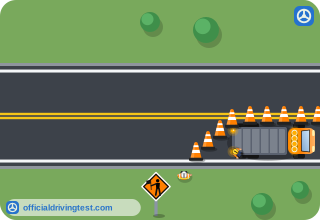
What should you do as you approach a flagging operation?
- Speed up to clear the zone before the flagger signals
- Be prepared to stop and follow the flagger's instructions
- Follow the car ahead and ignore the flagger
- Move to the shoulder and wait for the workers
Show answer
Correct answer: Be prepared to stop and follow the flagger's instructions
For a flagging operation you should be prepared to stop as you approach the work zone and follow the flagger's instructions.
Source: Missouri Driver Guide (Revised August 2026), page 53 · Open this page in the manual (Manual page 53)
-
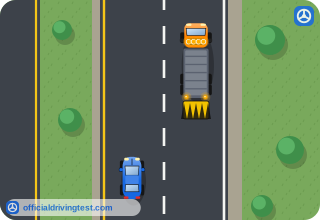
What may workers in a mobile work zone do?
- Work only on the shoulder
- Work only when no traffic is present
- Work only from inside their vehicles
- Exit their vehicles briefly to conduct work
Show answer
Correct answer: Exit their vehicles briefly to conduct work
In a mobile work zone, workers may exit their vehicles briefly to conduct work.
Source: Missouri Driver Guide (Revised August 2026), page 53 · Open this page in the manual (Manual page 53)
-
In a mobile work zone, what does the manual tell you to follow?
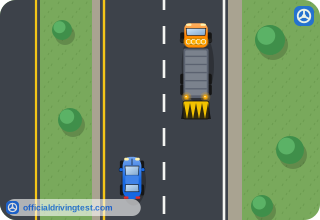
- The directional guide of the flashing arrow panel
- The taillights of the slowest work vehicle
- The lane lines alone
- The speed of the traffic behind you
Show answer
Correct answer: The directional guide of the flashing arrow panel
In a mobile work zone you follow the directional guide of the Flashing Arrow Panel.
Source: Missouri Driver Guide (Revised August 2026), page 53 · Open this page in the manual (Manual page 53)
-
What should you expect to see when approaching a mobile work zone?
- A flagger holding a stop paddle at both ends of the work zone
- A row of orange barrels placed across every lane of the road
- A protective vehicle with a flashing arrow panel showing the merge lane
- A lowered gate and flashing red lights at each work zone end
Show answer
Correct answer: A protective vehicle with a flashing arrow panel showing the merge lane
A driver approaching a mobile work zone should expect a protective vehicle in the lane with a flashing arrow panel designating the correct lane to merge to.
Source: Missouri Driver Guide (Revised August 2026), page 53 · Open this page in the manual (Manual page 53)
-
What does the sign on the protective vehicle in a mobile work zone usually state?
- ROAD CLOSED
- SLOW VEHICLES
- WORK ZONE ENDS
- KEEP LEFT
Show answer
Correct answer: SLOW VEHICLES
The protective vehicle in a mobile work zone is marked with a sign, usually stating "SLOW VEHICLES".
Source: Missouri Driver Guide (Revised August 2026), page 53 · Open this page in the manual (Manual page 53)
-
You see emergency lights behind you. What should you do?
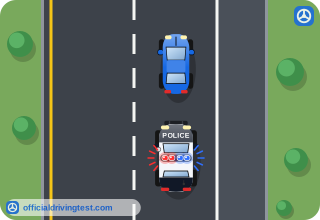
- Speed up slightly to reach a well-lit place, and then stop there
- Activate your turn signal and pull off or to the side of the roadway safely
- Stop immediately in your travel lane with the flashers turned on
- Keep driving at the same speed until the officer drives past you
Show answer
Correct answer: Activate your turn signal and pull off or to the side of the roadway safely
When you see emergency lights behind you, stay calm, activate your turn signal, and pull off or to the side of the roadway as soon and safely as possible.
Source: Missouri Driver Guide (Revised August 2026), page 60 · Open this page in the manual (Manual page 60)
-
When stopped by a law enforcement officer, what should you do with the ignition and the radio?
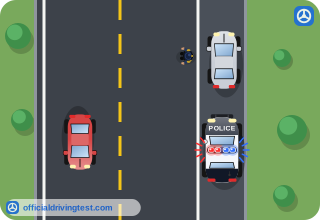
- Turn them off
- Leave them on
- Turn off the radio and leave the engine running
- Turn up the radio to hear the officer
Show answer
Correct answer: Turn them off
Turn off the ignition and radio, and stay in your vehicle unless directed by the officer to exit.
Source: Missouri Driver Guide (Revised August 2026), page 60 · Open this page in the manual (Manual page 60)
-
When stopped by a law enforcement officer, where should you keep your hands?
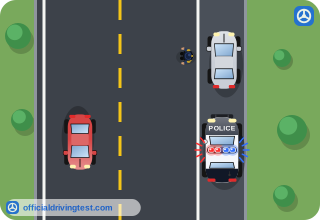
- On your lap
- Reaching for the glove box
- On the steering wheel
- Out of sight under the seat
Show answer
Correct answer: On the steering wheel
Keep your hands on the steering wheel so they are easily observable.
Source: Missouri Driver Guide (Revised August 2026), page 60 · Open this page in the manual (Manual page 60)
-
During a traffic stop, what should you ask your passengers to do?
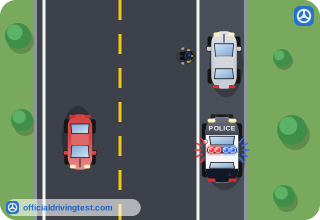
- Get out and stand away from the vehicle by the road
- Stay calm and in the vehicle, with their hands in plain view
- Help look for the vehicle documents in the glove box
- Use their phones to record the whole stop on video
Show answer
Correct answer: Stay calm and in the vehicle, with their hands in plain view
Ask your passengers to remain calm and to stay in the vehicle while keeping their hands in plain view as well.
Source: Missouri Driver Guide (Revised August 2026), page 60 · Open this page in the manual (Manual page 60)
-
What does the manual say about using cell phones and mobile devices during a traffic stop?
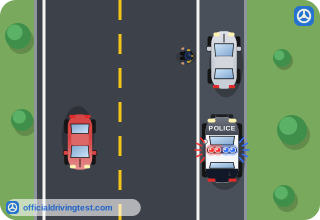
- Only the driver may use them during the whole stop
- Only the passengers may use them during the stop
- Anyone may use them if the officer takes a long time
- They should not be used by you or any of your passengers
Show answer
Correct answer: They should not be used by you or any of your passengers
Cell phones and mobile devices should not be used by you or any of your passengers during the stop.
Source: Missouri Driver Guide (Revised August 2026), page 60 · Open this page in the manual (Manual page 60)
-
During a traffic stop, what should you do about your driver license and vehicle documents?
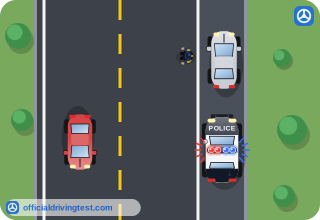
- Reach for them right away to save the officer a lot of time
- Hold them out of the window before the officer walks up to you
- Do not search for them; wait for the officer to give you instructions
- Start searching for them as soon as you have stopped the vehicle
Show answer
Correct answer: Do not search for them; wait for the officer to give you instructions
Do not make sudden moves or search for your driver’s license or vehicle documents; wait for the officer to give you instructions.
Source: Missouri Driver Guide (Revised August 2026), page 60 · Open this page in the manual (Manual page 60)
-
You have a weapon in the vehicle when stopped by a law enforcement officer. What should you do?
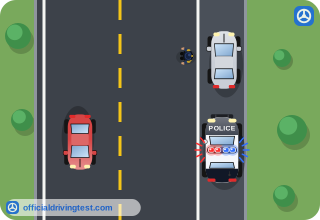
- Inform the officer upon first contact
- Say nothing unless the officer asks
- Hide it under the seat
- Tell the officer only if you are asked to exit
Show answer
Correct answer: Inform the officer upon first contact
If you have a weapon(s) in the vehicle, inform the officer upon first contact.
Source: Missouri Driver Guide (Revised August 2026), page 60 · Open this page in the manual (Manual page 60)
-
You are stopped by a law enforcement officer at night. What should you do to help the officer see inside your vehicle?
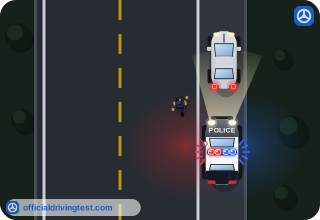
- Turn on your high beams so the officer sees you
- Turn off all of your lights, including the interior ones
- Turn on your hazard flashers and nothing else
- Turn on your interior lights as soon as you stop
Show answer
Correct answer: Turn on your interior lights as soon as you stop
To assist with visibility, turn on your interior lights as soon as you stop to help the officer see inside your vehicle.
Source: Missouri Driver Guide (Revised August 2026), page 61 · Open this page in the manual (Manual page 61)
-
The officer who stopped you is not in uniform. What does the manual say?
- You may not ask to see the officer’s credentials at all
- The officer shows credentials, or you may ask to see them
- You must drive to the nearest police station before stopping
- You must call the police agency before you roll down your window
Show answer
Correct answer: The officer shows credentials, or you may ask to see them
If the officer isn’t in uniform they will show you their law enforcement credentials or you may ask to see them.
Source: Missouri Driver Guide (Revised August 2026), page 61 · Open this page in the manual (Manual page 61)
-
Which set of documents may an officer ask to see during a traffic stop?
- Driver license, proof of insurance, and vehicle registration
- Driver license, vehicle title, and bill of sale
- Birth certificate, proof of insurance, and registration
- Driver license, inspection report, and vehicle title
Show answer
Correct answer: Driver license, proof of insurance, and vehicle registration
The officer may ask to see your driver license, proof of insurance, and vehicle registration.
Source: Missouri Driver Guide (Revised August 2026), page 61 · Open this page in the manual (Manual page 61)
-
During a traffic stop, the documents the officer asks for are out of your reach. What should you do?
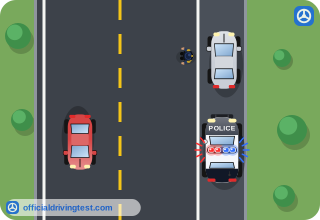
- Reach for them quickly without saying anything first
- Get out of the vehicle to find them in the trunk
- Tell the officer where they are before you reach for them
- Ask a passenger to search the vehicle quietly for them
Show answer
Correct answer: Tell the officer where they are before you reach for them
If the documents are out of your reach, tell the officer where they are before you reach for them.
Source: Missouri Driver Guide (Revised August 2026), page 61 · Open this page in the manual (Manual page 61)
-
The officer asks you to exit the vehicle. What should you do?
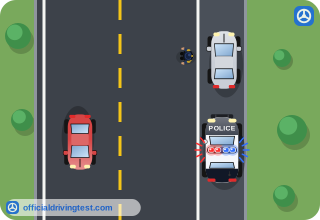
- Stay beside your open door with your back to the traffic
- Stay safely away from traffic and keep your hands in plain view
- Stand in the travel lane so that you can be seen clearly
- Keep your hands in your pockets to stay warm and calm
Show answer
Correct answer: Stay safely away from traffic and keep your hands in plain view
If the officer asks you to exit the vehicle, stay safely away from traffic and keep your hands in plain view.
Source: Missouri Driver Guide (Revised August 2026), page 61 · Open this page in the manual (Manual page 61)
-
You believe a law enforcement officer acted inappropriately during a stop. What does the manual say to do?
- Argue with the officer at the roadside until he or she apologizes
- Do nothing, since such reports are never accepted by the agency
- Report it to the Department of Revenue license office in person
- Document the officer’s behavior and report it to the officer’s agency
Show answer
Correct answer: Document the officer’s behavior and report it to the officer’s agency
If you believe the officer acted inappropriately, document the officer’s behavior and report it to the officer’s agency in a timely manner.
Source: Missouri Driver Guide (Revised August 2026), page 61 · Open this page in the manual (Manual page 61)
-
Why do law enforcement officers conduct traffic stops, according to the manual?
- They see a violation or are conducting a police investigation
- Only when a driver asks the officer for help on the road
- Only to check driver licenses and vehicle registrations
- Only when the officer believes a driver has been drinking
Show answer
Correct answer: They see a violation or are conducting a police investigation
Officers conduct traffic stops because they observe a traffic violation or are conducting a police investigation.
Source: Missouri Driver Guide (Revised August 2026), page 60 · Open this page in the manual (Manual page 60)
-
Which of these is a legal right you have during a traffic stop, according to the manual?
- The right to leave the traffic stop whenever you choose to go
- The right to drive without a license for one day
- The right to be free from being forced to incriminate yourself
- The right to have the ticket cancelled on the spot
Show answer
Correct answer: The right to be free from being forced to incriminate yourself
The manual lists the right to be free from unreasonable search and seizure, the right to remain silent (not incriminating yourself), and the right to an attorney.
Source: Missouri Driver Guide (Revised August 2026), page 61 · Open this page in the manual (Manual page 61)
-
What may happen to your driving privilege if you are in a crash and strike a highway worker or emergency responder within a designated construction, work, or emergency zone?
- It is always cancelled for life
- It is never affected if no one is hurt
- It is lowered to a learner status
- It may be revoked
Show answer
Correct answer: It may be revoked
Striking a highway worker or emergency responder in a designated construction, work, or emergency zone may lead to revocation of your driving privilege.
Source: Missouri Driver Guide (Revised August 2026), page 82 · Open this page in the manual (Manual page 82)