Missouri: Emergency vehicles, work zones and traffic stops — Part 1 Practice Test
Questions in this part include: “What is the minimum fine for a first offense of speeding or passing in a work zone on Missouri state roadways?” · “What should you do if an emergency vehicle is approaching as you reach a roundabout?”
Independent educational site · not affiliated with any government agency or DMV
Ready? Test yourself
- Instant feedback with an explanation
- Every answer cites its source in the manual
- Your best score is saved on this device
Questions are original and based on the official manual "Missouri Driver Guide" (Revised August 2026), Missouri Department of Revenue.
All 21 questions in this practice test
Take the test above first, then use this list to study. Tap “Show answer” to see the correct answer and explanation.
Show the questions and answersHide the questions
-
What is the minimum fine for a first offense of speeding or passing in a work zone on Missouri state roadways?
- $100
- $150
- $500
- $250
Show answer
Correct answer: $250
A driver caught speeding or passing in a construction or work zone on Missouri state roadways could be fined a minimum of $250 for the first offense.
Source: Missouri Driver Guide (Revised August 2026), page 22 · Open this page in the manual (Manual page 22)
-
What is the minimum fine for a second or subsequent offense of speeding or passing in a work zone on Missouri state roadways?
- $250
- $300
- $350
- $500
Show answer
Correct answer: $300
The minimum fine rises to $300 for a second or subsequent offense, in addition to any other fine authorized by law.
Source: Missouri Driver Guide (Revised August 2026), page 22 · Open this page in the manual (Manual page 22)
-
Which emergency vehicle signals mean you must yield the right-of-way?
- A siren or air horn and a red or blue flashing light
- A siren or air horn and a green or white flashing light
- Only a yellow flashing light on its roof
- Flashing headlights and a steady horn
Show answer
Correct answer: A siren or air horn and a red or blue flashing light
You must yield to police, fire, ambulance, or any other emergency vehicle using a siren or air horn and a red or blue flashing light.
Source: Missouri Driver Guide (Revised August 2026), page 23 · Open this page in the manual (Manual page 23)
-
What should you do when you see or hear an emergency vehicle approaching from any direction?
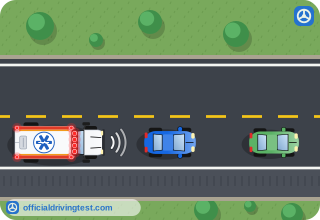
- Pull over to the nearest edge of the road, whichever side it is
- Slow down and keep driving in your lane until it passes
- Pull over to the right edge of the road or as near as possible
- Stop in the middle of your lane and wait for it to pass
Show answer
Correct answer: Pull over to the right edge of the road or as near as possible
The manual says to pull over to the right edge of the road, or as near to the right as possible, when an emergency vehicle approaches from any direction.
Source: Missouri Driver Guide (Revised August 2026), page 23 · Open this page in the manual (Manual page 23)
-
If you are in an intersection when an emergency vehicle approaches, what should you do?
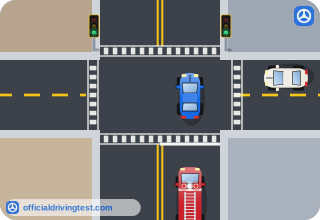
- Stop immediately where you are, even in the intersection
- Drive through the intersection before you pull over
- Back up out of the intersection and pull over
- Turn left at once and pull over to the left side
Show answer
Correct answer: Drive through the intersection before you pull over
The manual says that if you are in an intersection, you should drive through it before pulling over.
Source: Missouri Driver Guide (Revised August 2026), page 23 · Open this page in the manual (Manual page 23)
-
After you pull over for an emergency vehicle, how long should you remain stopped?
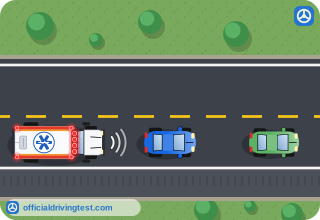
- For at least one minute after it passes
- Until your lane is clear of traffic
- Until another driver goes ahead of you
- Until the emergency vehicle passes
Show answer
Correct answer: Until the emergency vehicle passes
You must remain stopped until the emergency vehicle passes.
Source: Missouri Driver Guide (Revised August 2026), page 23 · Open this page in the manual (Manual page 23)
-
What should you do about instructions given over an emergency vehicle's loudspeaker?
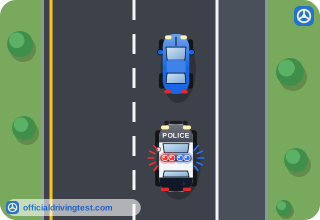
- Ignore them unless a police officer waves you on
- Keep driving unless the siren is also sounding
- Follow them only if you are in an intersection
- Follow any instructions given
Show answer
Correct answer: Follow any instructions given
The manual says to follow any instructions given over the emergency vehicle's loudspeaker.
Source: Missouri Driver Guide (Revised August 2026), page 23 · Open this page in the manual (Manual page 23)
-
After one emergency vehicle has passed, what should you remember?
- You may pull out as soon as the first vehicle has passed
- Others may follow, so proceed only when the way is clear
- You should follow the first vehicle until it turns off
- Others never follow, so you may continue at once
Show answer
Correct answer: Others may follow, so proceed only when the way is clear
Emergency vehicles may follow each other, so you should proceed only when the way is clear.
Source: Missouri Driver Guide (Revised August 2026), page 23 · Open this page in the manual (Manual page 23)
-
On a roadway with at least four lanes and at least two lanes in your direction, what should you do if it is safe when approaching a stationary emergency vehicle displaying lighted red or red and blue lights?
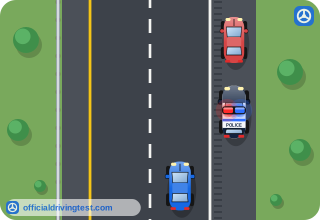
- Stop behind the stationary vehicle until it leaves
- Change into the lane next to the stationary vehicle
- Change into a lane not adjacent to the stationary vehicle
- Sound your horn and keep driving in the same lane
Show answer
Correct answer: Change into a lane not adjacent to the stationary vehicle
You must proceed with caution and, if it is safe, change into a lane not adjacent to the stationary emergency vehicle.
Source: Missouri Driver Guide (Revised August 2026), page 23 · Open this page in the manual (Manual page 23)
-
When approaching a stationary emergency vehicle displaying lighted red or red and blue lights, what must you do if changing lanes would be unsafe or impossible?
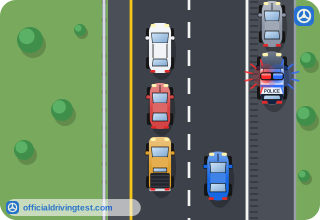
- Proceed with due caution and reduce speed
- Speed up to get past the vehicle quickly
- Maintain your speed and move to the shoulder
- Stop completely until the vehicle leaves
Show answer
Correct answer: Proceed with due caution and reduce speed
If changing lanes would be unsafe or impossible, you must proceed with due caution and reduce your speed, maintaining a safe speed for road conditions.
Source: Missouri Driver Guide (Revised August 2026), page 23 · Open this page in the manual (Manual page 23)
-
What should you do if an emergency vehicle is approaching as you reach a roundabout?
- Enter quickly and clear the circle ahead of it
- Enter and stop inside the circle
- Enter and move to the center of the circle
- Do not enter the roundabout
Show answer
Correct answer: Do not enter the roundabout
The manual says not to enter a roundabout if an emergency vehicle is approaching.
Source: Missouri Driver Guide (Revised August 2026), page 27 · Open this page in the manual (Manual page 27)
-
If an emergency vehicle approaches while you are in a roundabout, what should you do?
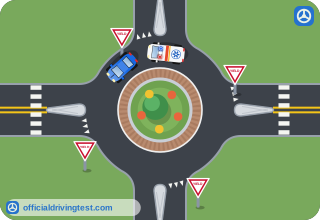
- Stop where you are inside the circle
- Exit immediately and pull to the right
- Circle once more and pull to the left
- Speed up and stay ahead of it until it passes
Show answer
Correct answer: Exit immediately and pull to the right
If an emergency vehicle approaches while you are in the roundabout, exit immediately and pull to the right.
Source: Missouri Driver Guide (Revised August 2026), page 27 · Open this page in the manual (Manual page 27)
-
What do work zone signs indicate?
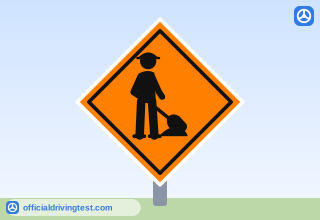
- The location of services such as rest areas and hospitals
- Direction and distance to the next city
- A railroad crossing is ahead
- Some type of work is being performed on or alongside the roadway
Show answer
Correct answer: Some type of work is being performed on or alongside the roadway
Work zone signs indicate that some type of work is being performed on or alongside the roadway.
Source: Missouri Driver Guide (Revised August 2026), page 51 · Open this page in the manual (Manual page 51)
-
When driving through work zones, what does the manual tell you to look for?
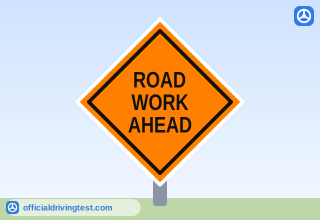
- Increased speed limits, wider lanes, and fewer workers
- Reduced speed limits, narrow driving lanes, and highway workers
- Only lane closures marked by flaggers
- Only vehicles that are stopped on the shoulder
Show answer
Correct answer: Reduced speed limits, narrow driving lanes, and highway workers
The manual says to stay alert and look for reduced speed limits, narrow driving lanes, and highway workers.
Source: Missouri Driver Guide (Revised August 2026), page 52 · Open this page in the manual (Manual page 52)
-
Which precaution does the manual list for driving through work zones?
- Speed up to clear the work zone quickly
- Follow other vehicles closely to stay in line
- Ignore the signs if no workers are in sight
- Watch for vehicles entering and exiting the work zone
Show answer
Correct answer: Watch for vehicles entering and exiting the work zone
Among the precautions for driving through work zones, the manual lists watching for vehicles entering and exiting the work zone.
Source: Missouri Driver Guide (Revised August 2026), page 52 · Open this page in the manual (Manual page 52)
-
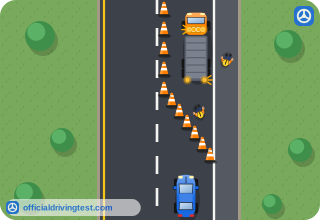
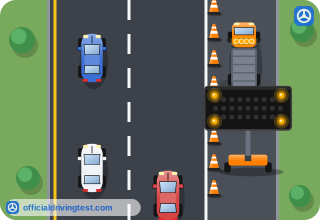
What is a shoulder work zone?
- Work that takes place on the shoulder or beyond the shoulder
- Work in a travel lane that closes it to traffic
- Work on a two-lane, two-way roadway with one lane closed
- Work in a travel lane where slow vehicles move with the workers
Show answer
Correct answer: Work that takes place on the shoulder or beyond the shoulder
A shoulder work zone is work that takes place on the shoulder or beyond the shoulder.
Source: Missouri Driver Guide (Revised August 2026), page 52 · Open this page in the manual (Manual page 52)
-
What should you do when approaching a shoulder work zone?
- Speed up to pass the workers quickly
- Move onto the shoulder to pass
- Reduce speed
- Stop and wait for the workers to leave
Show answer
Correct answer: Reduce speed
For a shoulder work zone, the manual tells you to use caution and reduce speed when approaching the work zone.
Source: Missouri Driver Guide (Revised August 2026), page 52 · Open this page in the manual (Manual page 52)
-
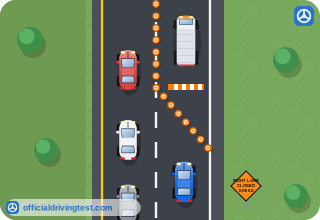
What does the manual tell you to do as you approach a lane closure work zone?
- Stay in the closed lane until workers wave you over
- Merge to a designated lane or one where no work is being done
- Stop in the travel lane and wait for the workers to finish
- Pass the work zone by driving on the shoulder
Show answer
Correct answer: Merge to a designated lane or one where no work is being done
For a lane closure, you merge to the designated lane or a lane that work is not being performed in.
Source: Missouri Driver Guide (Revised August 2026), page 52 · Open this page in the manual (Manual page 52)
-
In a lane closure work zone, to what speed does the manual tell you to reduce?
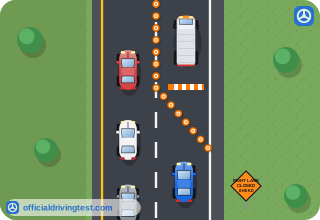
- The speed of the slowest vehicle ahead
- Exactly 10 mph
- The regular posted speed minus 5 mph
- The designated work zone speed limit
Show answer
Correct answer: The designated work zone speed limit
In a lane closure you reduce speed to the designated work zone speed limit.
Source: Missouri Driver Guide (Revised August 2026), page 52 · Open this page in the manual (Manual page 52)
-
On what kind of roadway does a flagging operation take place?
- A two-lane, two-way roadway with one lane closed
- A multi-lane interstate with two lanes closed
- A one-way roadway with the shoulder closed
- A freeway ramp with no lanes closed
Show answer
Correct answer: A two-lane, two-way roadway with one lane closed
A flagging operation takes place on a two-lane, two-way roadway with one lane closed.
Source: Missouri Driver Guide (Revised August 2026), page 53 · Open this page in the manual (Manual page 53)
-
Where are flaggers present in a flagging operation?
- Only at the middle point of the work zone
- Only at the beginning point of the work zone
- At the beginning and end points of the work zone
- Only at the nearest intersection to the work zone
Show answer
Correct answer: At the beginning and end points of the work zone
In a flagging operation, a flagger or flaggers will be present at the beginning and end points of the work zone providing traffic control to oncoming vehicles.
Source: Missouri Driver Guide (Revised August 2026), page 53 · Open this page in the manual (Manual page 53)