Minnesota: Traffic signals Practice Test
Red, yellow and green lights, arrows, flashing signals, lane-use control signals and pedestrian signals.
Independent educational site · not affiliated with any government agency or DMV
Ready? Test yourself
- Instant feedback with an explanation
- Every answer cites its source in the manual
- Your best score is saved on this device
Questions are original and based on the official manual "Minnesota Driver’s Manual" (June 2026), Minnesota Driver and Vehicle Services.
All 28 questions in this practice test
Take the test above first, then use this list to study. Tap “Show answer” to see the correct answer and explanation.
Show the questions and answersHide the questions
-
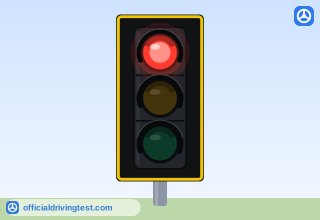
You are stopped at a red traffic light and want to go straight through. What must be true before you proceed?
- The light has turned yellow for cross traffic
- Cross traffic has slowed down or stopped
- The light is green and your path is clear
- At least five seconds have passed
Show answer
Correct answer: The light is green and your path is clear
At a red light you wait until the light turns green and your path is clear before proceeding.
Source: Minnesota Driver’s Manual (June 2026), page 41
-
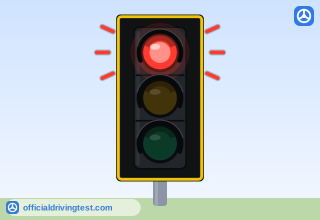
How should you treat a flashing red traffic light?
- As a yield sign
- As a warning to slow down
- As a signal that is out of order
- As you would a stop sign
Show answer
Correct answer: As you would a stop sign
The manual says to treat a flashing red traffic light as you would a stop sign.
Source: Minnesota Driver’s Manual (June 2026), page 41
-
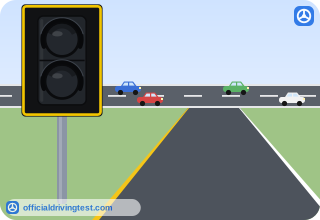
When must you stop at a freeway ramp meter?
- When the light is red
- Whenever another car is waiting ahead
- Only during rush hour
- Whenever the light is flashing
Show answer
Correct answer: When the light is red
You must come to a complete stop at a freeway ramp meter when the light is red.
Source: Minnesota Driver’s Manual (June 2026), page 41
-
Where are traffic-control signals used?
- At intersections with high traffic volume
- Only on roads with a high speed limit
- At every driveway that meets a public road
- Only at intersections near schools and hospitals
Show answer
Correct answer: At intersections with high traffic volume
Traffic-control signals are used at intersections with high traffic volume.
Source: Minnesota Driver’s Manual (June 2026), page 65
-
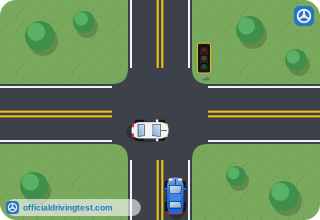
How should you treat an intersection where the traffic signal is not functioning?
- Like an intersection with flashing red lights in all directions
- Stop and wait there until the signal is repaired
- Like an uncontrolled intersection
- Go through at your normal speed, because you have the right of way
Show answer
Correct answer: Like an uncontrolled intersection
If a traffic signal is not functioning, treat the intersection like an uncontrolled intersection.
Source: Minnesota Driver’s Manual (June 2026), page 65
-
When should you not enter an intersection controlled by a traffic signal?
- When another vehicle is waiting close behind you
- When you cannot clear it without blocking cross traffic
- When pedestrians are waiting at the crosswalk
- When the cross street has fewer lanes than your road
Show answer
Correct answer: When you cannot clear it without blocking cross traffic
You should not enter a signal-controlled intersection unless you can move through it immediately, continuously and completely without blocking cross traffic.
Source: Minnesota Driver’s Manual (June 2026), page 65
-
When does the rule against entering a signal-controlled intersection you cannot clear not apply?
- When your light has just turned green
- When the traffic behind you is honking
- When you are driving on a one-way street
- When an agent or peace officer directs you
Show answer
Correct answer: When an agent or peace officer directs you
The intersection gridlock rule does not apply if you are directed by a traffic-control agent or a peace officer.
Source: Minnesota Driver’s Manual (June 2026), page 65
-
Which of these is an exception to the rule against entering a signal-controlled intersection you cannot clear?
- Moving to let an authorized emergency vehicle pass
- Following a large truck that is entering the intersection
- Waiting to turn onto a street that has no traffic signal
- Driving a vehicle with a flashing amber light
Show answer
Correct answer: Moving to let an authorized emergency vehicle pass
The gridlock rule does not apply when you are moving to allow the passing of an authorized emergency vehicle with its lights activated.
Source: Minnesota Driver’s Manual (June 2026), page 65
-
Which of these is an exception to the rule against entering a signal-controlled intersection you cannot clear?
- Going straight when the light has been green for a long time
- Entering the intersection to get ahead of a vehicle behind you
- Making a turn that allows the vehicle to safely leave the intersection
- Crossing when cross traffic has not started to move yet
Show answer
Correct answer: Making a turn that allows the vehicle to safely leave the intersection
The gridlock rule does not apply when you are making a turn that allows the vehicle to safely leave the intersection.
Source: Minnesota Driver’s Manual (June 2026), page 65
-
Where must you stop for a steady red light?
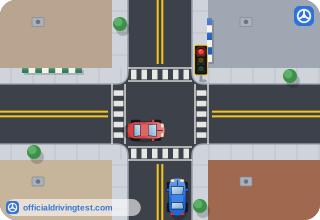
- In the crosswalk, as close to cross traffic as you safely can
- At the stop line, before the crosswalk or before entering the intersection
- Past the crosswalk, with your front wheels inside the intersection
- At the far edge of the intersection after cross traffic has cleared
Show answer
Correct answer: At the stop line, before the crosswalk or before entering the intersection
At a steady red light you must come to a complete stop at the stop line, before the crosswalk or before entering the intersection.
Source: Minnesota Driver’s Manual (June 2026), page 66
-
You have stopped for a red arrow. When may you proceed in the direction the arrow indicates?
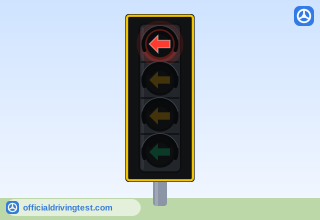
- When the pedestrian signal shows Walk
- When the arrow turns green
- When cross traffic has stopped moving
- After waiting three seconds
Show answer
Correct answer: When the arrow turns green
After stopping for a red arrow, you may proceed in the direction it indicates when the arrow turns green.
Source: Minnesota Driver’s Manual (June 2026), page 66
-
What does a steady yellow light or arrow mean?
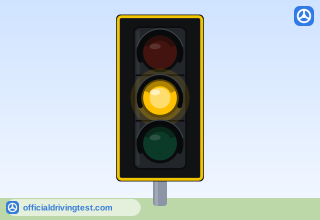
- The signal is about to turn red
- The signal is about to turn green
- Traffic from the other direction has stopped
- The intersection is closed to traffic
Show answer
Correct answer: The signal is about to turn red
A steady yellow light or arrow means caution, because the signal is about to turn red.
Source: Minnesota Driver’s Manual (June 2026), page 66
-
The light turns steady yellow while you can still stop safely before the intersection. What should you do?
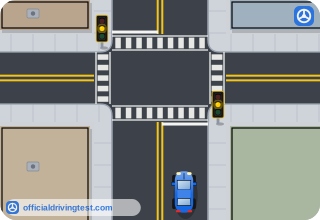
- Proceed through the intersection with caution
- Speed up to cross before the light turns red
- Do not enter the intersection
- Enter the intersection and stop if needed
Show answer
Correct answer: Do not enter the intersection
On a steady yellow you should not enter the intersection if you can stop safely before doing so.
Source: Minnesota Driver’s Manual (June 2026), page 66
-
What must you do at a flashing yellow light?
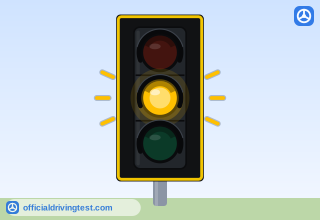
- Come to a complete stop and go when the intersection is clear
- Stop only if a pedestrian is crossing in front of you
- Speed up to clear the intersection before it changes
- Proceed with caution, yielding to vehicles already in the intersection
Show answer
Correct answer: Proceed with caution, yielding to vehicles already in the intersection
At a flashing yellow light, proceed with caution and yield the right of way to vehicles and pedestrians already in the intersection.
Source: Minnesota Driver’s Manual (June 2026), page 67
-
What does a green arrow mean?
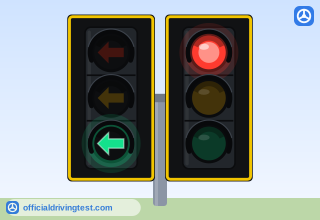
- You must stop before turning in the direction of the arrow
- You must wait for the arrow to turn yellow before turning
- You may turn either way or go straight
- You can safely turn in the direction of the arrow
Show answer
Correct answer: You can safely turn in the direction of the arrow
A green arrow means you can safely turn in the direction of the arrow, because your turn should be protected from oncoming or crossing traffic.
Source: Minnesota Driver’s Manual (June 2026), page 67
-
What do lane use control signals allow?
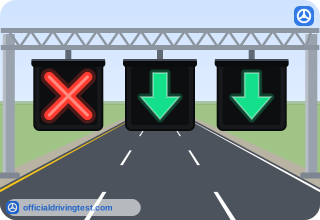
- Lanes used by traffic from different directions at different times
- Drivers to ignore other signs and signals in the lane shown
- Lanes to be reserved for large vehicles at all hours
- Traffic to use the freeway shoulder during rush hour
Show answer
Correct answer: Lanes used by traffic from different directions at different times
Lane use control signals allow lanes to be used by traffic from different directions at different times.
Source: Minnesota Driver’s Manual (June 2026), page 68
-
While you follow a lane use control signal, what else must you do?
- Ignore regulatory signs in that lane
- Follow only the lane signal until it changes
- Follow all other traffic signs and signals that apply
- Follow only the overhead signal when an officer is present
Show answer
Correct answer: Follow all other traffic signs and signals that apply
You must also follow all other traffic signs and signals that apply when lane use control signals are displayed.
Source: Minnesota Driver’s Manual (June 2026), page 68
-
A signal above a lane shows a steady downward green arrow. What does it mean?
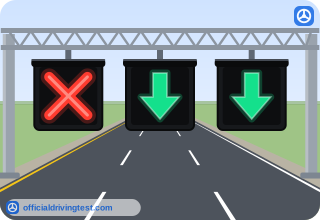
- You must change into the lane below the arrow
- You are allowed to drive in the lane below the arrow
- A lane change is being made in the lane below the arrow
- Only left turns are allowed in the lane below the arrow
Show answer
Correct answer: You are allowed to drive in the lane below the arrow
A steady downward green arrow means you are allowed to drive in the lane below it.
Source: Minnesota Driver’s Manual (June 2026), page 68
-
A signal above a lane shows a steady yellow X. What does it mean?
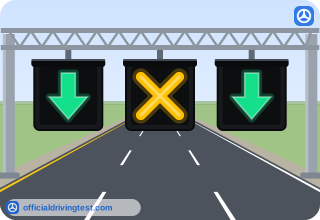
- Use the lane below only to make a left turn
- Drive in the lane below with extra caution
- Stop and wait for the signal to turn green
- Prepare to move safely into another lane
Show answer
Correct answer: Prepare to move safely into another lane
A steady yellow X means you should prepare to move safely into another lane because a lane-control change is being made in that lane.
Source: Minnesota Driver’s Manual (June 2026), page 68
-
What is displayed next after a steady yellow X over a lane?
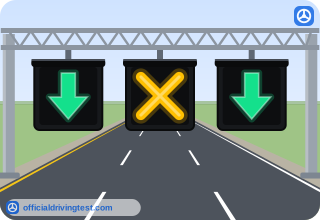
- A steady red X
- A steady downward green arrow
- A flashing yellow X
- A flashing downward yellow arrow
Show answer
Correct answer: A steady red X
After a steady yellow X, a steady red X will be displayed next, and you cannot occupy the lane at that time.
Source: Minnesota Driver’s Manual (June 2026), page 68
-
A signal above a lane shows a flashing yellow X. What does it mean?
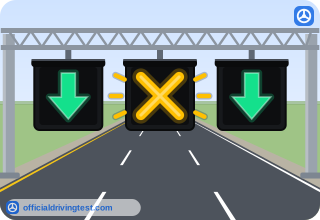
- The lane below is closed to all traffic and you must leave it
- You must prepare to move into another lane
- You can use the lane below to turn left, with caution
- Only through traffic may use the lane below
Show answer
Correct answer: You can use the lane below to turn left, with caution
A flashing yellow X means you can use the lane below it to make a left turn, with caution because left-turning vehicles from the other direction may be using the same lane.
Source: Minnesota Driver’s Manual (June 2026), page 68
-
A signal above a freeway lane shows a steady downward yellow arrow. What does it mean?
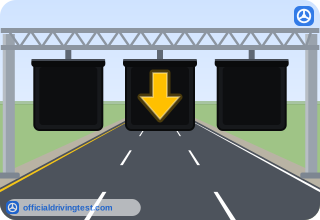
- Use the lane below with caution
- Prepare to move into another lane, because the lane below will close
- The lane below is reserved for left turns
- The lane below is for vehicles with two or more occupants only
Show answer
Correct answer: Prepare to move into another lane, because the lane below will close
A steady downward yellow arrow means you should prepare to move safely into another lane because the freeway lane below it will be closed.
Source: Minnesota Driver’s Manual (June 2026), page 68
-
A signal above a freeway lane shows a flashing downward yellow arrow. What does it mean?
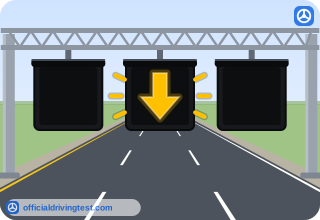
- The lane under it will soon be closed
- The lane under it is for left turns only
- You must stop before entering the lane under it
- You can use the freeway lane under it, with caution
Show answer
Correct answer: You can use the freeway lane under it, with caution
A flashing downward yellow arrow means you can use the freeway lane under it, but you should exercise caution in that lane.
Source: Minnesota Driver’s Manual (June 2026), page 68
-
A signal above a lane shows a steady red X. What does it mean?
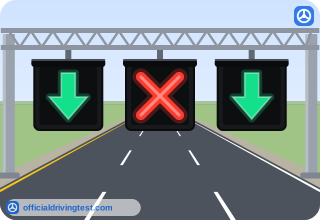
- You cannot drive in the lane
- You may drive in the lane with caution
- You may use the lane only to turn left
- You should prepare to move into the lane
Show answer
Correct answer: You cannot drive in the lane
A steady red X means you cannot drive in the lane.
Source: Minnesota Driver’s Manual (June 2026), page 68
-
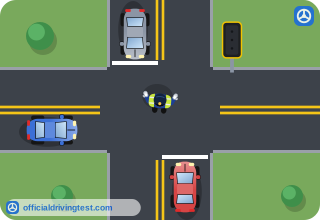
A traffic officer gives you hand signals that differ from a traffic signal, sign or pavement marking. What should you obey?
- The traffic signal ahead
- The posted sign
- The pavement marking
- The officer’s hand signals
Show answer
Correct answer: The officer’s hand signals
When an officer is present, you must obey the officer’s hand signals rather than traffic signals, signs or pavement markings.
Source: Minnesota Driver’s Manual (June 2026), page 71
-
How do most traffic officers signal drivers to stop?
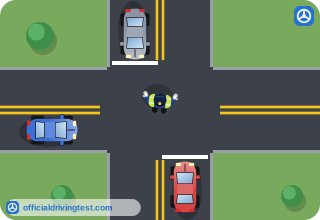
- By holding up one hand with the palm facing the vehicle and giving a long blast on the whistle
- By pointing at the vehicle with both arms and giving two short blasts on the whistle
- By waving a hand above the head and giving a series of short blasts on the whistle
- By pointing at the ground and giving a long blast on the whistle
Show answer
Correct answer: By holding up one hand with the palm facing the vehicle and giving a long blast on the whistle
Most traffic officers signal drivers to stop by holding up one hand with the palm facing the vehicle and giving a long blast on the whistle.
Source: Minnesota Driver’s Manual (June 2026), page 71
-
How do officers signal drivers to start or keep moving?
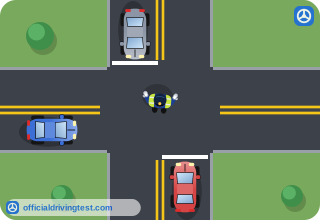
- By holding up one hand and giving a long blast on the whistle
- By pointing at the vehicle and giving one short blast on the whistle
- By motioning with the hand and giving a series of short blasts on the whistle
- By holding up two fingers and giving two long blasts on the whistle
Show answer
Correct answer: By motioning with the hand and giving a series of short blasts on the whistle
Officers signal drivers to start or keep moving by motioning with the hand and giving a series of short blasts on the whistle.
Source: Minnesota Driver’s Manual (June 2026), page 71
-
What may an officer use to signal drivers during low-light conditions?
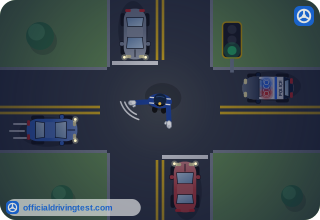
- A traffic cone
- A flashlight
- A hand-held horn
- A reflective vest only
Show answer
Correct answer: A flashlight
Officers may signal with a flashlight during low-light conditions.
Source: Minnesota Driver’s Manual (June 2026), page 71