Minnesota: Railroad crossings Practice Test
Railroad signs, signals and gates, where to stop, when it is safe to cross, which vehicles must always stop, and a stall on the tracks.
Independent educational site · not affiliated with any government agency or DMV
Ready? Test yourself
- Instant feedback with an explanation
- Every answer cites its source in the manual
- Your best score is saved on this device
Questions are original and based on the official manual "Minnesota Driver’s Manual" (June 2026), Minnesota Driver and Vehicle Services.
All 29 questions in this practice test
Take the test above first, then use this list to study. Tap “Show answer” to see the correct answer and explanation.
Show the questions and answersHide the questions
-
Why are most vehicle-train collisions deadly for the driver?
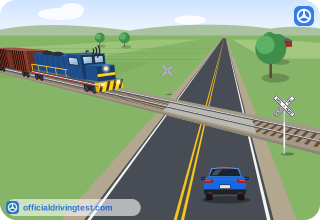
- Because of the size and weight of a train
- Because trains cannot be seen at night
- Because trains travel faster than 100 mph
- Because crossing gates do not work in cold weather
Show answer
Correct answer: Because of the size and weight of a train
Because of the size and weight of a train, most vehicle-train collisions are deadly for the driver.
Source: Minnesota Driver’s Manual (June 2026), page 53
-
What do the signs near the track show at a public railroad crossing?
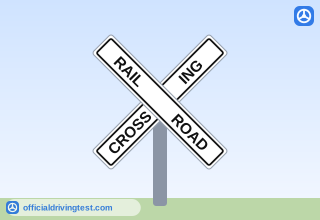
- How fast trains are traveling
- When the next train will arrive
- Which direction the next train is traveling
- How many tracks are present
Show answer
Correct answer: How many tracks are present
Signs near the track show how many tracks are present.
Source: Minnesota Driver’s Manual (June 2026), page 53
-
Flashing lights, bells and gates are activated at a railroad crossing. What do they indicate?
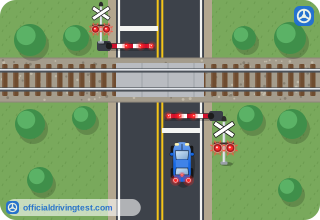
- The crossing is closed for repairs today
- A train or other equipment is approaching
- A train has just passed through the crossing
- Only school buses must stop at the crossing
Show answer
Correct answer: A train or other equipment is approaching
Flashing lights, bells and gates indicate that a train or other on-track equipment is approaching.
Source: Minnesota Driver’s Manual (June 2026), page 53
-
When railroad lights or gates are activated, how far from the nearest rail or gate must you stop your vehicle?
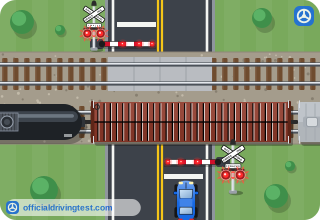
- At least 10 feet
- At least 3 feet
- At least 25 feet
- At least 50 feet
Show answer
Correct answer: At least 10 feet
Stop your vehicle at least 10 feet from the nearest rail or gate when the lights or gates are activated.
Source: Minnesota Driver’s Manual (June 2026), page 53
-
After you stop for activated lights or gates, what must be true before it is safe to cross?
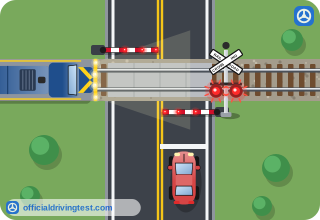
- The train has passed and the gates have started to rise
- The train ahead has slowed to a stop
- You can proceed without stopping within 10 feet past the rails
- You have waited at least one minute
Show answer
Correct answer: You can proceed without stopping within 10 feet past the rails
It is safe to cross when traffic ahead has moved and you can proceed without stopping within 10 feet past the rails.
Source: Minnesota Driver’s Manual (June 2026), page 53
-
At some railroad crossings a flag person controls traffic while a train is approaching. What should you do?
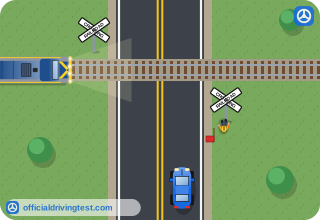
- Ignore the flag person and follow the signs
- Obey the flag person as you would a warning device
- Cross after the flag person leaves
- Wait for a police officer
Show answer
Correct answer: Obey the flag person as you would a warning device
You obey the flag person as you would a warning device.
Source: Minnesota Driver’s Manual (June 2026), page 53
-
Which vehicles must stop at railroad tracks even when no train is present (unless the crossing is marked exempt)?
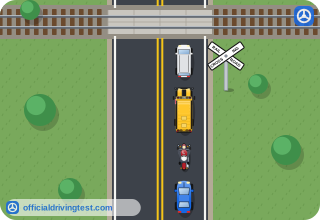
- Passenger cars with automatic transmission
- Motorcycles
- Neighborhood electric vehicles
- Passenger vans, buses and larger trucks
Show answer
Correct answer: Passenger vans, buses and larger trucks
Some vehicles, such as passenger vans, buses and larger trucks, are required to stop at all railroad tracks, whether or not a train is present.
Source: Minnesota Driver’s Manual (June 2026), page 53
-
When the last car of a train passes, what must you do before crossing?
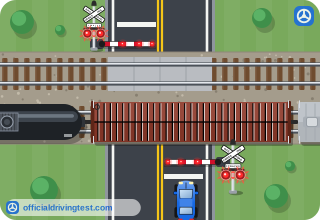
- Cross right away, since the danger has passed
- Be sure no second train is coming on another track
- Wait exactly ten minutes before crossing
- Stop on the rails to look for a second train
Show answer
Correct answer: Be sure no second train is coming on another track
More than one train may approach at the same time from different directions, so be sure a second train is not approaching on another track.
Source: Minnesota Driver’s Manual (June 2026), page 53
-
At which railroad crossings should you look for trains in both directions?
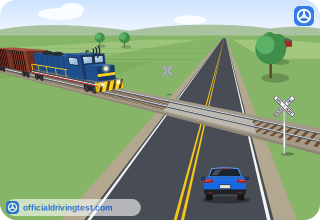
- Only crossings that have no gates or lights
- Only crossings marked with a stop sign
- Every crossing, with or without warning devices
- Only crossings that have more than one track
Show answer
Correct answer: Every crossing, with or without warning devices
Look for trains in both directions at every railroad crossing, whether or not there are warning devices.
Source: Minnesota Driver’s Manual (June 2026), page 53
-
There is heavy traffic on both sides of a railroad crossing. What should you do?
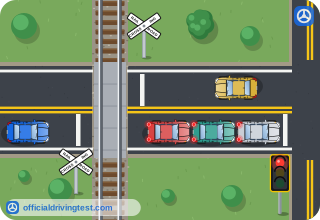
- Wait behind the tracks until you are sure you can get across
- Move onto the tracks and wait there for traffic to clear
- Stop on the tracks only if no train is in sight
- Cross quickly before the traffic builds up behind you
Show answer
Correct answer: Wait behind the tracks until you are sure you can get across
When there is heavy traffic on both sides, you wait behind the tracks until you are sure you can reach the other side without stopping on the tracks.
Source: Minnesota Driver’s Manual (June 2026), page 53
-
Why should you never race a train to get to the other side of a crossing?
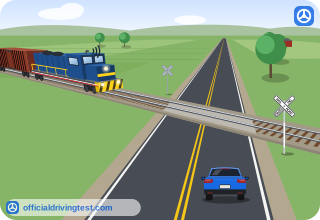
- Trains always travel slower than vehicles
- Trains sound a horn only after the gates close
- Trains cannot stop as quickly as motor vehicles
- Trains stop at every crossing
Show answer
Correct answer: Trains cannot stop as quickly as motor vehicles
Trains cannot stop as quickly as motor vehicles, and a misjudgment could leave you killed or severely injured.
Source: Minnesota Driver’s Manual (June 2026), page 53
-
What should you do about shifting gears while your vehicle is within a railroad crossing?
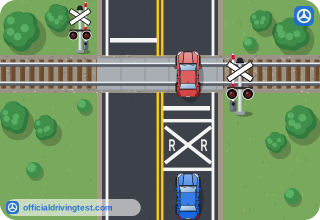
- Do not shift gears
- Shift up to gain speed
- Shift to neutral to coast
- Shift only if a train is in sight
Show answer
Correct answer: Do not shift gears
You should not shift gears while your vehicle is within a crossing.
Source: Minnesota Driver’s Manual (June 2026), page 53
-
If your vehicle has a manual transmission, when should you shift down for a railroad crossing?
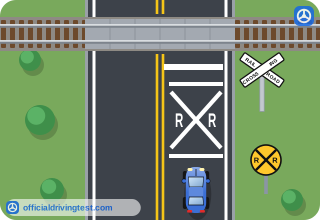
- While on the tracks
- Just after leaving the crossing
- Only when a train is in sight
- Before entering the crossing
Show answer
Correct answer: Before entering the crossing
With a manual transmission you shift down before entering the crossing, not while on it.
Source: Minnesota Driver’s Manual (June 2026), page 53
-
Why should a motorcyclist not swerve to get a better angle for crossing railroad tracks?
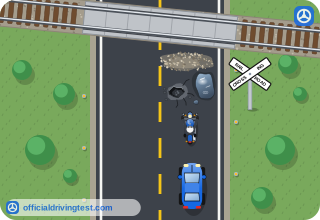
- It may cause the rider to miss the flashing lights
- It may put the rider in a lane of oncoming traffic
- It may damage the rails and the motorcycle tires
- It may be distracting to the driver of the train
Show answer
Correct answer: It may put the rider in a lane of oncoming traffic
Swerving to get a better angle for crossing may cause a motorcyclist to enter into a lane of oncoming traffic.
Source: Minnesota Driver’s Manual (June 2026), page 53
-
If you feel hesitation about crossing railroad tracks when a train is in sight, what should you do?
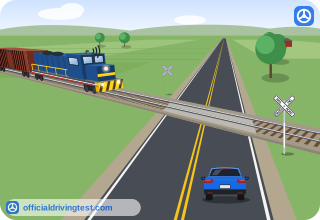
- Stop and wait for the train to pass
- Cross quickly before the train arrives
- Slow down and cross the tracks carefully
- Sound your horn and cross
Show answer
Correct answer: Stop and wait for the train to pass
If you feel hesitation about crossing when a train is in sight, you stop and wait for the train to pass before proceeding.
Source: Minnesota Driver’s Manual (June 2026), page 53
-
When are a train’s distance and speed especially difficult to judge?
- At noon
- In dry weather
- At night
- When the gates are down
Show answer
Correct answer: At night
Although trains are equipped with bright lights and loud horns, their distance and speed are difficult to judge, especially at night.
Source: Minnesota Driver’s Manual (June 2026), page 53
-
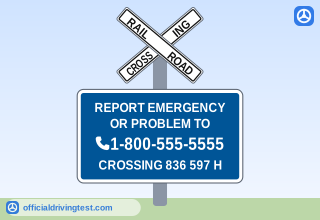
What does the blue Emergency Notification System (ENS) sign at a highway-rail crossing provide?
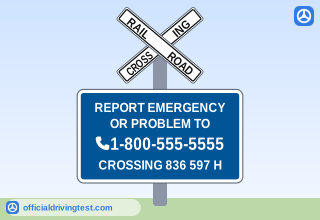
- The speed limit for trains at that crossing
- A 24/7 telephone number for reporting emergencies
- A schedule of the trains that use the crossing
- A radio frequency for contacting train drivers
Show answer
Correct answer: A 24/7 telephone number for reporting emergencies
Every highway-rail crossing has an ENS sign that provides a 24/7 telephone number to call to report problems or emergencies at the railroad location.
Source: Minnesota Driver’s Manual (June 2026), page 54
-
Where is the blue ENS sign located?
- On the highway shoulder a mile before the crossing
- On the front of each train that uses the crossing
- On the pavement just in front of the crossing
- On the crossing posts or the metal control box
Show answer
Correct answer: On the crossing posts or the metal control box
The blue ENS sign is located on the railroad crossing posts or the metal control box near the tracks.
Source: Minnesota Driver’s Manual (June 2026), page 54
-
What can dispatchers do when you give them the number on an ENS sign?
- Close the road and send a tow truck at no cost
- Give you the arrival time of the next train
- Close the road to traffic until the problem is fixed
- Identify the location and tell trains to stop or slow
Show answer
Correct answer: Identify the location and tell trains to stop or slow
By providing the number on the sign, dispatchers can identify the exact location of the grade crossing and notify trains moving in that direction to either stop or slow down.
Source: Minnesota Driver’s Manual (June 2026), page 54
-
Which pavement markings are painted in front of a railroad crossing?
- A double yellow line, an arrow and the word TRAIN
- A stop line, an X and the letters RR
- A crosswalk, a circle and the letters RXR
- Orange cones, an X and the word RAIL
Show answer
Correct answer: A stop line, an X and the letters RR
Pavement markings in front of a railroad crossing include a stop line, an X and the letters RR.
Source: Minnesota Driver’s Manual (June 2026), page 59
-
What kind of sign identifies a railroad crossing?
- A pentagon-shaped sign
- An octagon-shaped sign
- A triangle-shaped sign
- An X-shaped sign
Show answer
Correct answer: An X-shaped sign
An X-shaped sign identifies a railroad crossing.
Source: Minnesota Driver’s Manual (June 2026), page 59
-
At a railroad crossing with more than one track, what does a sign below the crossbuck show?
- The number of tracks
- The distance to the next crossing
- The number of trains due that day
- The speed limit at the crossing
Show answer
Correct answer: The number of tracks
If there is more than one track, a sign below the crossbuck indicates the number of tracks.
Source: Minnesota Driver’s Manual (June 2026), page 59
-
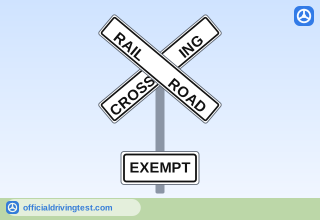
What does an “exempt” sign below a railroad crossbuck mean?
- All drivers may cross without slowing down or looking both ways
- Only passenger cars may cross the tracks
- Bus and truck drivers who usually must stop may proceed without stopping
- Trains no longer use the crossing
Show answer
Correct answer: Bus and truck drivers who usually must stop may proceed without stopping
An exempt sign means that bus and truck drivers, who are usually required to stop at railroad crossings, may proceed without stopping.
Source: Minnesota Driver’s Manual (June 2026), page 59
-
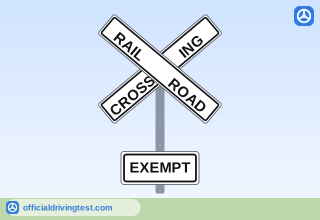
At a crossing with an exempt sign, what do drivers still need to do?
- Stop at the stop line before crossing
- Look in both directions for trains
- Sound the horn before crossing
- Slow to 5 mph for the whole crossing
Show answer
Correct answer: Look in both directions for trains
Even where an exempt sign allows bus and truck drivers to proceed without stopping, drivers still need to look in both directions for trains.
Source: Minnesota Driver’s Manual (June 2026), page 59
-
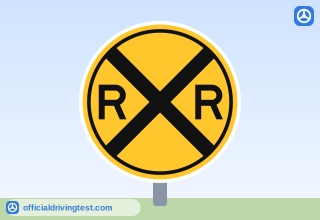
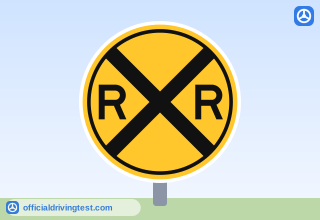
A round yellow sign shows a black X with the letters R and R. What should you do?
- Come to a complete stop and wait for a train to pass first
- Speed up to cross before a train arrives
- Keep your speed and look only to the left
- Slow down, look carefully in both directions and be prepared to stop
Show answer
Correct answer: Slow down, look carefully in both directions and be prepared to stop
A Railroad Crossings Ahead sign means you should slow down, look carefully in both directions and be prepared to stop.
Source: Minnesota Driver’s Manual (June 2026), page 60
-
What does the manual remind you about trains when you see a railroad crossing ahead sign?
- Trains cannot stop quickly
- Trains always slow down at crossings
- Trains must yield to vehicles at crossings
- Trains give a warning before every crossing
Show answer
Correct answer: Trains cannot stop quickly
The manual reminds drivers that trains cannot stop quickly.
Source: Minnesota Driver’s Manual (June 2026), page 60
-
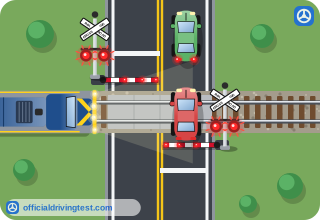
If your vehicle stalls on railroad tracks and a train is approaching, what should you do?
- Stay inside and sound the horn
- Try to restart the engine first
- Stay in the vehicle and wait for the train to pass
- Leave the vehicle immediately
Show answer
Correct answer: Leave the vehicle immediately
If your vehicle stalls on railroad tracks and a train is approaching, leave the vehicle immediately.
Source: Minnesota Driver’s Manual (June 2026), page 85
-
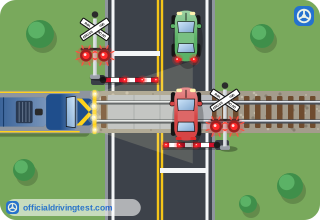
After leaving a vehicle stalled on railroad tracks with a train approaching, at what angle should you walk away from the tracks?
- 45 degrees
- 90 degrees
- 30 degrees
- 60 degrees
Show answer
Correct answer: 45 degrees
You should walk quickly at a 45-degree angle away from the tracks.
Source: Minnesota Driver’s Manual (June 2026), page 85
-
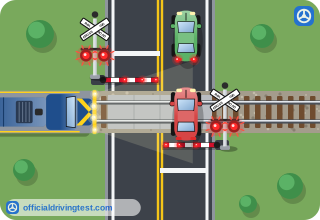
After leaving a vehicle stalled on railroad tracks, in which direction relative to the train should you walk?
- In the direction the train is traveling
- Straight along the side of the tracks
- In the direction from which the train is approaching
- Back toward the vehicle once the train passes
Show answer
Correct answer: In the direction from which the train is approaching
You should walk quickly away from the tracks at a 45-degree angle in the direction from which the train is approaching, to stay clear of debris from the collision.
Source: Minnesota Driver’s Manual (June 2026), page 85