Minnesota: Pedestrians Practice Test
Yielding to pedestrians at crosswalks and intersections, and what pedestrian signals mean.
Independent educational site · not affiliated with any government agency or DMV
Ready? Test yourself
- Instant feedback with an explanation
- Every answer cites its source in the manual
- Your best score is saved on this device
Questions are original and based on the official manual "Minnesota Driver’s Manual" (June 2026), Minnesota Driver and Vehicle Services.
All 21 questions in this practice test
Take the test above first, then use this list to study. Tap “Show answer” to see the correct answer and explanation.
Show the questions and answersHide the questions
-
You see a blind pedestrian with a white or metallic cane or a guide dog. What should you not do?
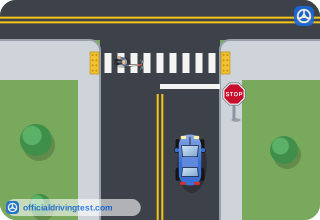
- Slow down
- Stop at the crosswalk
- Look for the pedestrian's path
- Use your horn or rev your engine
Show answer
Correct answer: Use your horn or rev your engine
Do not use your horn or rev your engine, as it may distract blind pedestrians.
Source: Minnesota Driver’s Manual (June 2026), page 47
-
Is it legal to pass a vehicle that has stopped for a pedestrian?
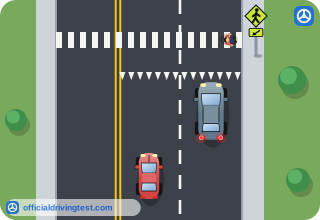
- No, it is illegal
- Yes, if you slow down
- Yes, if the pedestrian is far away
- Yes, on a multilane road
Show answer
Correct answer: No, it is illegal
It is illegal to pass a vehicle that has stopped for a pedestrian.
Source: Minnesota Driver’s Manual (June 2026), page 47
-
What is a second violation within a year of pedestrian right-of-way laws?
- A misdemeanor
- A petty misdemeanor
- A gross misdemeanor
- A felony
Show answer
Correct answer: A gross misdemeanor
Violating pedestrian right-of-way laws is a misdemeanor; a second violation within a year is a gross misdemeanor.
Source: Minnesota Driver’s Manual (June 2026), page 47
-
How are marked crosswalks identified?
- They have dashed yellow lines
- They have solid white lines on the road
- They have a solid yellow line
- They are always signed with flashing lights
Show answer
Correct answer: They have solid white lines on the road
Marked crosswalks have solid white lines on the road and may have signs or flashing lights.
Source: Minnesota Driver’s Manual (June 2026), page 47
-
What is an unmarked crosswalk?
- A crosswalk where the painted lines have faded or worn away
- A place where pedestrians may not cross the road
- A crossing that is marked only by a road sign
- An area where a road meets a sidewalk without solid painted lines
Show answer
Correct answer: An area where a road meets a sidewalk without solid painted lines
Unmarked crosswalks are areas where a road intersects a sidewalk without solid lines painted on the road.
Source: Minnesota Driver’s Manual (June 2026), page 47
-
When stopping at a marked or unmarked crosswalk, what must you not do?
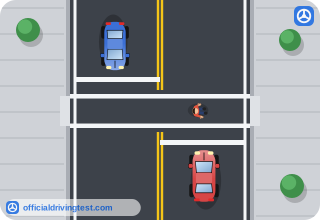
- Block the crosswalk with your vehicle
- Stop before the crosswalk for the pedestrian
- Wait for pedestrians to pass your lane
- Use your turn signal when you stop
Show answer
Correct answer: Block the crosswalk with your vehicle
When stopping at a crosswalk, do not block the crosswalk with your vehicle.
Source: Minnesota Driver’s Manual (June 2026), page 47
-
As a pedestrian waiting for the WALK signal, where should you stand?
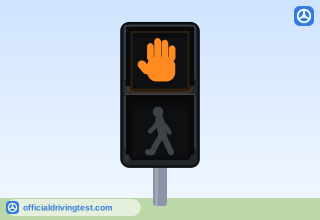
- At the very edge of the curb
- In the lane next to the curb
- A few feet back from the road
- In the crosswalk
Show answer
Correct answer: A few feet back from the road
Stay a few feet back from the road when waiting for the WALK signal.
Source: Minnesota Driver’s Manual (June 2026), page 47
-
When the WALK signal is activated, what must a pedestrian do?
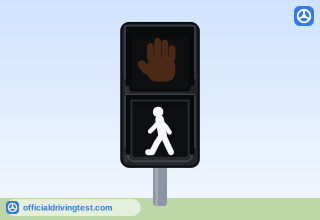
- Cross immediately
- Yield to vehicles within the intersection
- Stop all traffic with a hand signal
- Run across before the light changes
Show answer
Correct answer: Yield to vehicles within the intersection
Pedestrians must yield to vehicles within the intersection when the WALK signal is activated.
Source: Minnesota Driver’s Manual (June 2026), page 47
-
As a pedestrian, how should you make your intention to cross clear?
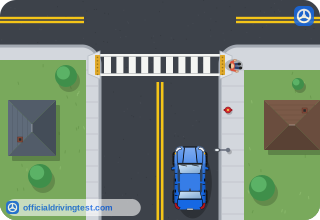
- Wave at the driver and then step into the road quickly
- Wait until the driver honks the horn at you
- Cross while the driver is looking away
- Make eye contact and ensure the driver yields before crossing
Show answer
Correct answer: Make eye contact and ensure the driver yields before crossing
Make eye contact with the driver and make sure they yield the right-of-way before crossing.
Source: Minnesota Driver’s Manual (June 2026), page 47
-
When crossing a road without crosswalks, a pedestrian must
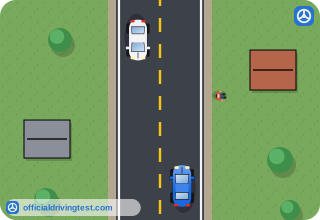
- yield to all vehicles on the road
- cross only at night
- expect vehicles to stop for them
- walk in the center of the road
Show answer
Correct answer: yield to all vehicles on the road
When crossing a road without crosswalks, yield to all vehicles on the road.
Source: Minnesota Driver’s Manual (June 2026), page 47
-
If a pedestrian must walk on the road, where should they walk?
- On the right side, with traffic
- In the center of the lane
- On the left side, facing oncoming traffic
- On whichever side has more shoulder
Show answer
Correct answer: On the left side, facing oncoming traffic
If walking on the road is necessary, stay on the left side or face oncoming traffic.
Source: Minnesota Driver’s Manual (June 2026), page 47
-
When walking at night or in poor visibility, what should a pedestrian do?
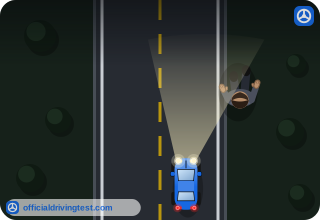
- Wear dark clothing and walk in the middle of the traffic lane to be seen
- Wear light-colored clothing with reflective material or carry a flashlight
- Walk in the traffic lane so drivers see you
- Rely on drivers to see you in time to stop, since you have the right-of-way
Show answer
Correct answer: Wear light-colored clothing with reflective material or carry a flashlight
At night, wear light-colored clothing with reflective material or carry a flashlight so drivers can see you.
Source: Minnesota Driver’s Manual (June 2026), page 47
-
What should you do when you see a school zone sign with figures of two children walking?
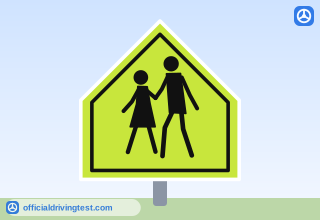
- Come to a complete stop at the sign
- Turn on your hazard lights and keep your speed
- Proceed at your speed if no children are in view
- Watch for children and be prepared to stop
Show answer
Correct answer: Watch for children and be prepared to stop
A school zone sign tells you to watch for children and be prepared to stop.
Source: Minnesota Driver’s Manual (June 2026), page 60
-
According to the school crossing sign text, who must drivers yield to in crosswalks?
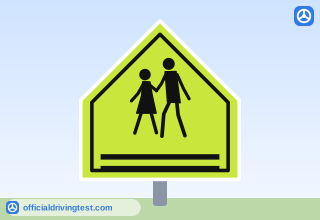
- All pedestrians in crosswalks
- Only children in crosswalks
- Only crossing guards and school patrols
- Only pedestrians who started crossing before you arrived
Show answer
Correct answer: All pedestrians in crosswalks
Drivers must yield to all pedestrians in crosswalks.
Source: Minnesota Driver’s Manual (June 2026), page 60
-
What should you do when you see a pedestrian crossing sign?
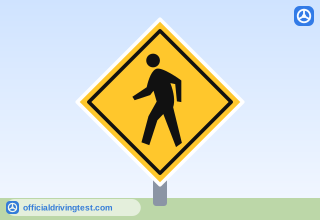
- Come to a complete stop every time
- Slow down and be prepared to stop for pedestrians
- Sound your horn to warn pedestrians
- Speed up to pass before pedestrians enter
Show answer
Correct answer: Slow down and be prepared to stop for pedestrians
Pedestrian crossing signs direct you to watch for pedestrians, slow down and be prepared to stop.
Source: Minnesota Driver’s Manual (June 2026), page 60
-
Where must you yield the right of way to pedestrians, according to the pedestrian crossing sign text?
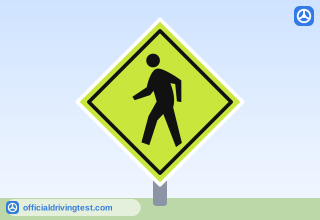
- Only at intersections with traffic signals
- Only at crosswalks near schools
- Only where a crossing guard is present
- At intersections and crosswalks
Show answer
Correct answer: At intersections and crosswalks
You must yield the right of way to pedestrians crossing at intersections and crosswalks.
Source: Minnesota Driver’s Manual (June 2026), page 60
-
What should pedestrians do when the “Walk” signal is visible?
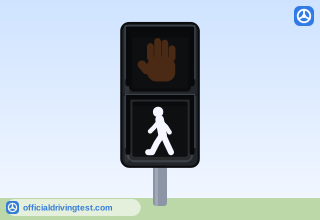
- Look to see if it is safe to cross before proceeding
- Cross at once, because vehicles must stop for them
- Wait until the signal starts to flash
- Wait for traffic in both directions to stop completely
Show answer
Correct answer: Look to see if it is safe to cross before proceeding
When the “Walk” signal is visible, pedestrians should look to see if it is safe to cross before proceeding.
Source: Minnesota Driver’s Manual (June 2026), page 67
-
What should a pedestrian who has not yet started to cross do when the “Don’t Walk” signal is flashing?
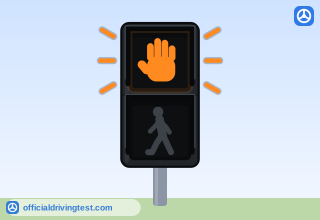
- Begin to cross if no vehicles are close
- Cross quickly before it turns steady
- Not begin to cross
- Begin crossing at a run
Show answer
Correct answer: Not begin to cross
When the raised hand or “Don’t Walk” signal is flashing, pedestrians should not begin to cross.
Source: Minnesota Driver’s Manual (June 2026), page 67
-
What may a pedestrian already in the intersection do when the “Don’t Walk” signal begins to flash?
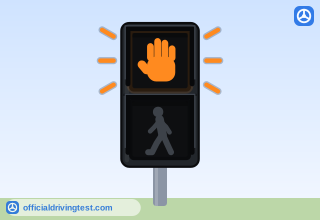
- Return to the curb they started from
- Continue walking to the other side at a normal pace
- Stop and wait in the intersection for the next Walk signal
- Run to the other side as fast as possible
Show answer
Correct answer: Continue walking to the other side at a normal pace
Pedestrians already in the intersection may continue walking to the other side at a normal pace when the “Don’t Walk” signal is flashing.
Source: Minnesota Driver’s Manual (June 2026), page 67
-
What should a pedestrian already in the intersection do when a steady “Don’t Walk” signal is visible?
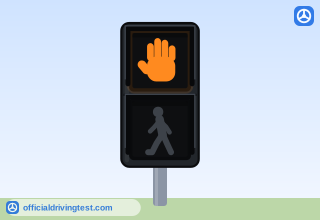
- Stop and stay where they are until the Walk signal appears
- Wave to drivers so that they will stop
- Wait for vehicles to stop before moving
- Walk to the nearest safe location as quickly and safely as possible
Show answer
Correct answer: Walk to the nearest safe location as quickly and safely as possible
When a steady “Don’t Walk” signal is visible, pedestrians already in the intersection should walk to the nearest safe location as quickly and safely as possible.
Source: Minnesota Driver’s Manual (June 2026), page 67
-
Where do pedestrians cross at a diverging diamond interchange?
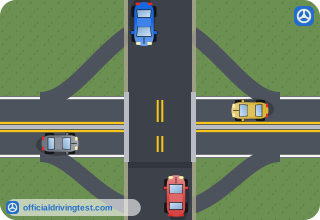
- Over a separate pedestrian bridge beside the main bridge
- To the middle of the bridge, between lanes with protective barriers
- Along the outside edges of the bridge on raised sidewalks
- Through a tunnel under the bridge and its ramps
Show answer
Correct answer: To the middle of the bridge, between lanes with protective barriers
Pedestrians cross to the middle of the bridge and walk between traffic lanes with protective barriers on either side.
Source: Minnesota Driver’s Manual (June 2026), page 77