Minnesota: Freeway driving Practice Test
Entering and leaving a freeway, ramp meters, lane choice, high-occupancy vehicle lanes, bus shoulders, interchanges and what to do if you miss your exit.
Independent educational site · not affiliated with any government agency or DMV
Ready? Test yourself
- Instant feedback with an explanation
- Every answer cites its source in the manual
- Your best score is saved on this device
Questions are original and based on the official manual "Minnesota Driver’s Manual" (June 2026), Minnesota Driver and Vehicle Services.
All 31 questions in this practice test
Take the test above first, then use this list to study. Tap “Show answer” to see the correct answer and explanation.
Show the questions and answersHide the questions
-
What are ramp meters?
- Gauges on freeway exits that measure the speed of leaving traffic
- Signs that show the distance to the next freeway entrance
- Signal lights on freeway entrance ramps that help control merging traffic
- Lights on freeway exits that tell drivers when a lane is closed
Show answer
Correct answer: Signal lights on freeway entrance ramps that help control merging traffic
Ramp meters are signal lights on freeway entrance ramps that help control the flow of merging traffic.
Source: Minnesota Driver’s Manual (June 2026), page 68
-
How many cars may proceed each time a ramp meter light turns green?
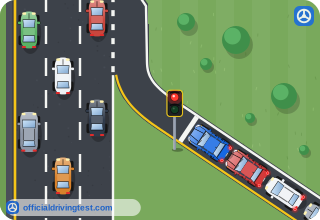
- Two
- One
- Three
- As many as can fit
Show answer
Correct answer: One
Only one car may proceed each time the ramp meter light is green, so drivers take turns entering the highway.
Source: Minnesota Driver’s Manual (June 2026), page 68
-
Where are carpool lanes usually located on a freeway?
- On the far-right side
- In the center
- On the far-left side
- On the entrance and exit ramps only
Show answer
Correct answer: On the far-left side
Carpool lanes are usually located on the far-left side of a freeway.
Source: Minnesota Driver’s Manual (June 2026), page 71
-
How does the manual describe freeways?
- Two-lane roads with stop signs at crossroads
- Undivided highways with traffic signals at each junction
- Roads where cross traffic has the right-of-way
- Multi-lane, divided highways with limited access from other roads
Show answer
Correct answer: Multi-lane, divided highways with limited access from other roads
Freeways are multi-lane, divided highways with limited access from other roads, so there are no stops or cross traffic.
Source: Minnesota Driver’s Manual (June 2026), page 74
-
What is the purpose of an acceleration lane at the end of an entry ramp?
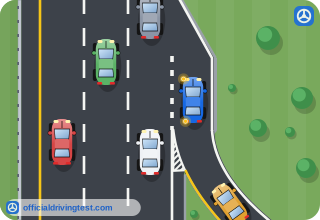
- To increase your speed so you can merge safely with traffic
- To stop and wait for a large gap in freeway traffic
- To pass slower vehicles on the ramp
- To park briefly if you are lost
Show answer
Correct answer: To increase your speed so you can merge safely with traffic
An acceleration lane allows you to increase your speed to safely merge with traffic already on the freeway.
Source: Minnesota Driver’s Manual (June 2026), page 74
-
When merging onto a freeway, how can you avoid disrupting traffic flow or cutting off other drivers?
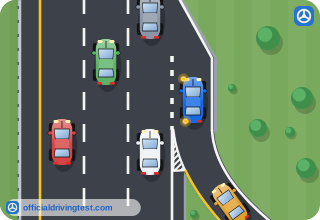
- Stop at the end of the ramp until all traffic has cleared
- Drive slower than traffic so others can pass you
- Adjust your speed to match the vehicles already on the freeway
- Flash your headlights so other drivers let you in
Show answer
Correct answer: Adjust your speed to match the vehicles already on the freeway
The manual says to adjust your speed to match the vehicles already on the freeway when you merge.
Source: Minnesota Driver’s Manual (June 2026), page 74
-
Which statement about merging onto a freeway is correct?
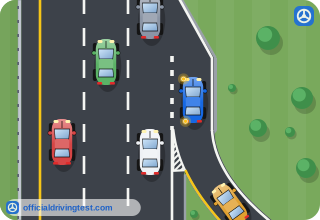
- Freeway traffic must always move over for you
- You must yield to other vehicles when merging
- Merging vehicles have the right-of-way over all other traffic
- Vehicles in the right lane must slow down for you
Show answer
Correct answer: You must yield to other vehicles when merging
The manual says you must yield to other vehicles when merging.
Source: Minnesota Driver’s Manual (June 2026), page 74
-
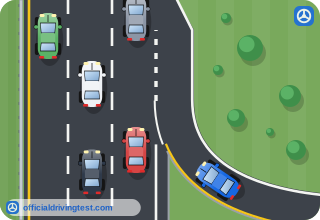
When may you stop on an entry ramp or in the acceleration lane?
- Whenever freeway traffic is heavy
- Whenever you want to wait for a larger gap
- Whenever you miss the first opening in traffic
- Only if it is absolutely necessary
Show answer
Correct answer: Only if it is absolutely necessary
The manual says not to stop on the ramp or in the acceleration lane unless it is absolutely necessary.
Source: Minnesota Driver’s Manual (June 2026), page 74
-
There is no acceleration lane and a “Yield” sign is posted on the entry ramp. What should you do?
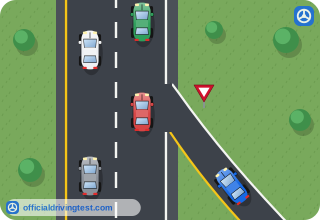
- Obey the sign and stop if necessary
- Speed up and merge ahead of traffic
- Ignore the sign if no cars are visible
- Stop completely at the end of the ramp every time
Show answer
Correct answer: Obey the sign and stop if necessary
When an acceleration lane is not available and a Yield sign is posted, you obey the sign, stop if necessary, and do not force your way into traffic.
Source: Minnesota Driver’s Manual (June 2026), page 74
-
Where on an entry ramp are freeway ramp meters placed?
- At the very end of the acceleration lane
- On the freeway just past the merge point
- About halfway down the entry ramp
- At the start of the ramp where it leaves the road
Show answer
Correct answer: About halfway down the entry ramp
The manual says the meters are traffic signals placed about halfway down the entry ramp.
Source: Minnesota Driver’s Manual (June 2026), page 74
-
When are ramp meters usually activated?
- Only at night
- During peak travel hours
- Only during snow or rain
- Only on weekends
Show answer
Correct answer: During peak travel hours
The ramp meters are usually activated during peak travel hours.
Source: Minnesota Driver’s Manual (June 2026), page 74
-
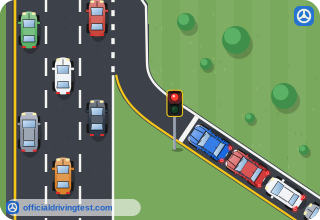
What does the manual say about going through the red light at a freeway ramp meter?
- It is allowed when the freeway is empty
- It is allowed during off-peak hours
- It is allowed if you signal first
- It is illegal
Show answer
Correct answer: It is illegal
The manual says it is illegal to go through the red light at a ramp meter.
Source: Minnesota Driver’s Manual (June 2026), page 74
-
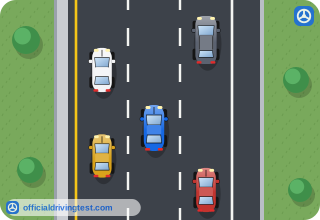
On a freeway, what speed should you maintain when possible?
- Faster than surrounding vehicles so you can pass them more easily
- Slower than surrounding vehicles so that they can pass you
- About the same speed as surrounding vehicles, within the limit
- The speed of the fastest vehicle that you can see ahead
Show answer
Correct answer: About the same speed as surrounding vehicles, within the limit
The manual says to maintain the same approximate speed as surrounding vehicles when possible but never exceed the posted speed limits.
Source: Minnesota Driver’s Manual (June 2026), page 74
-
If you are driving slower than other traffic on a freeway, which lane should you stay in?
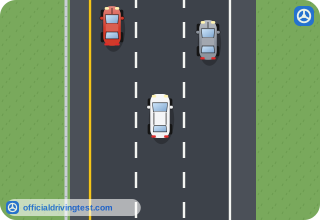
- The lane nearest the left side, next to the median
- The lane nearest to the right side of the road
- The center lane of a three-lane freeway
- Any lane with the fewest vehicles
Show answer
Correct answer: The lane nearest to the right side of the road
The manual says that if you are driving slower than other traffic, you should stay in the lane nearest to the right side of the road.
Source: Minnesota Driver’s Manual (June 2026), page 74
-
What should you do before changing lanes on a freeway to pass or to leave the freeway?
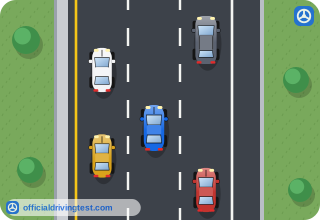
- Sound your horn and move over quickly
- Flash your high beams and slow to a stop
- Slow down and wait for the lane to open on its own
- Signal your intent and make sure your path is clear
Show answer
Correct answer: Signal your intent and make sure your path is clear
The manual says to signal your intent and make sure your path is clear before moving over.
Source: Minnesota Driver’s Manual (June 2026), page 74
-
Which vehicles are permitted to use the shoulder of a freeway or expressway?
- Transit buses and metro mobility buses
- Motorcycles and mopeds
- Delivery trucks and taxis
- Any vehicle carrying two or more people
Show answer
Correct answer: Transit buses and metro mobility buses
The manual permits transit buses and metro mobility buses to use the shoulder of a freeway or expressway.
Source: Minnesota Driver’s Manual (June 2026), page 75
-
Buses can use the freeway shoulder only when main-line traffic speeds are less than what?
- 25 miles per hour
- 45 miles per hour
- 35 miles per hour
- 55 miles per hour
Show answer
Correct answer: 35 miles per hour
Buses can use the shoulder only when main-line traffic speeds are less than 35 miles per hour.
Source: Minnesota Driver’s Manual (June 2026), page 75
-
A bus driver on the freeway shoulder may not exceed the speed of main-line traffic by more than how much?
- 5 miles per hour
- 15 miles per hour
- 10 miles per hour
- 20 miles per hour
Show answer
Correct answer: 15 miles per hour
Bus drivers on the shoulder may not exceed the speed of main-line traffic by more than 15 miles per hour.
Source: Minnesota Driver’s Manual (June 2026), page 75
-
What is the highest speed a bus driver on the freeway shoulder may ever drive?
- 25 miles per hour
- 45 miles per hour
- 55 miles per hour
- 35 miles per hour
Show answer
Correct answer: 35 miles per hour
Bus drivers on the shoulder may never exceed 35 miles per hour.
Source: Minnesota Driver’s Manual (June 2026), page 75
-
What must a bus driver using the freeway shoulder do about other traffic?
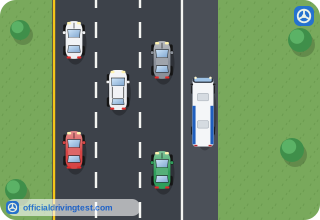
- Yield to merging, entering and exiting traffic and shoulder vehicles
- Keep the right-of-way because buses are allowed to use the shoulder
- Sound the horn and proceed so that other traffic yields to the bus
- Yield only to emergency vehicles on the main line
Show answer
Correct answer: Yield to merging, entering and exiting traffic and shoulder vehicles
Bus drivers on the shoulder must yield to merging, entering and exiting traffic and to other vehicles on the shoulder.
Source: Minnesota Driver’s Manual (June 2026), page 75
-
What do message and lane-use signs on some freeways warn drivers of?
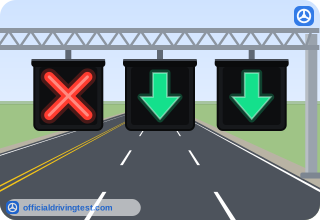
- The exact speed of the traffic ahead of you
- Which lane has the lowest speed limit
- Crashes, stalled vehicles or other conditions ahead
- The number of vehicles that entered at the last ramp
Show answer
Correct answer: Crashes, stalled vehicles or other conditions ahead
Message and lane-use signs warn drivers of traffic crashes, stalled vehicles or other traffic conditions ahead.
Source: Minnesota Driver’s Manual (June 2026), page 75
-
Freeway message signs may also be activated when the state issues an AMBER Alert in response to what?
- A stalled vehicle on the freeway
- A child abduction
- A severe weather warning
- A closed highway ramp
Show answer
Correct answer: A child abduction
Message signs may be activated when the state issues an AMBER Alert in response to a child abduction.
Source: Minnesota Driver’s Manual (June 2026), page 75
-
What information may freeway message signs provide during an AMBER Alert?
- A map of nearby police stations
- The speed limit for the next ten miles
- Only the words AMBER ALERT
- Information such as a vehicle description
Show answer
Correct answer: Information such as a vehicle description
During an AMBER Alert the signs provide information such as a vehicle description.
Source: Minnesota Driver’s Manual (June 2026), page 75
-
During an AMBER Alert, what will drivers who see a vehicle fitting the description be asked to do?
- Notify law enforcement
- Follow the vehicle until it stops
- Stop the vehicle themselves
- Block the vehicle’s path
Show answer
Correct answer: Notify law enforcement
Drivers who see a vehicle fitting the description, or who have other information about the missing child, will be asked to notify law enforcement.
Source: Minnesota Driver’s Manual (June 2026), page 75
-
What is a freeway interchange?
- A section of freeway where several lanes merge into one
- Ramps connecting a freeway to a road or another freeway
- A rest area joined to a freeway by a short ramp
- A signal that controls traffic entering a freeway
Show answer
Correct answer: Ramps connecting a freeway to a road or another freeway
An interchange connects a freeway to a road or another freeway by a series of ramps.
Source: Minnesota Driver’s Manual (June 2026), page 75
-
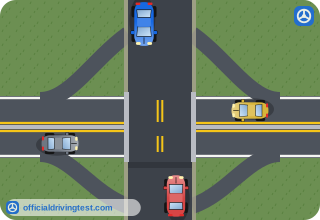
What is a diverging diamond interchange designed to eliminate?
- Right-hand turns onto the bridge
- Crossings by pedestrians at the bridge
- Merging from entry ramps
- Left-hand turns across opposing traffic
Show answer
Correct answer: Left-hand turns across opposing traffic
In a diverging diamond interchange the traffic lanes cross over at each end of the bridge, eliminating left-hand turns across opposing traffic.
Source: Minnesota Driver’s Manual (June 2026), page 77
-
At a diverging diamond interchange, what do you do instead of making a sharp left turn?
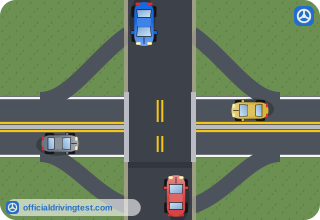
- Veer to the left for access
- Veer to the right for access
- Make a U-turn at the end of the bridge
- Turn left from the right lane
Show answer
Correct answer: Veer to the left for access
Instead of making a sharp left turn, you veer to the left for access.
Source: Minnesota Driver’s Manual (June 2026), page 77
-
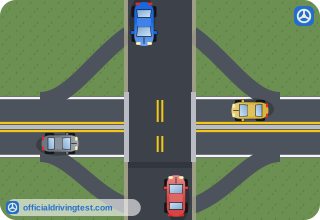
Which of these is a safety benefit of diverging diamond interchanges?
- Conflict points are concentrated in one place
- Drivers have a shorter sight distance at turns
- There are fewer conflict points
- Wrong way entry to ramps is made easier
Show answer
Correct answer: There are fewer conflict points
The manual lists fewer conflict points, spread-out conflict points, longer sight distance, extremely difficult wrong way entry and shorter pedestrian crossings.
Source: Minnesota Driver’s Manual (June 2026), page 77
-
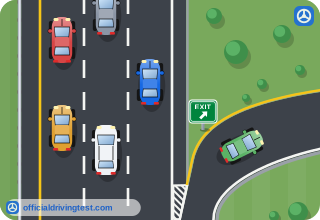
For a driver of an ordinary passenger vehicle, what does the manual say about backing up or turning around on a freeway?
- It is allowed on the shoulder only
- It is illegal
- It is allowed if no traffic is visible
- It is allowed after you miss an exit
Show answer
Correct answer: It is illegal
The manual says it is illegal to back up or turn around on a freeway.
Source: Minnesota Driver’s Manual (June 2026), page 77
-
As you near your freeway exit, what should you do?
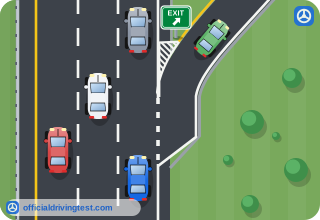
- Signal, then move into the deceleration lane when safe
- Slow down in your lane, then cut across to the exit ramp
- Wait until you reach the ramp, then signal and slow down
- Move to the left lane to see the exit signs better
Show answer
Correct answer: Signal, then move into the deceleration lane when safe
You should signal your intent to change lanes and move into the deceleration lane when safe, which gives you time to slow down before the exit ramp.
Source: Minnesota Driver’s Manual (June 2026), page 78
-
What should you do if you miss your freeway exit?
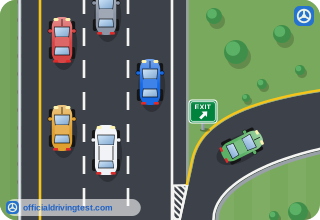
- Back up on the shoulder to the exit
- Make a U-turn at the next opening in the median
- Proceed to the next exit
- Stop on the shoulder and wait for a gap
Show answer
Correct answer: Proceed to the next exit
If you miss your exit, you should proceed to the next one and not back up or make a U-turn.
Source: Minnesota Driver’s Manual (June 2026), page 78