Minnesota: Emergencies and winter driving — Part 5 Practice Test
Questions in this part include: “What is the only cure for carbon monoxide poisoning?” · “If you notice symptoms of carbon monoxide poisoning, what should you do?”
Independent educational site · not affiliated with any government agency or DMV
Ready? Test yourself
- Instant feedback with an explanation
- Every answer cites its source in the manual
- Your best score is saved on this device
Questions are original and based on the official manual "Minnesota Driver’s Manual" (June 2026), Minnesota Driver and Vehicle Services.
All 16 questions in this practice test
Take the test above first, then use this list to study. Tap “Show answer” to see the correct answer and explanation.
Show the questions and answersHide the questions
-
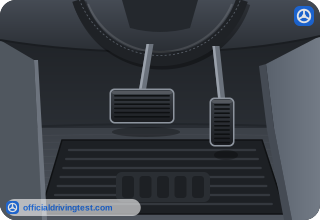
If your gas pedal sticks, what might free it?
- Pressing the brake and accelerator together
- Hooking your toe under the pedal and raising it
- Shifting into park while driving
- Turning off the ignition
Show answer
Correct answer: Hooking your toe under the pedal and raising it
If your gas pedal sticks, you may be able to free it by hooking your toe under the pedal and raising it.
Source: Minnesota Driver’s Manual (June 2026), page 86
-
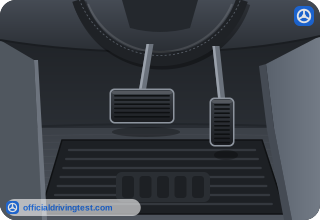
If you cannot free a stuck gas pedal, what should you do next?
- Turn off the ignition and let the vehicle coast
- Shift into reverse while steering to the shoulder
- Pump the accelerator until the pedal comes loose
- Apply the brakes and shift into neutral
Show answer
Correct answer: Apply the brakes and shift into neutral
If hooking your toe under the pedal does not work, apply the brakes and shift into neutral to disengage the engine, then steer to the shoulder.
Source: Minnesota Driver’s Manual (June 2026), page 86
-
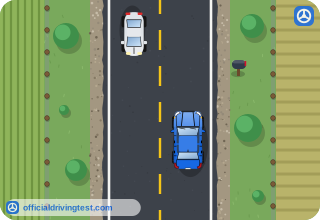
After a gas pedal sticks, what should you do if the shoulder is not paved?
- Switch on your hazard lights and keep steering straight until you can pull over
- Steer onto the unpaved shoulder at once and stop as quickly as you can
- Stop in the lane and wait for help
- Turn off the ignition and steer onto the shoulder
Show answer
Correct answer: Switch on your hazard lights and keep steering straight until you can pull over
If the shoulder is not paved, switch on your hazard lights and continue steering straight until you can safely pull over to the shoulder.
Source: Minnesota Driver’s Manual (June 2026), page 86
-
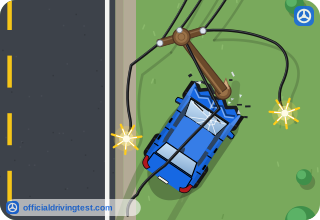
If your car comes into contact with a utility pole, wire or power box, what should you do?
- Get out and move away at once
- Get out and check for damage
- Stay in your vehicle and call 911
- Stay in your vehicle and turn on the engine
Show answer
Correct answer: Stay in your vehicle and call 911
After contact with a utility pole, wire or power box, stay in your vehicle and call 911.
Source: Minnesota Driver’s Manual (June 2026), page 86
-
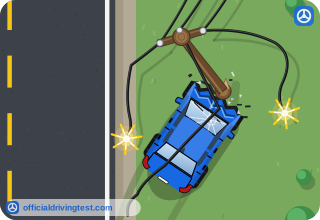
After your vehicle hits a utility pole or power box, when should you get out of the vehicle?
- As soon as the vehicle stops moving
- Once the engine has been turned off
- After a passerby says it is safe
- Only if it is on fire
Show answer
Correct answer: Only if it is on fire
You should only get out of the vehicle if it is on fire.
Source: Minnesota Driver’s Manual (June 2026), page 86
-
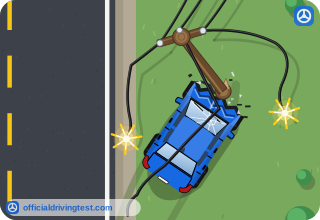
If you must get out of a vehicle that has touched a power line, how should you leave it?
- Jump with both feet together and shuffle your feet as you move away
- Step out with one foot at a time and run from the vehicle
- Hold onto the door and lower yourself to the ground slowly
- Climb out through a window and walk away on your toes
Show answer
Correct answer: Jump with both feet together and shuffle your feet as you move away
If you must get out, jump from the vehicle with both feet together and shuffle your feet on the ground as you move away from the scene.
Source: Minnesota Driver’s Manual (June 2026), page 86
-
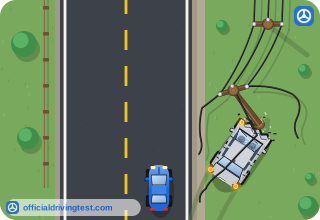
After a crash with a utility pole or power box, what should you always assume about the wires and equipment?
- That they are not live once the vehicle is turned off
- That they are safe if they are not sparking
- That they are electrified
- That they are safe if they are lying on the ground
Show answer
Correct answer: That they are electrified
Always assume all wires and equipment are electrified.
Source: Minnesota Driver’s Manual (June 2026), page 86
-
What is the only cure for carbon monoxide poisoning?
- A cup of warm water
- A good supply of fresh air
- Rest in a warm place
- Leaving the engine idling
Show answer
Correct answer: A good supply of fresh air
The only cure for carbon monoxide poisoning is a good supply of fresh air.
Source: Minnesota Driver’s Manual (June 2026), page 86
-
Which of these are early symptoms of carbon monoxide poisoning?
- Sudden fatigue, headache, dizziness and nausea
- Fever, coughing and sore throat
- Sweating, chest pain and blurred vision
- Thirst, muscle cramps and a stiff neck
Show answer
Correct answer: Sudden fatigue, headache, dizziness and nausea
Early symptoms of carbon monoxide poisoning include sudden fatigue, headache, dizziness and nausea.
Source: Minnesota Driver’s Manual (June 2026), page 86
-
If you notice symptoms of carbon monoxide poisoning, what should you do?
- Close the windows and turn on the heater to warm up
- Turn on the air conditioning and keep driving
- Open the windows, turn off the ignition and get out as soon as possible
- Rest in the vehicle with the engine running until the symptoms pass
Show answer
Correct answer: Open the windows, turn off the ignition and get out as soon as possible
If you have carbon monoxide symptoms, open the windows, turn off the ignition, and get out of the vehicle or garage as soon as possible.
Source: Minnesota Driver’s Manual (June 2026), page 86
-
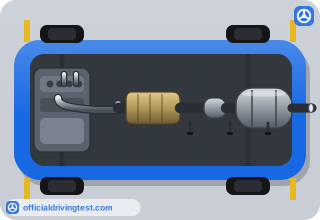
What should you do if you suspect your vehicle’s exhaust system is leaking?
- Drive with all windows closed
- Have the exhaust system inspected
- Idle the vehicle in the garage
- Wait until winter to check it
Show answer
Correct answer: Have the exhaust system inspected
The manual says to have the vehicle’s exhaust system inspected if you suspect it is leaking.
Source: Minnesota Driver’s Manual (June 2026), page 86
-
When does carbon monoxide poisoning occur most frequently?
- During summer months, when engines run much hotter
- During spring, when roads are wet
- During heavy rain, when visibility is poor
- During winter months, when vehicle windows tend to be closed
Show answer
Correct answer: During winter months, when vehicle windows tend to be closed
Carbon monoxide poisoning occurs most frequently during winter months when vehicle windows tend to be closed.
Source: Minnesota Driver’s Manual (June 2026), page 87
-
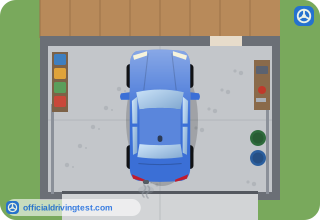
In cold temperatures, what can happen to carbon monoxide in a garage even when the garage door is open completely?
- It always clears out within a few minutes
- It can get trapped inside the garage
- It rises and leaves through the roof
- It is pushed out by the cold air
Show answer
Correct answer: It can get trapped inside the garage
When temperatures are cold, carbon monoxide can get trapped inside the garage even when the garage door is open completely.
Source: Minnesota Driver’s Manual (June 2026), page 87
-
Where is a safer place to warm up a vehicle than a garage?
- With the garage door half open
- Inside the garage with the door open
- Next to the garage wall
- In the driveway
Show answer
Correct answer: In the driveway
Avoid idling a vehicle in a garage; a safer place to warm up a vehicle is in the driveway.
Source: Minnesota Driver’s Manual (June 2026), page 87
-
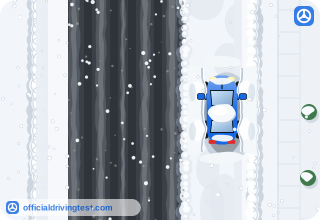
To reduce the risk of carbon monoxide poisoning, what should you avoid when your vehicle is stuck in snow or mud?
- Idling the vehicle
- Opening the windows
- Turning on the heater
- Keeping the exhaust clear
Show answer
Correct answer: Idling the vehicle
To reduce the risk of carbon monoxide poisoning, avoid idling a vehicle when stuck in the snow or mud.
Source: Minnesota Driver’s Manual (June 2026), page 87
-
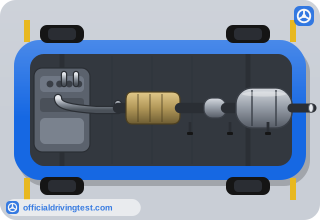
To reduce the risk of carbon monoxide poisoning, what should you make sure about your vehicle’s exhaust system?
- That it is checked once a year
- That it is covered when parked in a garage
- That it does not leak and is not blocked
- That it is cold before you start the engine
Show answer
Correct answer: That it does not leak and is not blocked
Make sure your vehicle’s exhaust system does not leak and is not blocked.
Source: Minnesota Driver’s Manual (June 2026), page 87