Michigan: Sharing the road — Part 2 Practice Test
Questions in this part include: “Which of the following can indicate that a motorcyclist or bicyclist is about to turn?” · “Where may bicyclists legally ride in Michigan?”
Independent educational site · not affiliated with any government agency or DMV
Ready? Test yourself
- Instant feedback with an explanation
- Every answer cites its source in the manual
- Your best score is saved on this device
Questions are original and based on the official manual "What Every Driver Must Know" (October 2025), Michigan Secretary of State.
Did you know?
- In 1927, the Ford Motor Company produced its fifteen millionth Model T.
- In 1939, the 3-M Corporation introduced reflective sheeting for roadside signs.
- In 1942, the Willow Run and Detroit Industrial Expressway, the nation's first four-lane divided highway, was completed. Nearly 42,000 Detroit-area motorists used it daily to commute to the Ypsilanti bomber factory.
More background reading from the manual →
All 19 questions in this practice test
Take the test above first, then use this list to study. Tap “Show answer” to see the correct answer and explanation.
Show the questions and answersHide the questions
-
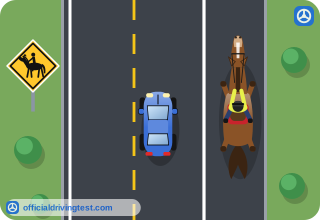
Why should you never honk your horn or rev your engine near a horse and rider or buggy?
- It is only rude, not dangerous
- It is only illegal at night
- It drains your car battery
- Loud noises can startle the horse
Show answer
Correct answer: Loud noises can startle the horse
Never honk or rev the engine near horses, as loud noises can startle them.
Source: What Every Driver Must Know (October 2025), page 54 · Open this page in the manual (Manual page 54)
-
According to the manual, motorcycle, scooter, moped and bicycle riders are allowed to:
- Only ride in bike lanes
- Only ride on the shoulder
- Share a lane
- Never share a lane with another rider
Show answer
Correct answer: Share a lane
Motorcycle, scooter, moped and bicycle riders are allowed to share a lane.
Source: What Every Driver Must Know (October 2025), page 55 · Open this page in the manual (Manual page 55)
-
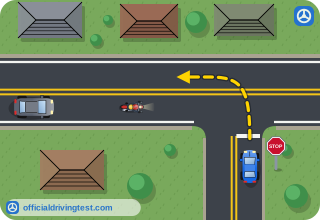
Because motorcyclists and other small vehicles have a smaller profile, when turning left you should:
- Only worry about them at night
- Ignore them until you're mid-turn
- Assume they are farther away than they appear and turn first
- Assume they are closer than they appear and wait for them to pass
Show answer
Correct answer: Assume they are closer than they appear and wait for them to pass
Always assume motorcyclists and other small vehicles are closer than they appear and wait for them to pass before turning.
Source: What Every Driver Must Know (October 2025), page 55 · Open this page in the manual (Manual page 55)
-
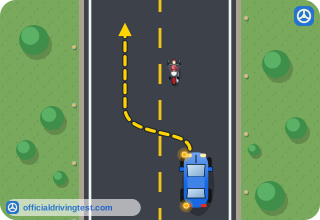
A fast-moving vehicle's "wind blast" or draft can:
- Have no effect at legal speeds
- Improve a motorcyclist's fuel economy
- Only affect bicyclists, not motorcyclists
- Startle or even push a rider off balance
Show answer
Correct answer: Startle or even push a rider off balance
A vehicle's wind blast can startle or even push a motorcyclist, scooter operator or bicyclist off balance.
Source: What Every Driver Must Know (October 2025), page 55 · Open this page in the manual (Manual page 55)
-
Which of the following can indicate that a motorcyclist or bicyclist is about to turn?
- The rider changing gears
- The rider using a phone
- The rider slowing to a complete stop only
- The rider leaning or tilting the vehicle
Show answer
Correct answer: The rider leaning or tilting the vehicle
If the rider turns to check traffic or begins to lean or tilt the vehicle, it likely signals an intent to turn.
Source: What Every Driver Must Know (October 2025), page 56 · Open this page in the manual (Manual page 56)
-
Why can it be hard to spot a motorcycle, scooter, moped, or bicycle at night?
- They always drive with lights off
- They are not allowed to use lights
- Their single headlight or taillight blends into other lights
- They are required by law to use only parking lights
Show answer
Correct answer: Their single headlight or taillight blends into other lights
The single headlight or taillight on these vehicles can blend into the lights of other vehicles.
Source: What Every Driver Must Know (October 2025), page 56 · Open this page in the manual (Manual page 56)
-
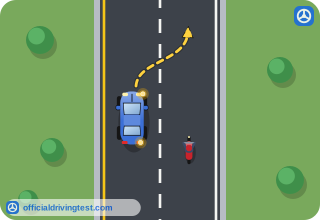
Before changing lanes near a motorcyclist, scooter operator, or bicyclist, you should:
- Signal only; riders will see you and make room
- Rely on your mirrors only, without turning your head
- Only check once and proceed
- Check your blind spot, and look again after passing
Show answer
Correct answer: Check your blind spot, and look again after passing
Check your blind spot before changing lanes, and after you pass, look again before moving back into the lane.
Source: What Every Driver Must Know (October 2025), page 56 · Open this page in the manual (Manual page 56)
-
Motorcyclists frequently use engine braking and downshifting, which:
- Automatically activates the brake lights
- Slows it without activating the brake lights
- Is illegal in Michigan
- Only works on freeways
Show answer
Correct answer: Slows it without activating the brake lights
Engine braking and downshifting slow the vehicle without activating the brake lights, so keep extra space.
Source: What Every Driver Must Know (October 2025), page 56 · Open this page in the manual (Manual page 56)
-
When parking, which technique helps you spot cyclists before opening your car door?
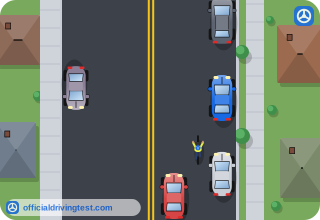
- Always exiting from the passenger side
- Opening the door with your right hand
- Opening the door quickly to warn cyclists
- Opening the window instead of the door
Show answer
Correct answer: Opening the door with your right hand
Use your right hand to open the door so you automatically look over your left shoulder for oncoming cyclists and pedestrians.
Source: What Every Driver Must Know (October 2025), page 56 · Open this page in the manual (Manual page 56)
-
As a motorist, how should you use your horn around motorcyclists?
- Only use it at night
- Never use it under any circumstance
- Use it judiciously to avoid startling riders
- Honk often so that riders know you're near
Show answer
Correct answer: Use it judiciously to avoid startling riders
Use your horn judiciously and avoid horn blasts that may startle riders and increase crash risk.
Source: What Every Driver Must Know (October 2025), page 56 · Open this page in the manual (Manual page 56)
-
According to the manual, the term "scooter" refers to:
- Only vehicles requiring a motorcycle endorsement
- Only vehicles under 50cc
- Only electric bicycles
- Mopeds and higher-powered two-wheeled machines
Show answer
Correct answer: Mopeds and higher-powered two-wheeled machines
"Scooter" is a generic term that applies to mopeds and to higher-powered machines that do not fit the moped definition.
Source: What Every Driver Must Know (October 2025), page 56 · Open this page in the manual (Manual page 56)
-
Where may bicyclists legally ride in Michigan?
- On Michigan roads, except limited-access freeways
- Only on designated bike paths
- Nowhere without a permit
- Only on roads with a posted speed limit under 25 mph
Show answer
Correct answer: On Michigan roads, except limited-access freeways
Bicyclists may legally ride on Michigan roads, except limited access freeways.
Source: What Every Driver Must Know (October 2025), page 57 · Open this page in the manual (Manual page 57)
-
Bicyclists riding with traffic:
- Must dismount at every intersection
- Are not allowed in the travel lane at all
- Must always ride as far right as physically possible
- May ride anywhere in the lane
Show answer
Correct answer: May ride anywhere in the lane
Bicyclists may ride anywhere in the lane as long as they are riding with traffic, and have the same rights and responsibilities as motorists.
Source: What Every Driver Must Know (October 2025), page 57 · Open this page in the manual (Manual page 57)
-
When turning right near a bicyclist riding in a bike lane or on the shoulder, you should:
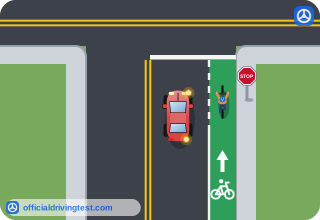
- Turn quickly before they catch up
- Use the bike lane as your right-turn lane
- Honk to make them stop
- Yield and allow them to pass before turning
Show answer
Correct answer: Yield and allow them to pass before turning
Look for bicyclists in the bike lane or on the shoulder before turning right and, as appropriate, yield and allow them to pass before turning. Do not use the bicycle lane as a right-turn lane.
Source: What Every Driver Must Know (October 2025), page 57 · Open this page in the manual (Manual page 57)
-
May you legally pass a bicyclist in a no-passing zone?
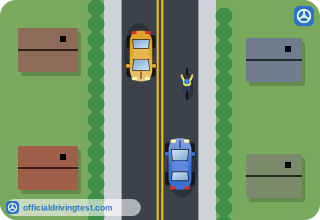
- Only if the bicyclist signals permission
- Only at night
- Never, under any circumstance
- Yes, as long as it is safe to do so
Show answer
Correct answer: Yes, as long as it is safe to do so
You may pass a bicyclist in a no-passing zone as long as it is safe to do so.
Source: What Every Driver Must Know (October 2025), page 57 · Open this page in the manual (Manual page 57)
-
While Michigan's general law requires 3 feet of passing distance for bicyclists, what should you know about some cities?
- Cities may reduce it to 1 foot
- Some cities require a 5-foot distance
- Cities cannot set their own rules
- Cities ban bicycles from all roads
Show answer
Correct answer: Some cities require a 5-foot distance
Some cities have stricter laws requiring a 5-foot passing distance for bicyclists.
Source: What Every Driver Must Know (October 2025), page 57 · Open this page in the manual (Manual page 57)
-
Are bicyclists required to stay within a bicycle lane at all times?
- Only during the day
- Only if there is no traffic
- Yes, they must always stay in it
- No, they may leave it to turn left
Show answer
Correct answer: No, they may leave it to turn left
Bicyclists are not required to use a bicycle lane and may leave it to turn left or to avoid hazards.
Source: What Every Driver Must Know (October 2025), page 57 · Open this page in the manual (Manual page 57)
-
Why can low-riding recumbent or super-recumbent handcycle riders be difficult to see, even though they often use mirrors and tall flags?
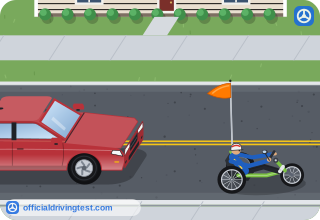
- They are not allowed to use flags
- They travel much faster than bicycles
- Their low profile makes them hard to spot
- They are usually ridden only at night
Show answer
Correct answer: Their low profile makes them hard to spot
These low-profile cycles can be difficult to see due to their low profile, despite mirrors and tall orange flags.
Source: What Every Driver Must Know (October 2025), page 57 · Open this page in the manual (Manual page 57)
-
What is an autocycle?
- A moped with a sidecar
- A four-wheeled electric car with no doors
- A bicycle with a small motor
- A three-wheeled motorcycle with a steering wheel
Show answer
Correct answer: A three-wheeled motorcycle with a steering wheel
An autocycle is a motorcycle with safety belts, a roll bar or roll hoops, a steering wheel and other required equipment; it has three wheels and no straddle seat.
Source: What Every Driver Must Know (October 2025), page 57 · Open this page in the manual (Manual page 57)