Michigan: Right of way & turning
Intersections, four-way stops, turns, passing, and roundabouts. Split into 3 shorter tests so you're not stuck in one long quiz.
Independent educational site · not affiliated with any government agency or DMV
Choose a part
Right of way & turning — Part 1
Intersections, four-way stops, turns, passing, and roundabouts. — Part 1
StartRight of way & turning — Part 2
Questions in this part include: “As a driver, whom must you yield to near or in a school zone crosswalk when school is in session?”
StartRight of way & turning — Part 3
Questions in this part include: “You must not pass a vehicle that has stopped where?”
StartAll 53 Right of way & turning questions with answers
Choose a part above to take a practice test, or study every question and answer here.
Show the questions and answersHide the questions
-
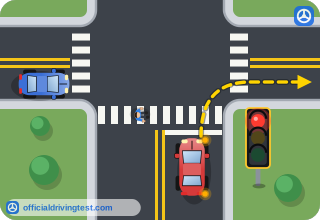
When making a right turn, including on a red light, a driver must...
- proceed immediately after signaling
- wait for a green arrow only
- yield the right of way to other vehicles
- always come to a full 10-second stop
Show answer
Correct answer: yield the right of way to other vehicles
Drivers must yield to other vehicles when making a right turn, including at a red light.
Source: What Every Driver Must Know (October 2025), page 29 · Open this page in the manual (Manual page 29)
-
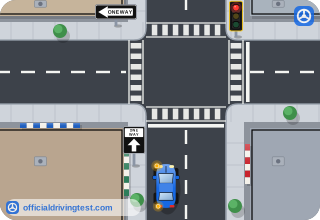
When turning left on red from a one-way street onto another one-way street, a driver must first...
- sound the horn twice
- stop completely and check for traffic from the right
- yield only to pedestrians
- proceed without stopping if no cars are visible
Show answer
Correct answer: stop completely and check for traffic from the right
The driver must come to a complete stop and check for traffic approaching from the right before turning.
Source: What Every Driver Must Know (October 2025), page 30 · Open this page in the manual (Manual page 30)
-
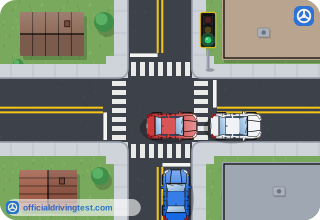
If the light turns green while other vehicles are still finishing their pass through the intersection, what must you do?
- Proceed immediately since you have the green light
- Sound your horn to hurry them
- Wait exactly five seconds before moving
- Yield to those vehicles before proceeding
Show answer
Correct answer: Yield to those vehicles before proceeding
Drivers must yield to vehicles still in the intersection when the light changes, before proceeding.
Source: What Every Driver Must Know (October 2025), page 30 · Open this page in the manual (Manual page 30)
-
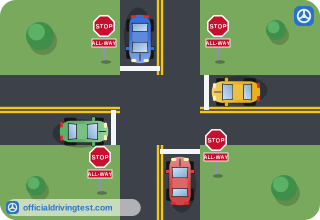
At a four-way stop intersection, if two vehicles arrive at the same time, who has the right of way?
- The vehicle on the left
- Whichever vehicle is larger
- The vehicle going straight, regardless of position
- The vehicle on the right
Show answer
Correct answer: The vehicle on the right
If two or more vehicles arrive simultaneously at a four-way stop, the vehicle on the left yields to the vehicle on its right.
Source: What Every Driver Must Know (October 2025), page 30 · Open this page in the manual (Manual page 30)
-
At an intersection with a malfunctioning traffic signal, what must a driver do?
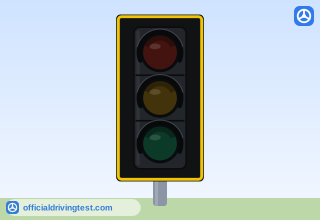
- Treat it like a green light and continue through with normal caution
- Come to a complete stop and yield to vehicles already at the intersection
- Slow down and drive through without stopping if no one is coming
- Stop only if a vehicle approaches from the left, then go ahead first
Show answer
Correct answer: Come to a complete stop and yield to vehicles already at the intersection
Come to a complete stop, yield to vehicles already at the intersection, and yield to the vehicle on your right if you both reach the intersection at the same time.
Source: What Every Driver Must Know (October 2025), page 30 · Open this page in the manual (Manual page 30)
-
At an intersection with a flashing yellow arrow, a driver preparing to turn must...
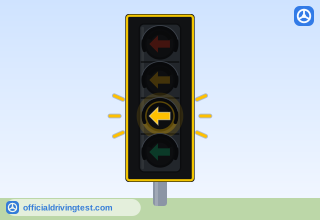
- proceed without stopping, since yellow means caution only
- stop completely for several seconds regardless of traffic
- yield to oncoming traffic before completing the turn
- treat it exactly like a red light
Show answer
Correct answer: yield to oncoming traffic before completing the turn
Drivers must yield to oncoming traffic before completing a turn at a flashing yellow arrow.
Source: What Every Driver Must Know (October 2025), page 30 · Open this page in the manual (Manual page 30)
-
If you have a green light but a pedestrian is still in a marked crosswalk, what must you do?
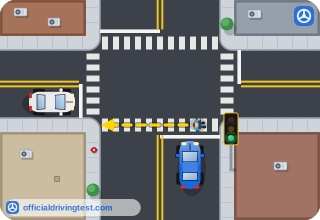
- Yield to the pedestrian
- Proceed, since you have the right of way
- Honk to alert the pedestrian to hurry
- Only yield if the pedestrian is a child
Show answer
Correct answer: Yield to the pedestrian
Drivers must yield to a pedestrian in a marked crosswalk even if their own traffic light is green.
Source: What Every Driver Must Know (October 2025), page 31 · Open this page in the manual (Manual page 31)
-
At an intersection with no traffic control devices and no marked crosswalk, a driver must yield to a pedestrian...
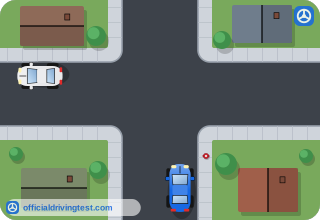
- only if the pedestrian is elderly or disabled
- never, since there is no marked crosswalk
- only during school hours
- on the driver's side of the roadway
Show answer
Correct answer: on the driver's side of the roadway
Drivers must yield to a pedestrian in an unmarked crosswalk on the driver's side of the roadway when no traffic control devices are present.
Source: What Every Driver Must Know (October 2025), page 31 · Open this page in the manual (Manual page 31)
-
Funeral processions have the right of way over all other vehicles except for...
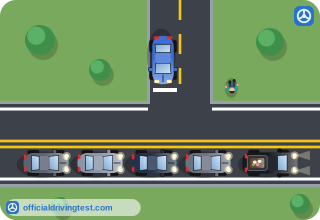
- delivery trucks and buses
- fire trucks, ambulances and police cars
- vehicles displaying hazard lights
- school buses only
Show answer
Correct answer: fire trucks, ambulances and police cars
Funeral processions have the right of way over all vehicles except fire trucks, ambulances, and police vehicles.
Source: What Every Driver Must Know (October 2025), page 31 · Open this page in the manual (Manual page 31)
-
After passing another vehicle, you must return to your lane before coming within how many feet of any oncoming vehicle?
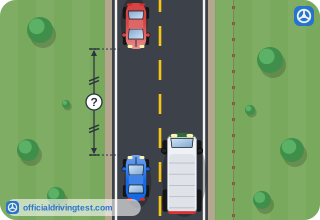
- 100 feet
- 150 feet
- 200 feet
- 300 feet
Show answer
Correct answer: 200 feet
You must return to your lane before getting within 200 feet of an oncoming vehicle.
Source: What Every Driver Must Know (October 2025), page 32 · Open this page in the manual (Manual page 32)
-
A driver must not pass another vehicle when...
- a solid yellow line is on their side of the centerline
- the speed limit is below 35 mph
- they are on a one-way street
- the other vehicle is more than 500 feet ahead
Show answer
Correct answer: a solid yellow line is on their side of the centerline
A solid yellow line on the driver's side of the centerline indicates passing is prohibited.
Source: What Every Driver Must Know (October 2025), page 32 · Open this page in the manual (Manual page 32)
-
Passing is prohibited when you are within how many feet of an intersection or railroad crossing?
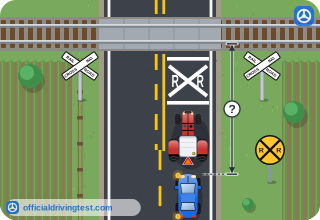
- 150 feet
- 200 feet
- 50 feet
- 100 feet
Show answer
Correct answer: 100 feet
Passing is prohibited within 100 feet of an intersection or railroad crossing.
Source: What Every Driver Must Know (October 2025), page 32 · Open this page in the manual (Manual page 32)
-
Michigan law generally requires driving in the right-hand lane, but allows moving into another lane when...
- traffic is simply light
- the driver prefers a faster pace
- it is after 10 p.m.
- there are three or more marked lanes
Show answer
Correct answer: there are three or more marked lanes
One of the listed exceptions to right-lane driving is a road divided into three or more marked traffic lanes.
Source: What Every Driver Must Know (October 2025), page 33 · Open this page in the manual (Manual page 33)
-
When entering a roundabout, a driver must yield to traffic approaching from which direction?
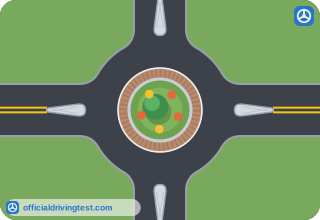
- The right
- The left
- Straight ahead only
- Behind them
Show answer
Correct answer: The left
Vehicles entering a roundabout must yield to traffic already circulating, which approaches from the left.
Source: What Every Driver Must Know (October 2025), page 35 · Open this page in the manual (Manual page 35)
-
When entering a roundabout, a driver should...
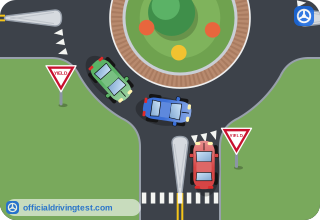
- never make a left turn to enter it
- always merge from the far-left lane
- enter from either direction depending on traffic
- come to a complete stop unless directed otherwise
Show answer
Correct answer: never make a left turn to enter it
The manual warns never to make a left turn to enter a roundabout, as it would put the driver in front of oncoming traffic.
Source: What Every Driver Must Know (October 2025), page 35 · Open this page in the manual (Manual page 35)
-
At a T-intersection with no signals or signs, who has the right of way?
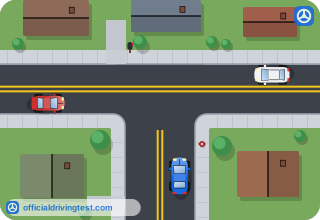
- Vehicles on the through road
- Vehicles turning onto the road
- Whichever vehicle is larger
- Whichever vehicle arrived last
Show answer
Correct answer: Vehicles on the through road
At a T-intersection without any signals or signs, you must yield the right of way to vehicles on the through road.
Source: What Every Driver Must Know (October 2025), page 30 · Open this page in the manual (Manual page 30)
-
At an intersection with a stop sign but no stop line or crosswalk, where should you stop?
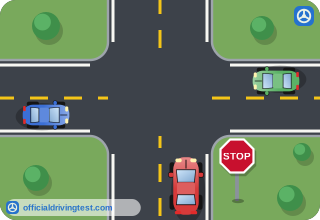
- You do not need to stop if there is no line
- As far back from the intersection as you possibly can
- Where you can see all approaching traffic without pulling in
- Anywhere within the intersection
Show answer
Correct answer: Where you can see all approaching traffic without pulling in
If there is no stop line or crosswalk, stop at a point that allows you to see all approaching traffic without having to pull into the intersection.
Source: What Every Driver Must Know (October 2025), page 30 · Open this page in the manual (Manual page 30)
-
When turning left from a two-way street onto a one-way street at a red light, whom must you yield to besides checking for traffic from the right?
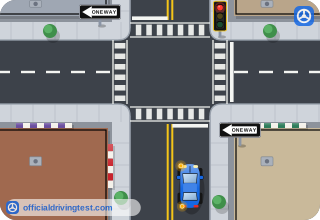
- Pedestrians only
- No one, since you have the red light
- Vehicles behind you
- Vehicles opposite you turning right
Show answer
Correct answer: Vehicles opposite you turning right
When turning left from a two-way street onto a one-way street at a red light, you must stop, scan for traffic from the right, and yield to any vehicles opposite you turning right.
Source: What Every Driver Must Know (October 2025), page 30 · Open this page in the manual (Manual page 30)
-
If you are still in the intersection making a left turn when the light turns red, what should you do?
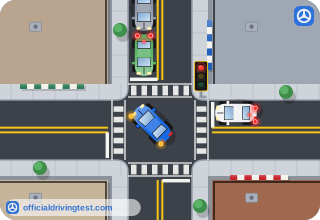
- Back up out of the intersection
- Complete your turn as quickly and safely as possible
- Stop in the middle of the intersection and wait
- Wait for the light to turn green again
Show answer
Correct answer: Complete your turn as quickly and safely as possible
If you are still in the intersection when the light turns red while making a left turn, complete your turn as quickly and safely as possible.
Source: What Every Driver Must Know (October 2025), page 30 · Open this page in the manual (Manual page 30)
-
What should you do when approaching a YIELD sign?
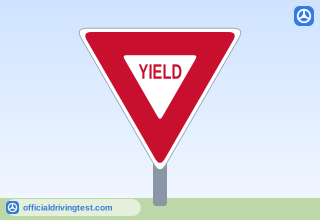
- Come to a complete stop regardless of traffic
- Maintain your speed since you have the right of way
- Sound your horn and proceed
- Slow down, check for traffic, and be prepared to stop
Show answer
Correct answer: Slow down, check for traffic, and be prepared to stop
When approaching a YIELD sign, slow down, check for traffic and be prepared to stop.
Source: What Every Driver Must Know (October 2025), page 30 · Open this page in the manual (Manual page 30)
-
What must you do when approaching a MERGE sign?
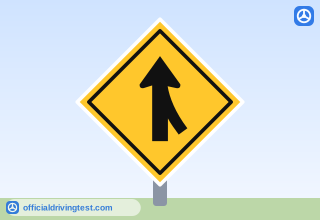
- Ignore the sign if your lane is ending
- Speed up to merge ahead of other traffic
- Yield to through traffic and adjust your speed
- Stop completely before merging
Show answer
Correct answer: Yield to through traffic and adjust your speed
Approaching a MERGE sign, you must yield to through traffic and adjust your speed as necessary to merge safely.
Source: What Every Driver Must Know (October 2025), page 31 · Open this page in the manual (Manual page 31)
-
As a driver, whom must you yield to near or in a school zone crosswalk when school is in session?
- Only vehicles with a green light
- Children, who may dart out unexpectedly
- Only school buses
- No one has priority in a school zone
Show answer
Correct answer: Children, who may dart out unexpectedly
You must yield to children near or in a school zone crosswalk when school is in session, as children may unexpectedly dart into the street.
Source: What Every Driver Must Know (October 2025), page 31 · Open this page in the manual (Manual page 31)
-
As a driver, you must yield to pedestrians with which of the following?
- Disabilities, including physical, hearing and visual disabilities
- Only wheelchairs, not other disabilities
- Only visible disabilities
- No special yielding rule exists for disabled pedestrians
Show answer
Correct answer: Disabilities, including physical, hearing and visual disabilities
You must yield to pedestrians with disabilities, including physical, hearing and visual disabilities.
Source: What Every Driver Must Know (October 2025), page 31 · Open this page in the manual (Manual page 31)
-
If a pedestrian enters a crosswalk before the signal changes, what must you do?
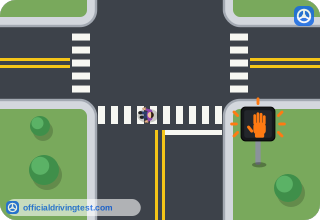
- Honk to warn the pedestrian to hurry
- Only yield if the pedestrian is a child
- Yield to the pedestrian
- Proceed since your light has already changed
Show answer
Correct answer: Yield to the pedestrian
You must yield to a pedestrian who enters a crosswalk before the signal has changed.
Source: What Every Driver Must Know (October 2025), page 31 · Open this page in the manual (Manual page 31)
-
You must yield to a pedestrian crossing the street from which of the following locations?
- Only from a marked crosswalk at an intersection
- Only from a traffic signal
- Only from another vehicle
- An alley, driveway, building or private road
Show answer
Correct answer: An alley, driveway, building or private road
You must yield to a pedestrian crossing the street from an alley, driveway, building or private road.
Source: What Every Driver Must Know (October 2025), page 31 · Open this page in the manual (Manual page 31)
-
What must vehicles in a funeral procession display?
- A fluorescent orange flag with a religious symbol
- A black ribbon tied to each car's radio antenna
- Flashing red and blue lights
- Nothing is required to be displayed
Show answer
Correct answer: A fluorescent orange flag with a religious symbol
Vehicles in a funeral procession must display a fluorescent orange flag with an appropriate religious symbol (such as a cross, Star of David, or crescent and star).
Source: What Every Driver Must Know (October 2025), page 31 · Open this page in the manual (Manual page 31)
-
Which statement about funeral processions in Michigan is TRUE?
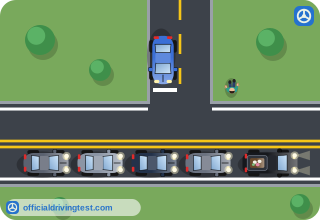
- It is a civil infraction to cut through a funeral procession
- Drivers are legally required to pull over for a funeral procession
- Funeral processions must always yield to regular traffic
- Cutting through a funeral procession carries no legal consequence
Show answer
Correct answer: It is a civil infraction to cut through a funeral procession
It is a civil infraction to cut through a funeral procession; drivers are not legally required to pull over for one, though they should be respectful.
Source: What Every Driver Must Know (October 2025), page 31 · Open this page in the manual (Manual page 31)
-
Before passing on a two-lane highway, what must you have?
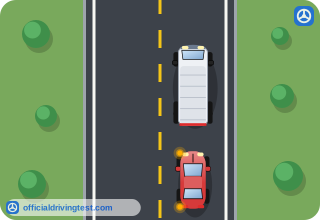
- Permission from the vehicle you are passing
- At least three vehicle lengths of following distance only
- A passing lane painted in yellow
- A clear view of the left lane, with any traffic far enough away
Show answer
Correct answer: A clear view of the left lane, with any traffic far enough away
On a two-lane highway, you should have a clear, unobstructed view of the left lane, with any traffic in it far enough away to pass safely.
Source: What Every Driver Must Know (October 2025), page 31 · Open this page in the manual (Manual page 31)
-
After starting to pass a vehicle, when should you cut back into the right-hand lane?
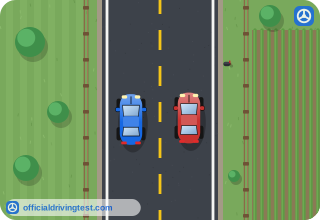
- Immediately after your front bumper passes theirs
- Only once you can see the entire vehicle you passed in your rearview mirror
- Whenever you feel like it
- After exactly 5 seconds
Show answer
Correct answer: Only once you can see the entire vehicle you passed in your rearview mirror
Once you have started passing a vehicle, do not cut back into the right-hand lane until you can see the entire vehicle you are passing in your rearview mirror.
Source: What Every Driver Must Know (October 2025), page 32 · Open this page in the manual (Manual page 32)
-
According to the manual, what should you avoid doing while passing?
- Passing more than one vehicle at a time
- Using your turn signal to change lanes
- Checking your mirrors and blind spot
- Returning to your lane after passing
Show answer
Correct answer: Passing more than one vehicle at a time
Do not pass more than one vehicle at a time or follow too closely when another vehicle is passing slower traffic.
Source: What Every Driver Must Know (October 2025), page 32 · Open this page in the manual (Manual page 32)
-
If another vehicle is passing you, what should you do?
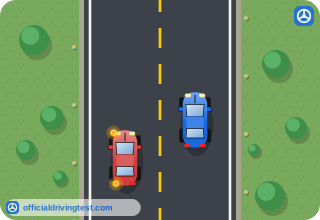
- Speed up to prevent them from passing
- Don't speed up or race; let them pass safely
- Move onto the shoulder
- Flash your high beams at them
Show answer
Correct answer: Don't speed up or race; let them pass safely
If you are being passed, do not increase your speed or race the driver who is passing you; allow them to complete the maneuver safely.
Source: What Every Driver Must Know (October 2025), page 32 · Open this page in the manual (Manual page 32)
-
On a three-lane road, when is using the center lane for passing prohibited?
- It is always prohibited on a three-lane road
- Only at night
- Only during rush hour
- When it is marked for left turns only
Show answer
Correct answer: When it is marked for left turns only
Using the center lane of a three-lane road for passing or merging is prohibited if the center lane is marked for left turns only.
Source: What Every Driver Must Know (October 2025), page 32 · Open this page in the manual (Manual page 32)
-
Passing on the right is allowed in certain circumstances, but you must never do what?
- Drive on the shoulder or off the road
- Use your turn signal
- Check your mirrors and blind spots first
- Slow down before passing
Show answer
Correct answer: Drive on the shoulder or off the road
Passing a vehicle on the right is allowed, but don't drive on the shoulder or off the road to do so.
Source: What Every Driver Must Know (October 2025), page 32 · Open this page in the manual (Manual page 32)
-
On a two-lane road, when is passing on the right permitted?
- When there is enough room and the vehicle ahead turns left
- Whenever the vehicle ahead is moving slower than you
- Only if you signal first
- Never, on any two-lane road
Show answer
Correct answer: When there is enough room and the vehicle ahead turns left
Passing on the right is allowed on a two-lane road when there is enough room and the vehicle you want to pass is turning left.
Source: What Every Driver Must Know (October 2025), page 32 · Open this page in the manual (Manual page 32)
-
On which of the following roadways is passing on the right permitted?
- A multilane one-way street, or a road with two or more lanes in each direction
- A single-lane rural road
- Any road with a solid yellow center line
- The paved shoulder of a highway, whenever the vehicle ahead is moving slowly
Show answer
Correct answer: A multilane one-way street, or a road with two or more lanes in each direction
Passing on the right is allowed on a one-way street with more than one lane, or on a roadway with two or more lanes in each direction.
Source: What Every Driver Must Know (October 2025), page 32 · Open this page in the manual (Manual page 32)
-
Besides an intersection or railroad crossing, near what other structures is passing prohibited within 100 feet if your view is blocked?
- A bridge, viaduct or tunnel
- A gas station
- A shopping center entrance
- A residential driveway
Show answer
Correct answer: A bridge, viaduct or tunnel
You must not pass if your view is blocked within 100 feet of a bridge, viaduct or tunnel.
Source: What Every Driver Must Know (October 2025), page 32 · Open this page in the manual (Manual page 32)
-
You must not pass a vehicle that has stopped where?
- At a rural mailbox while the carrier delivers mail
- In a parking lot
- At a gas station
- At a crosswalk or intersection to let a pedestrian cross
Show answer
Correct answer: At a crosswalk or intersection to let a pedestrian cross
You may not pass a vehicle that has stopped at a crosswalk or intersection to allow a pedestrian to cross.
Source: What Every Driver Must Know (October 2025), page 32 · Open this page in the manual (Manual page 32)
-
If a crash or obstacle forces you to cross the center line, what must you do first?
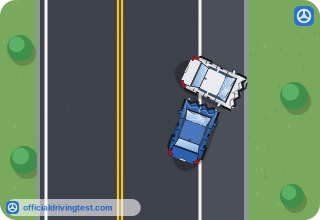
- Wait for a police officer to direct you
- Cross immediately without checking
- Yield to any oncoming traffic
- Sound your horn continuously
Show answer
Correct answer: Yield to any oncoming traffic
If stopped vehicles, a crash or other obstacles make it necessary to cross the center line, you must yield to any oncoming traffic before leaving your lane.
Source: What Every Driver Must Know (October 2025), page 33 · Open this page in the manual (Manual page 33)
-
On which type of road is a driver exempt from the general right-hand-lane requirement due to having multiple lanes?
- A one-way street with two or more lanes
- A two-way road with one lane each way
- A gravel road
- A residential cul-de-sac
Show answer
Correct answer: A one-way street with two or more lanes
You are not required to drive in the right-hand lane on a one-way street with two or more lanes of traffic.
Source: What Every Driver Must Know (October 2025), page 33 · Open this page in the manual (Manual page 33)
-
When is it acceptable to cross the center line into the oncoming lane?
- To make a left turn into or from an alley, private road or driveway
- Whenever traffic is light
- To get a better view of the road ahead
- Whenever you are running late
Show answer
Correct answer: To make a left turn into or from an alley, private road or driveway
You may cross the center line to make a left turn into or from an alley, private road or driveway.
Source: What Every Driver Must Know (October 2025), page 33 · Open this page in the manual (Manual page 33)
-
Slow vehicles must use which lane, except when passing or making a left turn?
- The right lane
- The center lane
- Any lane they choose
- The left lane
Show answer
Correct answer: The right lane
Slow vehicles must use the right lane except when passing or making a left turn.
Source: What Every Driver Must Know (October 2025), page 33 · Open this page in the manual (Manual page 33)
-
What does Michigan law say about weaving from lane to lane to speed through traffic?
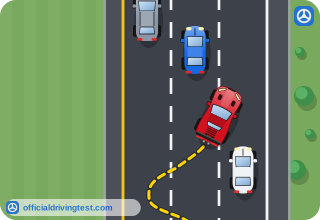
- It is allowed if done carefully
- It is only illegal on freeways
- It is allowed for commercial vehicles
- It is illegal
Show answer
Correct answer: It is illegal
Weaving from lane to lane to speed through traffic is illegal.
Source: What Every Driver Must Know (October 2025), page 33 · Open this page in the manual (Manual page 33)
-
Who is allowed to drive against the flow of traffic?
- Emergency and police vehicles using lights and sirens
- Any vehicle in a hurry
- Delivery trucks
- Any vehicle when no other traffic is in sight
Show answer
Correct answer: Emergency and police vehicles using lights and sirens
Only emergency vehicles and law enforcement using their lights and sirens are allowed to drive against the flow of traffic.
Source: What Every Driver Must Know (October 2025), page 33 · Open this page in the manual (Manual page 33)
-
When making a right turn, what should you follow to stay in your lane?
- The general curve of the curb
- The vehicle ahead of you, no matter its lane
- The center line only
- Whatever path feels fastest
Show answer
Correct answer: The general curve of the curb
Follow the general curve of the curb as you make your right turn; do not stray into other lanes.
Source: What Every Driver Must Know (October 2025), page 34 · Open this page in the manual (Manual page 34)
-
When multiple turn lanes are present at an intersection, what must you do?
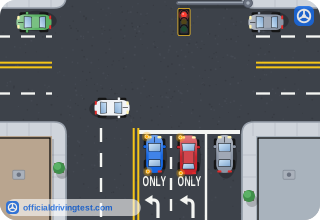
- Turn into the lane matching your turn lane
- Move into whichever lane is emptiest
- Change lanes freely while turning
- Always end up in the far-right lane
Show answer
Correct answer: Turn into the lane matching your turn lane
When multiple turn lanes are present, complete your turn by entering the lane that corresponds to your turn lane; moving into another lane could cut off traffic and cause a crash.
Source: What Every Driver Must Know (October 2025), page 34 · Open this page in the manual (Manual page 34)
-
While waiting to make a left turn, how should your front wheels be positioned until you actually start turning?
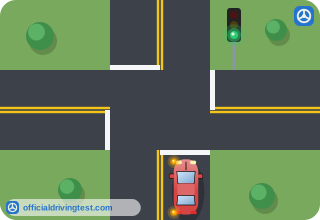
- Pointed straight ahead
- Already turned toward the direction you plan to go
- Turned toward the curb
- It does not matter
Show answer
Correct answer: Pointed straight ahead
Keep your front wheels pointed straight ahead until you start your turn.
Source: What Every Driver Must Know (October 2025), page 34 · Open this page in the manual (Manual page 34)
-
How do vehicles exit a roundabout?
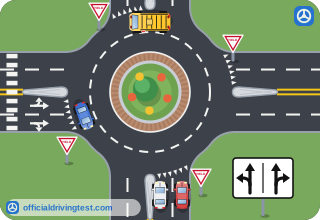
- By making a right turn onto the desired road
- By making a left turn across traffic
- By stopping and reversing out
- By driving straight through the center island
Show answer
Correct answer: By making a right turn onto the desired road
Vehicles exit the roundabout by making a right turn onto the desired road.
Source: What Every Driver Must Know (October 2025), page 35 · Open this page in the manual (Manual page 35)
-
When should you stop while traveling in a roundabout?
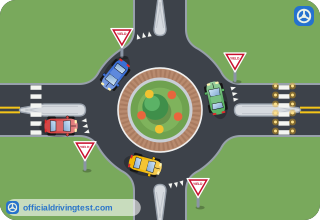
- At every exit, regardless of traffic
- Whenever you feel unsure
- Only if it is the only way to avoid a collision or danger
- Whenever a car at the yield line is waiting to enter
Show answer
Correct answer: Only if it is the only way to avoid a collision or danger
Do not stop in a roundabout unless it is the only way to safely avoid a collision or other danger.
Source: What Every Driver Must Know (October 2025), page 35 · Open this page in the manual (Manual page 35)
-
If you hear or see an emergency vehicle approaching while you are inside a roundabout, what should you do?
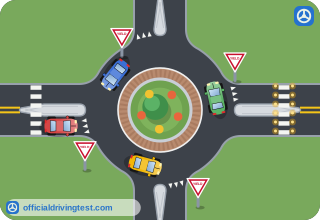
- Stop immediately inside the roundabout and wait
- Leave at the nearest exit, then pull over and stop
- Speed up to exit before it arrives
- Reverse out of the roundabout
Show answer
Correct answer: Leave at the nearest exit, then pull over and stop
If an emergency vehicle is heard or seen approaching while in a roundabout, do not stop; leave at the nearest exit, pull over to the right and stop to let it pass.
Source: What Every Driver Must Know (October 2025), page 35 · Open this page in the manual (Manual page 35)
-
When should you choose your lane for a roundabout?
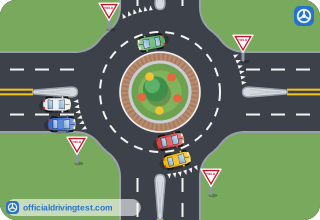
- Before entering; avoid changing lanes while inside it
- After entering, once you see traffic
- Only right before your exit
- It does not matter, lane changes are encouraged inside
Show answer
Correct answer: Before entering; avoid changing lanes while inside it
Avoid changing lanes inside a roundabout; move into the lane you need before entering.
Source: What Every Driver Must Know (October 2025), page 35 · Open this page in the manual (Manual page 35)
-
What should you refrain from doing while inside a roundabout?
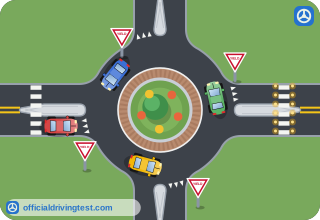
- Yielding to traffic on your left
- Signaling your exit
- Staying to the right of the center island
- Passing other vehicles, bicycles and mopeds
Show answer
Correct answer: Passing other vehicles, bicycles and mopeds
Refrain from passing other vehicles, bicycles and mopeds while inside a roundabout.
Source: What Every Driver Must Know (October 2025), page 35 · Open this page in the manual (Manual page 35)
-
What should you do if you miss your exit in a roundabout?
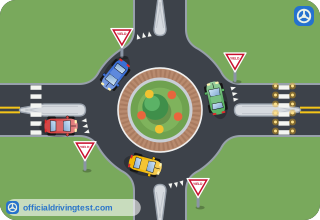
- Go around the roundabout again to your exit
- Stop and reverse to the exit
- Make a U-turn across the center island
- Exit at the next available driveway
Show answer
Correct answer: Go around the roundabout again to your exit
Maintain a slow speed; if you miss your exit, drive around the roundabout to your exit again.
Source: What Every Driver Must Know (October 2025), page 35 · Open this page in the manual (Manual page 35)
-
When exiting a roundabout, when should you accelerate?
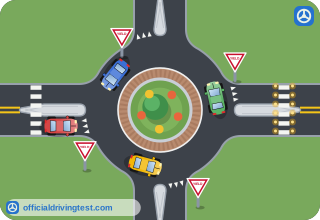
- Once past the pedestrian crossing at the exit
- Immediately upon reaching the exit lane
- As soon as you see your exit sign
- Before checking for pedestrians
Show answer
Correct answer: Once past the pedestrian crossing at the exit
Do not accelerate until you are past the pedestrian crossing at the roundabout exit.
Source: What Every Driver Must Know (October 2025), page 35 · Open this page in the manual (Manual page 35)