Michigan: Right of way & turning — Part 3 Practice Test
Questions in this part include: “You must not pass a vehicle that has stopped where?” · “Slow vehicles must use which lane, except when passing or making a left turn?”
Independent educational site · not affiliated with any government agency or DMV
Ready? Test yourself
- Instant feedback with an explanation
- Every answer cites its source in the manual
- Your best score is saved on this device
Questions are original and based on the official manual "What Every Driver Must Know" (October 2025), Michigan Secretary of State.
Did you know?
- In 1904, the speed limit in Saginaw was 8 mph for cars and 10 mph for bicycles.
- In 1922, the Detroit Police Department began keeping traffic crash statistics.
- In 1945, the first chemical test to identify suspected drunken drivers was administered by the Detroit Police Department.
More background reading from the manual →
All 17 questions in this practice test
Take the test above first, then use this list to study. Tap “Show answer” to see the correct answer and explanation.
Show the questions and answersHide the questions
-
You must not pass a vehicle that has stopped where?
- At a rural mailbox while the carrier delivers mail
- In a parking lot
- At a gas station
- At a crosswalk or intersection to let a pedestrian cross
Show answer
Correct answer: At a crosswalk or intersection to let a pedestrian cross
You may not pass a vehicle that has stopped at a crosswalk or intersection to allow a pedestrian to cross.
Source: What Every Driver Must Know (October 2025), page 32 · Open this page in the manual (Manual page 32)
-
If a crash or obstacle forces you to cross the center line, what must you do first?
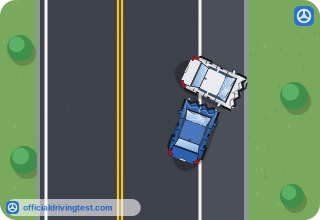
- Wait for a police officer to direct you
- Cross immediately without checking
- Yield to any oncoming traffic
- Sound your horn continuously
Show answer
Correct answer: Yield to any oncoming traffic
If stopped vehicles, a crash or other obstacles make it necessary to cross the center line, you must yield to any oncoming traffic before leaving your lane.
Source: What Every Driver Must Know (October 2025), page 33 · Open this page in the manual (Manual page 33)
-
On which type of road is a driver exempt from the general right-hand-lane requirement due to having multiple lanes?
- A one-way street with two or more lanes
- A two-way road with one lane each way
- A gravel road
- A residential cul-de-sac
Show answer
Correct answer: A one-way street with two or more lanes
You are not required to drive in the right-hand lane on a one-way street with two or more lanes of traffic.
Source: What Every Driver Must Know (October 2025), page 33 · Open this page in the manual (Manual page 33)
-
When is it acceptable to cross the center line into the oncoming lane?
- To make a left turn into or from an alley, private road or driveway
- Whenever traffic is light
- To get a better view of the road ahead
- Whenever you are running late
Show answer
Correct answer: To make a left turn into or from an alley, private road or driveway
You may cross the center line to make a left turn into or from an alley, private road or driveway.
Source: What Every Driver Must Know (October 2025), page 33 · Open this page in the manual (Manual page 33)
-
Slow vehicles must use which lane, except when passing or making a left turn?
- The right lane
- The center lane
- Any lane they choose
- The left lane
Show answer
Correct answer: The right lane
Slow vehicles must use the right lane except when passing or making a left turn.
Source: What Every Driver Must Know (October 2025), page 33 · Open this page in the manual (Manual page 33)
-
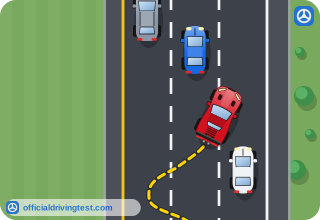
What does Michigan law say about weaving from lane to lane to speed through traffic?
- It is allowed if done carefully
- It is only illegal on freeways
- It is allowed for commercial vehicles
- It is illegal
Show answer
Correct answer: It is illegal
Weaving from lane to lane to speed through traffic is illegal.
Source: What Every Driver Must Know (October 2025), page 33 · Open this page in the manual (Manual page 33)
-
Who is allowed to drive against the flow of traffic?
- Emergency and police vehicles using lights and sirens
- Any vehicle in a hurry
- Delivery trucks
- Any vehicle when no other traffic is in sight
Show answer
Correct answer: Emergency and police vehicles using lights and sirens
Only emergency vehicles and law enforcement using their lights and sirens are allowed to drive against the flow of traffic.
Source: What Every Driver Must Know (October 2025), page 33 · Open this page in the manual (Manual page 33)
-
When making a right turn, what should you follow to stay in your lane?
- The general curve of the curb
- The vehicle ahead of you, no matter its lane
- The center line only
- Whatever path feels fastest
Show answer
Correct answer: The general curve of the curb
Follow the general curve of the curb as you make your right turn; do not stray into other lanes.
Source: What Every Driver Must Know (October 2025), page 34 · Open this page in the manual (Manual page 34)
-
When multiple turn lanes are present at an intersection, what must you do?
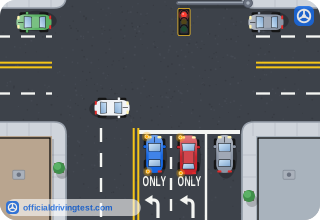
- Turn into the lane matching your turn lane
- Move into whichever lane is emptiest
- Change lanes freely while turning
- Always end up in the far-right lane
Show answer
Correct answer: Turn into the lane matching your turn lane
When multiple turn lanes are present, complete your turn by entering the lane that corresponds to your turn lane; moving into another lane could cut off traffic and cause a crash.
Source: What Every Driver Must Know (October 2025), page 34 · Open this page in the manual (Manual page 34)
-
While waiting to make a left turn, how should your front wheels be positioned until you actually start turning?
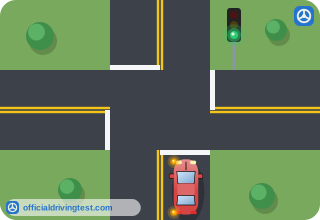
- Pointed straight ahead
- Already turned toward the direction you plan to go
- Turned toward the curb
- It does not matter
Show answer
Correct answer: Pointed straight ahead
Keep your front wheels pointed straight ahead until you start your turn.
Source: What Every Driver Must Know (October 2025), page 34 · Open this page in the manual (Manual page 34)
-
How do vehicles exit a roundabout?
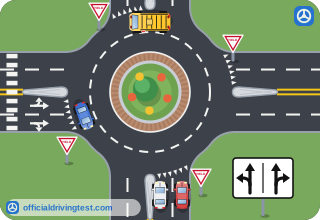
- By making a right turn onto the desired road
- By making a left turn across traffic
- By stopping and reversing out
- By driving straight through the center island
Show answer
Correct answer: By making a right turn onto the desired road
Vehicles exit the roundabout by making a right turn onto the desired road.
Source: What Every Driver Must Know (October 2025), page 35 · Open this page in the manual (Manual page 35)
-
When should you stop while traveling in a roundabout?
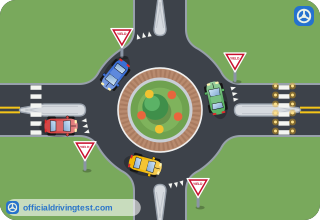
- At every exit, regardless of traffic
- Whenever you feel unsure
- Only if it is the only way to avoid a collision or danger
- Whenever a car at the yield line is waiting to enter
Show answer
Correct answer: Only if it is the only way to avoid a collision or danger
Do not stop in a roundabout unless it is the only way to safely avoid a collision or other danger.
Source: What Every Driver Must Know (October 2025), page 35 · Open this page in the manual (Manual page 35)
-
If you hear or see an emergency vehicle approaching while you are inside a roundabout, what should you do?
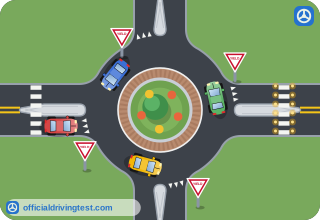
- Stop immediately inside the roundabout and wait
- Leave at the nearest exit, then pull over and stop
- Speed up to exit before it arrives
- Reverse out of the roundabout
Show answer
Correct answer: Leave at the nearest exit, then pull over and stop
If an emergency vehicle is heard or seen approaching while in a roundabout, do not stop; leave at the nearest exit, pull over to the right and stop to let it pass.
Source: What Every Driver Must Know (October 2025), page 35 · Open this page in the manual (Manual page 35)
-
When should you choose your lane for a roundabout?
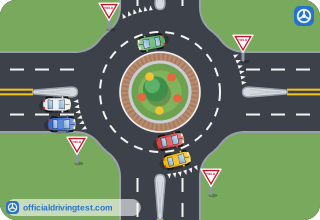
- Before entering; avoid changing lanes while inside it
- After entering, once you see traffic
- Only right before your exit
- It does not matter, lane changes are encouraged inside
Show answer
Correct answer: Before entering; avoid changing lanes while inside it
Avoid changing lanes inside a roundabout; move into the lane you need before entering.
Source: What Every Driver Must Know (October 2025), page 35 · Open this page in the manual (Manual page 35)
-
What should you refrain from doing while inside a roundabout?
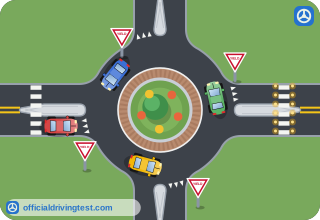
- Yielding to traffic on your left
- Signaling your exit
- Staying to the right of the center island
- Passing other vehicles, bicycles and mopeds
Show answer
Correct answer: Passing other vehicles, bicycles and mopeds
Refrain from passing other vehicles, bicycles and mopeds while inside a roundabout.
Source: What Every Driver Must Know (October 2025), page 35 · Open this page in the manual (Manual page 35)
-
What should you do if you miss your exit in a roundabout?
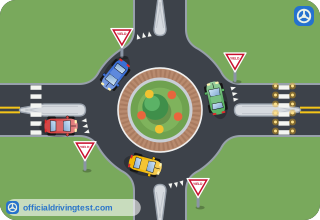
- Go around the roundabout again to your exit
- Stop and reverse to the exit
- Make a U-turn across the center island
- Exit at the next available driveway
Show answer
Correct answer: Go around the roundabout again to your exit
Maintain a slow speed; if you miss your exit, drive around the roundabout to your exit again.
Source: What Every Driver Must Know (October 2025), page 35 · Open this page in the manual (Manual page 35)
-
When exiting a roundabout, when should you accelerate?
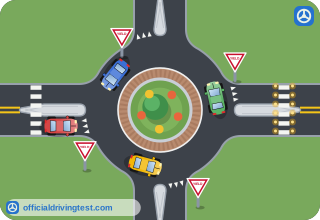
- Once past the pedestrian crossing at the exit
- Immediately upon reaching the exit lane
- As soon as you see your exit sign
- Before checking for pedestrians
Show answer
Correct answer: Once past the pedestrian crossing at the exit
Do not accelerate until you are past the pedestrian crossing at the roundabout exit.
Source: What Every Driver Must Know (October 2025), page 35 · Open this page in the manual (Manual page 35)