Michigan: Pedestrian rights Practice Test
Crosswalks, school zones, and sharing the road with people on foot.
Independent educational site · not affiliated with any government agency or DMV
Ready? Test yourself
- Instant feedback with an explanation
- Every answer cites its source in the manual
- Your best score is saved on this device
- Keyboard: press 1 to 4 to answer and Enter for the next question
Questions are original and based on the official manual "What Every Driver Must Know" (October 2025), Michigan Secretary of State.
Did you know?
- In 1927, the Ford Motor Company produced its fifteen millionth Model T.
- In 1939, the 3-M Corporation introduced reflective sheeting for roadside signs.
- In 1942, the Willow Run and Detroit Industrial Expressway, the nation's first four-lane divided highway, was completed. Nearly 42,000 Detroit-area motorists used it daily to commute to the Ypsilanti bomber factory.
More background reading from the manual →
All 12 questions in this practice test
Take the test above first, then use this list to study. Tap “Show answer” to see the correct answer and explanation.
Show the questions and answersHide the questions
-
If you have a green light but a pedestrian is still crossing the intersection, what must you do?
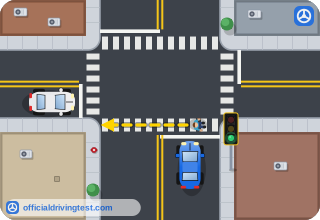
- Proceed, since you have the right of way
- Honk to make the pedestrian hurry
- Yield to the pedestrian until they finish crossing
- Only yield if the pedestrian is elderly or a child
Show answer
Correct answer: Yield to the pedestrian until they finish crossing
Even with a green light, you must yield to pedestrians who are still crossing the street or intersection.
Source: What Every Driver Must Know (October 2025), page 54 · Open this page in the manual (Manual page 54)
-
What should you do if you approach a vehicle that has stopped for a pedestrian?
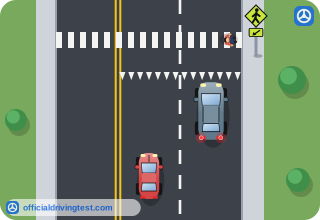
- Pass carefully on the left if there is room
- Sound your horn and proceed
- Never attempt to pass the stopped vehicle
- Pass only if it is a passenger car and not a truck
Show answer
Correct answer: Never attempt to pass the stopped vehicle
Never attempt to pass a vehicle stopped for a pedestrian; a pedestrian may be hidden from your view.
Source: What Every Driver Must Know (October 2025), page 54 · Open this page in the manual (Manual page 54)
-
If a street has no sidewalk, which direction should a pedestrian walking along the road's edge face?
- In the same direction as traffic
- Facing oncoming traffic
- It does not matter as long as they stay off the pavement
- In the middle of the road
Show answer
Correct answer: Facing oncoming traffic
On streets without sidewalks, pedestrians should face oncoming traffic if walking along the road's edge.
Source: What Every Driver Must Know (October 2025), page 55 · Open this page in the manual (Manual page 55)
-
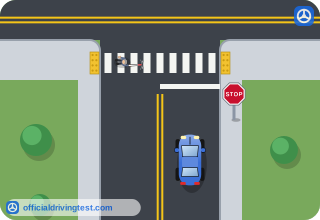
What must a driver do when approaching a pedestrian carrying a white cane or using a guide dog?
- Honk to alert them that a vehicle is nearby
- Stop or yield the right of way to them
- Flash the headlights to signal them to wait
- Proceed if traffic is light
Show answer
Correct answer: Stop or yield the right of way to them
Drivers are required by law to stop or yield the right of way for a pedestrian with a white cane or guide dog.
Source: What Every Driver Must Know (October 2025), page 55 · Open this page in the manual (Manual page 55)
-
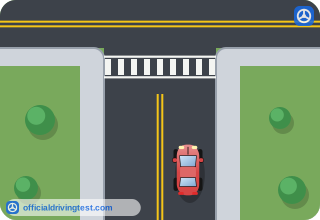
Where must a driver stop for a marked crosswalk, according to Michigan law?
- Anywhere within the crosswalk itself
- At the limit line, or before the intersection if there is none
- At least one full car length before the crosswalk begins
- Only when a pedestrian is already stepping into the road
Show answer
Correct answer: At the limit line, or before the intersection if there is none
Michigan law requires drivers to stop at the marked crosswalk limit line, or before entering the intersection if no limit line exists.
Source: What Every Driver Must Know (October 2025), page 55 · Open this page in the manual (Manual page 55)
-
Why does the manual say you should never block a crosswalk?
- It only affects traffic flow, not pedestrian safety
- It makes crossing difficult and unsafe for pedestrians
- It is not actually against any traffic law
- It only matters at intersections with traffic signals
Show answer
Correct answer: It makes crossing difficult and unsafe for pedestrians
Blocking a crosswalk makes it difficult for people with visual and mobility challenges to navigate and creates an unsafe environment for pedestrians.
Source: What Every Driver Must Know (October 2025), page 55 · Open this page in the manual (Manual page 55)
-
Why does the manual advise extra caution around parked cars, school zones, playgrounds and parks?
- Speed limits are always lower there regardless of signage
- Children are unpredictable and may dart into the street
- These areas typically have no traffic signals
- Insurance rates increase for crashes in these zones
Show answer
Correct answer: Children are unpredictable and may dart into the street
Children are unpredictable and may dart into the street unexpectedly, so drivers should pay close attention near parked cars, school zones, playgrounds and parks.
Source: What Every Driver Must Know (October 2025), page 55 · Open this page in the manual (Manual page 55)
-
Under Michigan's right-of-way rules, which of the following counts as a 'pedestrian'?
- Only children
- Only wheelchair users
- Only people walking on foot
- People walking, jogging, hiking, skateboarding, or pushing strollers, among others
Show answer
Correct answer: People walking, jogging, hiking, skateboarding, or pushing strollers, among others
"Pedestrians" includes people walking, jogging, hiking, skateboarding, pushing strollers, etc.
Source: What Every Driver Must Know (October 2025), page 54 · Open this page in the manual (Manual page 54)
-
Besides intersections and crosswalks, where else must you watch closely for pedestrians?
- Only in parking garages
- Only near hospitals
- When leaving a driveway or alley
- Only on interstate highways
Show answer
Correct answer: When leaving a driveway or alley
Watch for pedestrians when entering a street from a driveway or alley, at stop signs, signals, roundabouts, crosswalks and intersections.
Source: What Every Driver Must Know (October 2025), page 54 · Open this page in the manual (Manual page 54)
-
True or false: pedestrians may only legally cross the street at a marked crosswalk.
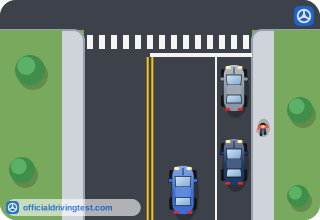
- True, it is always illegal elsewhere
- True, unless a police officer permits it
- False, only children may do so
- False, they may also cross mid-block
Show answer
Correct answer: False, they may also cross mid-block
Pedestrians may also cross in the middle of a block, even if there is a crosswalk nearby.
Source: What Every Driver Must Know (October 2025), page 54 · Open this page in the manual (Manual page 54)
-
Drivers should make extra allowances for which pedestrians, who may need more time to cross the street?
- Only cyclists who walk their bikes across
- The elderly, the young, and people with disabilities
- Only joggers
- Only pedestrians who are walking with their pets
Show answer
Correct answer: The elderly, the young, and people with disabilities
Make extra allowances for the elderly, the young and people with disabilities, as they may need more time to cross.
Source: What Every Driver Must Know (October 2025), page 55 · Open this page in the manual (Manual page 55)
-
At a mid-block crosswalk, what does a yield line indicate?
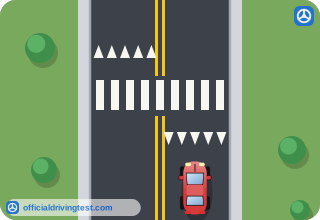
- A no-parking zone only
- Where pedestrians must wait for a signal
- Where drivers should stop for pedestrians
- Where bicyclists must dismount
Show answer
Correct answer: Where drivers should stop for pedestrians
A yield line at a mid-block crosswalk indicates where drivers should stop for pedestrians in the crosswalk.
Source: What Every Driver Must Know (October 2025), page 55 · Open this page in the manual (Manual page 55)