Michigan: Parking rules Practice Test
Hill parking, parallel parking, disability parking, and where parking is prohibited.
Independent educational site · not affiliated with any government agency or DMV
Ready? Test yourself
- Instant feedback with an explanation
- Every answer cites its source in the manual
- Your best score is saved on this device
- Keyboard: press 1 to 4 to answer and Enter for the next question
Questions are original and based on the official manual "What Every Driver Must Know" (October 2025), Michigan Secretary of State.
Did you know?
- In 1904, the speed limit in Saginaw was 8 mph for cars and 10 mph for bicycles.
- In 1922, the Detroit Police Department began keeping traffic crash statistics.
- In 1945, the first chemical test to identify suspected drunken drivers was administered by the Detroit Police Department.
More background reading from the manual →
All 28 questions in this practice test
Take the test above first, then use this list to study. Tap “Show answer” to see the correct answer and explanation.
Show the questions and answersHide the questions
-
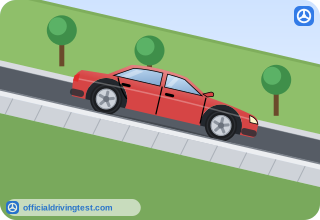
When parking on a hill facing downhill, which way should you turn your front wheels?
- Away from the curb
- Straight ahead
- Toward the curb
- It doesn't matter as long as the parking brake is set
Show answer
Correct answer: Toward the curb
The manual states to turn wheels toward the curb when parking downhill.
Source: What Every Driver Must Know (October 2025), page 37 · Open this page in the manual (Manual page 37)
-
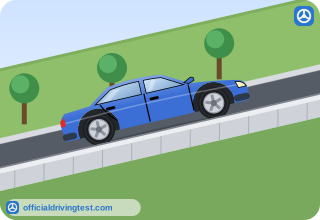
When parking on a hill facing uphill (with a curb present), which way should the front wheels point?
- Toward the curb
- Away from the curb
- Straight ahead
- Whichever way is easiest to exit
Show answer
Correct answer: Away from the curb
The manual states to turn wheels away from the curb when parking uphill.
Source: What Every Driver Must Know (October 2025), page 37 · Open this page in the manual (Manual page 37)
-
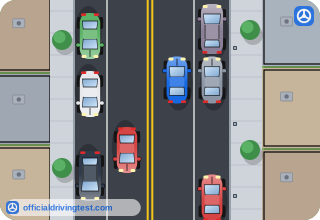
When positioning your vehicle alongside a car to begin parallel parking, how much space should generally separate the two vehicles?
- 2-5 feet
- 6-10 feet
- 10-15 feet
- Less than 1 foot
Show answer
Correct answer: 2-5 feet
The manual recommends 2-5 feet of space between your vehicle and the parked vehicle ahead before backing in.
Source: What Every Driver Must Know (October 2025), page 37 · Open this page in the manual (Manual page 37)
-
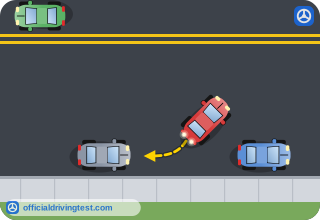
After completing a parallel park, how far from the curb should the vehicle be positioned?
- At least 2 feet
- Exactly 24 inches
- It doesn't matter as long as the wheels are straight
- No more than 6-12 inches
Show answer
Correct answer: No more than 6-12 inches
The manual states a parked vehicle should not be more than 6-12 inches from the curb.
Source: What Every Driver Must Know (October 2025), page 37 · Open this page in the manual (Manual page 37)
-
To park for free in a disability parking space in Michigan, a vehicle must display...
- any disability placard or plate
- a placard with a yellow free-parking sticker
- a valid state ID
- a disability plate from any other state
Show answer
Correct answer: a placard with a yellow free-parking sticker
Free parking is only provided to vehicles displaying a disability placard with the yellow free-parking sticker; a standard placard or plate alone does not qualify.
Source: What Every Driver Must Know (October 2025), page 38 · Open this page in the manual (Manual page 38)
-
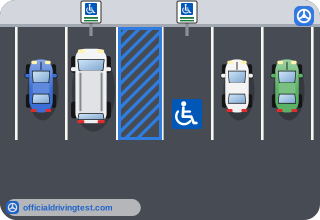
Why should drivers avoid parking in the blue-striped area next to a van-accessible disability parking space?
- It is reserved for motorcycles
- It is a fire lane
- It gives room for a wheelchair lift and ramp
- It is reserved for loading zones only
Show answer
Correct answer: It gives room for a wheelchair lift and ramp
The blue-striped access aisle provides room for a van's wheelchair lift and ramp; blocking it can prevent a person with a disability from entering or exiting the vehicle.
Source: What Every Driver Must Know (October 2025), page 38 · Open this page in the manual (Manual page 38)
-
A driver may not park within how many feet of a fire hydrant?
- 10 feet
- 20 feet
- 25 feet
- 15 feet
Show answer
Correct answer: 15 feet
Parking within 15 feet of a fire hydrant is prohibited.
Source: What Every Driver Must Know (October 2025), page 38 · Open this page in the manual (Manual page 38)
-
Parking is prohibited within how many feet of the scene of a fire or a crash?
- 100 feet
- 300 feet
- 1,000 feet
- 500 feet
Show answer
Correct answer: 500 feet
Parking is prohibited within 500 feet of a fire or crash.
Source: What Every Driver Must Know (October 2025), page 38 · Open this page in the manual (Manual page 38)
-
Whenever you park, what should you rely on to hold your vehicle in place, rather than the transmission?
- Leaving the engine running
- Chocking the wheels with rocks
- Leaving the vehicle in drive
- The parking brake
Show answer
Correct answer: The parking brake
Whenever you park, set the parking brake; do not rely on the transmission to hold your vehicle in place.
Source: What Every Driver Must Know (October 2025), page 37 · Open this page in the manual (Manual page 37)
-
Which hand should you use to open your car door after parking, and why?
- Your right hand, so you look over your left shoulder
- Your left hand, so you can exit faster
- Either hand, it makes no difference
- Your right hand, so the door opens toward traffic
Show answer
Correct answer: Your right hand, so you look over your left shoulder
Use your right hand to open the door, so you automatically look over your left shoulder for oncoming cyclists and pedestrians.
Source: What Every Driver Must Know (October 2025), page 37 · Open this page in the manual (Manual page 37)
-
When returning to your parked vehicle, how should you approach the driver's side?
- With your back to traffic
- From behind the vehicle only
- It does not matter which direction you approach from
- Facing oncoming traffic
Show answer
Correct answer: Facing oncoming traffic
When returning to your vehicle, face oncoming traffic as you approach the driver's side.
Source: What Every Driver Must Know (October 2025), page 37 · Open this page in the manual (Manual page 37)
-
What is considered a qualifying disability for disability parking?
- Blindness or a condition that significantly limits walking
- Only permanent physical disabilities that others can see
- Being over age 65
- Any minor, short-term injury
Show answer
Correct answer: Blindness or a condition that significantly limits walking
A qualifying disability is defined as blindness or any condition that significantly limits a person's ability to walk or that requires a wheelchair, walker, crutch or other assistive device; it may be temporary or permanent.
Source: What Every Driver Must Know (October 2025), page 38 · Open this page in the manual (Manual page 38)
-
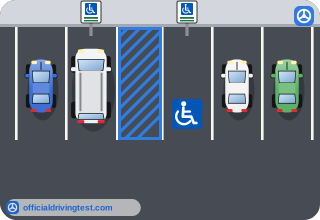
To legally park in a disability parking space, what must you have, and when must you never park there?
- A disability plate or placard; never without the disabled person
- Nothing special is required as long as the space is empty
- A doctor's note only, no plate or placard needed
- Only a temporary paper permit from the store
Show answer
Correct answer: A disability plate or placard; never without the disabled person
You must have a disability license plate or parking placard, and should never park in a disability space if none of the occupants are disabled or the disabled person is not accompanying you into the store.
Source: What Every Driver Must Know (October 2025), page 38 · Open this page in the manual (Manual page 38)
-
Who is responsible for parking tickets on an illegally parked vehicle?
- Whoever was driving it last month
- No one, if the driver was not present
- The owner, or the person leasing it
- The city where it was parked
Show answer
Correct answer: The owner, or the person leasing it
The owner of an illegally parked vehicle is responsible for any parking tickets; if the vehicle is leased, the person leasing it is responsible.
Source: What Every Driver Must Know (October 2025), page 38 · Open this page in the manual (Manual page 38)
-
How close to a fire station driveway may you never park?
- Within 20 feet on the same side, 75 feet on the other side if marked
- Within 15 feet on the same side, 50 feet on the other side if marked
- Within 100 feet on either side
- There is no minimum distance
Show answer
Correct answer: Within 20 feet on the same side, 75 feet on the other side if marked
Never park within 20 feet of a fire station driveway on the same side of the street or, when marked, within 75 feet of the driveway on the other side.
Source: What Every Driver Must Know (October 2025), page 38 · Open this page in the manual (Manual page 38)
-
How close to the nearest rail of a railroad crossing may you never park?
- Within 50 feet
- Within 10 feet
- Within 200 feet
- There is no restriction for parking
Show answer
Correct answer: Within 50 feet
Never park within 50 feet of the nearest rail of a railroad crossing.
Source: What Every Driver Must Know (October 2025), page 38 · Open this page in the manual (Manual page 38)
-
Which of the following locations is on the Michigan 'never park' list?
- In front of a theater or emergency exit
- In a paid parking garage
- In a properly marked parking space
- In your own driveway
Show answer
Correct answer: In front of a theater or emergency exit
Never park in front of any driveway, alley, theater, emergency exit or fire escape.
Source: What Every Driver Must Know (October 2025), page 38 · Open this page in the manual (Manual page 38)
-
May you park next to a road where you block the view of drivers turning at an intersection?
- No, it is on the 'never park' list
- Yes, it is only a courtesy rule
- Yes, if your hazard lights are on
- Only trucks are prohibited
Show answer
Correct answer: No, it is on the 'never park' list
Never park next to a road where you block the view of drivers turning at an intersection.
Source: What Every Driver Must Know (October 2025), page 38 · Open this page in the manual (Manual page 38)
-
Is it legal to park against the flow of traffic (on the wrong side of the road)?
- No, it is never allowed
- Yes, if there are no other vehicles around
- Yes, but only during the day
- Yes, if the street is residential
Show answer
Correct answer: No, it is never allowed
Never park against the flow of traffic.
Source: What Every Driver Must Know (October 2025), page 38 · Open this page in the manual (Manual page 38)
-
How close to a stop sign, traffic light, or flashing beacon may you never park?
- Within 100 feet
- There is no set distance
- Within 30 feet
- Within 5 feet
Show answer
Correct answer: Within 30 feet
Never park within 30 feet of a stop sign, traffic light, or flashing beacon, including a warning sign.
Source: What Every Driver Must Know (October 2025), page 38 · Open this page in the manual (Manual page 38)
-
Outside city or village limits, when may you not park in a lane of a highway?
- If there is a highway shoulder available
- Only at night
- Only in winter
- You may always park in a lane outside city limits
Show answer
Correct answer: If there is a highway shoulder available
Never park in a lane of a highway outside city or village limits if there is a highway shoulder.
Source: What Every Driver Must Know (October 2025), page 38 · Open this page in the manual (Manual page 38)
-
Where is parking prohibited?
- On an overpass or in a tunnel
- In a shopping mall parking lot
- On a residential street with no signs
- In a rest area
Show answer
Correct answer: On an overpass or in a tunnel
Never park on or under a bridge (unless otherwise posted), on an overpass or in a tunnel.
Source: What Every Driver Must Know (October 2025), page 38 · Open this page in the manual (Manual page 38)
-
Is it legal to park on a sidewalk?
- No, it is never allowed
- Yes, if you leave enough room for pedestrians
- Yes, for less than 10 minutes
- Yes, if no one is walking nearby
Show answer
Correct answer: No, it is never allowed
Never park on a sidewalk.
Source: What Every Driver Must Know (October 2025), page 39 · Open this page in the manual (Manual page 39)
-
Which of the following locations is illegal to park in?
- An intersection or a crosswalk
- A metered parking spot
- A private residential garage
- A paid parking lot
Show answer
Correct answer: An intersection or a crosswalk
Never park within an intersection, crosswalk, or designated bike lane.
Source: What Every Driver Must Know (October 2025), page 39 · Open this page in the manual (Manual page 39)
-
How close to a marked crosswalk, or to an intersection with no crosswalk, may you never park?
- Crosswalk 15 feet; intersection 20 feet
- Within 50 feet of either
- There is no distance requirement
- Crosswalk 20 feet; intersection 15 feet
Show answer
Correct answer: Crosswalk 20 feet; intersection 15 feet
Never park within 20 feet of a marked crosswalk or 15 feet of an intersection if there is no crosswalk.
Source: What Every Driver Must Know (October 2025), page 39 · Open this page in the manual (Manual page 39)
-
What is it called when you park on the street-side of a legally parked vehicle, and is it allowed?
- Double parking; it is not allowed
- Curbside parking; it is allowed
- Angle parking; it is allowed
- Valet parking; it is allowed with permission
Show answer
Correct answer: Double parking; it is not allowed
Parking on the street-side of a legally parked vehicle is called double parking, and it is never allowed.
Source: What Every Driver Must Know (October 2025), page 39 · Open this page in the manual (Manual page 39)
-
You must never park in a way that does what to a rural mailbox?
- Block sunlight from reaching it
- Cover its flag
- Change its address number
- Obstruct delivery of mail to it
Show answer
Correct answer: Obstruct delivery of mail to it
Never park so as to obstruct delivery of mail to a rural mailbox.
Source: What Every Driver Must Know (October 2025), page 39 · Open this page in the manual (Manual page 39)
-
Is it legal to park at a transit stop?
- No, it is on the 'never park' list
- Yes, if only briefly
- Yes, if no bus is scheduled soon
- Yes, on weekends only
Show answer
Correct answer: No, it is on the 'never park' list
Never park at a transit stop.
Source: What Every Driver Must Know (October 2025), page 39 · Open this page in the manual (Manual page 39)