Massachusetts: Sharing the road — Part 5 Practice Test
Vulnerable road users and the four-foot passing rule, bicycles and bicycle lanes, motorcycles, mopeds, scooters, trucks and buses, school buses, farm vehicles, animals and funeral processions. — Part 5
Independent educational site · not affiliated with any government agency or DMV
Ready? Test yourself
- Instant feedback with an explanation
- Every answer cites its source in the manual
- Your best score is saved on this device
Questions are original and based on the official manual "Massachusetts Driver's Manual" (Revised April 2026), Massachusetts Registry of Motor Vehicles.
All 34 questions in this practice test
Take the test above first, then use this list to study. Tap “Show answer” to see the correct answer and explanation.
Show the questions and answersHide the questions
-
What must a bicyclist do at red lights and stop signs?
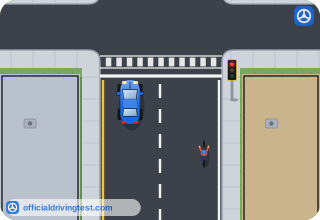
- Slow down and go if no traffic is coming
- Yield only to pedestrians
- Stop only if a motor vehicle is waiting
- Stop
Show answer
Correct answer: Stop
The manual says bicyclists must stop at red lights and stop signs.
Source: Massachusetts Driver's Manual (Revised April 2026), page 113 · Open this page in the manual (Manual page 113)
-
What does the law allow a bicyclist to do when passing a motor vehicle moving in the travel lane?
- Only on the left side of it
- By keeping to the right of it
- Only after the vehicle stops
- Only by leaving the road
Show answer
Correct answer: By keeping to the right of it
The manual says a bicyclist can keep to the right when passing a motor vehicle moving in the travel lane.
Source: Massachusetts Driver's Manual (Revised April 2026), page 113 · Open this page in the manual (Manual page 113)
-
Which hand may a bicyclist use to signal a stop or turn?
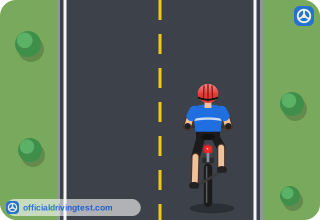
- Either hand
- Only the left hand
- Only the right hand
- Neither, since bicyclists never signal
Show answer
Correct answer: Either hand
The manual says bicyclists must signal their intent by either hand to stop or turn.
Source: Massachusetts Driver's Manual (Revised April 2026), page 113 · Open this page in the manual (Manual page 113)
-
When does the manual say a bicyclist does not have to signal a stop or turn continuously, or at all?
- When the bicyclist is riding inside of a bike lane
- When no motor vehicle is anywhere near the bicyclist
- When both hands are needed for the bicycle's safe operation
- When the bicyclist is riding in a group of bicyclists
Show answer
Correct answer: When both hands are needed for the bicycle's safe operation
The manual says the signal does not have to be continuous or be made at all if both hands are needed for the bicycle's safe operation.
Source: Massachusetts Driver's Manual (Revised April 2026), page 113 · Open this page in the manual (Manual page 113)
-
Where may bicyclists ride on sidewalks for safety?
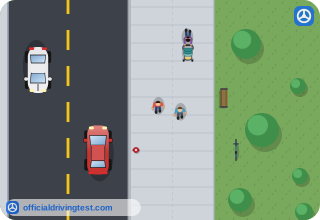
- Only in business districts
- Outside of business districts, unless banned locally
- Anywhere, even where banned locally
- Nowhere, because sidewalks are banned statewide
Show answer
Correct answer: Outside of business districts, unless banned locally
The manual says you can ride on sidewalks outside of business districts for safety unless banned locally.
Source: Massachusetts Driver's Manual (Revised April 2026), page 113 · Open this page in the manual (Manual page 113)
-
On a sidewalk or shared use path, what must a bicyclist do before overtaking or passing a pedestrian?
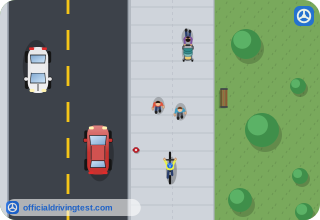
- Sound a siren or whistle to alert the pedestrian
- Pass silently so as not to startle anyone nearby
- Flash the bicycle's light twice in the pedestrian's view
- Give an audible signal, but not a siren or whistle
Show answer
Correct answer: Give an audible signal, but not a siren or whistle
The manual says that on a sidewalk or shared use path you must give an audible signal before overtaking or passing, with no sirens or whistles.
Source: Massachusetts Driver's Manual (Revised April 2026), page 113 · Open this page in the manual (Manual page 113)
-
On a sidewalk or shared use path, which road users must a bicyclist yield to?
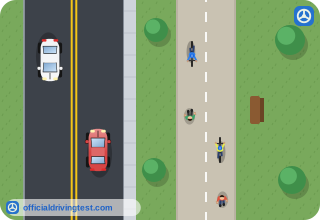
- Other bicyclists only
- Motor vehicles only
- Nobody, if the bicyclist is riding slowly
- Pedestrians
Show answer
Correct answer: Pedestrians
The manual says that on a sidewalk or shared use path, a bicyclist must yield to pedestrians.
Source: Massachusetts Driver's Manual (Revised April 2026), page 113 · Open this page in the manual (Manual page 113)
-
How many bicycles can be operated side-by-side?
- No more than three
- No more than two
- No more than four
- Only one
Show answer
Correct answer: No more than two
The manual says no more than two bicycles can be operated side-by-side.
Source: Massachusetts Driver's Manual (Revised April 2026), page 113 · Open this page in the manual (Manual page 113)
-
On a roadway with more than one lane in the direction of travel, how must bicyclists riding side-by-side ride?
- With one bicycle riding in each of the available lanes
- In the left lane only, so that they can be seen clearly
- In one lane, without unnecessarily restricting a passing vehicle
- On the shoulder only, so cars can pass freely in the lanes
Show answer
Correct answer: In one lane, without unnecessarily restricting a passing vehicle
The manual says bicyclists riding side-by-side must stay in one lane and not unnecessarily restrict a passing vehicle's ability to overtake them.
Source: Massachusetts Driver's Manual (Revised April 2026), page 113 · Open this page in the manual (Manual page 113)
-
When must bicyclists be especially careful to maintain a safe distance from other bicyclists?
- When approaching intersections
- When riding uphill on a long slope
- When riding along sidewalks where it is legal
- When riding after dark on an unlit road
Show answer
Correct answer: When approaching intersections
The manual says bicyclists must maintain a safe distance from other bicyclists, especially when approaching intersections.
Source: Massachusetts Driver's Manual (Revised April 2026), page 113 · Open this page in the manual (Manual page 113)
-
What must a bicyclist do when approaching crosswalks, especially during heavy traffic?
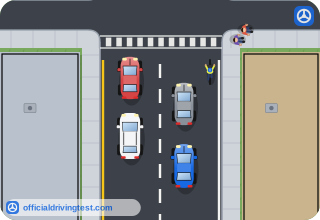
- Speed up to clear the crosswalk
- Slow down
- Ring a bell and keep the same speed
- Get off and walk the bicycle
Show answer
Correct answer: Slow down
The manual says you must slow down when approaching crosswalks, especially during heavy traffic.
Source: Massachusetts Driver's Manual (Revised April 2026), page 113 · Open this page in the manual (Manual page 113)
-
How must a bicycle operator ride?
- Standing up on the pedals whenever riding in traffic
- On the handlebars, when the bicycle is carrying a child
- On a removable cushion that is placed on the frame
- On or astride a permanent seat affixed to the bicycle
Show answer
Correct answer: On or astride a permanent seat affixed to the bicycle
The manual says you must ride on or astride a permanent seat affixed to the bicycle.
Source: Massachusetts Driver's Manual (Revised April 2026), page 113 · Open this page in the manual (Manual page 113)
-
Where must a bicycle passenger ride?
- On a permanent seat on the bicycle or on a trailer towed by it
- On the handlebars, held in place by the operator
- On a rear rack, holding on to the operator
- Standing on the rear axle, holding the operator's seat
Show answer
Correct answer: On a permanent seat on the bicycle or on a trailer towed by it
The manual says a passenger must also ride on a permanent seat attached to the bicycle or to a trailer towed by the bicycle.
Source: Massachusetts Driver's Manual (Revised April 2026), page 113 · Open this page in the manual (Manual page 113)
-
Which person may be transported on a bicycle only in a baby seat attached to the bicycle?
- Any child who is under 12 years old and rides along
- Any person who is under 16 years of age and rides along
- A person aged one to four, or who weighs 40 lbs. or less
- Only a child who is under one year of age and rides along
Show answer
Correct answer: A person aged one to four, or who weighs 40 lbs. or less
The manual says you cannot transport a person who is between one and four years old or who weighs 40 lbs. or less except in a baby seat attached to the bicycle.
Source: Massachusetts Driver's Manual (Revised April 2026), page 113 · Open this page in the manual (Manual page 113)
-
What must be true of a person riding in a baby seat on a bicycle?
- The person is strapped in with a lap belt, facing backward, with hands free to hold on
- The person is seated upright but free to hold the handlebars with both hands
- The person is in a harness, seated upright, with hands and feet protected from the wheel spokes
- The person is in a harness with the feet resting on the pedals
Show answer
Correct answer: The person is in a harness, seated upright, with hands and feet protected from the wheel spokes
The manual says the person must be in a harness, seated upright, and have their hands and feet protected from hitting the wheel spokes.
Source: Massachusetts Driver's Manual (Revised April 2026), page 113 · Open this page in the manual (Manual page 113)
-
When can a person ride on or astride a seat on a tandem bicycle?
- If the person can reach the pedals and handlebars
- If the tandem bicycle has a baby seat attached
- If the person wears a helmet and a reflective vest
- If the person is the operator's relative
Show answer
Correct answer: If the person can reach the pedals and handlebars
The manual says a person can ride on or astride a seat on a tandem bicycle if the person can reach the pedals and handlebars.
Source: Massachusetts Driver's Manual (Revised April 2026), page 113 · Open this page in the manual (Manual page 113)
-
What does the manual say about transporting a child under the age of one year on a bicycle?
- Only in a baby seat with a harness
- Only if the child wears a helmet
- Only on streets that have a bike lane
- You cannot transport a child that young
Show answer
Correct answer: You cannot transport a child that young
The manual says you cannot transport a child under the age of one year on a bicycle.
Source: Massachusetts Driver's Manual (Revised April 2026), page 113 · Open this page in the manual (Manual page 113)
-
Who must wear a bicycle helmet approved by the U.S. Consumer Product Safety Commission?
- Any operator or passenger under 12 years old
- A bicycle operator or passenger under 16 years old
- Any operator or passenger under 18 years old
- Every bicyclist of any age
Show answer
Correct answer: A bicycle operator or passenger under 16 years old
The manual says an approved helmet must be worn by a bicycle operator or passenger under 16 years old.
Source: Massachusetts Driver's Manual (Revised April 2026), page 113 · Open this page in the manual (Manual page 113)
-
When must a bicycle helmet be secured to the person’s head?
- When the bicycle is operated on a public way or bicycle path
- Only when it is on a public way, not on a bicycle path
- Only when it is on a bicycle path, not on a public way
- Only on roads with a posted speed limit above 25 mph
Show answer
Correct answer: When the bicycle is operated on a public way or bicycle path
The manual says the helmet must be secured to the person's head when the bicycle is operated on a public way or bicycle path.
Source: Massachusetts Driver's Manual (Revised April 2026), page 113 · Open this page in the manual (Manual page 113)
-
When is a bicycle passenger under 16 not required to wear the helmet?
- When riding on a sidewalk instead of on the road
- When riding at a slow walking speed on a path
- When secured in an enclosed trailer that protects their head
- When riding on a street that has a marked bike lane
Show answer
Correct answer: When secured in an enclosed trailer that protects their head
The manual makes an exception for a passenger secured in an enclosed trailer which protects their head.
Source: Massachusetts Driver's Manual (Revised April 2026), page 113 · Open this page in the manual (Manual page 113)
-
When must a bicyclist give an audible warning?
- At every intersection, using a siren or a whistle
- When necessary for safe operation, but not with a siren or whistle
- Only at night, when it is dark enough to need lights
- Each time the bicyclist passes a parked car on the road
Show answer
Correct answer: When necessary for safe operation, but not with a siren or whistle
The manual says a bicyclist must give an audible warning, other than a siren or whistle, when necessary to ensure safe operation.
Source: Massachusetts Driver's Manual (Revised April 2026), page 113 · Open this page in the manual (Manual page 113)
-
When may a bicyclist park the bicycle on a way or a sidewalk?
- Only if it is locked to a post or a bicycle rack
- Only outside of the business districts of the town
- Only for no longer than one hour at a single time
- Only if it does not obstruct vehicle or pedestrian traffic
Show answer
Correct answer: Only if it does not obstruct vehicle or pedestrian traffic
The manual says you can park your bicycle on a way or a sidewalk, but only if it does not obstruct vehicle or pedestrian traffic.
Source: Massachusetts Driver's Manual (Revised April 2026), page 113 · Open this page in the manual (Manual page 113)
-
What may a bicycle tow?
- Another bicycle
- A skateboard rider
- Any small wheeled cart
- Only a bicycle trailer
Show answer
Correct answer: Only a bicycle trailer
The manual says you cannot let the bicycle be pulled by another vehicle and can only tow a bicycle trailer.
Source: Massachusetts Driver's Manual (Revised April 2026), page 113 · Open this page in the manual (Manual page 113)
-
Which of these is a bicyclist not allowed to do?
- Park the bicycle on a sidewalk without obstructing pedestrians
- Carry objects that would interfere with the safe operation of the bicycle
- Ride on a sidewalk outside of business districts where not banned locally
- Keep to the right when passing a motor vehicle moving in the travel lane
Show answer
Correct answer: Carry objects that would interfere with the safe operation of the bicycle
The manual says you cannot carry any objects that would interfere with the safe operation of the bicycle.
Source: Massachusetts Driver's Manual (Revised April 2026), page 113 · Open this page in the manual (Manual page 113)
-
What must a bicyclist keep on the handlebars at all times?
- Both hands, with no exceptions
- One hand or one foot
- At least one hand
- No hands, if in a bike lane
Show answer
Correct answer: At least one hand
The manual says a bicyclist must keep one hand on the handlebars at all times.
Source: Massachusetts Driver's Manual (Revised April 2026), page 113 · Open this page in the manual (Manual page 113)
-
What kind of brake system must a bicycle have?
- A proper working brake system that stops it from 15 MPH within 30 feet
- A proper working brake system that stops it from 10 MPH within 15 feet
- A proper working brake system that stops it from 20 MPH within 30 feet
- A proper working brake system that stops it from 15 MPH within 50 feet
Show answer
Correct answer: A proper working brake system that stops it from 15 MPH within 30 feet
The manual says you must have a proper working brake system to stop from 15 MPH within 30 feet.
Source: Massachusetts Driver's Manual (Revised April 2026), page 114 · Open this page in the manual (Manual page 114)
-
When must a bicycle have a white lamp in front and a rear facing red light or reflector?
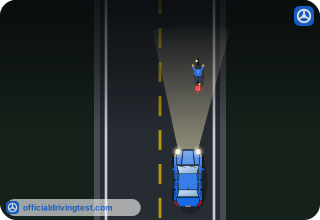
- From sunset to sunrise, and in any rain or fog
- From a half hour after sunset to a half hour before sunrise
- From one hour after sunset to one hour before sunrise
- Only when it is completely dark outside
Show answer
Correct answer: From a half hour after sunset to a half hour before sunrise
The manual says that from a half hour after sunset to a half hour before sunrise you must have a white lamp in front and a rear facing red light or reflector.
Source: Massachusetts Driver's Manual (Revised April 2026), page 114 · Open this page in the manual (Manual page 114)
-
How far must the white lamp on the front of a bicycle be visible at night?
- Up to 200 feet
- Up to 300 feet
- Up to 1,000 feet
- Up to 500 feet
Show answer
Correct answer: Up to 500 feet
The manual says the white lamp in front must be visible from up to 500 feet.
Source: Massachusetts Driver's Manual (Revised April 2026), page 114 · Open this page in the manual (Manual page 114)
-
How far must the rear facing red light or reflector on a bicycle be visible at night?
- Up to 600 feet
- Up to 200 feet
- Up to 300 feet
- Up to 1,000 feet
Show answer
Correct answer: Up to 600 feet
The manual says the rear facing red light or reflector must be visible up to 600 feet.
Source: Massachusetts Driver's Manual (Revised April 2026), page 114 · Open this page in the manual (Manual page 114)
-
How far must the reflectors or reflective material that a bicyclist uses at night be visible?
- Up to 300 feet from all sides
- Up to 200 feet from the rear only
- Up to 600 feet from all sides
- Up to 100 feet from the front only
Show answer
Correct answer: Up to 600 feet from all sides
The manual says the reflectors must be visible up to 600 feet from all sides.
Source: Massachusetts Driver's Manual (Revised April 2026), page 114 · Open this page in the manual (Manual page 114)
-
How high may a bicyclist's handlebars be set?
- No higher than the waist while gripping them
- No higher than the seat while gripping them
- No higher than the shoulders while gripping them
- No higher than the top of the head
Show answer
Correct answer: No higher than the shoulders while gripping them
The manual says handlebars cannot be set at a height above your shoulders while gripping them.
Source: Massachusetts Driver's Manual (Revised April 2026), page 114 · Open this page in the manual (Manual page 114)
-
What may a bicyclist not do to the bicycle's fork?
- Extend it from its original manufacturer's design
- Paint it a different bright color of their choice
- Wrap it with reflective tape of any color
- Fit a front light to it with a bracket
Show answer
Correct answer: Extend it from its original manufacturer's design
The manual says you cannot extend the fork from its original manufacturer's design.
Source: Massachusetts Driver's Manual (Revised April 2026), page 114 · Open this page in the manual (Manual page 114)
-
To whom must a bicyclist report any crash involving personal injury?
- The Registry of Motor Vehicles in Boston
- The State Police barracks nearest the crash
- The bicyclist's own insurance company
- The police in the municipality where it occurred
Show answer
Correct answer: The police in the municipality where it occurred
The manual says you must report any crash involving personal injury to the police in the municipality where it occurred.
Source: Massachusetts Driver's Manual (Revised April 2026), page 114 · Open this page in the manual (Manual page 114)
-
A bicyclist must report a crash to the police if the property damage is in excess of what amount?
- $50
- $100
- $250
- $500
Show answer
Correct answer: $100
The manual says a bicyclist must report any crash involving property damage in excess of $100 to the police in the municipality where it occurred.
Source: Massachusetts Driver's Manual (Revised April 2026), page 114 · Open this page in the manual (Manual page 114)