Massachusetts: Sharing the road — Part 2 Practice Test
Vulnerable road users and the four-foot passing rule, bicycles and bicycle lanes, motorcycles, mopeds, scooters, trucks and buses, school buses, farm vehicles, animals and funeral processions. — Part 2
Independent educational site · not affiliated with any government agency or DMV
Ready? Test yourself
- Instant feedback with an explanation
- Every answer cites its source in the manual
- Your best score is saved on this device
Questions are original and based on the official manual "Massachusetts Driver's Manual" (Revised April 2026), Massachusetts Registry of Motor Vehicles.
All 35 questions in this practice test
Take the test above first, then use this list to study. Tap “Show answer” to see the correct answer and explanation.
Show the questions and answersHide the questions
-
What is a motorized scooter?
- A two or three-wheeled vehicle with handlebars and an electric or gas motor
- A four-wheeled enclosed vehicle with seat belts, doors, a roof, and a windshield
- A pedal bicycle with no motor
- A vehicle with a gross weight rating near 3,000 lbs
Show answer
Correct answer: A two or three-wheeled vehicle with handlebars and an electric or gas motor
A motorized scooter is any two or three-wheeled vehicle with handlebars and an electric or gas motor.
Source: Massachusetts Driver's Manual (Revised April 2026), page 53 · Open this page in the manual (Manual page 53)
-
What will the Registry of Motor Vehicles not do for motorized scooters?
- Accept a learner’s permit for operating them
- Require a license to drive them
- Register them
- Accept any class of license for operating them
Show answer
Correct answer: Register them
The Registry of Motor Vehicles will not register motorized scooters.
Source: Massachusetts Driver's Manual (Revised April 2026), page 53 · Open this page in the manual (Manual page 53)
-
What do you need to operate a motorized scooter?
- A Class M license and a scooter registration
- A scooter registration
- A valid driver’s license (any class) or learner’s permit
- No license, because scooters are not registered by the RMV
Show answer
Correct answer: A valid driver’s license (any class) or learner’s permit
You must have a valid driver’s license of any class or a learner’s permit to operate a motorized scooter.
Source: Massachusetts Driver's Manual (Revised April 2026), page 53 · Open this page in the manual (Manual page 53)
-
When driving a motorized scooter, what is the fastest you may drive?
- 20 mph
- 10 mph
- 25 mph
- 30 mph
Show answer
Correct answer: 20 mph
Motorized scooter rules say do not drive faster than 20 mph.
Source: Massachusetts Driver's Manual (Revised April 2026), page 53 · Open this page in the manual (Manual page 53)
-
Where may you not drive a motorized scooter?
- On any road that has a marked bicycle lane or path
- On roads with sidewalks
- On residential streets
- On limited-access or express state highways
Show answer
Correct answer: On limited-access or express state highways
Do not drive a motorized scooter on limited-access or express state highways.
Source: Massachusetts Driver's Manual (Revised April 2026), page 53 · Open this page in the manual (Manual page 53)
-
Where should you stay on the road when driving a motorized scooter, even when passing another vehicle?
- In the center of the lane when passing
- To the right side of the road
- To the left side of the road
- On the sidewalk
Show answer
Correct answer: To the right side of the road
Always stay to the right side of the road, even when passing another vehicle.
Source: Massachusetts Driver's Manual (Revised April 2026), page 53 · Open this page in the manual (Manual page 53)
-
When may you not drive a motorized scooter?
- After sunset or before sunrise
- On weekends and public holidays
- During rain or wet weather
- Before 9 a.m. on weekdays
Show answer
Correct answer: After sunset or before sunrise
Motorized scooter rules say do not drive after sunset or before sunrise.
Source: Massachusetts Driver's Manual (Revised April 2026), page 53 · Open this page in the manual (Manual page 53)
-
How many passengers may you carry on a motorized scooter?
- One adult
- One child
- None
- Two
Show answer
Correct answer: None
Motorized scooter rules say do not carry any passengers.
Source: Massachusetts Driver's Manual (Revised April 2026), page 53 · Open this page in the manual (Manual page 53)
-
What is the fine for a third or later offense of the motorized scooter rules?
- Up to $25
- $50-$100
- $25-$50
- $100-$500
Show answer
Correct answer: $50-$100
The fine is up to $25 for a first offense, $25-$50 for a second, and $50-$100 for a third or later offense.
Source: Massachusetts Driver's Manual (Revised April 2026), page 53 · Open this page in the manual (Manual page 53)
-
How fast can a limited use vehicle go?
- Between 10 and 20 mph
- Between 20 and 25 mph
- Faster than 40 mph but not more than 55 mph on roads
- Faster than 30 mph, but not more than 40 mph
Show answer
Correct answer: Faster than 30 mph, but not more than 40 mph
A limited use vehicle can go faster than 30 mph, but not more than 40 mph.
Source: Massachusetts Driver's Manual (Revised April 2026), page 53 · Open this page in the manual (Manual page 53)
-
What decides whether a limited use vehicle is a motorcycle or a passenger vehicle?
- How fast it can safely travel
- Its engine size
- Its color
- How many wheels it has
Show answer
Correct answer: How many wheels it has
A limited use vehicle can either be a motorcycle or a passenger vehicle, depending on how many wheels it has.
Source: Massachusetts Driver's Manual (Revised April 2026), page 53 · Open this page in the manual (Manual page 53)
-
Where can you not drive a limited use vehicle?
- Limited-access or express highways, or roads with limits above 40 mph
- Any road with a speed limit faster than 30 mph, or any local street at all
- Any road with a bicycle lane or a separated path
- Any two-lane road that has no painted center line
Show answer
Correct answer: Limited-access or express highways, or roads with limits above 40 mph
A limited use vehicle cannot be driven on a limited-access or express state highway or any road with a speed limit faster than 40 mph.
Source: Massachusetts Driver's Manual (Revised April 2026), page 53 · Open this page in the manual (Manual page 53)
-
How many wheels does a Low Speed Vehicle (LSV) have?
- Two
- Four
- Three
- Six
Show answer
Correct answer: Four
A Low Speed Vehicle has four wheels and can only go between 20 and 25 mph.
Source: Massachusetts Driver's Manual (Revised April 2026), page 54 · Open this page in the manual (Manual page 54)
-
How fast can a Low Speed Vehicle (LSV) go?
- Between 5 and 10 mph
- Between 30 and 40 mph on any road
- Up to 55 mph on any road
- Only between 20 and 25 mph
Show answer
Correct answer: Only between 20 and 25 mph
A Low Speed Vehicle has four wheels and can only go between 20 and 25 mph.
Source: Massachusetts Driver's Manual (Revised April 2026), page 54 · Open this page in the manual (Manual page 54)
-
What gross weight rating must a Low Speed Vehicle have?
- Lower than 3,000 lbs
- Higher than 3,000 lbs
- Exactly 1,000 lbs
- Higher than 6,000 lbs
Show answer
Correct answer: Lower than 3,000 lbs
A Low Speed Vehicle must have a gross weight rating lower than 3,000 lbs.
Source: Massachusetts Driver's Manual (Revised April 2026), page 54 · Open this page in the manual (Manual page 54)
-
Where can you not drive a low speed vehicle?
- Any residential street with a posted speed limit of 25 mph or less in town
- Any road with a bicycle lane or a separated path along it
- Limited access or express highways, or roads with limits above 30 mph
- Any parking lot or private road open to the public
Show answer
Correct answer: Limited access or express highways, or roads with limits above 30 mph
A low speed vehicle cannot be driven on a limited access or express state highway or any road with a speed limit faster than 30 mph.
Source: Massachusetts Driver's Manual (Revised April 2026), page 54 · Open this page in the manual (Manual page 54)
-
Where may low speed vehicles also not be allowed?
- In areas with heavy traffic
- On rural roads
- In parking lots
- On quiet residential streets
Show answer
Correct answer: In areas with heavy traffic
Low speed vehicles may also not be allowed in areas with heavy traffic.
Source: Massachusetts Driver's Manual (Revised April 2026), page 54 · Open this page in the manual (Manual page 54)
-
If a police officer sees a bicyclist commit a traffic violation, what can the officer do?
- Only give a verbal warning, never a citation or fine
- Take the bicycle away
- Suspend the bicyclist’s license
- Issue a citation the same way as for a motorist
Show answer
Correct answer: Issue a citation the same way as for a motorist
The officer can issue a citation to a bicyclist the same way as for a motorist.
Source: Massachusetts Driver's Manual (Revised April 2026), page 54 · Open this page in the manual (Manual page 54)
-
What must a bicyclist give a police officer when asked?
- Their true name and address
- Their license number
- Their insurance information card
- Their route of travel
Show answer
Correct answer: Their true name and address
A bicyclist must give the officer their true name and address when asked and can be fined for not doing so.
Source: Massachusetts Driver's Manual (Revised April 2026), page 54 · Open this page in the manual (Manual page 54)
-
What can happen to a bicyclist who refuses to give an officer their name?
- Nothing, since no ID is required
- The bicyclist is given a warning only
- The bicyclist can be arrested
- The bicyclist loses the right to ride on public roads
Show answer
Correct answer: The bicyclist can be arrested
A bicyclist can also be arrested for refusing to give their name.
Source: Massachusetts Driver's Manual (Revised April 2026), page 54 · Open this page in the manual (Manual page 54)
-
What must companies that rent bicycles offer?
- Insurance coverage for each renter while riding on the road
- Helmets that meet all safety requirements for renters
- A locked storage area for renters
- Reflective vests for night riding
Show answer
Correct answer: Helmets that meet all safety requirements for renters
Companies that rent bicycles must offer helmets that meet all safety requirements for renters.
Source: Massachusetts Driver's Manual (Revised April 2026), page 54 · Open this page in the manual (Manual page 54)
-
What does the law allow regarding motorists and certain behaviors around bicycles?
- Motorists cannot be cited if a bicyclist breaks a rule
- Motorists receive only a warning
- Only bicyclists can be cited
- Motorists can be cited for a motor vehicle violation
Show answer
Correct answer: Motorists can be cited for a motor vehicle violation
The law allows motorists to be cited for a motor vehicle violation for certain behaviors around bicycles.
Source: Massachusetts Driver's Manual (Revised April 2026), page 54 · Open this page in the manual (Manual page 54)
-
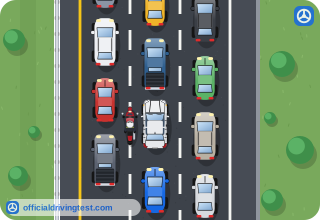
Is a motorcycle operator allowed to weave between lanes?
- Yes, when traffic is stopped
- Yes, when the lane is wide
- Yes, if the operator signals first
- No, it is illegal at any time
Show answer
Correct answer: No, it is illegal at any time
It is illegal for a motorcycle operator to weave between lanes at any time.
Source: Massachusetts Driver's Manual (Revised April 2026), page 51 · Open this page in the manual (Manual page 51)
-
What do Shared Lane Markings (Sharrows) help bicyclists do?
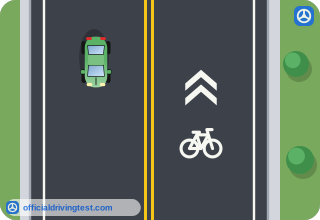
- Find the right position and direction in a lane shared with motor vehicles
- Find where a bicycle lane that is five feet wide begins on the street
- Know when they are allowed to ride on the sidewalk beside the lane
- Know when they must stop to let motor vehicles go ahead of them
Show answer
Correct answer: Find the right position and direction in a lane shared with motor vehicles
Sharrows help bicyclists position themselves in the right location and in the right direction in a lane shared with motor vehicles.
Source: Massachusetts Driver's Manual (Revised April 2026), page 91 · Open this page in the manual (Manual page 91)
-
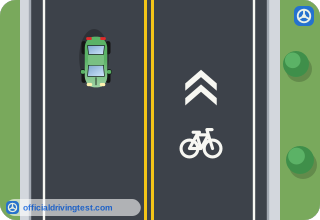
What must you do when you see a Shared Lane Marking?
- Stay out of the lane because it is for bicyclists only
- Slow down to 15 mph until you have passed the marking
- Look out for bicyclists and leave them enough space when passing
- Honk to let bicyclists know you are behind them
Show answer
Correct answer: Look out for bicyclists and leave them enough space when passing
When you see a Shared Lane Marking, you must look out for bicyclists and make sure you leave them enough space when passing.
Source: Massachusetts Driver's Manual (Revised April 2026), page 91 · Open this page in the manual (Manual page 91)
-
How wide are bicycle lanes, according to the manual?
- Three feet wide
- Five feet wide
- Eight feet wide
- Ten feet wide
Show answer
Correct answer: Five feet wide
The manual states that bicycle lanes are five feet wide.
Source: Massachusetts Driver's Manual (Revised April 2026), page 91 · Open this page in the manual (Manual page 91)
-
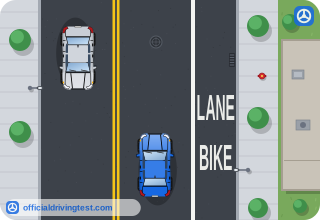
When may motor vehicles drive in a bicycle lane?
- When the traffic lane next to it is backed up
- When a vehicle ahead is turning left
- When they are passing a slow bicyclist
- Only when turning on or off the road
Show answer
Correct answer: Only when turning on or off the road
Motor vehicles may only drive in bicycle lanes when turning on or off the road.
Source: Massachusetts Driver's Manual (Revised April 2026), page 91 · Open this page in the manual (Manual page 91)
-
What must you do before crossing a bicycle lane?
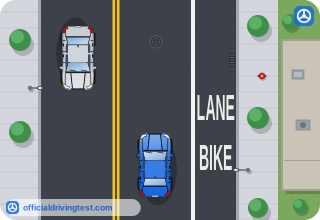
- Look carefully for bicyclists and cross with care
- Come to a full stop and wait for a bicyclist to wave you across
- Sound your horn and then cross at a normal speed
- Check only your rearview mirror and then cross
Show answer
Correct answer: Look carefully for bicyclists and cross with care
Before crossing a bicycle lane, you must look carefully for bicyclists and you must cross with care.
Source: Massachusetts Driver's Manual (Revised April 2026), page 91 · Open this page in the manual (Manual page 91)
-
Where are advisory bicycle lanes becoming common?
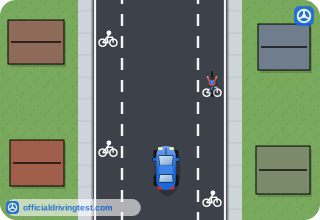
- On expressways with several lanes in each direction and a wide shoulder
- On streets with a center lane marked for left turns in both directions
- On streets too narrow for a full bicycle lane that have a lot of bicycle traffic
- On wide streets where motor vehicles are not allowed to drive at all
Show answer
Correct answer: On streets too narrow for a full bicycle lane that have a lot of bicycle traffic
Advisory bicycle lanes are becoming common on streets too narrow for a full bicycle lane that still have a lot of bicycle traffic.
Source: Massachusetts Driver's Manual (Revised April 2026), page 91 · Open this page in the manual (Manual page 91)
-
An advisory bicycle lane is dashed on one or both sides. What does this mean for motor vehicles?
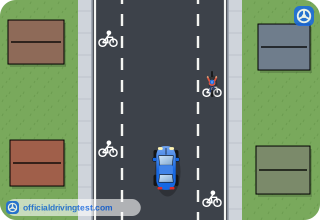
- They may never enter the lane for any reason, even when they are turning
- They may use the lane space when necessary, but must always yield to bicyclists
- They may use the lane for passing whenever they choose to do so
- They have the right-of-way over bicyclists who are using the lane
Show answer
Correct answer: They may use the lane space when necessary, but must always yield to bicyclists
Advisory bicycle lanes are dashed to show that motor vehicles may use the lane space when necessary, but they must always yield to bicyclists first.
Source: Massachusetts Driver's Manual (Revised April 2026), page 91 · Open this page in the manual (Manual page 91)
-
Why is green pavement used on some roads?
- To mark lanes that are reserved for buses and other public transit vehicles
- To show where a work zone begins and where workers may be present
- To mark the edge of the roadway where it meets the sidewalk or curb
- In areas where motor vehicles and bicycles could have road sharing conflicts
Show answer
Correct answer: In areas where motor vehicles and bicycles could have road sharing conflicts
Green pavement is used in areas where there could be road sharing conflicts between motor vehicles and bicycles.
Source: Massachusetts Driver's Manual (Revised April 2026), page 91 · Open this page in the manual (Manual page 91)
-
At a red light, where should you NOT stop?
- On green pavement
- Behind the solid white STOP line
- Behind the crosswalk line
- Behind a YIELD line
Show answer
Correct answer: On green pavement
The manual says that at a red light you should not stop on green pavement.
Source: Massachusetts Driver's Manual (Revised April 2026), page 91 · Open this page in the manual (Manual page 91)
-
What does the manual say motorcyclists should not do with respect to pavement lines?
- Ride along pavement lines, between lanes of traffic
- Cross a broken white line to pass a vehicle ahead
- Ride in the center of a lane of traffic
- Stop behind a crosswalk line at an intersection
Show answer
Correct answer: Ride along pavement lines, between lanes of traffic
Special rules for motorcycles say not to ride along pavement lines, between lanes of traffic.
Source: Massachusetts Driver's Manual (Revised April 2026), page 94 · Open this page in the manual (Manual page 94)
-
What is the most motorcycles may ride abreast (side-by-side) in a lane?
- Three
- Four
- Two
- One
Show answer
Correct answer: Two
Special rules for motorcycles say to ride no more than two abreast.
Source: Massachusetts Driver's Manual (Revised April 2026), page 94 · Open this page in the manual (Manual page 94)
-
When should a motorcycle not travel on highways or expressways?
- When the road has three or more lanes in each direction
- When it cannot safely drive at the minimum posted speeds
- When the highway has a toll booth at the entrance
- When there is a breakdown lane along the shoulder
Show answer
Correct answer: When it cannot safely drive at the minimum posted speeds
Unless your motorcycle can safely drive at minimum posted speeds, do not travel on highways or expressways.
Source: Massachusetts Driver's Manual (Revised April 2026), page 94 · Open this page in the manual (Manual page 94)