Maryland: Emergencies and crashes — Part 2 Practice Test
Questions in this part include: “Which of these should you keep in an emergency kit in your car?” · “Why does the manual list kitty litter or sand in an emergency kit?”
Independent educational site · not affiliated with any government agency or DMV
Ready? Test yourself
- Instant feedback with an explanation
- Every answer cites its source in the manual
- Your best score is saved on this device
Questions are original and based on the official manual "Maryland Driver’s Manual" (October 2025 Edition (DL-002 10-25)), Maryland Motor Vehicle Administration.
All 20 questions in this practice test
Take the test above first, then use this list to study. Tap “Show answer” to see the correct answer and explanation.
Show the questions and answersHide the questions
-
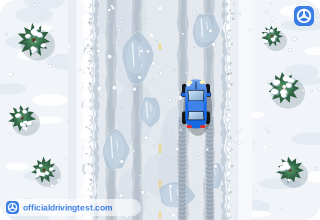
When you start driving on ice or snow, how should you test your brakes?
- Press them hard at normal speed
- Start very slowly, then test them gently
- Start at normal speed, then press them lightly
- Do not test them until you reach an intersection
Show answer
Correct answer: Start very slowly, then test them gently
The manual says to start very slowly, then test your brakes gently to find out how well you can stop.
Source: Maryland Driver’s Manual (October 2025 Edition (DL-002 10-25)), page 29
-
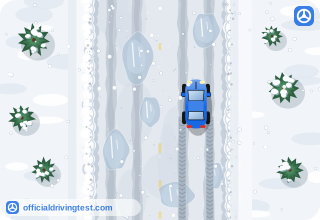
On ice or snow, when should you start slowing down for an intersection or turn?
- Only when you reach it
- Just after you enter it
- Only when other vehicles are close
- Long before you come to it
Show answer
Correct answer: Long before you come to it
The manual says to start slowing down long before you come to an intersection or turn.
Source: Maryland Driver’s Manual (October 2025 Edition (DL-002 10-25)), page 29
-
Which two things does the manual say to keep full in snow or ice?
- Your gas tank and windshield washer fluid
- Your engine oil and your brake fluid
- Your tire pressure and your coolant
- Your battery and your spare tire
Show answer
Correct answer: Your gas tank and windshield washer fluid
The manual says to keep your gas tank and windshield washer fluid full when driving in snow or ice.
Source: Maryland Driver’s Manual (October 2025 Edition (DL-002 10-25)), page 29
-
When does the manual say to use chains, snow tires, or radial tires?
- On every road throughout the whole winter season
- Only on roads that the state has not yet plowed
- On snow emergency routes when a snow emergency is declared
- Only on bridges and ramps that have already frozen
Show answer
Correct answer: On snow emergency routes when a snow emergency is declared
The manual says to use chains, snow tires, or radial tires on designated snow emergency routes when a snow emergency is declared.
Source: Maryland Driver’s Manual (October 2025 Edition (DL-002 10-25)), page 29
-
Which of these should you keep in an emergency kit in your car?
- Jumper cables
- A first aid kit
- A tow rope
- A road atlas
Show answer
Correct answer: A first aid kit
The manual lists flares, a flashlight and batteries, a first aid kit, a blanket, kitty litter or sand, and a small shovel and ice scraper for an emergency kit.
Source: Maryland Driver’s Manual (October 2025 Edition (DL-002 10-25)), page 29
-
Why does the manual list kitty litter or sand in an emergency kit?
- To soak up oil spills on the road
- To fill the gas tank
- To clean the windshield
- For traction on snow and ice
Show answer
Correct answer: For traction on snow and ice
The manual lists kitty litter or sand in the emergency kit for traction on snow and ice.
Source: Maryland Driver’s Manual (October 2025 Edition (DL-002 10-25)), page 29
-
Which of these decreases traction between your tires and the road?
- Water on the road
- Tires with good tread
- A dry, smooth road
- A clean windshield
Show answer
Correct answer: Water on the road
The manual says sand, gravel, uneven road surfaces, oil slicks or spills, increased speed, or water on the road decreases traction.
Source: Maryland Driver’s Manual (October 2025 Edition (DL-002 10-25)), page 29
-
When does the possibility of skidding or sliding increase?
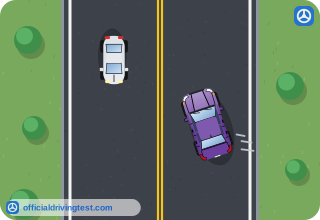
- When traction increases
- When your tires have good tread
- When traction decreases
- When your vehicle has anti-lock brakes
Show answer
Correct answer: When traction decreases
The manual says the possibility of skidding or sliding increases when traction decreases.
Source: Maryland Driver’s Manual (October 2025 Edition (DL-002 10-25)), page 29
-
If your vehicle begins to skid, what should you do with the pedal you are using?
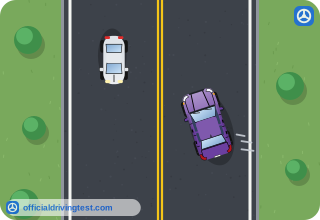
- Press harder on the brake pedal to stop sliding
- Release the gas pedal or the brake pedal you are using
- Press harder on the accelerator to drive out of it
- Shift the vehicle into reverse right away
Show answer
Correct answer: Release the gas pedal or the brake pedal you are using
The manual says to release the accelerator (gas pedal) or brake pedal, whichever one you are using, to regain control.
Source: Maryland Driver’s Manual (October 2025 Edition (DL-002 10-25)), page 29
-
If your vehicle begins to skid, in which direction should you steer?
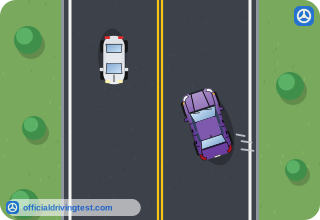
- Opposite to the direction you are skidding
- Toward the shoulder
- Straight ahead without moving the wheel
- In the direction you are skidding
Show answer
Correct answer: In the direction you are skidding
The manual says to steer in the direction you are skidding.
Source: Maryland Driver’s Manual (October 2025 Edition (DL-002 10-25)), page 29
-
If your vehicle begins to skid, where should you look?
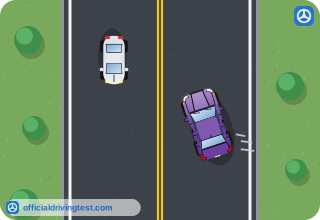
- Where you want your vehicle to go
- At the front wheels
- At the object you are afraid to hit
- At the dashboard
Show answer
Correct answer: Where you want your vehicle to go
The manual says to look where you want your vehicle to go.
Source: Maryland Driver’s Manual (October 2025 Edition (DL-002 10-25)), page 29
-
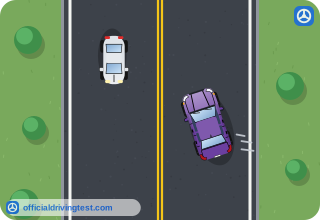
When should you press on the brake pedal during a skid?
- Right away, as hard as you can
- Only after the vehicle has stopped
- Only after you have traction again
- Never during a skid
Show answer
Correct answer: Only after you have traction again
The manual says to press on your brake pedal only after you have traction again, when your tires are gripping the road again.
Source: Maryland Driver’s Manual (October 2025 Edition (DL-002 10-25)), page 29
-
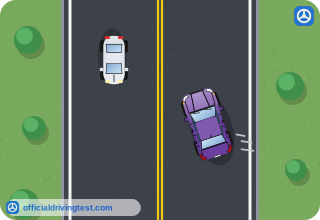
Which action may help if your back wheels lose traction?
- Braking hard
- Slowly accelerating
- Turning the wheel sharply
- Shifting into neutral
Show answer
Correct answer: Slowly accelerating
The manual says slowly accelerating (pressing on the gas) may help if your back wheels lose traction.
Source: Maryland Driver’s Manual (October 2025 Edition (DL-002 10-25)), page 29
-
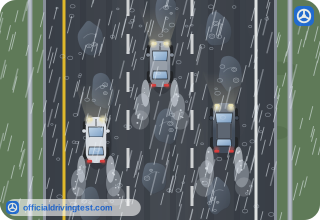
When your vehicle rides on a sheet of water and the tires lose contact with the road, what is this called?
- Hydroplaning
- Skidding
- Fishtailing
- Brake fade
Show answer
Correct answer: Hydroplaning
The manual says that when tires lose contact with the road because the vehicle is riding on a sheet of water, it is called hydroplaning.
Source: Maryland Driver’s Manual (October 2025 Edition (DL-002 10-25)), page 30
-
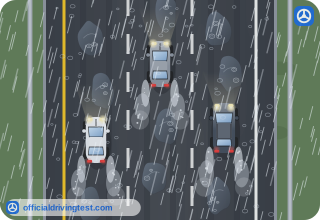
How much control of your vehicle can hydroplaning make you lose?
- Only steering control
- Only braking control
- Some or all of it
- None, if tires are new
Show answer
Correct answer: Some or all of it
Hydroplaning can cause you to lose some or all control of your vehicle.
Source: Maryland Driver’s Manual (October 2025 Edition (DL-002 10-25)), page 30
-
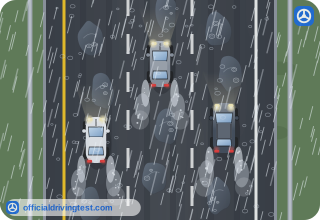
To help prevent hydroplaning, what should you keep in good condition?
- Your headlights
- Your tires
- Your brake lights
- Your wiper blades
Show answer
Correct answer: Your tires
The manual says to prevent hydroplaning you should keep your tires in good condition and lower your speed on wet roads.
Source: Maryland Driver’s Manual (October 2025 Edition (DL-002 10-25)), page 30
-
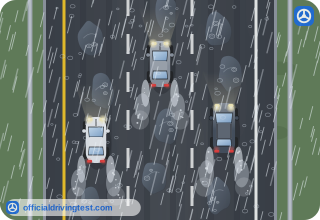
If you start to lose control of your vehicle on a wet road, what should you do with the gas pedal?
- Press it harder to regain traction
- Tap it repeatedly
- Hold it at a steady position
- Take your foot off the gas
Show answer
Correct answer: Take your foot off the gas
When you start to lose control while hydroplaning, the manual says to take your foot off the gas.
Source: Maryland Driver’s Manual (October 2025 Edition (DL-002 10-25)), page 30
-
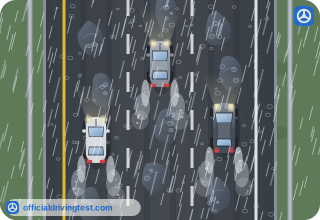
If your vehicle starts to hydroplane, what should you do with your brakes?
- Apply them firmly
- Do not apply them
- Press them gently and steadily
- Hold them down hard
Show answer
Correct answer: Do not apply them
The manual says not to apply your brakes if you start to lose control from hydroplaning.
Source: Maryland Driver’s Manual (October 2025 Edition (DL-002 10-25)), page 30
-
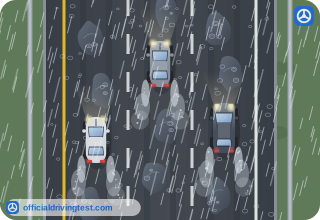
If you start to lose control from hydroplaning, how should you steer?
- Steer sharply toward the shoulder
- Turn the wheel quickly back and forth
- Keep your vehicle going straight
- Steer toward the center of the road
Show answer
Correct answer: Keep your vehicle going straight
The manual says to keep your vehicle going straight if you start to lose control from hydroplaning.
Source: Maryland Driver’s Manual (October 2025 Edition (DL-002 10-25)), page 30
-
After you take your foot off the gas while losing control on a wet road, what should you do until you get control back?
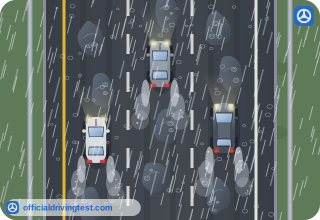
- Slow down
- Keep the same speed
- Brake as hard as you can
- Turn the wheel sharply
Show answer
Correct answer: Slow down
The manual says to slow down until you get control back.
Source: Maryland Driver’s Manual (October 2025 Edition (DL-002 10-25)), page 30