Maine: Signals and vehicle controls — Part 4 Practice Test
Inspecting and maintaining your vehicle, adjusting the seat and mirrors, starting, shifting, stopping and backing, and signaling with lights and hand signals. — Part 4
Independent educational site · not affiliated with any government agency or DMV
Ready? Test yourself
- Instant feedback with an explanation
- Every answer cites its source in the manual
- Your best score is saved on this device
Questions are original and based on the official manual "Maine Driver’s License Manual" (Rev 4/24), Maine Bureau of Motor Vehicles.
All 40 questions in this practice test
Take the test above first, then use this list to study. Tap “Show answer” to see the correct answer and explanation.
Show the questions and answersHide the questions
-
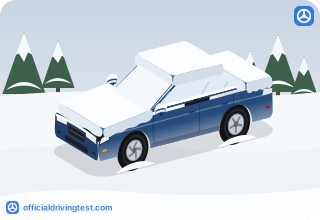
What does the manual say to do about snow, ice, or frost before you start to drive?
- Clear it only from the windshield
- Clear it only from the windows you use most
- Clear the windshield and mirrors but leave the lights
- Clear it from all windows and head and taillights
Show answer
Correct answer: Clear it from all windows and head and taillights
The manual says to clear snow, ice or frost from all windows and head and taillights before you start to drive.
Source: Maine Driver’s License Manual (Rev 4/24), page 8-1 · Open this page in the manual (Manual page 8-1)
-
What is the legal problem with hanging things from the mirror or cluttering the windshield with decals?
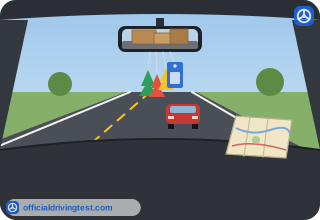
- Anything that blocks a driver's vision is a violation of the law
- They are a violation only at night
- They are a violation only if an officer asks you to remove them
- They are allowed as long as the windshield is clean
Show answer
Correct answer: Anything that blocks a driver's vision is a violation of the law
Anything in the car that blocks a driver's vision is a violation of the law.
Source: Maine Driver’s License Manual (Rev 4/24), page 8-1 · Open this page in the manual (Manual page 8-1)
-
What should you keep in the car in case your regular glasses are broken or lost?
- A copy of your eyeglass prescription
- A pair of dark sunglasses
- An extra pair of glasses
- A written record of your vision test
Show answer
Correct answer: An extra pair of glasses
The manual advises keeping an extra pair of glasses in the car in case your regular ones are broken or lost.
Source: Maine Driver’s License Manual (Rev 4/24), page 8-1 · Open this page in the manual (Manual page 8-1)
-
What must drivers let other drivers know by communicating?
- How fast they intend to drive along the road
- Which route they plan to take
- Where they are and what they plan to do
- Who has the right of way
Show answer
Correct answer: Where they are and what they plan to do
Drivers must let others know where they are and what they plan to do by communicating.
Source: Maine Driver’s License Manual (Rev 4/24), page 8-15 · Open this page in the manual (Manual page 8-15)
-
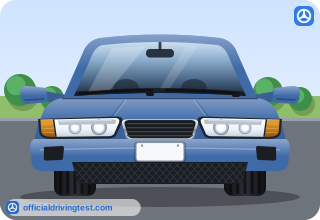
Besides helping you to see at night, what else do headlights do?
- Show other drivers where you plan to turn
- Help other people see you in the daytime as well
- Warn other drivers to stay back
- Reduce glare from the sun
Show answer
Correct answer: Help other people see you in the daytime as well
Turning on your headlights helps other roadway users see you, in the daytime as well.
Source: Maine Driver’s License Manual (Rev 4/24), page 8-15 · Open this page in the manual (Manual page 8-15)
-
By Maine law, you must turn on your headlights whenever visibility is too dim for you to see how far ahead?
- 100 feet
- 250 feet
- 2000 feet
- 1000 feet
Show answer
Correct answer: 1000 feet
By Maine law headlights must be on whenever visibility is too dim to see 1000 feet ahead, or whenever windshield wipers are in constant use.
Source: Maine Driver’s License Manual (Rev 4/24), page 8-16 · Open this page in the manual (Manual page 8-16)
-
By Maine law, you must turn on your headlights any time which of these is in constant use?
- Windshield wipers
- The defroster
- Your hazard flashers
- The cruise control
Show answer
Correct answer: Windshield wipers
By Maine law you must turn on the headlights at any time when windshield wipers are in constant use.
Source: Maine Driver’s License Manual (Rev 4/24), page 8-16 · Open this page in the manual (Manual page 8-16)
-
What does the manual say about driving with only the parking lights on?
- It is acceptable at dusk
- It is required in fog
- It is not a good driving practice
- It is acceptable on well-lit streets
Show answer
Correct answer: It is not a good driving practice
The manual says it is not a good driving practice to operate a motor vehicle with only the parking lights on.
Source: Maine Driver’s License Manual (Rev 4/24), page 8-16 · Open this page in the manual (Manual page 8-16)
-
What does the manual say about motorcyclists and headlights on Maine roadways?
- Only in rain, snow or fog
- They must always have their headlights on
- Only on roads that have no streetlights
- Only when riding on highways
Show answer
Correct answer: They must always have their headlights on
Motorcyclists are always required to have their headlights on when operating a motorcycle on Maine roadways.
Source: Maine Driver’s License Manual (Rev 4/24), page 8-16 · Open this page in the manual (Manual page 8-16)
-
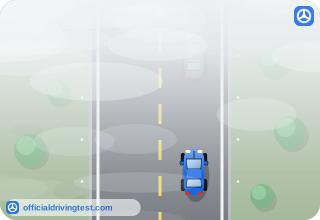
What should you do whenever you have trouble seeing other cars?
- Turn on only your parking lights
- Turn on your hazard flashers
- Sound your horn every few seconds
- Turn on your headlights
Show answer
Correct answer: Turn on your headlights
Turn on the headlights whenever you have trouble seeing other cars: if you can't see them, they can't see you.
Source: Maine Driver’s License Manual (Rev 4/24), page 8-16 · Open this page in the manual (Manual page 8-16)
-
Compared with low beams, how far do high beams let you see?
- Twice as far
- Three times as far
- Four times as far
- The same distance
Show answer
Correct answer: Twice as far
High beams let you see twice as far as low beams.
Source: Maine Driver’s License Manual (Rev 4/24), page 8-16 · Open this page in the manual (Manual page 8-16)
-
In which situation does the manual say to be sure to use your high beams?
- In heavy fog
- When following a vehicle closely
- In a construction area
- When approaching an oncoming vehicle
Show answer
Correct answer: In a construction area
Be sure to use high beams on unfamiliar roads, in construction areas, or where there may be people along the side of the road.
Source: Maine Driver’s License Manual (Rev 4/24), page 8-16 · Open this page in the manual (Manual page 8-16)
-
A vehicle with multiple beam road lights must dim its headlights or switch to a low beam when it approaches an oncoming vehicle within how far?
- 100 feet
- 500 feet
- 250 feet
- 750 feet
Show answer
Correct answer: 500 feet
The operator shall dim the headlights or switch to a low beam when approaching an oncoming vehicle within 500 feet.
Source: Maine Driver’s License Manual (Rev 4/24), page 8-16 · Open this page in the manual (Manual page 8-16)
-
A vehicle with multiple beam road lights must dim its headlights or switch to a low beam when it follows another vehicle within how far?
- 100 feet
- 200 feet
- 600 feet
- 300 feet
Show answer
Correct answer: 300 feet
The operator shall dim the headlights or switch to a low beam when following a vehicle within 300 feet.
Source: Maine Driver’s License Manual (Rev 4/24), page 8-16 · Open this page in the manual (Manual page 8-16)
-
Why should you use low beams in fog, snow, or heavy rain?
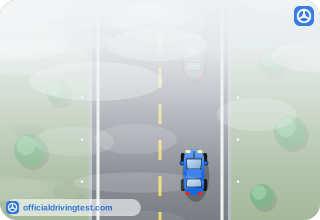
- Light from high beams reflects back and causes glare
- Low beams light up the road farther than high beams
- High beams use more battery power in wet weather
- Other drivers cannot see high beams in precipitation
Show answer
Correct answer: Light from high beams reflects back and causes glare
Light from your own high beams reflects back on you from the precipitation and causes a glare that affects your vision.
Source: Maine Driver’s License Manual (Rev 4/24), page 8-16 · Open this page in the manual (Manual page 8-16)
-
An oncoming vehicle has its high beams on and fails to dim them. What should you do?
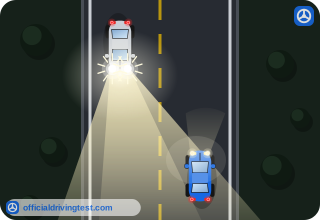
- Flash your high beams back at the driver
- Speed up to pass the oncoming car more quickly
- Slow down and look toward the right side of the road
- Look toward the left side of the road and brake hard
Show answer
Correct answer: Slow down and look toward the right side of the road
Slowing down and looking toward the right side of the road keeps you from being blinded and lets you see the edge of the lane until the car passes.
Source: Maine Driver’s License Manual (Rev 4/24), page 8-16 · Open this page in the manual (Manual page 8-16)
-
Why should you not keep your bright lights on to "get back" at an oncoming driver who did not dim?
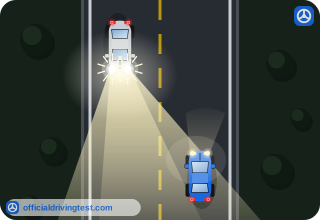
- Only the other driver will be blinded
- Both drivers will be blinded
- Your lights will be reflected back to you
- Neither driver will be affected
Show answer
Correct answer: Both drivers will be blinded
The manual says not to try to "get back" at the other driver by keeping your bright lights on, because both drivers will be blinded.
Source: Maine Driver’s License Manual (Rev 4/24), page 8-16 · Open this page in the manual (Manual page 8-16)
-
How should you use your horn to inform others that you are there?
- Hold it down continuously
- Sound a sharp blast as you pass
- Sound it twice as you start to pass
- Tap it lightly, well in advance
Show answer
Correct answer: Tap it lightly, well in advance
Tap the horn lightly, well in advance, to inform others that you are there.
Source: Maine Driver’s License Manual (Rev 4/24), page 8-17 · Open this page in the manual (Manual page 8-17)
-
Why should you try to avoid using the horn when near bicyclists or horses?
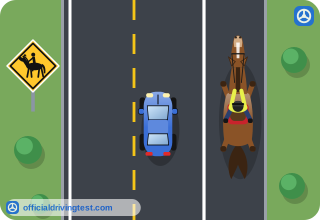
- They may be startled and veer out into the roadway
- They cannot hear a horn over the road noise
- The horn may be mistaken for an emergency siren
- A horn is only meant for use on highways
Show answer
Correct answer: They may be startled and veer out into the roadway
The riders or the horse may become startled, lose control, and veer out into the roadway.
Source: Maine Driver’s License Manual (Rev 4/24), page 8-17 · Open this page in the manual (Manual page 8-17)
-
Which is a time to give your horn a light tap?
- When a driver ahead is slower than you would like
- When you want to hurry a driver at a green light
- When passing a driver who starts to turn into your lane
- When you drive through a quiet residential area
Show answer
Correct answer: When passing a driver who starts to turn into your lane
The manual lists passing a driver who starts to turn into your lane as a time for a light tap of the horn.
Source: Maine Driver’s License Manual (Rev 4/24), page 8-17 · Open this page in the manual (Manual page 8-17)
-
When should you use your horn?
- Every time you pass a parked vehicle
- Whenever it will help prevent an accident
- Whenever you want to greet another driver
- To make other drivers hurry at intersections
Show answer
Correct answer: Whenever it will help prevent an accident
Use the horn whenever it will help prevent an accident, but not without cause or just to make an unreasonably loud noise.
Source: Maine Driver’s License Manual (Rev 4/24), page 8-17 · Open this page in the manual (Manual page 8-17)
-
What do timely signals give other drivers?
- The right of way
- Permission to pass
- Priority at the next intersection
- Time to react
Show answer
Correct answer: Time to react
Timely signals give other drivers time to react.
Source: Maine Driver’s License Manual (Rev 4/24), page 8-17 · Open this page in the manual (Manual page 8-17)
-
What should you do with your turn signal after you change lanes, turn, or merge into traffic?
- Make sure it is canceled afterwards
- Leave it on until the next intersection
- Leave it on if another car is following you
- Leave it on for the next few seconds for safety
Show answer
Correct answer: Make sure it is canceled afterwards
The manual says to be sure to cancel your signal afterwards.
Source: Maine Driver’s License Manual (Rev 4/24), page 8-17 · Open this page in the manual (Manual page 8-17)
-
You plan to turn beyond a side street. When should you turn your signal on?
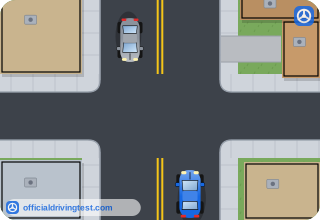
- Before you reach the side street
- As soon as the side street comes into view
- After passing the side street
- Only when traffic is waiting on the side street
Show answer
Correct answer: After passing the side street
When making a turn that is beyond a side street, do not put your turn signal on until after passing the side street.
Source: Maine Driver’s License Manual (Rev 4/24), page 8-17 · Open this page in the manual (Manual page 8-17)
-
When should you tap your brake pedal to let others know you are slowing?
- When entering a freeway from an entrance lane
- When turning off a road with no separate turn or exit lane
- When changing lanes on a road that has several lanes
- When passing a vehicle on a two-lane road
Show answer
Correct answer: When turning off a road with no separate turn or exit lane
Brake lights let others know you are slowing; tap your brake pedal when turning off a road that does not have a separate turn or exit lane.
Source: Maine Driver’s License Manual (Rev 4/24), page 8-17 · Open this page in the manual (Manual page 8-17)
-
Before which of these must you always signal?
- Driving straight through an intersection
- Driving straight past a side street
- Keeping a steady speed in your lane
- Entering or exiting a parking lot
Show answer
Correct answer: Entering or exiting a parking lot
The manual says to always signal before you enter or exit a parking lot, as well as when you change lanes, turn, enter or leave a freeway, or turn into a driveway.
Source: Maine Driver’s License Manual (Rev 4/24), page 8-17 · Open this page in the manual (Manual page 8-17)
-
Besides changing direction, before which action is it a good idea to signal?
- Pulling away from the curb
- Driving straight ahead in your lane
- Shifting to a lower gear
- Turning on your headlights
Show answer
Correct answer: Pulling away from the curb
It is a good idea to also signal before you pull away from the curb or pull over to the side of the road to stop.
Source: Maine Driver’s License Manual (Rev 4/24), page 8-18 · Open this page in the manual (Manual page 8-18)
-
What should you do about signaling when you do not see anyone around?
- Skip the signal because no one needs it
- Signal only at an intersection
- Signal anyway, every time you change direction
- Signal only at night
Show answer
Correct answer: Signal anyway, every time you change direction
Make it a habit to signal every time you change direction, even when no one is around, because the car you don't see is the most dangerous.
Source: Maine Driver’s License Manual (Rev 4/24), page 8-18 · Open this page in the manual (Manual page 8-18)
-
What should you use if your turn signals are not working?
- Your horn
- Your high beams
- Your brake lights alone
- Hand signals
Show answer
Correct answer: Hand signals
The manual says to use hand signals if the turn signals are not working.
Source: Maine Driver’s License Manual (Rev 4/24), page 8-18 · Open this page in the manual (Manual page 8-18)
-
You plan to turn beyond an intersection. What might another driver do if you signal before that intersection?
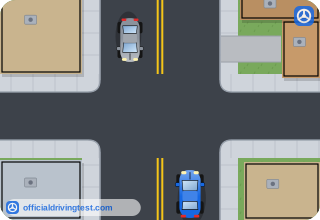
- Get the wrong idea and pull into your path
- Stop and wait for you to make the turn ahead of them
- Flash headlights to warn you
- Move over to let you turn
Show answer
Correct answer: Get the wrong idea and pull into your path
If you signal before the intersection, another driver might get the wrong idea at that intersection and pull into your path, so signal after the intersection.
Source: Maine Driver’s License Manual (Rev 4/24), page 8-18 · Open this page in the manual (Manual page 8-18)
-
A driver's left arm is held straight out of the driver's window, pointing to the side. What does this hand signal mean?
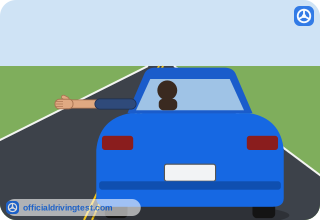
- Right turn
- Left turn
- Slowing or stopping
- You may pass on the left
Show answer
Correct answer: Left turn
An arm held straight out to the left side means a left turn, one of the manual's hand signals for when turn signals are not working.
Source: Maine Driver’s License Manual (Rev 4/24), page 8-18 · Open this page in the manual (Manual page 8-18)
-
A driver's left arm is held out of the window and bent at the elbow so the hand points up. What does this hand signal mean?
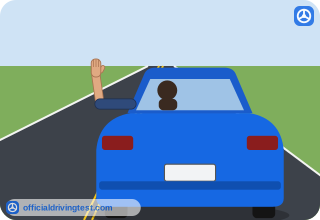
- Left turn
- Slowing or stopping
- Right turn
- You may pass on the left
Show answer
Correct answer: Right turn
An arm bent at the elbow with the hand pointing up is the hand signal for a right turn.
Source: Maine Driver’s License Manual (Rev 4/24), page 8-18 · Open this page in the manual (Manual page 8-18)
-
A driver's left arm is held out of the window and bent at the elbow so the hand points down. What does this hand signal mean?
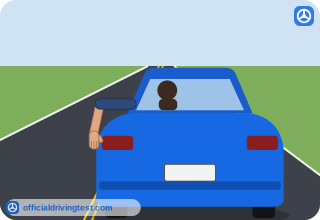
- Left turn
- Right turn
- You may pass on the left
- Slowing or stopping
Show answer
Correct answer: Slowing or stopping
An arm bent at the elbow with the hand pointing down is the hand signal for slowing or stopping.
Source: Maine Driver’s License Manual (Rev 4/24), page 8-18 · Open this page in the manual (Manual page 8-18)
-
When does the manual say to use your high beams at night?
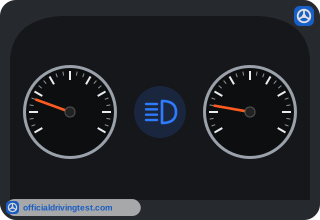
- Only in fog, rain, or snow
- Whenever you are following another vehicle
- When there are no oncoming vehicles
- Never; low beams are always required at night
Show answer
Correct answer: When there are no oncoming vehicles
It says to use high beams if there are no oncoming vehicles and to dim them for oncoming traffic.
Source: Maine Driver’s License Manual (Rev 4/24), page 11-1 · Open this page in the manual (Manual page 11-1)
-
An oncoming vehicle does not dim its headlights. Where should you look to avoid being temporarily blinded?
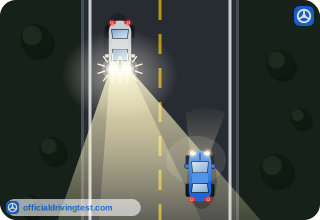
- Toward the left side of the roadway
- Toward the right side of the roadway
- Straight into the oncoming headlights
- Toward the center of the road
Show answer
Correct answer: Toward the right side of the roadway
Looking toward the right side of the roadway helps you avoid being temporarily blinded by oncoming headlights.
Source: Maine Driver’s License Manual (Rev 4/24), page 11-1 · Open this page in the manual (Manual page 11-1)
-
Which headlight setting should you use when following another vehicle at night?
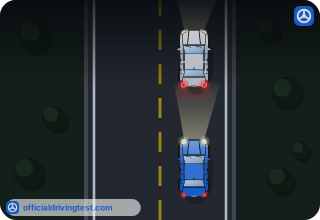
- High beams
- Fog lights only
- Parking lights
- Low beams
Show answer
Correct answer: Low beams
The manual says to use your low beams when following another vehicle.
Source: Maine Driver’s License Manual (Rev 4/24), page 11-1 · Open this page in the manual (Manual page 11-1)
-
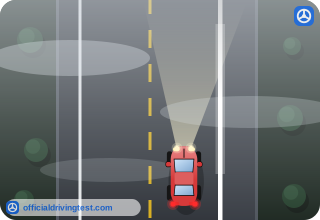
Which headlight setting should you use in fog, rain, or snow to avoid glare?
- Low beams
- High beams
- Parking lights
- Hazard flashers
Show answer
Correct answer: Low beams
In fog, rain, or snow, low beams avoid glare.
Source: Maine Driver’s License Manual (Rev 4/24), page 11-1 · Open this page in the manual (Manual page 11-1)
-
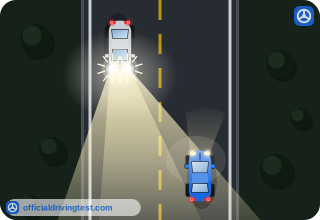
At night, what should you do instead of looking directly into the headlights of other vehicles?
- Switch on your high beams to match theirs
- Look at the face of the oncoming driver
- Keep scanning the roadway around your vehicle
- Watch only your own dashboard instruments
Show answer
Correct answer: Keep scanning the roadway around your vehicle
You should avoid looking directly into the headlights of other vehicles and keep scanning the roadway around your vehicle.
Source: Maine Driver’s License Manual (Rev 4/24), page 11-1 · Open this page in the manual (Manual page 11-1)
-
Why should you not wear sunglasses at night?
- They reduce the light you need for good vision
- They make oncoming headlights look much brighter than they are
- They hide the colors of road signs
- They make other vehicles look farther away
Show answer
Correct answer: They reduce the light you need for good vision
Do not wear sunglasses at night: they reduce the light you need for good vision.
Source: Maine Driver’s License Manual (Rev 4/24), page 11-1 · Open this page in the manual (Manual page 11-1)
-
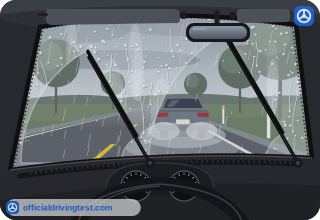
In rain, how can you make sure you are clearly seen?
- Use your hazard flashers
- Drive in the left lane
- Turn on your headlights
- Sound your horn at intervals
Show answer
Correct answer: Turn on your headlights
The manual says to make sure you are clearly seen by turning on your headlights.
Source: Maine Driver’s License Manual (Rev 4/24), page 11-6 · Open this page in the manual (Manual page 11-6)