Maine: Signals and vehicle controls — Part 2 Practice Test
Inspecting and maintaining your vehicle, adjusting the seat and mirrors, starting, shifting, stopping and backing, and signaling with lights and hand signals. — Part 2
Independent educational site · not affiliated with any government agency or DMV
Ready? Test yourself
- Instant feedback with an explanation
- Every answer cites its source in the manual
- Your best score is saved on this device
Questions are original and based on the official manual "Maine Driver’s License Manual" (Rev 4/24), Maine Bureau of Motor Vehicles.
All 40 questions in this practice test
Take the test above first, then use this list to study. Tap “Show answer” to see the correct answer and explanation.
Show the questions and answersHide the questions
-
How often does the manual say frequent oil changes should be done?
- Every 500 - 1,000 miles
- Every 3,000 - 5,000 miles
- Every 7,000 - 10,000 miles
- Every 12,000 - 15,000 miles
Show answer
Correct answer: Every 3,000 - 5,000 miles
The manual lists frequent oil changes every 3,000 - 5,000 miles as prevention against common motor vehicle problems.
Source: Maine Driver’s License Manual (Rev 4/24), page 2-6 · Open this page in the manual (Manual page 2-6)
-
A sound system in a vehicle on a public way may not be audible at a distance greater than what, while exceeding 85 decibels?
- 10 feet
- 50 feet
- 100 feet
- 25 feet
Show answer
Correct answer: 25 feet
A sound system may not be audible at a distance greater than 25 feet and exceed 85 decibels.
Source: Maine Driver’s License Manual (Rev 4/24), page 2-6 · Open this page in the manual (Manual page 2-6)
-
A sound system in a vehicle on a public way may not exceed how many decibels while audible at a distance greater than 25 feet?
- 65 decibels
- 85 decibels
- 75 decibels
- 95 decibels
Show answer
Correct answer: 85 decibels
A sound system may not be audible at more than 25 feet and exceed 85 decibels.
Source: Maine Driver’s License Manual (Rev 4/24), page 2-6 · Open this page in the manual (Manual page 2-6)
-
What is a violation of Maine’s excessive sound system noise law?
- A criminal misdemeanor
- A felony
- A traffic infraction
- A civil warning with no penalty
Show answer
Correct answer: A traffic infraction
Violation of the excessive sound system noise law is a traffic infraction.
Source: Maine Driver’s License Manual (Rev 4/24), page 2-6 · Open this page in the manual (Manual page 2-6)
-
What is the penalty for a first offense of operating a sound system with excessive noise?
- $25
- $75
- $200
- $50
Show answer
Correct answer: $50
A first offense of excessive sound system noise is assessed $50.
Source: Maine Driver’s License Manual (Rev 4/24), page 2-6 · Open this page in the manual (Manual page 2-6)
-
What is the penalty for a second offense of operating a sound system with excessive noise?
- $100
- $75
- $125
- $200
Show answer
Correct answer: $100
A second offense of excessive sound system noise is assessed $100.
Source: Maine Driver’s License Manual (Rev 4/24), page 2-6 · Open this page in the manual (Manual page 2-6)
-
What is the penalty for a third or subsequent offense of operating a sound system with excessive noise?
- $125
- $150
- $200
- $250
Show answer
Correct answer: $150
A third or subsequent offense of excessive sound system noise is assessed $150.
Source: Maine Driver’s License Manual (Rev 4/24), page 2-6 · Open this page in the manual (Manual page 2-6)
-
What should you do if your seat is too low for you to see the road well?
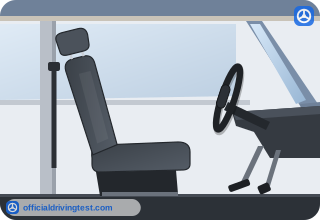
- Use a seat cushion
- Lean the seat back to raise your eyes
- Tilt the inside mirror upward
- Move the seat as close to the wheel as it goes
Show answer
Correct answer: Use a seat cushion
The manual says to adjust the seat so you are high enough to see the road and, if the seat is too low, to use a seat cushion.
Source: Maine Driver’s License Manual (Rev 4/24), page 4-1 · Open this page in the manual (Manual page 4-1)
-
When you adjust your seat, you should be able to move your foot easily from the brake to the gas pedal while keeping what on the floor?
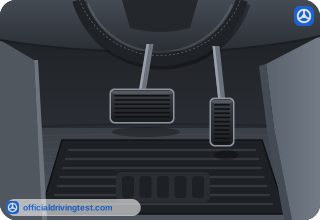
- Your toes
- The ball of your foot
- Your heel
- Your whole ankle
Show answer
Correct answer: Your heel
The seat should be set so your foot moves easily from the brake to the gas pedal with your heel staying on the floor.
Source: Maine Driver’s License Manual (Rev 4/24), page 4-1 · Open this page in the manual (Manual page 4-1)
-
According to the manual, where should the top of the steering wheel be in relation to your body?
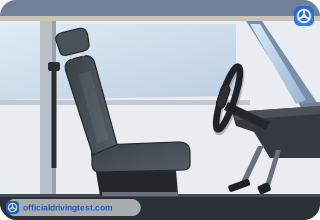
- Level with your chin or slightly higher than it
- No higher than your shoulders and below your chin level
- Level with your eyes so you can see over it
- Higher than your shoulders but below your ears
Show answer
Correct answer: No higher than your shoulders and below your chin level
The top of the steering wheel should be no higher than your shoulders and also below your chin level.
Source: Maine Driver’s License Manual (Rev 4/24), page 4-1 · Open this page in the manual (Manual page 4-1)
-
Where should your head rest contact the back of your head?
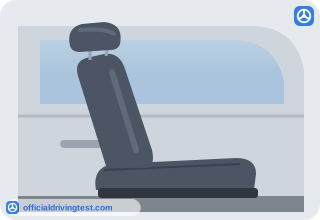
- Below the level of your ears
- At the base of your neck
- At the level of your shoulders
- Above the level of your ears
Show answer
Correct answer: Above the level of your ears
The head rest should contact the back of your head above the level of your ears.
Source: Maine Driver’s License Manual (Rev 4/24), page 4-1 · Open this page in the manual (Manual page 4-1)
-
How should you adjust the inside mirror?
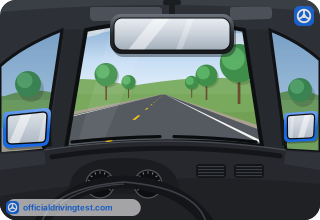
- So that it shows your back seat and doors
- So that you can barely see the rear edge of your vehicle
- So that it frames the rear window
- So that it points slightly toward the road surface
Show answer
Correct answer: So that it frames the rear window
The inside mirror should be adjusted so that it frames the rear window.
Source: Maine Driver’s License Manual (Rev 4/24), page 4-1 · Open this page in the manual (Manual page 4-1)
-
What should you use a day/night mirror to guard against?
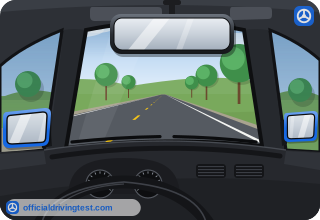
- Glare from the headlights of cars behind you
- Glare from the sun through the windshield
- Blind spots on either side of your vehicle
- Fog forming on the rear window
Show answer
Correct answer: Glare from the headlights of cars behind you
A day/night mirror, set for the time of day you are driving, guards against glare from the headlights of cars behind you.
Source: Maine Driver’s License Manual (Rev 4/24), page 4-1 · Open this page in the manual (Manual page 4-1)
-
When should you adjust the rearview and side mirrors?
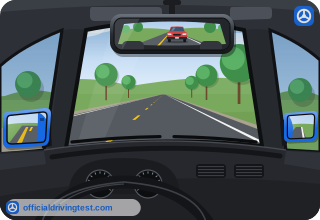
- As soon as traffic becomes heavy
- Each time you change lanes
- After you reach highway speed
- Before you start driving
Show answer
Correct answer: Before you start driving
In heavy traffic, when you really need the mirrors, you will not have time to adjust them, so adjust them before you start driving.
Source: Maine Driver’s License Manual (Rev 4/24), page 4-1 · Open this page in the manual (Manual page 4-1)
-
As you adjust your seat, what should you be able to do easily?
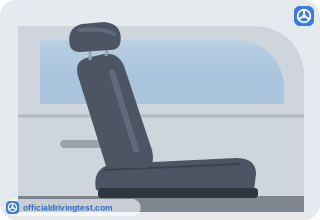
- Reach the glove box
- Reach the foot pedals
- Touch the dashboard with your head
- Reach the rear seat
Show answer
Correct answer: Reach the foot pedals
The manual says you should be sitting so you can easily reach the foot pedals.
Source: Maine Driver’s License Manual (Rev 4/24), page 4-1 · Open this page in the manual (Manual page 4-1)
-
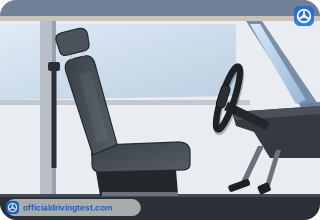
How should you sit when you begin adjusting your seat?
- Leaning forward with your chest close to the steering wheel
- Straight up with your back against the seat and feet on the floor
- Reclined with your arms stretched out to the wheel
- Sitting on the edge of the seat with your toes on the pedals
Show answer
Correct answer: Straight up with your back against the seat and feet on the floor
The manual starts seat adjustment with sitting straight up, back against the seat and feet on the floor.
Source: Maine Driver’s License Manual (Rev 4/24), page 4-1 · Open this page in the manual (Manual page 4-1)
-
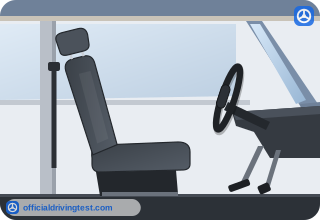
Why should you not move the seat too far forward?
- You cannot see the dashboard gauges
- You cannot reach the foot pedals
- The air bag could not be turned off
- You may not be able to steer properly
Show answer
Correct answer: You may not be able to steer properly
The manual warns not to move the seat so far forward that you cannot steer properly.
Source: Maine Driver’s License Manual (Rev 4/24), page 4-1 · Open this page in the manual (Manual page 4-1)
-
Proper seat adjustment lets you comfortably reach the steering wheel while leaving enough space for what?
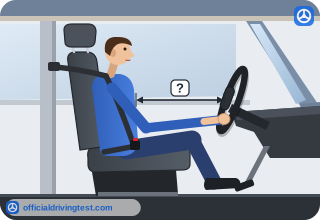
- Airbag deployment in a crash
- Using a seat cushion
- Moving your foot between the pedals
- Adjusting the mirrors while driving
Show answer
Correct answer: Airbag deployment in a crash
A properly adjusted seat leaves enough space for the airbag to deploy in a crash while you can still comfortably reach the wheel.
Source: Maine Driver’s License Manual (Rev 4/24), page 4-1 · Open this page in the manual (Manual page 4-1)
-
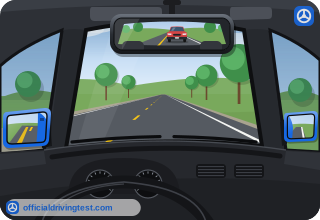
What is the purpose of adjusting your outside mirrors?
- To show mainly the sides of your own vehicle
- To focus only on the lane directly behind you
- To give maximum view to the side and rear
- To point straight down at the pavement beside you
Show answer
Correct answer: To give maximum view to the side and rear
Outside mirrors are adjusted to give maximum view to the side and rear.
Source: Maine Driver’s License Manual (Rev 4/24), page 4-2 · Open this page in the manual (Manual page 4-2)
-
When setting the left side mirror, where should your head be?
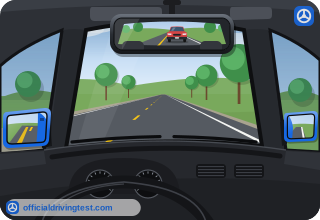
- Leaning toward the center of the vehicle
- Pressed back against the head rest
- Turned toward the rear window
- Resting against the closed left window
Show answer
Correct answer: Resting against the closed left window
To set the left side mirror, you rest your head against the closed left window.
Source: Maine Driver’s License Manual (Rev 4/24), page 4-2 · Open this page in the manual (Manual page 4-2)
-
When the left side mirror is set correctly, what should you be able to barely see in it?
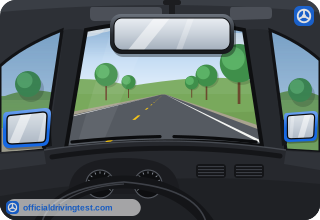
- The tires of the car behind you
- The rear left edge of your vehicle
- The full length of the left lane
- The top of your rear window
Show answer
Correct answer: The rear left edge of your vehicle
The left side mirror is set so you can barely see the rear left edge of your vehicle.
Source: Maine Driver’s License Manual (Rev 4/24), page 4-2 · Open this page in the manual (Manual page 4-2)
-
How should you position your head to set the right-side mirror?
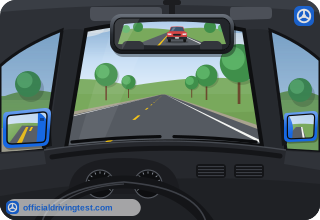
- Rest your head against the closed right window and hold still
- Sit upright and keep your head against the head rest
- Lean to the right so your head is directly below the rearview mirror
- Lean toward the center and turn your head to the left
Show answer
Correct answer: Lean to the right so your head is directly below the rearview mirror
To set the right-side mirror, you lean to the right so your head is directly below the rearview mirror.
Source: Maine Driver’s License Manual (Rev 4/24), page 4-2 · Open this page in the manual (Manual page 4-2)
-
Before you start the engine, which position should the vehicle be in?
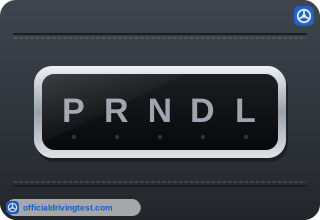
- "P" (park)
- "N" (neutral)
- "D" (drive)
- "R" (reverse)
Show answer
Correct answer: "P" (park)
The manual says to be sure the vehicle is in "P" (park) before starting the engine.
Source: Maine Driver’s License Manual (Rev 4/24), page 5-1 · Open this page in the manual (Manual page 5-1)
-
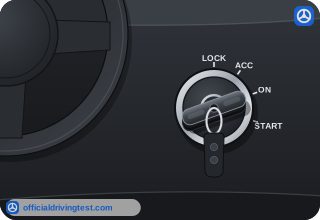
When you turn the ignition to the on position before engaging the engine, what are you checking?
- The parking brake and the tire pressure
- Only the doors and the mirrors
- The lights and gauges
- The oil level and the washer fluid
Show answer
Correct answer: The lights and gauges
Turning the ignition to the on position lets you check the lights and gauges, such as fuel level, ABS and air bags.
Source: Maine Driver’s License Manual (Rev 4/24), page 5-1 · Open this page in the manual (Manual page 5-1)
-
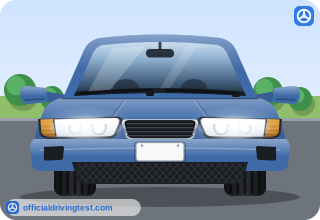
After the engine is started, which headlights does the manual say to turn on?
- The high beam headlights
- The low beam headlights
- The fog lights only
- The hazard flashers
Show answer
Correct answer: The low beam headlights
The starting steps say to turn on the low beam headlights after engaging the engine.
Source: Maine Driver’s License Manual (Rev 4/24), page 5-1 · Open this page in the manual (Manual page 5-1)
-
After you start the engine, what does the manual say to do about the doors?
- Leave them unlocked until you reach the road
- Open the driver door slightly
- Lock only the passenger doors
- Lock them
Show answer
Correct answer: Lock them
The starting steps end with turning on the low beam headlights and locking the doors.
Source: Maine Driver’s License Manual (Rev 4/24), page 5-1 · Open this page in the manual (Manual page 5-1)
-
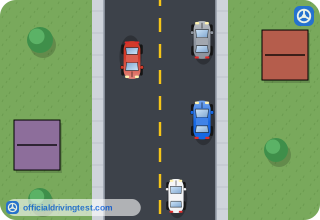
When moving forward in an automatic vehicle, what do you do right before you gradually accelerate?
- Signal
- Tap the brake three or four times
- Sound your horn
- Turn on the high beam headlights
Show answer
Correct answer: Signal
The manual says to check around you, signal and then gradually accelerate.
Source: Maine Driver’s License Manual (Rev 4/24), page 5-1 · Open this page in the manual (Manual page 5-1)
-
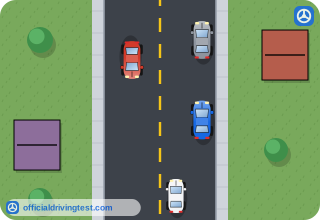
After putting the vehicle in "D" (drive), where does the manual say to check for traffic?
- Only straight ahead of you
- Only behind your vehicle
- Ahead, to the sides and behind
- Only to the left and right
Show answer
Correct answer: Ahead, to the sides and behind
The manual says to check ahead and check for traffic to the sides and behind.
Source: Maine Driver’s License Manual (Rev 4/24), page 5-1 · Open this page in the manual (Manual page 5-1)
-
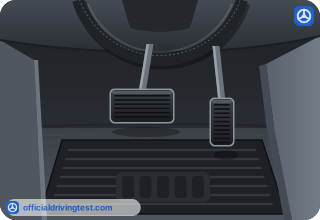
How should your foot be placed on the gas pedal when you accelerate?
- Your whole foot flat on the pedal with the heel lifted
- The top of your foot on the pedal and your heel on the floor
- Only your toes on the pedal with your heel in the air
- Your heel on the pedal and your toes on the floor
Show answer
Correct answer: The top of your foot on the pedal and your heel on the floor
The top of your foot should be on the gas pedal while your heel remains on the floor.
Source: Maine Driver’s License Manual (Rev 4/24), page 5-1 · Open this page in the manual (Manual page 5-1)
-
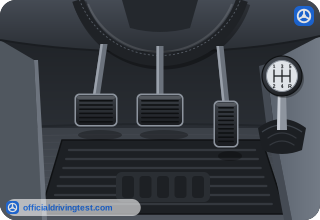
In a manual transmission car, what is the friction point?
- The point where the car reaches the speed needed to shift into second gear
- The point where the brake pedal first starts to slow the car down
- The point where the clutch pedal reaches the floor of the car
- The point where the engine and transmission engage as you let up the clutch
Show answer
Correct answer: The point where the engine and transmission engage as you let up the clutch
The manual defines the friction point as the point where the engine and transmission engage as you let up the clutch pedal.
Source: Maine Driver’s License Manual (Rev 4/24), page 5-1 · Open this page in the manual (Manual page 5-1)
-
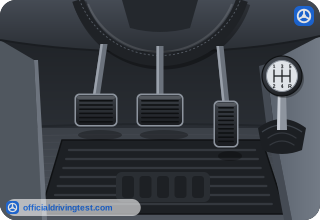
As you let up the clutch in a manual transmission car, what must you match the motion of the car with?
- An increase in pressure on the gas pedal
- An increase in pressure on the brake pedal
- A decrease in pressure on the gas pedal
- A turn of the steering wheel
Show answer
Correct answer: An increase in pressure on the gas pedal
You must match the forward or backward motion of the car with an increase in pressure on the gas pedal as you let up the clutch.
Source: Maine Driver’s License Manual (Rev 4/24), page 5-1 · Open this page in the manual (Manual page 5-1)
-
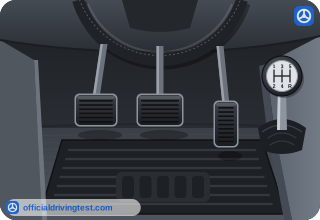
When putting a manual transmission car in motion, which pedals do you press first, and with which feet?
- The brake with your left foot and the clutch with your right foot
- The clutch and the gas pedal with your right foot
- The brake with your right foot and the clutch with your left foot
- The brake and the clutch with your left foot
Show answer
Correct answer: The brake with your right foot and the clutch with your left foot
Step 1 says to press the brake pedal with your right foot and press the clutch pedal to the floor with your left foot.
Source: Maine Driver’s License Manual (Rev 4/24), page 5-1 · Open this page in the manual (Manual page 5-1)
-
After you shift into first gear to put a manual transmission car in motion, what do you do next?
- Shift into second gear
- Release the parking brake
- Sound your horn
- Switch off your turn signal
Show answer
Correct answer: Release the parking brake
In the steps to put the car in motion, releasing the parking brake follows shifting into first gear.
Source: Maine Driver’s License Manual (Rev 4/24), page 5-1 · Open this page in the manual (Manual page 5-1)
-
What do you do to show the direction you plan to move when starting a manual transmission car?
- Tap your brake pedal quickly
- Sound your horn
- Flash your high beams
- Switch on your turn signal
Show answer
Correct answer: Switch on your turn signal
The manual says to switch on your turn signal to indicate the direction you plan to move.
Source: Maine Driver’s License Manual (Rev 4/24), page 5-1 · Open this page in the manual (Manual page 5-1)
-
Before you move a manual transmission car, how do you check your blind spots?
- Look over your shoulder
- Use only your rear-view mirror
- Use only your side-view mirrors
- Lean toward the window and listen
Show answer
Correct answer: Look over your shoulder
After checking the mirrors, you look over your shoulder to check blind spots.
Source: Maine Driver’s License Manual (Rev 4/24), page 5-1 · Open this page in the manual (Manual page 5-1)
-
While slowly letting the clutch up to the friction point, where should you look?
- Down at your feet
- Down at your hands
- Toward the roadway
- At the gauges
Show answer
Correct answer: Toward the roadway
The manual says to look towards the roadway and not down at your feet or hands.
Source: Maine Driver’s License Manual (Rev 4/24), page 5-1 · Open this page in the manual (Manual page 5-1)
-
After you slowly let the clutch up to the friction point, what do you do with your right foot?
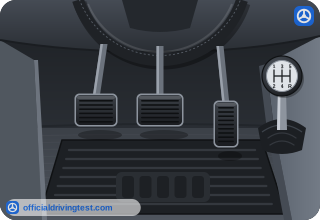
- Press it harder on the brake
- Move it from the brake to the accelerator
- Move it to the clutch pedal
- Keep it on the brake until the clutch is all the way up
Show answer
Correct answer: Move it from the brake to the accelerator
Step 7 says to move your right foot from the brake to the accelerator.
Source: Maine Driver’s License Manual (Rev 4/24), page 5-1 · Open this page in the manual (Manual page 5-1)
-
According to the manual, what causes a manual transmission car to jerk forward?
- You let the clutch up too slowly or pressed the gas pedal too lightly
- You left the parking brake set and used too high a gear
- You started moving in second gear instead of first gear
- You released the clutch abruptly or pressed too hard on the gas pedal
Show answer
Correct answer: You released the clutch abruptly or pressed too hard on the gas pedal
If the car jerks forward, you either released the clutch abruptly or pressed too hard on the gas pedal.
Source: Maine Driver’s License Manual (Rev 4/24), page 5-1 · Open this page in the manual (Manual page 5-1)
-
According to the manual, what does it mean if a manual transmission car lurches and the engine stalls?
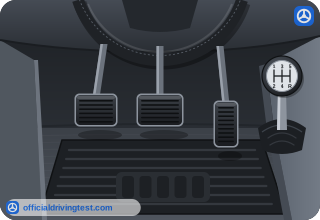
- You have not fed the engine enough gas
- You pressed the brake pedal too lightly
- You shifted the car into reverse
- You left the turn signal on
Show answer
Correct answer: You have not fed the engine enough gas
The manual says that if the car lurches and the engine stalls, you have not fed the engine enough gas.
Source: Maine Driver’s License Manual (Rev 4/24), page 5-1 · Open this page in the manual (Manual page 5-1)
-
Which gear gives the power needed to set a manual transmission car in motion?
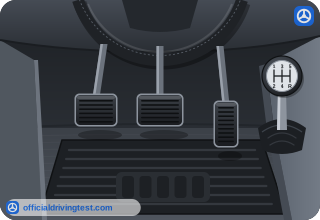
- Second gear
- Third gear
- First gear
- Fourth gear
Show answer
Correct answer: First gear
The manual says first gear gives the power needed to set a car in motion.
Source: Maine Driver’s License Manual (Rev 4/24), page 5-1 · Open this page in the manual (Manual page 5-1)