Maine: Expressway driving Practice Test
Entering, passing on and leaving a multi-lane highway, lane choice and highway hypnosis.
Independent educational site · not affiliated with any government agency or DMV
Ready? Test yourself
- Instant feedback with an explanation
- Every answer cites its source in the manual
- Your best score is saved on this device
Questions are original and based on the official manual "Maine Driver’s License Manual" (Rev 4/24), Maine Bureau of Motor Vehicles.
All 30 questions in this practice test
Take the test above first, then use this list to study. Tap “Show answer” to see the correct answer and explanation.
Show the questions and answersHide the questions
-
Which signal do you use to communicate when entering a multi-lane highway?
- Your right turn signal
- Your left turn signal
- Your hazard flashers
- No signal is used
Show answer
Correct answer: Your left turn signal
The manual says to communicate by using your left turn signal when entering a multi-lane highway.
Source: Maine Driver’s License Manual (Rev 4/24), page 7-4 · Open this page in the manual (Manual page 7-4)
-
What is the purpose of an expressway acceleration lane?
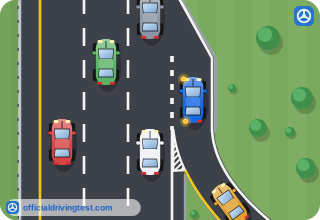
- To stop and wait for a gap in the traffic flow
- To get up to the speed of traffic before merging
- To pass slower vehicles on the ramp
- To park briefly before entering
Show answer
Correct answer: To get up to the speed of traffic before merging
The manual says the acceleration lane enables you to get up to the speed of traffic before merging into the regular lanes.
Source: Maine Driver’s License Manual (Rev 4/24), page 7-4 · Open this page in the manual (Manual page 7-4)
-
After you find a gap in traffic on an expressway entrance ramp, in which direction do you merge?
- Right
- Straight ahead
- Either direction
- Left
Show answer
Correct answer: Left
The manual says to find a gap in traffic and merge left.
Source: Maine Driver’s License Manual (Rev 4/24), page 7-4 · Open this page in the manual (Manual page 7-4)
-
Before merging onto an expressway, what should you use to make sure the way is clear?
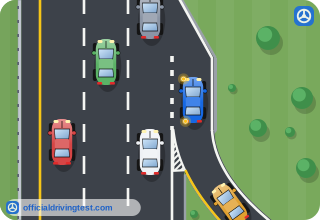
- Your rear-view mirror and a look over your shoulder
- Only a quick look at the traffic ahead of you
- Your horn and your hazard flashers
- Only the mirror on the passenger side
Show answer
Correct answer: Your rear-view mirror and a look over your shoulder
The manual says to use your rear-view mirror and look over your shoulder to ensure the way is clear before merging.
Source: Maine Driver’s License Manual (Rev 4/24), page 7-4 · Open this page in the manual (Manual page 7-4)
-
What should you do at an expressway entrance that has no acceleration lane?
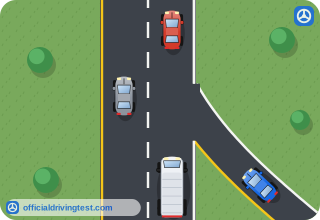
- Enter slowly and expect expressway traffic to yield
- Drive on the shoulder until you reach highway speed
- Stop, wait for a break in traffic, then speed up and merge
- Merge at once and rely on your horn
Show answer
Correct answer: Stop, wait for a break in traffic, then speed up and merge
The manual says to stop before entering, wait for a break in the traffic, and then speed up and merge.
Source: Maine Driver’s License Manual (Rev 4/24), page 7-4 · Open this page in the manual (Manual page 7-4)
-
Which statement about merging onto an expressway is correct?
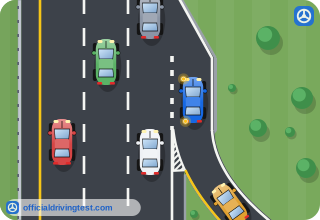
- Cars already on the expressway do not have to yield to you
- Cars on the expressway must slow down for merging vehicles
- Merging vehicles have the right-of-way over expressway traffic
- Cars on the expressway must move to the left lane
Show answer
Correct answer: Cars already on the expressway do not have to yield to you
The manual says cars already on the expressway are traveling very fast and do not have to yield to you.
Source: Maine Driver’s License Manual (Rev 4/24), page 7-5 · Open this page in the manual (Manual page 7-5)
-
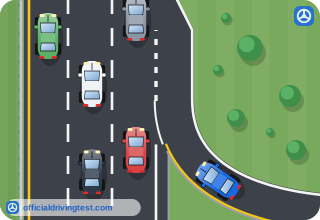
What is the problem with pulling into an expressway lane before you have built up enough speed?
- It makes your turn signal cancel too soon
- It uses up the acceleration lane
- It impedes the flow of traffic
- It is a problem only at night
Show answer
Correct answer: It impedes the flow of traffic
The manual says not to impede the flow of traffic by pulling into the lane before you have built up enough speed.
Source: Maine Driver’s License Manual (Rev 4/24), page 7-5 · Open this page in the manual (Manual page 7-5)
-
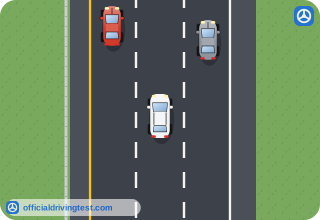
Which lane should you always be in on an expressway unless you are passing?
- The left-hand lane
- The right-hand lane
- The breakdown lane
- The lane with the fastest traffic
Show answer
Correct answer: The right-hand lane
The manual says you should always be in the right-hand lane on an expressway unless you are passing.
Source: Maine Driver’s License Manual (Rev 4/24), page 7-5 · Open this page in the manual (Manual page 7-5)
-
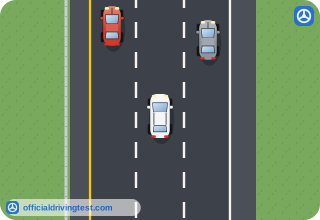
Which expressway passing move does the manual say not to make?
- Passing on the left in the left lane
- Passing after you signal
- Passing a slower vehicle in the next lane
- Passing on the shoulder of the roadway
Show answer
Correct answer: Passing on the shoulder of the roadway
On an expressway, do not pass on the shoulder of the roadway.
Source: Maine Driver’s License Manual (Rev 4/24), page 7-5 · Open this page in the manual (Manual page 7-5)
-
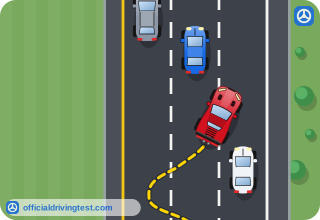
How does the manual describe sudden movements at high speeds?
- Acceptable when passing
- Safe if you signal first
- Very dangerous
- Needed to avoid blind spots
Show answer
Correct answer: Very dangerous
The manual says sudden movements at high speeds are very dangerous.
Source: Maine Driver’s License Manual (Rev 4/24), page 7-5 · Open this page in the manual (Manual page 7-5)
-
On an expressway, what is true of a car directly behind you in an adjacent lane?
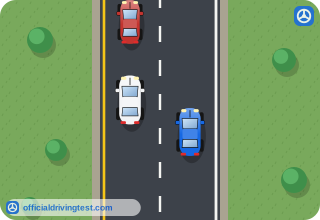
- It will not be visible in the side mirrors
- It will be visible in the side mirrors if they are well adjusted
- It will be visible in the side mirrors when you signal
- It will be visible in both mirrors at low speeds
Show answer
Correct answer: It will not be visible in the side mirrors
The manual says a car directly behind you in an adjacent lane will not be visible in the side mirrors.
Source: Maine Driver’s License Manual (Rev 4/24), page 7-5 · Open this page in the manual (Manual page 7-5)
-
How should you notify other vehicles of your intent to pass on an expressway?
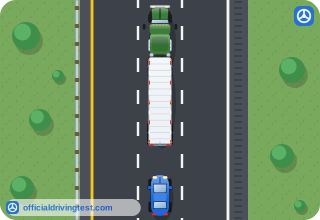
- Tap your brakes twice
- Flash your headlights
- Move partly onto the shoulder
- Use the appropriate blinker
Show answer
Correct answer: Use the appropriate blinker
The manual says to always notify other vehicles of your intent to pass by using the appropriate blinker.
Source: Maine Driver’s License Manual (Rev 4/24), page 7-5 · Open this page in the manual (Manual page 7-5)
-
How long should you stay alongside another vehicle when you pass it on an expressway?
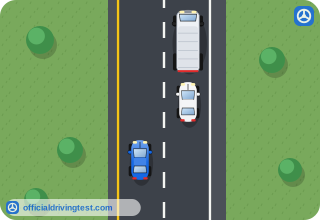
- Long enough to be sure the driver has seen you
- No longer than you must
- Until the other driver signals
- Until the traffic behind you has passed
Show answer
Correct answer: No longer than you must
The manual says not to stay alongside another vehicle any longer than you must.
Source: Maine Driver’s License Manual (Rev 4/24), page 7-5 · Open this page in the manual (Manual page 7-5)
-
What should you never do while driving alongside another vehicle on an expressway?
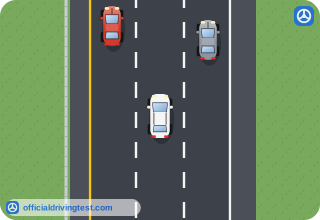
- Signal before moving over
- Cruise along in its blind spot
- Check your mirrors
- Stay in the right-hand lane
Show answer
Correct answer: Cruise along in its blind spot
The manual says never to cruise along in the blind spot of the vehicle next to you.
Source: Maine Driver’s License Manual (Rev 4/24), page 7-5 · Open this page in the manual (Manual page 7-5)
-
Where should you be before you reach the exit of a multi-lane highway?
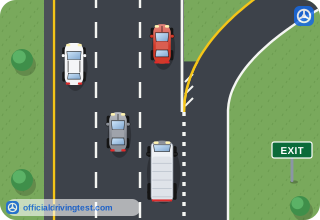
- In the left lane until you reach the exit
- In the center lane near the exit
- In the lane with the fastest traffic
- In the right-hand lane, well before the exit
Show answer
Correct answer: In the right-hand lane, well before the exit
The manual says to get into the right-hand lane well before reaching the exit.
Source: Maine Driver’s License Manual (Rev 4/24), page 7-5 · Open this page in the manual (Manual page 7-5)
-
When exiting a multi-lane highway, where should you start slowing down?
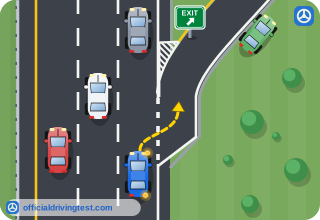
- As soon as you enter the deceleration lane
- On the main expressway, well before the exit
- Only at the end of the exit ramp
- Only after the first sharp curve
Show answer
Correct answer: As soon as you enter the deceleration lane
The manual says not to slow down on the main expressway but to start slowing as soon as you enter the deceleration lane.
Source: Maine Driver’s License Manual (Rev 4/24), page 7-5 · Open this page in the manual (Manual page 7-5)
-
Why should you slow down to the posted speed on an exit ramp?
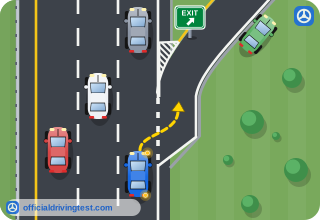
- Exit ramps have no shoulder for stopping
- Traffic behind you is required to stop
- You may have difficulty getting around sharp curves
- Traffic on the main expressway will slow down too
Show answer
Correct answer: You may have difficulty getting around sharp curves
The manual says to slow down to the posted speed on the ramp or you may have difficulty getting around sharp curves.
Source: Maine Driver’s License Manual (Rev 4/24), page 7-5 · Open this page in the manual (Manual page 7-5)
-
When may you stop on an expressway?
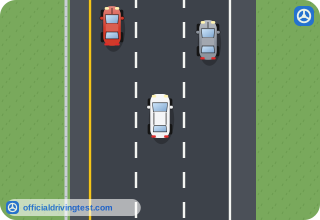
- Only in an emergency
- To check a map
- To let a passenger out
- Whenever traffic is light
Show answer
Correct answer: Only in an emergency
The manual says never to stop on an expressway unless it is an emergency.
Source: Maine Driver’s License Manual (Rev 4/24), page 7-5 · Open this page in the manual (Manual page 7-5)
-
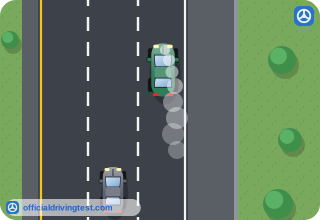
If an emergency occurs on an expressway, how far should you pull off the pavement?
- Only to the edge of the traveled lane
- As far as the shoulder permits
- Just far enough to turn on your lights
- All the way to the next exit
Show answer
Correct answer: As far as the shoulder permits
The manual says to use the proper signal and pull off the pavement as far as the shoulder permits.
Source: Maine Driver’s License Manual (Rev 4/24), page 7-5 · Open this page in the manual (Manual page 7-5)
-
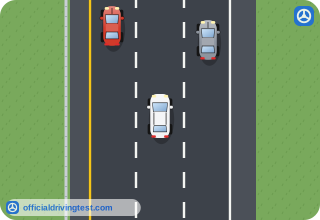
What should you never do on the traveled portion of an expressway?
- Signal before changing lanes
- Drive in the right-hand lane
- Check your mirrors
- Back up, walk or stand
Show answer
Correct answer: Back up, walk or stand
The manual says that under no circumstance should you ever back up, walk or stand on the traveled portion of the expressway.
Source: Maine Driver’s License Manual (Rev 4/24), page 7-5 · Open this page in the manual (Manual page 7-5)
-
What may traveling long distances on straight roads make you?
- More alert and better able to see distant hazards
- Better able to judge the speed of other cars
- Drowsy or unaware of what is happening around you
- Less in need of rest stops
Show answer
Correct answer: Drowsy or unaware of what is happening around you
The manual says long distances on straight roads may make you drowsy or unaware of what is happening around you.
Source: Maine Driver’s License Manual (Rev 4/24), page 7-6 · Open this page in the manual (Manual page 7-6)
-
How should you keep the interior of the car to stay alert on the highway?
- Cool
- Warm
- Dimly lit
- Silent
Show answer
Correct answer: Cool
The manual lists keeping the interior of the car cool as a way to stay alert on the highway.
Source: Maine Driver’s License Manual (Rev 4/24), page 7-6 · Open this page in the manual (Manual page 7-6)
-
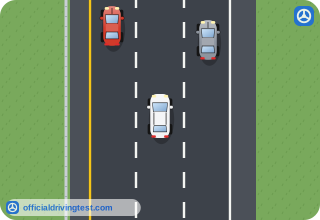
What should you constantly do to stay alert on the highway?
- Stare at the vehicle in front of you
- Watch your speedometer
- Look at the scenery
- Scan the road ahead of you
Show answer
Correct answer: Scan the road ahead of you
The manual says to constantly scan the road ahead of you to stay alert.
Source: Maine Driver’s License Manual (Rev 4/24), page 7-6 · Open this page in the manual (Manual page 7-6)
-
Which of these does the manual list as a way to stay alert on the highway?
- Driving in complete silence
- Talking with your companion
- Setting the cruise control
- Following a truck closely
Show answer
Correct answer: Talking with your companion
To stay alert on the highway, the manual suggests talking with your companion.
Source: Maine Driver’s License Manual (Rev 4/24), page 7-6 · Open this page in the manual (Manual page 7-6)
-
What does the manual suggest doing from time to time to stay alert on the highway?
- Keep your speed exactly the same
- Vary your speed slightly
- Change lanes often
- Follow another vehicle closely
Show answer
Correct answer: Vary your speed slightly
The manual says to vary your speed slightly from time to time to stay alert.
Source: Maine Driver’s License Manual (Rev 4/24), page 7-6 · Open this page in the manual (Manual page 7-6)
-
Where should you pull over at the first sign of drowsiness?
- On the shoulder of the expressway
- Wherever the road has a gentle curve
- At a town far down the road
- At the nearest rest stop or service area
Show answer
Correct answer: At the nearest rest stop or service area
The manual says to pull over at the nearest rest stop or service area at the first sign of drowsiness.
Source: Maine Driver’s License Manual (Rev 4/24), page 7-6 · Open this page in the manual (Manual page 7-6)
-
If possible, what does the manual suggest when you become drowsy, besides stretching or taking a nap?
- Change drivers
- Open the windows and keep driving
- Eat a snack and continue
- Drive faster to get home sooner
Show answer
Correct answer: Change drivers
The manual says to walk around and stretch, take a nap, or if possible, change drivers.
Source: Maine Driver’s License Manual (Rev 4/24), page 7-6 · Open this page in the manual (Manual page 7-6)
-
How should you enter a freeway from an access lane?
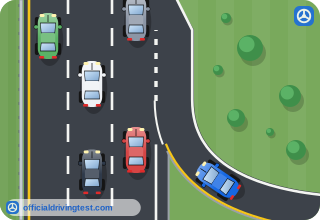
- Enter slowly and let the traffic go around you
- Look for a gap, speed up, and enter it at highway speed
- Match the speed of the slowest car in the right lane
- Enter the lane at the speed of the access lane
Show answer
Correct answer: Look for a gap, speed up, and enter it at highway speed
You need skill and caution to enter a freeway safely: look for a gap, then increase speed in the entrance lane and enter the gap at highway speed.
Source: Maine Driver’s License Manual (Rev 4/24), page 8-9 · Open this page in the manual (Manual page 8-9)
-
On an expressway, when should you start to slow down to leave?
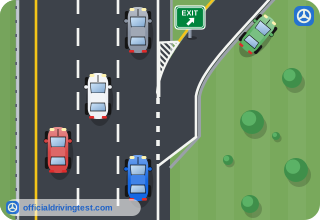
- As soon as you see the exit sign
- Before you move into the right-hand lane
- Right after you signal for the exit
- Not until you move into the exit lane
Show answer
Correct answer: Not until you move into the exit lane
On an expressway, do not slow down until you move into the exit lane.
Source: Maine Driver’s License Manual (Rev 4/24), page 8-9 · Open this page in the manual (Manual page 8-9)
-
Why should you not drive alongside other cars at a freeway exit?
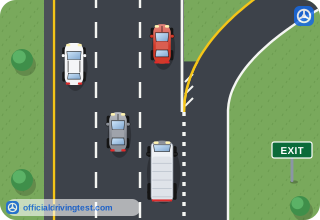
- Exit lanes are always narrower than freeway lanes
- The posted speed limit is lower beside an exit lane
- Your car's mirrors cannot show an exit lane
- A driver may exit suddenly or swerve back onto the freeway
Show answer
Correct answer: A driver may exit suddenly or swerve back onto the freeway
A driver on the freeway may exit suddenly, or a driver who is exiting may suddenly swerve back onto the freeway.
Source: Maine Driver’s License Manual (Rev 4/24), page 8-13 · Open this page in the manual (Manual page 8-13)