Maine: Emergency vehicles and work zones — Part 2 Practice Test
Questions in this part include: “Why does road work often go on while traffic passes through the work site or in nearby lanes?” · “What do flaggers normally wear?”
Independent educational site · not affiliated with any government agency or DMV
Ready? Test yourself
- Instant feedback with an explanation
- Every answer cites its source in the manual
- Your best score is saved on this device
Questions are original and based on the official manual "Maine Driver’s License Manual" (Rev 4/24), Maine Bureau of Motor Vehicles.
All 20 questions in this practice test
Take the test above first, then use this list to study. Tap “Show answer” to see the correct answer and explanation.
Show the questions and answersHide the questions
-
When an officer asks for your license, insurance card or vehicle registration, what should you do?
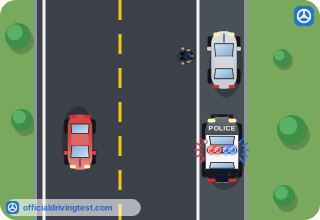
- Tell the officer where they are and reach slowly with one hand on the wheel
- Reach for them quickly using both hands, then tell the officer
- Get out and take them from the trunk without telling the officer
- Pass them out through the rear window before the officer asks
Show answer
Correct answer: Tell the officer where they are and reach slowly with one hand on the wheel
Tell the officer where the documents are located and reach for them slowly with one hand on the wheel.
Source: Maine Driver’s License Manual (Rev 4/24), page 10-10 · Open this page in the manual (Manual page 10-10)
-
Why should you never try to run from the police?
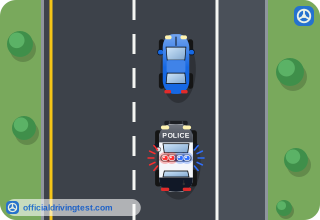
- Police cars are always faster
- The officer will be unable to find you
- Many fatal crashes result from police chases
- A chase ends your license test
Show answer
Correct answer: Many fatal crashes result from police chases
Never try to run from the law, because many fatal crashes result from police chases.
Source: Maine Driver’s License Manual (Rev 4/24), page 10-10 · Open this page in the manual (Manual page 10-10)
-
What must you do when you encounter an emergency vehicle that is stopped on the roadside?
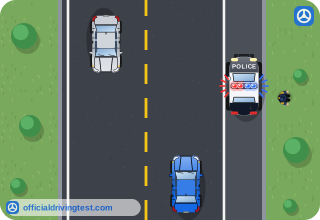
- Stop beside it and wait
- Slow and yield the right-of-way
- Speed up and pass quickly
- Sound your horn as you pass
Show answer
Correct answer: Slow and yield the right-of-way
When you encounter an emergency vehicle that is stopped on the roadside you must slow and yield the right-of-way.
Source: Maine Driver’s License Manual (Rev 4/24), page 10-10 · Open this page in the manual (Manual page 10-10)
-
Under the move-over law, what should you do if a lane change is not safe?
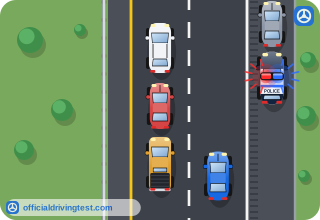
- Stop until the emergency vehicle leaves
- Keep your speed and pass quickly
- Move onto the shoulder
- Slow down and use caution as you drive by
Show answer
Correct answer: Slow down and use caution as you drive by
If possible, move over to the next lane; if a lane change is not safe, slow down and use caution as you drive by the emergency vehicle.
Source: Maine Driver’s License Manual (Rev 4/24), page 10-10 · Open this page in the manual (Manual page 10-10)
-
Why does road work often go on while traffic passes through the work site or in nearby lanes?
- Detours are forbidden on state roads while work is under way
- Workers cannot work without moving traffic
- Closing a road and detouring traffic adds expense and travel time
- Traffic is lightest while work is in progress
Show answer
Correct answer: Closing a road and detouring traffic adds expense and travel time
Closing a road and detouring traffic adds expense and travel time, so the work must go on while traffic passes.
Source: Maine Driver’s License Manual (Rev 4/24), page 11-1 · Open this page in the manual (Manual page 11-1)
-
Why should you slow down in a work zone even when no workers are visible?
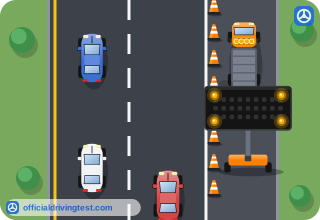
- Workers may be hidden inside the vehicles
- Narrow lanes and rough pavement can be a hazard
- Detours always begin where no workers are visible
- Flaggers cannot see traffic at that time
Show answer
Correct answer: Narrow lanes and rough pavement can be a hazard
Narrow lanes and rough pavement can be a hazard even when no workers are visible.
Source: Maine Driver’s License Manual (Rev 4/24), page 11-2 · Open this page in the manual (Manual page 11-2)
-
Large flashing or sequencing arrow panels may be used in a work zone if:
- A flagger is not available
- The road ahead is a dirt road
- Workers are on the shoulder
- A lane ahead is closed
Show answer
Correct answer: A lane ahead is closed
Arrow panels may be used if a lane ahead is closed.
Source: Maine Driver’s License Manual (Rev 4/24), page 11-2 · Open this page in the manual (Manual page 11-2)
-
What should you do when you see a large flashing arrow panel ahead?
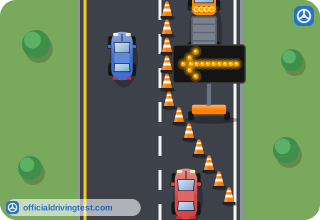
- Prepare to slow down and move into the lane indicated
- Stop and wait for a flagger to wave you through
- Speed up and pass before the lane ends
- Stay in your lane and sound your horn
Show answer
Correct answer: Prepare to slow down and move into the lane indicated
The manual says to prepare to slow down and move into the lane indicated.
Source: Maine Driver’s License Manual (Rev 4/24), page 11-2 · Open this page in the manual (Manual page 11-2)
-
Where should you keep your vehicle when driving near channeling devices such as barrels, drums and cones?
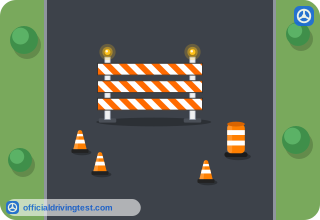
- Close to the devices on your right
- In the middle of the lane
- Along the left edge of your lane
- Straddling the lane line
Show answer
Correct answer: In the middle of the lane
The manual says to keep your vehicle in the middle of the lane and maintain a responsible speed.
Source: Maine Driver’s License Manual (Rev 4/24), page 11-2 · Open this page in the manual (Manual page 11-2)
-
As you leave a work zone, when may you change lanes?
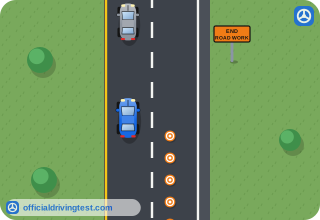
- As soon as you see the first open lane ahead of you
- As soon as you pass the last worker
- Once the last cone is beside your vehicle
- Not until you are completely clear of the work zone
Show answer
Correct answer: Not until you are completely clear of the work zone
You should stay in your lane and not change lanes until you are completely clear of the work zone.
Source: Maine Driver’s License Manual (Rev 4/24), page 11-2 · Open this page in the manual (Manual page 11-2)
-
What do flaggers use to control traffic through a work zone?
- A stop/slow paddle and hand signals
- Flashing arrow panels and a horn
- A whistle and traffic cones only
- A portable traffic light
Show answer
Correct answer: A stop/slow paddle and hand signals
Flaggers use a stop/slow paddle and hand signals.
Source: Maine Driver’s License Manual (Rev 4/24), page 11-3 · Open this page in the manual (Manual page 11-3)
-
Where is a flagger usually stationed?
- In the middle of the work zone
- Only at the start of the work zone
- On each end of the work zone
- Beside the nearest intersection
Show answer
Correct answer: On each end of the work zone
Usually a flagger is stationed on each end of the work zone so the two directions of traffic can alternately travel through.
Source: Maine Driver’s License Manual (Rev 4/24), page 11-3 · Open this page in the manual (Manual page 11-3)
-
What do flaggers normally wear?
- White uniforms with black stripes
- Orange vests, shirts or jackets
- Blue vests with reflective bands
- Red helmets and gloves
Show answer
Correct answer: Orange vests, shirts or jackets
Flaggers normally wear orange vests, shirts or jackets and use red flags or paddles.
Source: Maine Driver’s License Manual (Rev 4/24), page 11-3 · Open this page in the manual (Manual page 11-3)
-
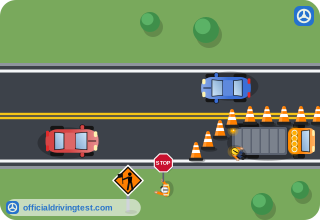
What should you do about a flagger's signals?
- Obey them only when no signs are posted
- Obey them only when workers are present
- Follow other traffic instead
- Be patient and always obey them
Show answer
Correct answer: Be patient and always obey them
The manual says to be patient and always obey the signals of a flagger.
Source: Maine Driver’s License Manual (Rev 4/24), page 11-3 · Open this page in the manual (Manual page 11-3)
-
In a work zone, you should slow down, be prepared to stop, and:
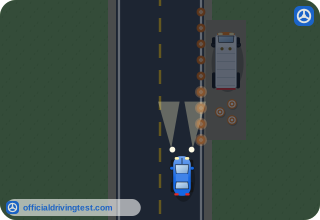
- Increase your following distance
- Stay close behind the vehicle ahead
- Switch to your high beams
- Move to the left lane
Show answer
Correct answer: Increase your following distance
In a work zone you should slow down, increase your following distance and be prepared to stop.
Source: Maine Driver’s License Manual (Rev 4/24), page 11-3 · Open this page in the manual (Manual page 11-3)
-
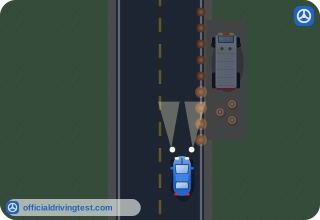
How should you drive through a work zone at night when no workers are there?
- At your usual speed
- Without regard to posted signs
- Very carefully
- Faster, to clear the zone sooner
Show answer
Correct answer: Very carefully
The manual says to be very careful when driving through a work zone at night even if no workers are there.
Source: Maine Driver’s License Manual (Rev 4/24), page 11-3 · Open this page in the manual (Manual page 11-3)
-
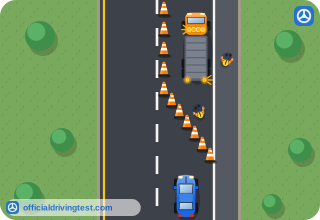
How close should you stay to workers and construction vehicles?
- Pass as close as possible to show you see them
- Stay well away from them
- Within one lane width
- Close enough to hear the workers
Show answer
Correct answer: Stay well away from them
The manual says to stay well away from workers and construction vehicles.
Source: Maine Driver’s License Manual (Rev 4/24), page 11-3 · Open this page in the manual (Manual page 11-3)
-
Until when should you obey the posted work zone signs?
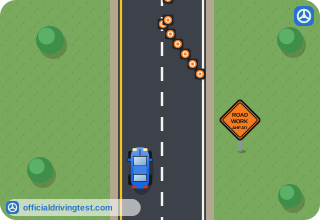
- Until you see the last cone beside the road
- Until you pass the last worker
- Until the next intersection
- Until you see an "End Road Work" sign
Show answer
Correct answer: Until you see an "End Road Work" sign
You should obey the posted work zone signs until you see an "End Road Work" sign.
Source: Maine Driver’s License Manual (Rev 4/24), page 11-3 · Open this page in the manual (Manual page 11-3)
-
What does the manual advise about delays in a work zone?
- Expect delays, plan for them, and leave early
- Leave at the usual time and drive faster
- Wait for the workers to finish
- Stay in the left lane to avoid delays
Show answer
Correct answer: Expect delays, plan for them, and leave early
You should expect delays, plan for them, and leave early so you can finish your trip on time.
Source: Maine Driver’s License Manual (Rev 4/24), page 11-3 · Open this page in the manual (Manual page 11-3)
-
How can you avoid a work zone, if possible?
- Drive through at night
- Follow a large truck
- Use a different route
- Use the shoulder
Show answer
Correct answer: Use a different route
The manual says to use a different route to avoid work zones if possible.
Source: Maine Driver’s License Manual (Rev 4/24), page 11-3 · Open this page in the manual (Manual page 11-3)