Maine: Emergency vehicles and work zones
Yielding to emergency vehicles, police traffic stops, Maine’s move-over law and driving through work zones. Split into 2 shorter tests so you're not stuck in one long quiz.
Independent educational site · not affiliated with any government agency or DMV
Choose a part
Emergency vehicles and work zones — Part 1
Questions in this part include: “Failing to yield to an emergency vehicle that is sounding a siren and emitting a flashing light is what kind of offense?”
StartEmergency vehicles and work zones — Part 2
Questions in this part include: “Why does road work often go on while traffic passes through the work site or in nearby lanes?”
StartAll 41 Emergency vehicles and work zones questions with answers
Choose a part above to take a practice test, or study every question and answer here.
Show the questions and answersHide the questions
-
An emergency vehicle is approaching and sounding a siren and flashing a light. What must you immediately do?
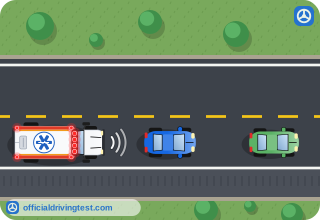
- Stop immediately where you are, even if you are in the middle of an intersection
- Pull to the left side of the roadway and keep moving slowly
- Speed up to clear the road well ahead of the emergency vehicle
- Drive to the right side of the roadway, clear of any intersection, and stop
Show answer
Correct answer: Drive to the right side of the roadway, clear of any intersection, and stop
You must immediately drive to the right side of the roadway, clear of any intersection, and stop until the emergency vehicle has passed.
Source: Maine Driver’s License Manual (Rev 4/24), page 6-2 · Open this page in the manual (Manual page 6-2)
-
From which direction must you yield to an emergency vehicle that is sounding a siren and emitting a flashing light?
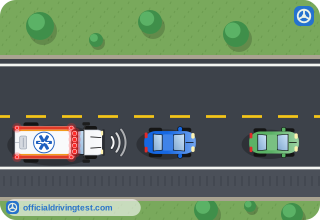
- From any direction
- Only from behind you
- Only from ahead of you
- Only from the side
Show answer
Correct answer: From any direction
You must yield to emergency vehicles approaching from any direction when they are sounding a siren and emitting a flashing light.
Source: Maine Driver’s License Manual (Rev 4/24), page 6-2 · Open this page in the manual (Manual page 6-2)
-
Failing to yield to an emergency vehicle that is sounding a siren and emitting a flashing light is what kind of offense?
- A Class A crime
- A traffic infraction with no criminal charge
- A Class E crime
- A warning for a first offense
Show answer
Correct answer: A Class E crime
The manual states that failure to yield to an emergency vehicle in this way is a Class E crime.
Source: Maine Driver’s License Manual (Rev 4/24), page 6-2 · Open this page in the manual (Manual page 6-2)
-
Which of these do work zone signs warn you about?
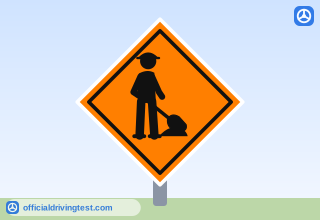
- Slow moving road machinery
- Animals crossing the road
- Falling rocks onto the road
- A hospital zone ahead
Show answer
Correct answer: Slow moving road machinery
Work zone signs warn of workers ahead, reduced speed, detours, slow moving road machinery or surface changes.
Source: Maine Driver’s License Manual (Rev 4/24), page 6-5 · Open this page in the manual (Manual page 6-5)
-
What must you do when a flagger directs traffic in a work zone?
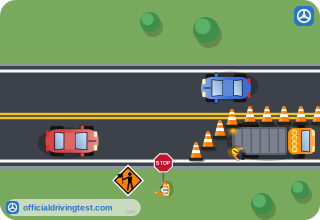
- Follow the posted signs instead of the flagger
- Proceed if the road looks clear
- Do as the flagger directs
- Wait for the vehicle ahead to go first
Show answer
Correct answer: Do as the flagger directs
A flagger may direct traffic in a work zone and you must do as the flagger directs.
Source: Maine Driver’s License Manual (Rev 4/24), page 6-5 · Open this page in the manual (Manual page 6-5)
-
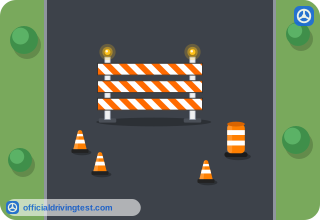
What do barriers do in a work zone area?
- Show you where the posted speed limit changes in the work zone
- Keep you from entering closed roads or other areas where there is danger
- Mark the lane where you may pass slow vehicles
- Tell you which way to turn at a detour
Show answer
Correct answer: Keep you from entering closed roads or other areas where there is danger
Barriers keep you from entering closed roads or other areas where there is danger.
Source: Maine Driver’s License Manual (Rev 4/24), page 6-5 · Open this page in the manual (Manual page 6-5)
-
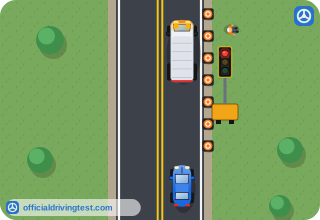
If a work zone has a short-term traffic signal, where must you stop?
- Beside the signal, even if there is a white line
- At the barrier closest to the signal
- Beyond the signal, before the workers
- At the white line, if there is one
Show answer
Correct answer: At the white line, if there is one
If there is a short-term traffic signal, you stop at the white line if there is one.
Source: Maine Driver’s License Manual (Rev 4/24), page 6-5 · Open this page in the manual (Manual page 6-5)
-
An orange diamond-shaped sign shows a black figure holding a flag. What is its label in the manual?
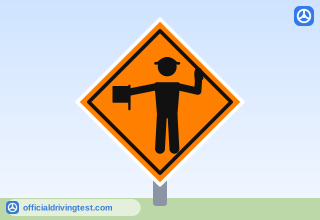
- Flagger Ahead
- Workers Ahead
- Detour
- One Lane Road Ahead
Show answer
Correct answer: Flagger Ahead
The orange sign with a figure holding a flag is labeled Flagger Ahead.
Source: Maine Driver’s License Manual (Rev 4/24), page 6-5 · Open this page in the manual (Manual page 6-5)
-
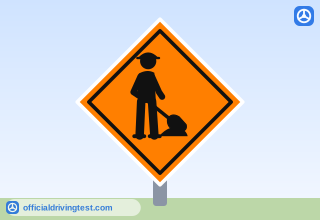
An orange diamond-shaped sign shows a black figure digging with a shovel. What is its label in the manual?
- Flagger Ahead
- Road Construction Ahead
- Workers Ahead
- Road Closed
Show answer
Correct answer: Workers Ahead
The orange sign with a figure digging with a shovel is labeled Workers Ahead.
Source: Maine Driver’s License Manual (Rev 4/24), page 6-5 · Open this page in the manual (Manual page 6-5)
-
What should you do in a work zone?
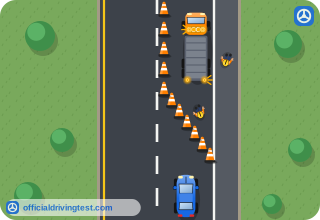
- Keep a steady speed to keep traffic moving
- Slow down and be ready to stop quickly
- Move into the lane with the least traffic
- Stay close behind the vehicle ahead
Show answer
Correct answer: Slow down and be ready to stop quickly
The manual says to slow down in work zones and be ready to stop quickly.
Source: Maine Driver’s License Manual (Rev 4/24), page 6-6 · Open this page in the manual (Manual page 6-6)
-
Fines for speeding in a work zone are
- Waived for a first offense
- Reduced when no workers are present
- The same as on other roads
- Doubled
Show answer
Correct answer: Doubled
The manual says fines for speeding in a work zone are doubled.
Source: Maine Driver’s License Manual (Rev 4/24), page 6-6 · Open this page in the manual (Manual page 6-6)
-
If you are at an intersection when an emergency vehicle approaches with its siren, what should you do before you pull over?
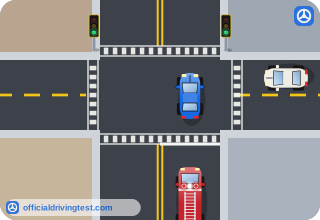
- Stop in the middle of it
- Get out of the intersection
- Turn around inside it
- Wait for the green light
Show answer
Correct answer: Get out of the intersection
If you are at an intersection, get out of it before you pull over.
Source: Maine Driver’s License Manual (Rev 4/24), page 10-9 · Open this page in the manual (Manual page 10-9)
-
Within how many feet is it unlawful to follow a fire truck responding to a fire alarm?
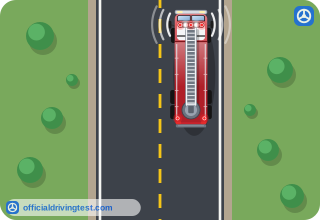
- 50 feet
- 150 feet
- 750 feet
- 500 feet
Show answer
Correct answer: 500 feet
It is unlawful to follow within 500 feet of any fire truck responding to a fire alarm.
Source: Maine Driver’s License Manual (Rev 4/24), page 10-9 · Open this page in the manual (Manual page 10-9)
-
What must you do when an emergency vehicle has its flashing lights and siren on?
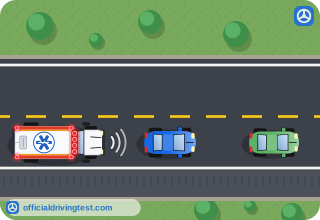
- Pull over to the edge of the road and stop
- Speed up to get out of its way quickly
- Stay in your lane and slow down a little
- Stop right where you are in your lane
Show answer
Correct answer: Pull over to the edge of the road and stop
You must yield to an emergency vehicle when its flashing lights and siren are on by pulling over to the edge of the road and stopping so it may pass.
Source: Maine Driver’s License Manual (Rev 4/24), page 10-9 · Open this page in the manual (Manual page 10-9)
-
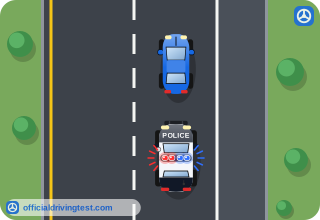
If you are pulled over by the police, where should you move?
- To the left side of the road
- To the center of the road
- To the right side of the road
- To a lot at least a mile away
Show answer
Correct answer: To the right side of the road
If you are pulled over by the police, move to the right side of the road and make sure you are in a safe spot.
Source: Maine Driver’s License Manual (Rev 4/24), page 10-10 · Open this page in the manual (Manual page 10-10)
-
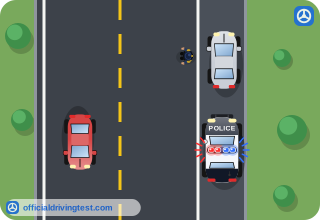
If you are pulled over by the police, when should you get out of your vehicle?
- As soon as you stop
- Only when asked to get out
- Right after you turn off the engine
- When the officer walks toward your car
Show answer
Correct answer: Only when asked to get out
Stay in the vehicle unless asked to get out.
Source: Maine Driver’s License Manual (Rev 4/24), page 10-10 · Open this page in the manual (Manual page 10-10)
-
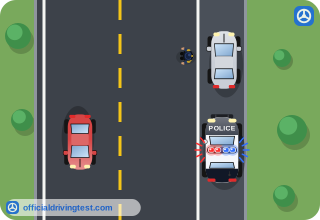
What should you do with your engine and flashers when you are pulled over by the police?
- Leave your engine running and turn on your hazard flashers
- Turn off your engine and your hazard flashers
- Leave your engine running and turn off your flashers
- Turn off your engine and turn on your hazard flashers
Show answer
Correct answer: Turn off your engine and turn on your hazard flashers
When pulled over by the police, turn off your engine and turn on your hazard flashers.
Source: Maine Driver’s License Manual (Rev 4/24), page 10-10 · Open this page in the manual (Manual page 10-10)
-
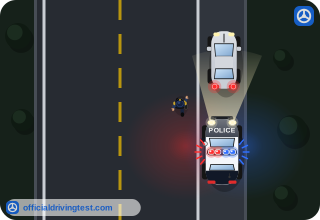
What should you do at night when you are pulled over by the police?
- Turn on your inside lights
- Turn off all your lights
- Turn on your high beams
- Get out and stand near the headlights
Show answer
Correct answer: Turn on your inside lights
At night, turn on your inside lights so the officer can see inside the vehicle.
Source: Maine Driver’s License Manual (Rev 4/24), page 10-10 · Open this page in the manual (Manual page 10-10)
-
When you are pulled over by the police, what should you do with your window?
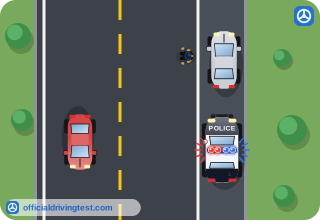
- Keep it closed and lock the doors
- Open it only if the officer knocks twice
- Roll it down so you and the officer can talk
- Roll it down halfway and turn off the radio
Show answer
Correct answer: Roll it down so you and the officer can talk
Roll down your window so that you and the officer can talk.
Source: Maine Driver’s License Manual (Rev 4/24), page 10-10 · Open this page in the manual (Manual page 10-10)
-
When you are pulled over by the police, what should you do with your safety belt and your passengers?
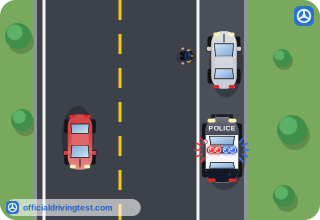
- Unbuckle your belt and ask passengers to stay seated
- Keep your belt fastened and ask your passengers to do the same
- Unbuckle so you can reach your documents
- Fasten only the front passenger's belt
Show answer
Correct answer: Keep your belt fastened and ask your passengers to do the same
Keep your safety belt fastened and ask your passengers to do the same.
Source: Maine Driver’s License Manual (Rev 4/24), page 10-10 · Open this page in the manual (Manual page 10-10)
-
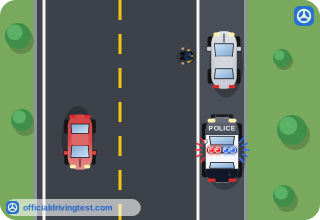
Where should you keep your hands when you are pulled over by the police?
- On top of the dashboard
- Resting in your lap
- On the door window ledge
- On the steering wheel
Show answer
Correct answer: On the steering wheel
Remain calm and keep your hands on the steering wheel.
Source: Maine Driver’s License Manual (Rev 4/24), page 10-10 · Open this page in the manual (Manual page 10-10)
-
When an officer asks for your license, insurance card or vehicle registration, what should you do?
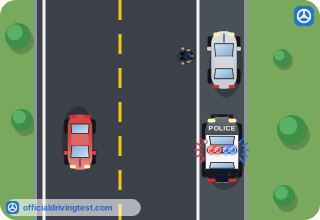
- Tell the officer where they are and reach slowly with one hand on the wheel
- Reach for them quickly using both hands, then tell the officer
- Get out and take them from the trunk without telling the officer
- Pass them out through the rear window before the officer asks
Show answer
Correct answer: Tell the officer where they are and reach slowly with one hand on the wheel
Tell the officer where the documents are located and reach for them slowly with one hand on the wheel.
Source: Maine Driver’s License Manual (Rev 4/24), page 10-10 · Open this page in the manual (Manual page 10-10)
-
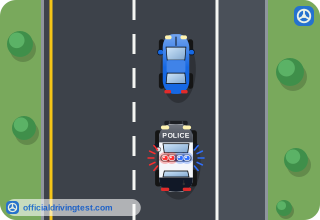
Why should you never try to run from the police?
- Police cars are always faster
- The officer will be unable to find you
- Many fatal crashes result from police chases
- A chase ends your license test
Show answer
Correct answer: Many fatal crashes result from police chases
Never try to run from the law, because many fatal crashes result from police chases.
Source: Maine Driver’s License Manual (Rev 4/24), page 10-10 · Open this page in the manual (Manual page 10-10)
-
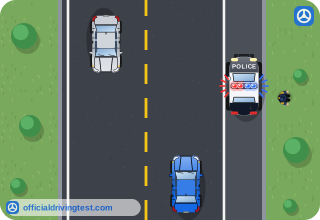
What must you do when you encounter an emergency vehicle that is stopped on the roadside?
- Stop beside it and wait
- Slow and yield the right-of-way
- Speed up and pass quickly
- Sound your horn as you pass
Show answer
Correct answer: Slow and yield the right-of-way
When you encounter an emergency vehicle that is stopped on the roadside you must slow and yield the right-of-way.
Source: Maine Driver’s License Manual (Rev 4/24), page 10-10 · Open this page in the manual (Manual page 10-10)
-
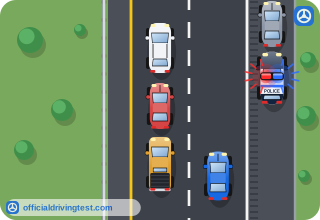
Under the move-over law, what should you do if a lane change is not safe?
- Stop until the emergency vehicle leaves
- Keep your speed and pass quickly
- Move onto the shoulder
- Slow down and use caution as you drive by
Show answer
Correct answer: Slow down and use caution as you drive by
If possible, move over to the next lane; if a lane change is not safe, slow down and use caution as you drive by the emergency vehicle.
Source: Maine Driver’s License Manual (Rev 4/24), page 10-10 · Open this page in the manual (Manual page 10-10)
-
Why does road work often go on while traffic passes through the work site or in nearby lanes?
- Detours are forbidden on state roads while work is under way
- Workers cannot work without moving traffic
- Closing a road and detouring traffic adds expense and travel time
- Traffic is lightest while work is in progress
Show answer
Correct answer: Closing a road and detouring traffic adds expense and travel time
Closing a road and detouring traffic adds expense and travel time, so the work must go on while traffic passes.
Source: Maine Driver’s License Manual (Rev 4/24), page 11-1 · Open this page in the manual (Manual page 11-1)
-
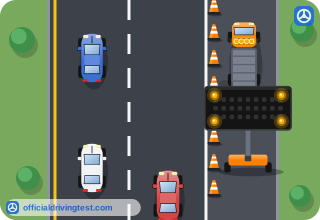
Why should you slow down in a work zone even when no workers are visible?
- Workers may be hidden inside the vehicles
- Narrow lanes and rough pavement can be a hazard
- Detours always begin where no workers are visible
- Flaggers cannot see traffic at that time
Show answer
Correct answer: Narrow lanes and rough pavement can be a hazard
Narrow lanes and rough pavement can be a hazard even when no workers are visible.
Source: Maine Driver’s License Manual (Rev 4/24), page 11-2 · Open this page in the manual (Manual page 11-2)
-
Large flashing or sequencing arrow panels may be used in a work zone if:
- A flagger is not available
- The road ahead is a dirt road
- Workers are on the shoulder
- A lane ahead is closed
Show answer
Correct answer: A lane ahead is closed
Arrow panels may be used if a lane ahead is closed.
Source: Maine Driver’s License Manual (Rev 4/24), page 11-2 · Open this page in the manual (Manual page 11-2)
-
What should you do when you see a large flashing arrow panel ahead?
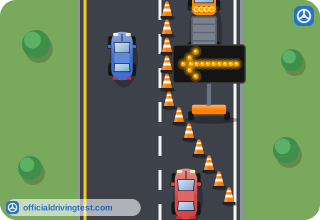
- Prepare to slow down and move into the lane indicated
- Stop and wait for a flagger to wave you through
- Speed up and pass before the lane ends
- Stay in your lane and sound your horn
Show answer
Correct answer: Prepare to slow down and move into the lane indicated
The manual says to prepare to slow down and move into the lane indicated.
Source: Maine Driver’s License Manual (Rev 4/24), page 11-2 · Open this page in the manual (Manual page 11-2)
-
Where should you keep your vehicle when driving near channeling devices such as barrels, drums and cones?
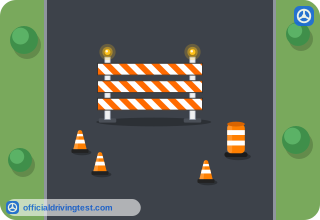
- Close to the devices on your right
- In the middle of the lane
- Along the left edge of your lane
- Straddling the lane line
Show answer
Correct answer: In the middle of the lane
The manual says to keep your vehicle in the middle of the lane and maintain a responsible speed.
Source: Maine Driver’s License Manual (Rev 4/24), page 11-2 · Open this page in the manual (Manual page 11-2)
-
As you leave a work zone, when may you change lanes?
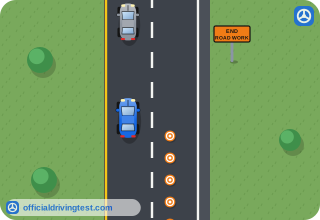
- As soon as you see the first open lane ahead of you
- As soon as you pass the last worker
- Once the last cone is beside your vehicle
- Not until you are completely clear of the work zone
Show answer
Correct answer: Not until you are completely clear of the work zone
You should stay in your lane and not change lanes until you are completely clear of the work zone.
Source: Maine Driver’s License Manual (Rev 4/24), page 11-2 · Open this page in the manual (Manual page 11-2)
-
What do flaggers use to control traffic through a work zone?
- A stop/slow paddle and hand signals
- Flashing arrow panels and a horn
- A whistle and traffic cones only
- A portable traffic light
Show answer
Correct answer: A stop/slow paddle and hand signals
Flaggers use a stop/slow paddle and hand signals.
Source: Maine Driver’s License Manual (Rev 4/24), page 11-3 · Open this page in the manual (Manual page 11-3)
-
Where is a flagger usually stationed?
- In the middle of the work zone
- Only at the start of the work zone
- On each end of the work zone
- Beside the nearest intersection
Show answer
Correct answer: On each end of the work zone
Usually a flagger is stationed on each end of the work zone so the two directions of traffic can alternately travel through.
Source: Maine Driver’s License Manual (Rev 4/24), page 11-3 · Open this page in the manual (Manual page 11-3)
-
What do flaggers normally wear?
- White uniforms with black stripes
- Orange vests, shirts or jackets
- Blue vests with reflective bands
- Red helmets and gloves
Show answer
Correct answer: Orange vests, shirts or jackets
Flaggers normally wear orange vests, shirts or jackets and use red flags or paddles.
Source: Maine Driver’s License Manual (Rev 4/24), page 11-3 · Open this page in the manual (Manual page 11-3)
-
What should you do about a flagger's signals?
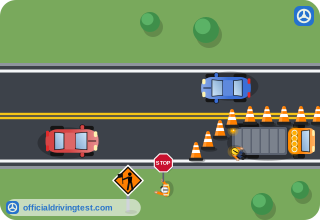
- Obey them only when no signs are posted
- Obey them only when workers are present
- Follow other traffic instead
- Be patient and always obey them
Show answer
Correct answer: Be patient and always obey them
The manual says to be patient and always obey the signals of a flagger.
Source: Maine Driver’s License Manual (Rev 4/24), page 11-3 · Open this page in the manual (Manual page 11-3)
-
In a work zone, you should slow down, be prepared to stop, and:
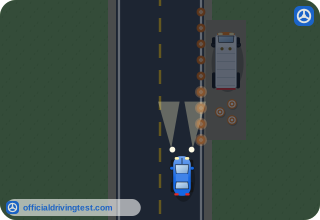
- Increase your following distance
- Stay close behind the vehicle ahead
- Switch to your high beams
- Move to the left lane
Show answer
Correct answer: Increase your following distance
In a work zone you should slow down, increase your following distance and be prepared to stop.
Source: Maine Driver’s License Manual (Rev 4/24), page 11-3 · Open this page in the manual (Manual page 11-3)
-
How should you drive through a work zone at night when no workers are there?
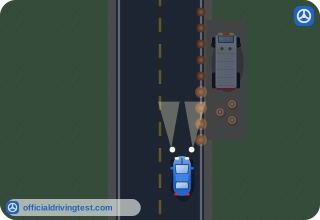
- At your usual speed
- Without regard to posted signs
- Very carefully
- Faster, to clear the zone sooner
Show answer
Correct answer: Very carefully
The manual says to be very careful when driving through a work zone at night even if no workers are there.
Source: Maine Driver’s License Manual (Rev 4/24), page 11-3 · Open this page in the manual (Manual page 11-3)
-
How close should you stay to workers and construction vehicles?
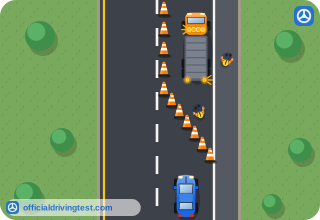
- Pass as close as possible to show you see them
- Stay well away from them
- Within one lane width
- Close enough to hear the workers
Show answer
Correct answer: Stay well away from them
The manual says to stay well away from workers and construction vehicles.
Source: Maine Driver’s License Manual (Rev 4/24), page 11-3 · Open this page in the manual (Manual page 11-3)
-
Until when should you obey the posted work zone signs?
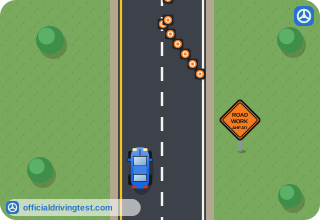
- Until you see the last cone beside the road
- Until you pass the last worker
- Until the next intersection
- Until you see an "End Road Work" sign
Show answer
Correct answer: Until you see an "End Road Work" sign
You should obey the posted work zone signs until you see an "End Road Work" sign.
Source: Maine Driver’s License Manual (Rev 4/24), page 11-3 · Open this page in the manual (Manual page 11-3)
-
What does the manual advise about delays in a work zone?
- Expect delays, plan for them, and leave early
- Leave at the usual time and drive faster
- Wait for the workers to finish
- Stay in the left lane to avoid delays
Show answer
Correct answer: Expect delays, plan for them, and leave early
You should expect delays, plan for them, and leave early so you can finish your trip on time.
Source: Maine Driver’s License Manual (Rev 4/24), page 11-3 · Open this page in the manual (Manual page 11-3)
-
How can you avoid a work zone, if possible?
- Drive through at night
- Follow a large truck
- Use a different route
- Use the shoulder
Show answer
Correct answer: Use a different route
The manual says to use a different route to avoid work zones if possible.
Source: Maine Driver’s License Manual (Rev 4/24), page 11-3 · Open this page in the manual (Manual page 11-3)