Maine: Emergencies and crashes — Part 4 Practice Test
Avoiding crashes, skids, brake and tire problems, a stuck gas pedal, breakdowns, what to do after a crash, and winter and flood driving. — Part 4
Independent educational site · not affiliated with any government agency or DMV
Ready? Test yourself
- Instant feedback with an explanation
- Every answer cites its source in the manual
- Your best score is saved on this device
Questions are original and based on the official manual "Maine Driver’s License Manual" (Rev 4/24), Maine Bureau of Motor Vehicles.
All 34 questions in this practice test
Take the test above first, then use this list to study. Tap “Show answer” to see the correct answer and explanation.
Show the questions and answersHide the questions
-
What does the manual say about smoking and eye protection when jump-starting a vehicle?
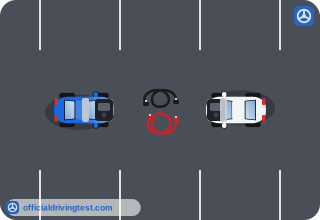
- Smoking is fine if the engine is off
- Never smoke and protect your eyes
- Wear eye protection only at night
- Smoke only after the clamps are removed
Show answer
Correct answer: Never smoke and protect your eyes
Never smoke when jump-starting a vehicle and make sure that your eyes are protected.
Source: Maine Driver’s License Manual (Rev 4/24), page 9-7 · Open this page in the manual (Manual page 9-7)
-
How long may a car with the windows and doors closed float if it plunges into water?
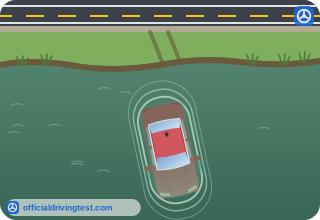
- From 30 seconds to 1 minute
- From 20 to 30 minutes
- About an hour
- From 3 to 10 minutes
Show answer
Correct answer: From 3 to 10 minutes
A car with windows and door closed may float from 3 to 10 minutes.
Source: Maine Driver’s License Manual (Rev 4/24), page 9-7 · Open this page in the manual (Manual page 9-7)
-
If your vehicle plunges into water, what is the best escape route, and why?
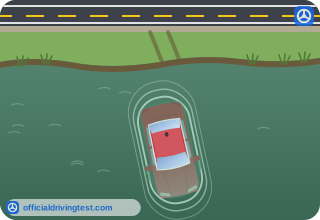
- Through a window, as water pressure makes doors hard to open
- Through a door, because windows will not open underwater
- Through the trunk, because it stays above the water
- Through the sunroof, because it is the largest opening
Show answer
Correct answer: Through a window, as water pressure makes doors hard to open
The best escape route is through a window, because water pressure makes it hard to open a door.
Source: Maine Driver’s License Manual (Rev 4/24), page 9-7 · Open this page in the manual (Manual page 9-7)
-
If your car has power windows and it plunges into water, when should you open them?
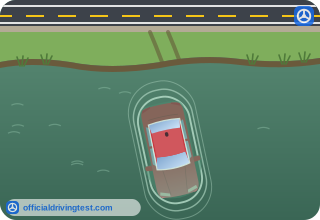
- Only after the car stops floating on the water
- After you have called for help from inside
- As soon as possible, because of a short circuit
- Only after the water reaches the dashboard
Show answer
Correct answer: As soon as possible, because of a short circuit
If your car has power windows, you open them as soon as possible, because the water will cause a short circuit in the electrical system.
Source: Maine Driver’s License Manual (Rev 4/24), page 9-7 · Open this page in the manual (Manual page 9-7)
-
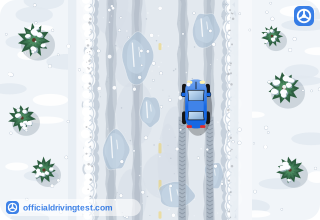
On slippery roads, which points are important to safe driving?
- Slower speeds, quicker stops and turns, and shorter following distances
- Slower speeds, gentler stops and turns, and increased following distances
- Steady speeds, gentler turns, and shorter following distances
- Higher speeds in a lower gear, and quicker stops
Show answer
Correct answer: Slower speeds, gentler stops and turns, and increased following distances
On slippery roads the important points are slower speeds, gentler stops and turns, and increased following distances.
Source: Maine Driver’s License Manual (Rev 4/24), page 11-4 · Open this page in the manual (Manual page 11-4)
-
What does the manual call an important first step in winterizing your car?
- Idling the engine for several minutes
- Washing the underside of the car
- Removing the spare tire
- Getting a tune-up
Show answer
Correct answer: Getting a tune-up
Getting a tune-up is an important first step in winterizing your car.
Source: Maine Driver’s License Manual (Rev 4/24), page 11-4 · Open this page in the manual (Manual page 11-4)
-
What happens to a cold engine that is driven instead of left to idle for long periods?
- It warms up faster
- It warms up more slowly
- It uses more oil
- It overheats
Show answer
Correct answer: It warms up faster
Even a cold engine will warm up faster when being driven than when left to idle for long periods of time.
Source: Maine Driver’s License Manual (Rev 4/24), page 11-4 · Open this page in the manual (Manual page 11-4)
-
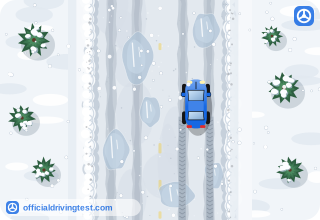
Why should you never slam on the brakes on a slippery road?
- The tires may blow out from the sudden stop
- Your wheels can lock and throw you into a skid
- The engine may stall
- The brakes may overheat
Show answer
Correct answer: Your wheels can lock and throw you into a skid
Slamming on the brakes can cause your wheels to lock and throw you into a skid.
Source: Maine Driver’s License Manual (Rev 4/24), page 11-4 · Open this page in the manual (Manual page 11-4)
-
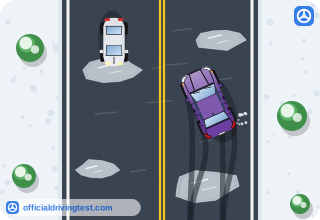
What should you do with the brake to steer out of a skid?
- Press it as hard as you can
- Press it firmly and hold it
- Press it only with your left foot
- Stay off the brake
Show answer
Correct answer: Stay off the brake
If you brake hard, your wheels will lock and that makes the skid worse.
Source: Maine Driver’s License Manual (Rev 4/24), page 11-4 · Open this page in the manual (Manual page 11-4)
-
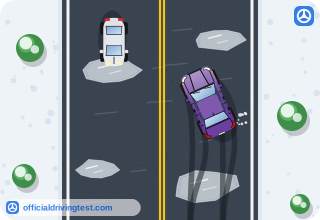
To steer out of a skid, you turn the steering wheel:
- In the direction you want the car to go
- Away from the direction you want to go
- Toward the shoulder of the road
- Straight and hold it there
Show answer
Correct answer: In the direction you want the car to go
Turning in the direction you want the car to go lines the front of the car up with the back.
Source: Maine Driver’s License Manual (Rev 4/24), page 11-4 · Open this page in the manual (Manual page 11-4)
-
What should you do as soon as the car begins to straighten out of a skid?
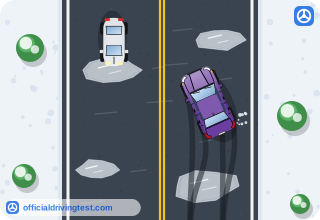
- Hold the wheel where it is until you stop
- Brake firmly
- Turn the wheel back the other way
- Accelerate
Show answer
Correct answer: Turn the wheel back the other way
You turn the wheel back so the car will not over correct.
Source: Maine Driver’s License Manual (Rev 4/24), page 11-4 · Open this page in the manual (Manual page 11-4)
-
What happens if you fail to turn the wheel back as the car straightens out of a skid?
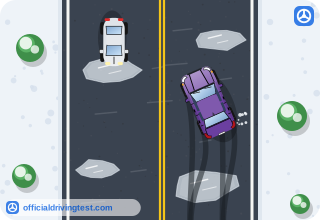
- The brakes will lock
- You will start a new skid
- The engine will stall
- The car will stop at once
Show answer
Correct answer: You will start a new skid
If you fail to turn the wheel back, you will start a new skid.
Source: Maine Driver’s License Manual (Rev 4/24), page 11-4 · Open this page in the manual (Manual page 11-4)
-
If you cannot control your car on a slippery surface, what should you try to do?
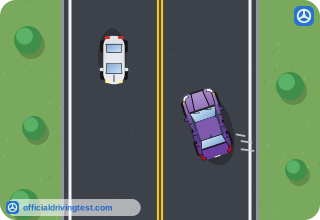
- Turn off the engine and wait for the car to stop
- Steer into the oncoming lane
- Shift into reverse
- Try to find something to stop you, like a snowbank
Show answer
Correct answer: Try to find something to stop you, like a snowbank
You should try to get a wheel on dry pavement or on the shoulder, or slowly edge into a snowbank or some bushes.
Source: Maine Driver’s License Manual (Rev 4/24), page 11-5 · Open this page in the manual (Manual page 11-5)
-
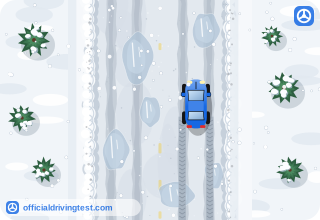
How should you stop on icy or snow-covered roads in a car without anti-lock brakes?
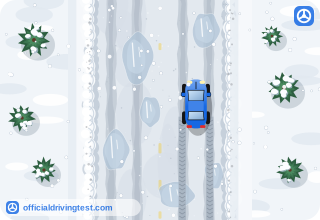
- Pump the brakes on and off very gently
- Brake hard once and release
- Press the pedal firmly and hold it
- Use only the parking brake
Show answer
Correct answer: Pump the brakes on and off very gently
On icy or snow-covered roads you pump the brakes on and off very gently, releasing pressure at the first hint the wheels slip.
Source: Maine Driver’s License Manual (Rev 4/24), page 11-5 · Open this page in the manual (Manual page 11-5)
-
How do you stop on icy or snow-covered roads in a car with anti-lock brakes?
- Turn off the engine and coast to a stop
- Shift into neutral and brake lightly
- Simply press firmly on the brake pedal
- Pull the parking brake as well
Show answer
Correct answer: Simply press firmly on the brake pedal
With anti-lock brakes you simply press firmly on the brake pedal.
Source: Maine Driver’s License Manual (Rev 4/24), page 11-5 · Open this page in the manual (Manual page 11-5)
-
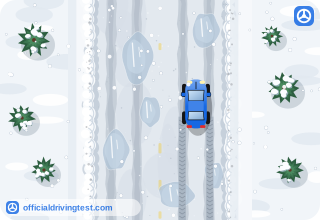
When stopping on ice, when should you release the clutch or take the vehicle out of drive?
- As soon as you start to slow down on the ice
- Not until the vehicle has almost completely stopped
- Right after the wheels slip
- Before you touch the brake
Show answer
Correct answer: Not until the vehicle has almost completely stopped
You should not release the clutch or take the vehicle out of drive until the vehicle has almost completely stopped.
Source: Maine Driver’s License Manual (Rev 4/24), page 11-5 · Open this page in the manual (Manual page 11-5)
-
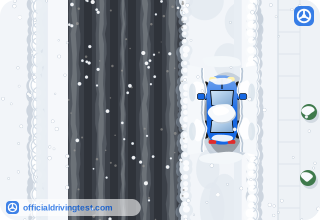
What can you use for extra traction if your vehicle gets stuck in snow?
- Salt or antifreeze spread under the tires
- Extra air in the tires
- Traction mats, sand or cat litter
- Newspaper under the engine
Show answer
Correct answer: Traction mats, sand or cat litter
The manual says to use traction mats, sand, or cat litter to provide extra traction.
Source: Maine Driver’s License Manual (Rev 4/24), page 11-5 · Open this page in the manual (Manual page 11-5)
-
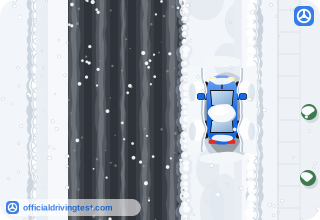
If you get stuck in snow and cannot pull out, how can you try to roll out?
- Spin the wheels at full speed to clear snow
- Rock the vehicle between reverse and drive
- Turn the wheels sharply to the side
- Let some air out of the tires
Show answer
Correct answer: Rock the vehicle between reverse and drive
The manual says to rock the vehicle by going back and forth from reverse to drive.
Source: Maine Driver’s License Manual (Rev 4/24), page 11-5 · Open this page in the manual (Manual page 11-5)
-
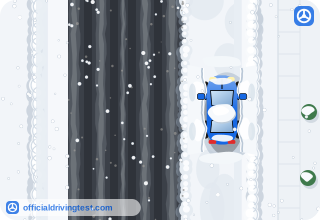
If you must wait for help in a winter storm, what should you do?
- Walk to find help right away
- Leave to look for the nearest house
- Wait outside next to the road
- Stay with your car
Show answer
Correct answer: Stay with your car
Most deaths occur when people leave the car, get lost, and freeze to death.
Source: Maine Driver’s License Manual (Rev 4/24), page 11-5 · Open this page in the manual (Manual page 11-5)
-
What should you put on your radio antenna or driver's door handle if you must wait for help?
- A red flag
- A white cloth
- A flashlight
- A yellow vest
Show answer
Correct answer: A red flag
The manual says to put a red flag on your radio antenna or driver's door handle.
Source: Maine Driver’s License Manual (Rev 4/24), page 11-5 · Open this page in the manual (Manual page 11-5)
-
While waiting for help in the cold, how should you use the engine and heater?
- Run them continuously and keep every window shut
- Run them for one minute every hour
- Run them until warm, then shut off; repeat when cold
- Leave them off to save fuel
Show answer
Correct answer: Run them until warm, then shut off; repeat when cold
You run the engine and heater until the car is warm, then shut it off, and repeat when you feel cold again.
Source: Maine Driver’s License Manual (Rev 4/24), page 11-5 · Open this page in the manual (Manual page 11-5)
-
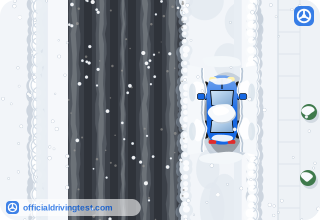
Why should you keep the exhaust pipe clear of snow while waiting in a running car?
- To keep the engine from overheating
- To avoid carbon monoxide poisoning
- To stop the muffler from freezing
- To keep the heater blowing warm air
Show answer
Correct answer: To avoid carbon monoxide poisoning
Keeping the exhaust pipe clear of snow avoids carbon monoxide poisoning.
Source: Maine Driver’s License Manual (Rev 4/24), page 11-5 · Open this page in the manual (Manual page 11-5)
-
What does the manual say about sleep while you wait for help in the cold?
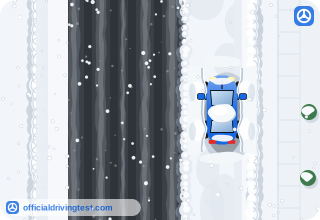
- Let passengers sleep in shifts
- Let children sleep first to stay warm
- Let everyone sleep to conserve warmth
- Do not let anyone go to sleep
Show answer
Correct answer: Do not let anyone go to sleep
The manual says to keep yourself and your passengers as active as possible and not let anyone go to sleep.
Source: Maine Driver’s License Manual (Rev 4/24), page 11-5 · Open this page in the manual (Manual page 11-5)
-
Which item does the manual list for preparing your vehicle for winter?
- A bag of sand
- A tow rope
- A spare can of gasoline
- A road atlas
Show answer
Correct answer: A bag of sand
The manual lists a shovel, flares and a red flag, an ice scraper, jumper cables, a bag of sand, and warm clothing and footwear.
Source: Maine Driver’s License Manual (Rev 4/24), page 11-5 · Open this page in the manual (Manual page 11-5)
-
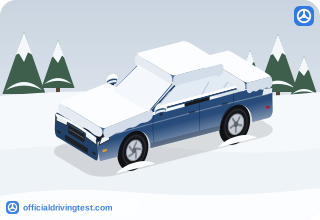
What must operators of vehicles under 10,000 pounds do about snow or ice on their vehicle?
- Remove it only from the windshield and windows
- Drive slowly until it melts
- Take reasonable measures to prevent it from falling off
- Nothing; only larger vehicles are covered
Show answer
Correct answer: Take reasonable measures to prevent it from falling off
Operators of vehicles under 10,000 pounds shall take reasonable measures to prevent snow or ice from falling off.
Source: Maine Driver’s License Manual (Rev 4/24), page 11-5 · Open this page in the manual (Manual page 11-5)
-
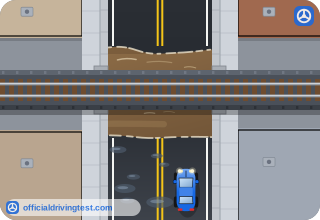
What does the manual say about driving across a flooded roadway?
- Cross slowly in a low gear
- Cross only in the middle of the road
- Cross at your normal speed
- Never attempt to drive across it
Show answer
Correct answer: Never attempt to drive across it
The manual says to never attempt to drive across a flooded roadway.
Source: Maine Driver’s License Manual (Rev 4/24), page 11-7 · Open this page in the manual (Manual page 11-7)
-
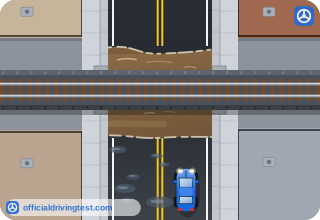
As little as how many inches of water can float some small cars?
- Six inches
- Two inches
- Three inches
- Four inches
Show answer
Correct answer: Six inches
As little as six inches of water can float some small cars.
Source: Maine Driver’s License Manual (Rev 4/24), page 11-7 · Open this page in the manual (Manual page 11-7)
-
How much water will carry away most vehicles?
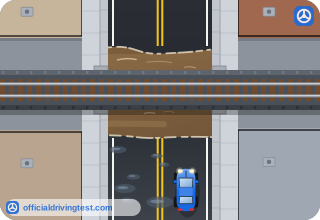
- Six inches
- Ten inches
- Two feet
- Four feet
Show answer
Correct answer: Two feet
Two feet of water will carry away most vehicles.
Source: Maine Driver’s License Manual (Rev 4/24), page 11-7 · Open this page in the manual (Manual page 11-7)
-
Why are flooded roadways especially dangerous at night?
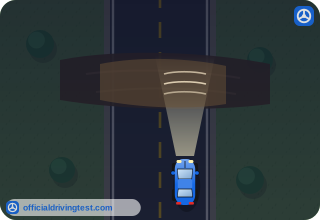
- Floodwater is much deeper at night than by day
- It is more difficult to recognize the flood dangers
- Floodwater is warmer at night
- Road signs cannot be read at night
Show answer
Correct answer: It is more difficult to recognize the flood dangers
Flooded roadways are especially dangerous at night when it is more difficult to recognize the flood dangers.
Source: Maine Driver’s License Manual (Rev 4/24), page 11-7 · Open this page in the manual (Manual page 11-7)
-
If your vehicle stalls in a flooded roadway, what should you do?
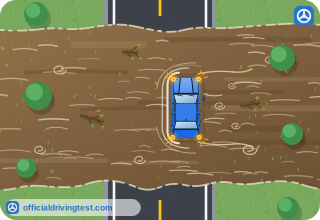
- Stay inside the vehicle and wait for rescue
- Close the windows and wait
- Restart the engine repeatedly
- Leave it immediately and seek higher ground
Show answer
Correct answer: Leave it immediately and seek higher ground
If your vehicle stalls in a flooded roadway you should leave it immediately and seek higher ground.
Source: Maine Driver’s License Manual (Rev 4/24), page 11-7 · Open this page in the manual (Manual page 11-7)
-
If a crash with an animal is imminent, how should you steer?
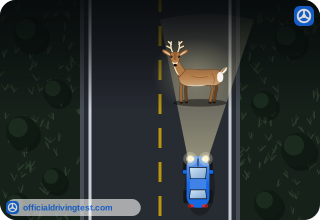
- Toward the shoulder
- Toward the left
- Toward the animal's head
- Straight
Show answer
Correct answer: Straight
The manual says to apply the brakes and steer straight.
Source: Maine Driver’s License Manual (Rev 4/24), page 11-8 · Open this page in the manual (Manual page 11-8)
-
Just before an unavoidable crash with an animal, what should you do with the brakes?
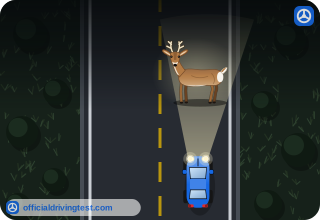
- Let up on them so the front of your vehicle can rise
- Press them harder to lock the wheels before impact
- Pump them rapidly
- Keep them firmly applied through impact
Show answer
Correct answer: Let up on them so the front of your vehicle can rise
Letting up on the brakes just before impact lets the front of your vehicle rise slightly, which can reduce the risk of the animal striking the windshield area.
Source: Maine Driver’s License Manual (Rev 4/24), page 11-8 · Open this page in the manual (Manual page 11-8)
-
In an unavoidable crash with an animal, which part of the animal should you try to hit?
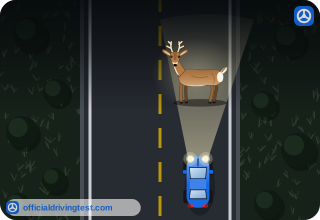
- The head
- The side
- The tail end
- The front legs
Show answer
Correct answer: The tail end
The manual says to try to hit the tail end of the animal.
Source: Maine Driver’s License Manual (Rev 4/24), page 11-8 · Open this page in the manual (Manual page 11-8)
-
Why should you duck down if a crash with an animal is imminent?
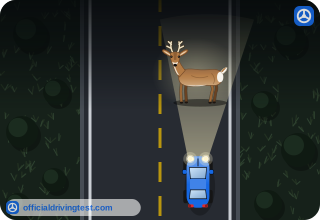
- To avoid the airbag
- To protect yourself from windshield debris
- To keep your eyes on the road
- To brace against the steering wheel
Show answer
Correct answer: To protect yourself from windshield debris
You duck down to protect yourself from windshield debris.
Source: Maine Driver’s License Manual (Rev 4/24), page 11-8 · Open this page in the manual (Manual page 11-8)