Louisiana: Speed and following distance — Part 3 Practice Test
Louisiana speed limits, stopping distances, the 3-second rule, space around your vehicle, night and rural driving. — Part 3
Independent educational site · not affiliated with any government agency or DMV
Ready? Test yourself
- Instant feedback with an explanation
- Every answer cites its source in the manual
- Your best score is saved on this device
Questions are original and based on the official manual "Class D & E Driver’s Guide" (Revised August 2025 (DPSMV2052 R08/25)), Louisiana Office of Motor Vehicles.
All 36 questions in this practice test
Take the test above first, then use this list to study. Tap “Show answer” to see the correct answer and explanation.
Show the questions and answersHide the questions
-
What is the average driver's reaction time?
- ¼ second to ½ second
- ¾ second to 1 second
- 1 second to 2 seconds
- 3 seconds to 4 seconds
Show answer
Correct answer: ¾ second to 1 second
The average driver has a reaction time of ¾ second to 1 second.
Source: Class D & E Driver’s Guide (Revised August 2025 (DPSMV2052 R08/25)), page 64 · Open this page in the manual (Manual page 64)
-
At 50 mph, how many feet does the average driver's reaction time account for?
- 33 feet
- 158 feet
- 268 feet
- 55 feet
Show answer
Correct answer: 55 feet
At 50 mph the average driver's reaction time accounts for 55 feet traveled.
Source: Class D & E Driver’s Guide (Revised August 2025 (DPSMV2052 R08/25)), page 64 · Open this page in the manual (Manual page 64)
-
What is braking distance?
- How far your vehicle travels, in ideal conditions, while you are braking
- How far your vehicle travels before you physically hit the brakes
- How far your vehicle travels from the time you see a hazard until you recognize it
- How far your vehicle rolls after the engine is turned off
Show answer
Correct answer: How far your vehicle travels, in ideal conditions, while you are braking
Braking distance is how far your vehicle travels, in ideal conditions, while you are braking.
Source: Class D & E Driver’s Guide (Revised August 2025 (DPSMV2052 R08/25)), page 64 · Open this page in the manual (Manual page 64)
-
At 50 mph on dry pavement with good brakes, about how many feet can the braking distance be?
- 55 feet
- 101 feet
- 158 feet
- 268 feet
Show answer
Correct answer: 158 feet
At 50 mph on dry pavement with good brakes, braking distance can be about 158 feet.
Source: Class D & E Driver’s Guide (Revised August 2025 (DPSMV2052 R08/25)), page 64 · Open this page in the manual (Manual page 64)
-
What is total stopping distance?
- The distance your vehicle travels from when you hit the brakes until it stops completely
- The total minimum distance traveled until you stop, counting perception, reaction and braking distance
- The distance your vehicle travels from when you see a hazard until you press the brake pedal
- The distance you can see ahead with your headlights at night, in feet
Show answer
Correct answer: The total minimum distance traveled until you stop, counting perception, reaction and braking distance
Total stopping distance is the total minimum distance your vehicle travels in ideal conditions, including perception distance, reaction distance and braking distance, until it stops completely.
Source: Class D & E Driver’s Guide (Revised August 2025 (DPSMV2052 R08/25)), page 64 · Open this page in the manual (Manual page 64)
-
At 50 mph, what is the minimum total distance your vehicle will travel until it comes to a complete stop?
- 158 feet
- 189 feet
- 359 feet
- 268 feet
Show answer
Correct answer: 268 feet
At 50 mph, your vehicle will travel a minimum of 268 feet until it comes to a complete stop.
Source: Class D & E Driver’s Guide (Revised August 2025 (DPSMV2052 R08/25)), page 65 · Open this page in the manual (Manual page 65)
-
When you double your speed from 20 to 40 mph, how much greater is the impact of your vehicle?
- 4 times greater
- 2 times greater
- 3 times greater
- 9 times greater
Show answer
Correct answer: 4 times greater
When you double your speed from 20 to 40 mph, the impact is 4 times greater, and the braking distance is also 4 times longer.
Source: Class D & E Driver’s Guide (Revised August 2025 (DPSMV2052 R08/25)), page 65 · Open this page in the manual (Manual page 65)
-
When you triple your speed from 20 to 60 mph, how much greater are the impact and braking distance?
- 3 times greater
- 6 times greater
- 9 times greater
- 12 times greater
Show answer
Correct answer: 9 times greater
Tripling the speed from 20 to 60 mph makes the impact and braking distance 9 times greater.
Source: Class D & E Driver’s Guide (Revised August 2025 (DPSMV2052 R08/25)), page 65 · Open this page in the manual (Manual page 65)
-
Compared with 20 mph, how much greater are the impact and braking distance at 80 mph?
- 4 times greater
- 16 times greater
- 8 times greater
- 12 times greater
Show answer
Correct answer: 16 times greater
Increasing the speed to 80 mph makes the impact and braking distance 16 times greater than at 20 mph.
Source: Class D & E Driver’s Guide (Revised August 2025 (DPSMV2052 R08/25)), page 65 · Open this page in the manual (Manual page 65)
-
At 60 mph, your stopping distance is greater than that of what?
- A city block
- A basketball court
- Two car lengths
- A football field
Show answer
Correct answer: A football field
At 60 mph, your stopping distance is greater than that of a football field.
Source: Class D & E Driver’s Guide (Revised August 2025 (DPSMV2052 R08/25)), page 65 · Open this page in the manual (Manual page 65)
-
What can you do to reduce your braking distance?
- Slow down
- Follow the vehicle ahead more closely
- Hold the brakes lightly while driving
- Drive faster to leave the danger sooner
Show answer
Correct answer: Slow down
High speeds greatly increase the severity of crashes and stopping distances, and by slowing down you can reduce braking distance.
Source: Class D & E Driver’s Guide (Revised August 2025 (DPSMV2052 R08/25)), page 65 · Open this page in the manual (Manual page 65)
-
Which of these does your stopping distance depend on?
- The color of the vehicle
- The make of the radio
- The type and condition of the tires
- The length of time you have held a license
Show answer
Correct answer: The type and condition of the tires
Stopping distance depends on your reaction time, weather and road conditions, the weight of the vehicle, the condition of the brakes, and the type and condition of the tires.
Source: Class D & E Driver’s Guide (Revised August 2025 (DPSMV2052 R08/25)), page 65 · Open this page in the manual (Manual page 65)
-
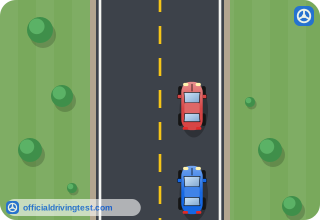
At what speeds can you use the "3-second rule" to judge following distance?
- Only below 30 mph
- At any speed
- Only above 50 mph
- Only on interstate highways
Show answer
Correct answer: At any speed
The 3-second rule makes judging following distance easier, and you can use it at any speed.
Source: Class D & E Driver’s Guide (Revised August 2025 (DPSMV2052 R08/25)), page 65 · Open this page in the manual (Manual page 65)
-
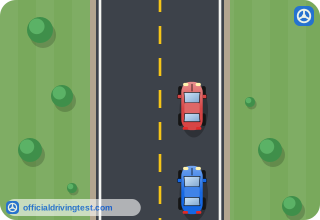
When do you begin counting three seconds in the "3-second rule"?
- When your own car reaches the object the vehicle ahead passed
- When the vehicle in front turns on its brake lights
- When the vehicle in front changes lanes
- As the vehicle in front passes an object such as a sign or pole
Show answer
Correct answer: As the vehicle in front passes an object such as a sign or pole
You choose an object ahead and begin counting three seconds as the vehicle in front passes it.
Source: Class D & E Driver’s Guide (Revised August 2025 (DPSMV2052 R08/25)), page 65 · Open this page in the manual (Manual page 65)
-
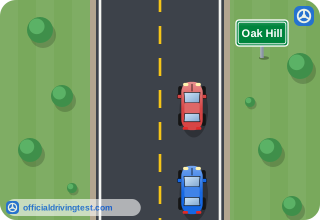
With the "3-second rule", what does it mean if it takes less than three seconds for your car to pass the checkpoint?
- You are following too closely
- You are following at a safe distance
- You are following too far behind
- The vehicle ahead is speeding
Show answer
Correct answer: You are following too closely
If it takes less than three seconds for your car to pass the checkpoint, you are following too closely.
Source: Class D & E Driver’s Guide (Revised August 2025 (DPSMV2052 R08/25)), page 65 · Open this page in the manual (Manual page 65)
-
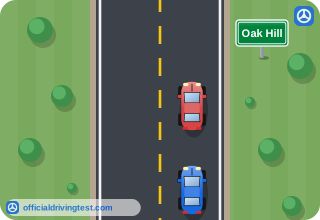
After the 3-second rule shows you are following too closely, what should you do?
- Stay where you are and count again at the same object
- Speed up and pass the vehicle ahead
- Drop back and count again at another spot
- Flash your lights at the vehicle ahead
Show answer
Correct answer: Drop back and count again at another spot
You drop back and count again at another spot to check the new following distance, repeating until you are following no closer than three seconds.
Source: Class D & E Driver’s Guide (Revised August 2025 (DPSMV2052 R08/25)), page 65 · Open this page in the manual (Manual page 65)
-
If another vehicle moves into the space between your car and the one ahead, what should you do?
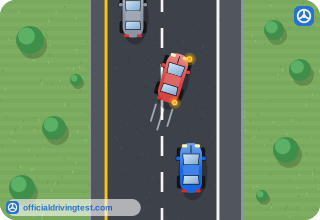
- Speed up to close the gap
- Drop back to a safe following distance
- Flash your headlights at the driver
- Move into the next lane at once
Show answer
Correct answer: Drop back to a safe following distance
If another vehicle moves into the space ahead of you, you drop back to a safe following distance.
Source: Class D & E Driver’s Guide (Revised August 2025 (DPSMV2052 R08/25)), page 66 · Open this page in the manual (Manual page 66)
-
Why should you leave more space in front of your vehicle on slippery roads?
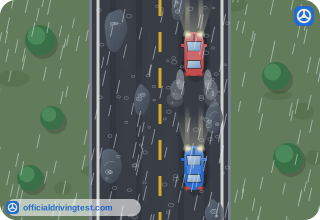
- Slippery roads make vehicles ahead stop much more often
- Slippery roads make your brake lights dim
- Slippery roads make other drivers pass you
- You need extra distance if the vehicle ahead stops suddenly
Show answer
Correct answer: You need extra distance if the vehicle ahead stops suddenly
You need more distance to stop your vehicle on slippery roads, so that you can stop safely if the vehicle ahead suddenly stops.
Source: Class D & E Driver’s Guide (Revised August 2025 (DPSMV2052 R08/25)), page 66 · Open this page in the manual (Manual page 66)
-
What should you do when the driver behind you wants to pass?
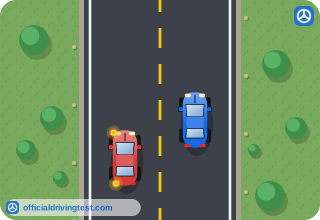
- Slow down to allow room in front of your vehicle
- Speed up to stay ahead of the other driver
- Turn on your hazard lights
- Brake hard to warn the driver
Show answer
Correct answer: Slow down to allow room in front of your vehicle
Slowing down allows room in front of your vehicle and also lets the pass be completed sooner.
Source: Class D & E Driver’s Guide (Revised August 2025 (DPSMV2052 R08/25)), page 66 · Open this page in the manual (Manual page 66)
-
Why do you need extra following distance behind a motorcycle?
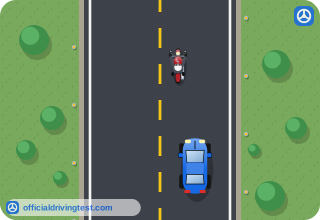
- Because motorcycles never use brake lights
- Because motorcycles cannot slow down quickly
- To avoid the obstacle if the rider should fall
- Because motorcycles cannot change lanes
Show answer
Correct answer: To avoid the obstacle if the rider should fall
If the motorcycle and its rider should fall, you need extra distance to avoid the obstacle.
Source: Class D & E Driver’s Guide (Revised August 2025 (DPSMV2052 R08/25)), page 66 · Open this page in the manual (Manual page 66)
-
Why might drivers of trucks, buses, vans or vehicles pulling campers or trailers not see you?
- Their mirrors are always folded in
- They never check their mirrors
- They are traveling faster than you
- You may be directly behind them
Show answer
Correct answer: You may be directly behind them
The drivers of trucks, buses, vans or vehicles pulling campers or trailers may not be able to see you when you are directly behind them, and they could stop suddenly without knowing you are there.
Source: Class D & E Driver’s Guide (Revised August 2025 (DPSMV2052 R08/25)), page 66 · Open this page in the manual (Manual page 66)
-
Why does falling back behind a large vehicle help you?
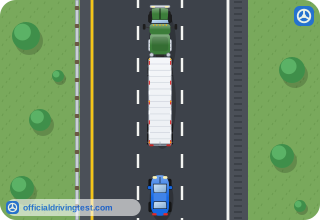
- Large vehicles block your view ahead, and falling back lets you see more
- Large vehicles always signal several seconds before they stop
- Large vehicles move out of your way faster when you are close
- Large vehicles never block the view of drivers behind them
Show answer
Correct answer: Large vehicles block your view ahead, and falling back lets you see more
Large vehicles block your view of the road ahead, and falling back gives you more room to see ahead.
Source: Class D & E Driver’s Guide (Revised August 2025 (DPSMV2052 R08/25)), page 66 · Open this page in the manual (Manual page 66)
-
What should you do if you are being followed closely?
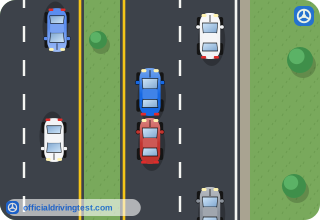
- Speed up to get away
- Brake suddenly to warn the following driver
- Pull to the right and let the vehicle behind pass
- Turn on your hazard lights and keep going
Show answer
Correct answer: Pull to the right and let the vehicle behind pass
If you are being followed closely, you pull to the right and allow the vehicle behind you to pass.
Source: Class D & E Driver’s Guide (Revised August 2025 (DPSMV2052 R08/25)), page 66 · Open this page in the manual (Manual page 66)
-
Why does pulling a trailer call for a longer following distance?
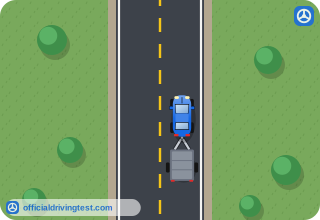
- A trailer blocks your mirrors completely
- The combined weight increases the stopping distance
- A trailer reduces your tire traction on dry roads
- A trailer makes your brake lights dim
Show answer
Correct answer: The combined weight increases the stopping distance
The combined weight of a vehicle and trailer increases the stopping distance.
Source: Class D & E Driver’s Guide (Revised August 2025 (DPSMV2052 R08/25)), page 66 · Open this page in the manual (Manual page 66)
-
What should you do with your following distance when it is hard to see ahead because of darkness?
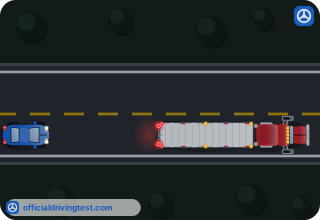
- Decrease it
- Keep it the same
- Follow the vehicle ahead's taillights closely
- Increase it
Show answer
Correct answer: Increase it
When it is hard for you to see ahead because of darkness, you need to increase your following distance.
Source: Class D & E Driver’s Guide (Revised August 2025 (DPSMV2052 R08/25)), page 66 · Open this page in the manual (Manual page 66)
-
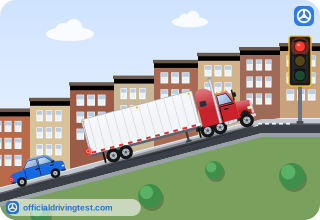
Why should you leave extra space when you are stopped on a hill or incline?
- The vehicle ahead will always stop suddenly
- The vehicle ahead may roll back when it starts up
- Your brake lights do not work on a hill
- Vehicles on hills cannot use turn signals
Show answer
Correct answer: The vehicle ahead may roll back when it starts up
Leave extra space when stopped on a hill or incline because the vehicle may roll back when it starts up.
Source: Class D & E Driver’s Guide (Revised August 2025 (DPSMV2052 R08/25)), page 66 · Open this page in the manual (Manual page 66)
-
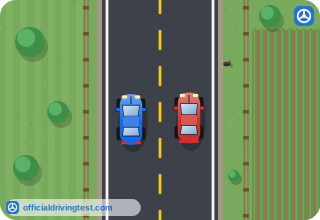
When may you pass another vehicle on the left?
- Whenever the other vehicle ahead is traveling below the posted speed limit
- Whenever you signal and honk the horn first
- Only when the vehicle ahead signals you to pass
- Only when you will not interfere with oncoming traffic or the vehicle being passed
Show answer
Correct answer: Only when you will not interfere with oncoming traffic or the vehicle being passed
The manual says to pass only when you will not interfere with oncoming traffic or the vehicle being passed.
Source: Class D & E Driver’s Guide (Revised August 2025 (DPSMV2052 R08/25)), page 71 · Open this page in the manual (Manual page 71)
-
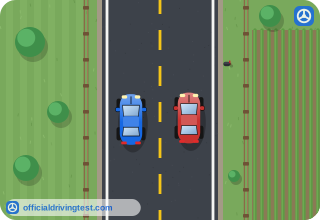
You must not cause another driver to do what in order for you to complete your pass?
- Speed up to stay ahead of you
- Slow down or pull over
- Check the rearview mirror
- Move to the center of the road
Show answer
Correct answer: Slow down or pull over
The manual says you must not cause another driver to slow down or pull over in order for you to complete your pass.
Source: Class D & E Driver’s Guide (Revised August 2025 (DPSMV2052 R08/25)), page 71 · Open this page in the manual (Manual page 71)
-
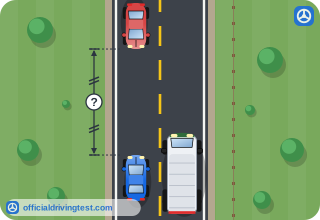
You must complete a passing maneuver before coming within how many feet of a vehicle approaching from the opposite direction?
- 50 feet
- 100 feet
- 200 feet
- 300 feet
Show answer
Correct answer: 100 feet
The manual says you must complete a passing maneuver before coming within 100 feet of any vehicle approaching from the opposite direction.
Source: Class D & E Driver’s Guide (Revised August 2025 (DPSMV2052 R08/25)), page 71 · Open this page in the manual (Manual page 71)
-
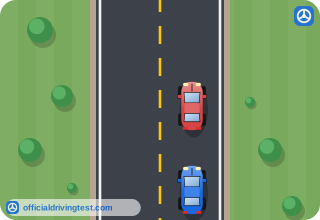
It is unsafe and against the law to pass another vehicle when your view is blocked by what?
- A green traffic light ahead
- A speed limit sign
- A road sign on the shoulder
- A hill or a curve
Show answer
Correct answer: A hill or a curve
The manual says it is unsafe and against the law to pass when your view is blocked by a hill or a curve.
Source: Class D & E Driver’s Guide (Revised August 2025 (DPSMV2052 R08/25)), page 71 · Open this page in the manual (Manual page 71)
-
It is against the law to pass another vehicle when there is what in your lane?
- A solid yellow line
- A broken yellow line
- A broken white line
- A stop line
Show answer
Correct answer: A solid yellow line
The manual says it is unsafe and against the law to pass when there is a solid yellow line in your lane.
Source: Class D & E Driver’s Guide (Revised August 2025 (DPSMV2052 R08/25)), page 71 · Open this page in the manual (Manual page 71)
-
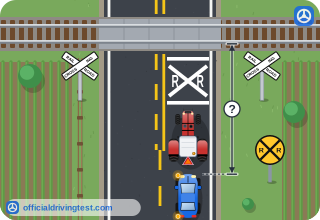
Within how many feet of an intersection or a railroad crossing is it against the law to pass another vehicle?
- 25 feet
- 200 feet
- 100 feet
- 300 feet
Show answer
Correct answer: 100 feet
The manual says it is unsafe and against the law to pass within one hundred feet of an intersection or a railroad crossing.
Source: Class D & E Driver’s Guide (Revised August 2025 (DPSMV2052 R08/25)), page 71 · Open this page in the manual (Manual page 71)
-
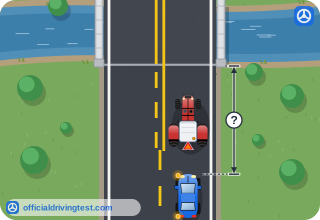
Within how many feet of a bridge or tunnel is it against the law to pass another vehicle?
- 25 feet
- 200 feet
- 300 feet
- 100 feet
Show answer
Correct answer: 100 feet
The manual says it is unsafe and against the law to pass within one hundred feet of a bridge or tunnel.
Source: Class D & E Driver’s Guide (Revised August 2025 (DPSMV2052 R08/25)), page 71 · Open this page in the manual (Manual page 71)
-
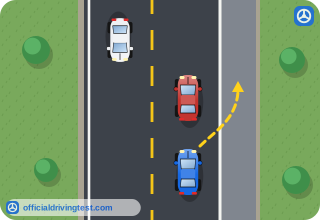
Is it against the law to pass another vehicle on the shoulder of the roadway?
- No, if the shoulder is paved
- Yes, it is unsafe and against the law
- No, if you signal first
- No, if the other vehicle is moving slowly
Show answer
Correct answer: Yes, it is unsafe and against the law
The manual lists passing on the shoulder of the roadway as unsafe and against the law.
Source: Class D & E Driver’s Guide (Revised August 2025 (DPSMV2052 R08/25)), page 71 · Open this page in the manual (Manual page 71)
-
When may you pass to the right of another vehicle?
- Only on a two-lane road that has a solid yellow center line
- Whenever the other driver ahead is signaling a left turn
- If there are two or more lanes of traffic moving in the same direction
- Only on a road that has a wide paved shoulder on the right
Show answer
Correct answer: If there are two or more lanes of traffic moving in the same direction
The manual says you may pass to the right of another vehicle if there are two or more lanes of traffic moving in the same direction.
Source: Class D & E Driver’s Guide (Revised August 2025 (DPSMV2052 R08/25)), page 72 · Open this page in the manual (Manual page 72)
-
May you pass to the right of another vehicle by driving off the roadway onto the shoulder?
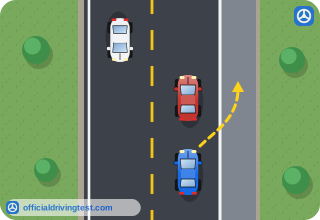
- No, never
- Yes, if the shoulder is paved
- Yes, if the other vehicle is turning left
- Yes, if you signal first
Show answer
Correct answer: No, never
The manual says you may never pass to the right of another vehicle by driving off the roadway onto the shoulder.
Source: Class D & E Driver’s Guide (Revised August 2025 (DPSMV2052 R08/25)), page 72 · Open this page in the manual (Manual page 72)