Louisiana: Speed and following distance — Part 2 Practice Test
Louisiana speed limits, stopping distances, the 3-second rule, space around your vehicle, night and rural driving. — Part 2
Independent educational site · not affiliated with any government agency or DMV
Ready? Test yourself
- Instant feedback with an explanation
- Every answer cites its source in the manual
- Your best score is saved on this device
Questions are original and based on the official manual "Class D & E Driver’s Guide" (Revised August 2025 (DPSMV2052 R08/25)), Louisiana Office of Motor Vehicles.
All 36 questions in this practice test
Take the test above first, then use this list to study. Tap “Show answer” to see the correct answer and explanation.
Show the questions and answersHide the questions
-
In the SIPDE method, what do you do in the “E” step?
- Examine your mirrors for a full minute before moving
- Execute a move to avoid conflict, such as braking
- End your trip at the next safe place to stop
- Expect other drivers to move out of your way
Show answer
Correct answer: Execute a move to avoid conflict, such as braking
The E in SIPDE stands for execute a move to avoid conflict, such as braking, accelerating or turning.
Source: Class D & E Driver’s Guide (Revised August 2025 (DPSMV2052 R08/25)), page 55 · Open this page in the manual (Manual page 55)
-
Besides helping road safety, which of these does the manual say defensive driving does?
- Lowers the cost of insurance premiums
- Shortens the time of every trip
- Removes the need to renew your license
- Makes safety belts unnecessary
Show answer
Correct answer: Lowers the cost of insurance premiums
The manual says defensive driving saves fuel, lowers the cost of insurance premiums and increases the overall life of the vehicle.
Source: Class D & E Driver’s Guide (Revised August 2025 (DPSMV2052 R08/25)), page 55 · Open this page in the manual (Manual page 55)
-
Which of these is one of the four characteristics of a defensive driver that the manual calls essential to the driving task?
- Aggressiveness
- Impulsiveness
- Anticipation
- Competitiveness
Show answer
Correct answer: Anticipation
The manual lists alertness, anticipation, judgment and skill as four characteristics essential to the driving task for a defensive driver.
Source: Class D & E Driver’s Guide (Revised August 2025 (DPSMV2052 R08/25)), page 55 · Open this page in the manual (Manual page 55)
-
The manual says good defensive drivers are alert. Which of these describes them?
- They take only over-the-counter drugs before they drive on long trips
- They are well rested and take no drugs or alcohol that affect concentration
- They drive only during the daytime when roads are clear of traffic
- They look only at the road directly ahead of their vehicle
Show answer
Correct answer: They are well rested and take no drugs or alcohol that affect concentration
The manual says alert defensive drivers are well rested and would never take any drugs or alcohol that could affect their concentration before driving.
Source: Class D & E Driver’s Guide (Revised August 2025 (DPSMV2052 R08/25)), page 55 · Open this page in the manual (Manual page 55)
-
Why does the manual say tailgating and following too closely are a problem for a defensive driver?
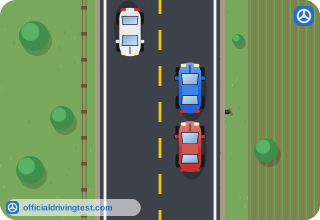
- They make your vehicle harder to steer in a hurry
- They hide the road signs ahead of you from view
- They wear out the tires of your vehicle faster
- They do not allow the needed seconds to avoid a crash
Show answer
Correct answer: They do not allow the needed seconds to avoid a crash
The manual says tailgating and following too closely does not allow the needed seconds to avoid a possible crash.
Source: Class D & E Driver’s Guide (Revised August 2025 (DPSMV2052 R08/25)), page 55 · Open this page in the manual (Manual page 55)
-
Which of these does the manual say good defensive drivers do NOT do?
- Keep a safe following distance
- Slow down in poor weather
- Try to beat red lights or trains
- Look for alternatives to a traffic situation
Show answer
Correct answer: Try to beat red lights or trains
The manual says good defensive drivers do not make risky maneuvers like trying to beat red lights or trains.
Source: Class D & E Driver’s Guide (Revised August 2025 (DPSMV2052 R08/25)), page 55 · Open this page in the manual (Manual page 55)
-
A skilled defensive driver is aware of which part of the vehicle in front of them?
- Its blind spot
- Its fuel tank
- Its tire tread
- Its engine size
Show answer
Correct answer: Its blind spot
The manual says a defensive driver is aware of the blind spot of the vehicle in front of them.
Source: Class D & E Driver’s Guide (Revised August 2025 (DPSMV2052 R08/25)), page 55 · Open this page in the manual (Manual page 55)
-
What does the manual say will do more to lower the nation’s crash rate than any safety feature of a car?
- Stricter inspection rules for every vehicle on the road
- More police patrols on interstate highways and city streets
- Wider shoulders and better-lit highways across the state
- A careful, responsible driver who obeys the traffic laws
Show answer
Correct answer: A careful, responsible driver who obeys the traffic laws
The manual says a careful, responsible driver who obeys the laws and regulations of the road does more to lower the nation’s crash rate than any safety feature of a car.
Source: Class D & E Driver’s Guide (Revised August 2025 (DPSMV2052 R08/25)), page 55 · Open this page in the manual (Manual page 55)
-
According to the manual, tailgating is a very common cause of crashes and can be avoided by doing what?
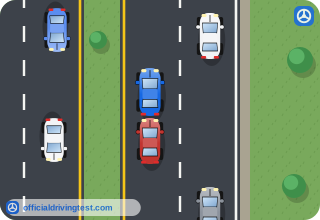
- Moving to the right lane and letting the driver pass
- Speeding up to stay ahead of the car behind you
- Braking suddenly to warn the driver behind you
- Staying in the left lane and holding your speed
Show answer
Correct answer: Moving to the right lane and letting the driver pass
The manual says tailgating can be avoided by simply moving to the right lane and letting the faster driver pass.
Source: Class D & E Driver’s Guide (Revised August 2025 (DPSMV2052 R08/25)), page 60 · Open this page in the manual (Manual page 60)
-
Why does the manual say you should try to avoid following other cars closely?
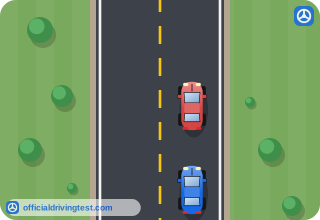
- The driver ahead cannot see your headlights at night
- Your horn may not be loud enough to warn the driver
- Your brake lights may be hidden from the driver ahead
- You never know when the driver ahead will slam on the brakes
Show answer
Correct answer: You never know when the driver ahead will slam on the brakes
The manual says to avoid following other cars closely because you never know when the driver in front of you will slam on the brakes and stop.
Source: Class D & E Driver’s Guide (Revised August 2025 (DPSMV2052 R08/25)), page 60 · Open this page in the manual (Manual page 60)
-
How much sooner does the manual say driving fast will get you to your destination?
- About an hour earlier on a typical trip
- Only a mere few minutes earlier
- Half the time of driving at the limit
- Several hours earlier on a long trip
Show answer
Correct answer: Only a mere few minutes earlier
The manual says driving fast will only get you to your destination a mere few minutes earlier.
Source: Class D & E Driver’s Guide (Revised August 2025 (DPSMV2052 R08/25)), page 60 · Open this page in the manual (Manual page 60)
-
According to the manual, what do more controlled speeds give you?
- Longer reaction time to change lanes, exit or stop
- A shorter trip time on long highway drives
- More room to pass slower vehicles on the road
- Fewer rest stops needed on a long trip
Show answer
Correct answer: Longer reaction time to change lanes, exit or stop
The manual says driving at more controlled speeds provides longer reaction time to change lanes, exit or stop your vehicle.
Source: Class D & E Driver’s Guide (Revised August 2025 (DPSMV2052 R08/25)), page 60 · Open this page in the manual (Manual page 60)
-
What does the manual call the visible path of travel from your vehicle to the area you are looking at further down the road?
- Your line of sight
- Your reaction distance
- Your peripheral vision
- Your braking zone
Show answer
Correct answer: Your line of sight
Your line of sight is the visible path of travel from your vehicle to the area you are looking at further down the road.
Source: Class D & E Driver’s Guide (Revised August 2025 (DPSMV2052 R08/25)), page 61 · Open this page in the manual (Manual page 61)
-
What is a common mistake drivers make when looking ahead?
- Looking well down the roadway to the end of the travel path
- Watching for brake lights from slowing vehicles
- Looking right in front of the car instead of down the road
- Checking traffic flow to the rear before slowing down
Show answer
Correct answer: Looking right in front of the car instead of down the road
A common mistake is looking right in front of the car instead of down the road. Looking well ahead lets you prepare for traffic conditions.
Source: Class D & E Driver’s Guide (Revised August 2025 (DPSMV2052 R08/25)), page 61 · Open this page in the manual (Manual page 61)
-
Looking far ahead down the road also makes it easier to do what with your car?
- Keep it in the lane of the vehicle ahead
- Keep it on a steady path
- Shorten its stopping distance
- Stay out of other drivers' blind spots
Show answer
Correct answer: Keep it on a steady path
Looking 20 to 30 seconds ahead gives you time to prepare for traffic conditions and makes it easier to keep your car on a steady path.
Source: Class D & E Driver’s Guide (Revised August 2025 (DPSMV2052 R08/25)), page 61 · Open this page in the manual (Manual page 61)
-
What must you do if your view is blocked by a curve, a hill, or another vehicle?
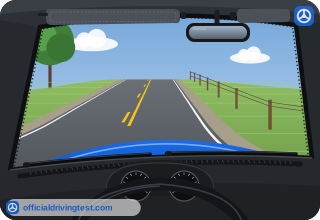
- Move to the center of the road for a better view
- Keep your speed and sound your horn
- Speed up to get past the obstruction quickly
- Slow down and be ready to adjust your path of travel
Show answer
Correct answer: Slow down and be ready to adjust your path of travel
When a curve, a hill, or another vehicle blocks your view, you must slow down and be ready to adjust your path of travel.
Source: Class D & E Driver’s Guide (Revised August 2025 (DPSMV2052 R08/25)), page 61 · Open this page in the manual (Manual page 61)
-
Which is a benefit of looking well down the travel path?
- You can steer with less weaving
- You can ignore the traffic behind you
- You no longer need to signal your turns
- You can safely follow the vehicle ahead more closely
Show answer
Correct answer: You can steer with less weaving
Looking well down the travel path helps you steer with less weaving.
Source: Class D & E Driver’s Guide (Revised August 2025 (DPSMV2052 R08/25)), page 61 · Open this page in the manual (Manual page 61)
-
Besides making driving safer, looking well ahead helps you save on what?
- Insurance
- Tire air pressure
- Fuel
- Brake fluid
Show answer
Correct answer: Fuel
By looking well ahead you can operate a vehicle more safely, save on fuel, and help keep traffic moving at a steady pace.
Source: Class D & E Driver’s Guide (Revised August 2025 (DPSMV2052 R08/25)), page 61 · Open this page in the manual (Manual page 61)
-
You are approaching a traffic light that has been green for a long time. What should you do?
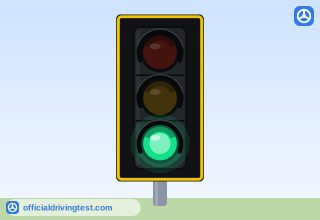
- Speed up to get through before it changes
- Start slowing down and be ready to stop
- Keep your speed because the light is green
- Move into the nearest turn lane
Show answer
Correct answer: Start slowing down and be ready to stop
A light that has been green for a long time may change to red before you get there, so you should start slowing down and be ready to stop.
Source: Class D & E Driver’s Guide (Revised August 2025 (DPSMV2052 R08/25)), page 61 · Open this page in the manual (Manual page 61)
-
How does making driving changes well ahead of time help the drivers behind you?
- It lets them follow you more closely
- It keeps them from having to signal
- It makes them drive faster
- It gives them more time to react
Show answer
Correct answer: It gives them more time to react
Making driving changes well ahead of time gives drivers behind you more time to react.
Source: Class D & E Driver’s Guide (Revised August 2025 (DPSMV2052 R08/25)), page 61 · Open this page in the manual (Manual page 61)
-
How do you calculate how many seconds ahead you are looking?
- Pick a stationary object far ahead and count the seconds until you reach it
- Count the cars you can see in front of you
- Count the seconds from when the car ahead passes an object until you pass it
- Count the seconds between two traffic signals
Show answer
Correct answer: Pick a stationary object far ahead and count the seconds until you reach it
You find a stationary object like a sign or telephone pole as far ahead as you can see and count until you reach it; the number of seconds is how far ahead you were looking.
Source: Class D & E Driver’s Guide (Revised August 2025 (DPSMV2052 R08/25)), page 61 · Open this page in the manual (Manual page 61)
-
What is a visual lead?
- An area 3 to 4 seconds ahead of your front bumper
- The area 100 feet around your vehicle
- An area 20 to 30 seconds ahead of your vehicle
- The part of the road you can see in your mirrors
Show answer
Correct answer: An area 20 to 30 seconds ahead of your vehicle
A visual lead is an area 20 to 30 seconds ahead from the front of the vehicle. It helps you see changes in your travel path.
Source: Class D & E Driver’s Guide (Revised August 2025 (DPSMV2052 R08/25)), page 61 · Open this page in the manual (Manual page 61)
-
Even with good tires, good brakes and dry pavement, about how many feet can it take to react to a problem and stop at 60 mph?
- 268 feet
- 359 feet
- 189 feet
- 123 feet
Show answer
Correct answer: 359 feet
At 60 mph on dry pavement with good tires and brakes, it can take about 359 feet to react to a problem and bring the vehicle to a stop.
Source: Class D & E Driver’s Guide (Revised August 2025 (DPSMV2052 R08/25)), page 62 · Open this page in the manual (Manual page 62)
-
Even with good tires, good brakes and dry pavement, about how many seconds can it take to react to a problem and stop at 60 mph?
- 1 to 2 seconds
- 2 to 3 seconds
- 7 to 8 seconds
- 4 to 5 seconds
Show answer
Correct answer: 4 to 5 seconds
At 60 mph it can take about 4 to 5 seconds, or 359 feet, to react to a problem and bring the vehicle to a stop.
Source: Class D & E Driver’s Guide (Revised August 2025 (DPSMV2052 R08/25)), page 62 · Open this page in the manual (Manual page 62)
-
Even with good tires, good brakes and dry pavement, about how many feet can it take to react to a problem and stop at 30 mph?
- 123 feet
- 69 feet
- 189 feet
- 268 feet
Show answer
Correct answer: 123 feet
At 30 mph on dry pavement with good tires and brakes, it can take about 123 feet to react to a problem and bring the vehicle to a stop.
Source: Class D & E Driver’s Guide (Revised August 2025 (DPSMV2052 R08/25)), page 62 · Open this page in the manual (Manual page 62)
-
Even with good tires, good brakes and dry pavement, about how many seconds can it take to react to a problem and stop at 30 mph?
- 1 to 2 seconds
- 4 to 5 seconds
- 2 to 3 seconds
- 6 to 7 seconds
Show answer
Correct answer: 2 to 3 seconds
At 30 mph it can take about 2 to 3 seconds, or 123 feet, to react to a problem and bring the vehicle to a stop.
Source: Class D & E Driver’s Guide (Revised August 2025 (DPSMV2052 R08/25)), page 62 · Open this page in the manual (Manual page 62)
-
At 60 mph, how far ahead must you be able to see so that you are not driving too fast for your visibility?
- At least 150 feet
- At least 400 feet
- At least 250 feet
- At least 600 feet
Show answer
Correct answer: At least 400 feet
At 60 mph, if you cannot see at least 400 feet ahead, you are driving too fast for your visibility.
Source: Class D & E Driver’s Guide (Revised August 2025 (DPSMV2052 R08/25)), page 62 · Open this page in the manual (Manual page 62)
-
At 30 mph, if you cannot see at least how many feet ahead, you may not be driving safely?
- 75 feet
- 250 feet
- 400 feet
- 150 feet
Show answer
Correct answer: 150 feet
At 30 mph, if you cannot see at least 150 feet ahead, you may not be driving safely.
Source: Class D & E Driver’s Guide (Revised August 2025 (DPSMV2052 R08/25)), page 62 · Open this page in the manual (Manual page 62)
-
What may happen if you do not have an adequate visual lead?
- It may be too late to stop without hitting an object in your path
- You will be unable to read traffic signals and signs at night
- Your tires will lose traction even on dry pavement
- Your mirrors will show a larger blind spot on each side
Show answer
Correct answer: It may be too late to stop without hitting an object in your path
Without an adequate visual lead, by the time you see an object in your travel path it may be too late to stop without hitting the object.
Source: Class D & E Driver’s Guide (Revised August 2025 (DPSMV2052 R08/25)), page 62 · Open this page in the manual (Manual page 62)
-
When do you need to check to the rear more often?
- When traffic is light
- When traffic is heavy
- When the road is straight and dry
- When driving in daylight
Show answer
Correct answer: When traffic is heavy
You need to check to the rear more often when traffic is heavy.
Source: Class D & E Driver’s Guide (Revised August 2025 (DPSMV2052 R08/25)), page 63 · Open this page in the manual (Manual page 63)
-
What is the only way to know whether someone is following too closely or coming up too fast?
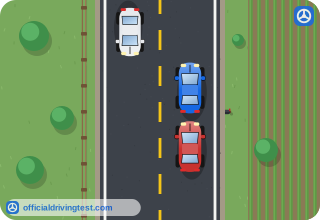
- Listening for other drivers' horns
- Watching the vehicle ahead of you
- Looking only in your side mirrors at intersections
- Checking the traffic flow to the rear
Show answer
Correct answer: Checking the traffic flow to the rear
Checking traffic flow to the rear is the only way you will know if someone is following too closely or coming up too fast.
Source: Class D & E Driver’s Guide (Revised August 2025 (DPSMV2052 R08/25)), page 63 · Open this page in the manual (Manual page 63)
-
When you slow down, where is it especially important to check your mirrors for traffic behind you?
- Points where a following driver already expects you to stop
- Points where a following driver would not expect you to slow down
- Only on roads with more than two lanes of traffic
- Only on roads with no other vehicles close behind you
Show answer
Correct answer: Points where a following driver would not expect you to slow down
Checking behind is very important when you slow down quickly or where a following driver would not expect it, such as private driveways or parking spaces.
Source: Class D & E Driver’s Guide (Revised August 2025 (DPSMV2052 R08/25)), page 63 · Open this page in the manual (Manual page 63)
-
Why should you check your mirrors when going down a long or steep hill?
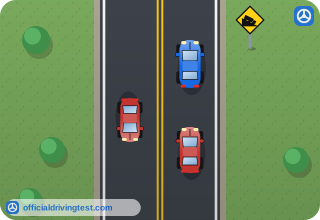
- Your brake lights can stop working on steep hills
- Vehicles behind you must slow down on hills
- Your mirrors move out of position on hills
- Vehicles often build up speed going down a steep grade
Show answer
Correct answer: Vehicles often build up speed going down a steep grade
You check your mirrors for vehicles approaching quickly because vehicles often build up speed going down a steep grade, and large trucks and buses may be going too fast.
Source: Class D & E Driver’s Guide (Revised August 2025 (DPSMV2052 R08/25)), page 63 · Open this page in the manual (Manual page 63)
-
What is perception distance?
- How far your vehicle travels, in ideal conditions, before you physically hit the brakes
- How far your vehicle travels, in ideal conditions, while you are braking
- How far your vehicle travels after you release the accelerator
- How far the vehicle travels from when your eyes see a hazard until your brain recognizes it
Show answer
Correct answer: How far the vehicle travels from when your eyes see a hazard until your brain recognizes it
Perception distance is how far your vehicle travels in ideal conditions from the time your eyes see a hazard until your brain recognizes it.
Source: Class D & E Driver’s Guide (Revised August 2025 (DPSMV2052 R08/25)), page 64 · Open this page in the manual (Manual page 64)
-
What is the average perception time for an alert driver?
- ¾ second to 1 second
- ½ second to ¾ second
- 1 second to 2 seconds
- 2 seconds to 3 seconds
Show answer
Correct answer: ¾ second to 1 second
The average perception time for an alert driver is ¾ second to 1 second.
Source: Class D & E Driver’s Guide (Revised August 2025 (DPSMV2052 R08/25)), page 64 · Open this page in the manual (Manual page 64)
-
What is reaction distance?
- How far your vehicle travels from the time your eyes see a hazard until your brain recognizes it
- How far your vehicle travels, in ideal conditions, while you are braking
- How far you continue to travel, in ideal conditions, before you physically hit the brakes in response to a hazard
- The total distance you travel before the vehicle stops
Show answer
Correct answer: How far you continue to travel, in ideal conditions, before you physically hit the brakes in response to a hazard
Reaction distance is how far you continue to travel, in ideal conditions, before you physically hit the brakes in response to a hazard seen ahead.
Source: Class D & E Driver’s Guide (Revised August 2025 (DPSMV2052 R08/25)), page 64 · Open this page in the manual (Manual page 64)