Louisiana: Signals and vehicle controls — Part 4 Practice Test
Checking your vehicle, tires, starting and stopping, steering, signaling, safety features, seasonal care, air brakes and towing a trailer. — Part 4
Independent educational site · not affiliated with any government agency or DMV
Ready? Test yourself
- Instant feedback with an explanation
- Every answer cites its source in the manual
- Your best score is saved on this device
Questions are original and based on the official manual "Class D & E Driver’s Guide" (Revised August 2025 (DPSMV2052 R08/25)), Louisiana Office of Motor Vehicles.
All 36 questions in this practice test
Take the test above first, then use this list to study. Tap “Show answer” to see the correct answer and explanation.
Show the questions and answersHide the questions
-
Why is hand-to-hand steering the preferred method of steering?
- It lets the driver turn the wheel faster than with any other method of steering at low speeds
- Hands and arms never cross over the wheel, so there is less chance of injury in a frontal crash with a driver side air bag
- It keeps both hands at the 2 and 10 o'clock position, where an air bag is least likely to cause injury
- It requires only one hand on the wheel, leaving the other hand free to operate the vehicle controls
Show answer
Correct answer: Hands and arms never cross over the wheel, so there is less chance of injury in a frontal crash with a driver side air bag
Because the hands and arms never cross over the steering wheel, there is less chance of injury to the face, hands and arms in a frontal crash with a driver side air bag.
Source: Class D & E Driver’s Guide (Revised August 2025 (DPSMV2052 R08/25)), page 49 · Open this page in the manual (Manual page 49)
-
Why does the manual say the 2 and 10 o'clock hand position is not recommended?
- It makes the wheel harder to turn at low speeds
- It blocks the driver's view of the instrument panel
- It causes the hands to tire quickly on long trips
- It can be dangerous in vehicles equipped with air bags
Show answer
Correct answer: It can be dangerous in vehicles equipped with air bags
The 2 and 10 o'clock position is not recommended because it can be dangerous in vehicles equipped with air bags.
Source: Class D & E Driver’s Guide (Revised August 2025 (DPSMV2052 R08/25)), page 49 · Open this page in the manual (Manual page 49)
-
When steering to evade a problem on the roadway, what is the most steering the manual says to use?
- 180 degrees
- 270 degrees
- 360 degrees
- 120 degrees
Show answer
Correct answer: 180 degrees
The manual says it is critical to limit the steering to not more than 180 degrees when trying to evade a problem on the roadway.
Source: Class D & E Driver’s Guide (Revised August 2025 (DPSMV2052 R08/25)), page 49 · Open this page in the manual (Manual page 49)
-
How much steering do modern vehicles take to move back on the road after an off-road encounter?
- 120 to 150 degrees
- 180 to 270 degrees
- 45 to 90 degrees
- 10 to 20 degrees
Show answer
Correct answer: 45 to 90 degrees
Modern vehicles only need 45 to 90 degrees of steering to move back on the road after an off-road encounter.
Source: Class D & E Driver’s Guide (Revised August 2025 (DPSMV2052 R08/25)), page 49 · Open this page in the manual (Manual page 49)
-
What often happens when a driver uses more than 180 degrees of steering input to evade a problem on the roadway?
- The anti-lock brakes release and the vehicle stops straight ahead in its own lane
- Traction is lost and the vehicle often moves across the roadway in the path of oncoming vehicles
- The steering locks and the vehicle continues in a straight line off the roadway
- The tires grip better and the vehicle stays within its intended lane of travel
Show answer
Correct answer: Traction is lost and the vehicle often moves across the roadway in the path of oncoming vehicles
More than 180 degrees of input causes traction loss, and the vehicle often moves across the roadway in the path of oncoming vehicles.
Source: Class D & E Driver’s Guide (Revised August 2025 (DPSMV2052 R08/25)), page 49 · Open this page in the manual (Manual page 49)
-
As speed increases, how much steering input is needed to move the vehicle one lane space to the left or right?
- Much more
- About the same
- Twice as much
- Much less
Show answer
Correct answer: Much less
As speeds increase, much less steering input is needed to move the vehicle one lane space to the left or right.
Source: Class D & E Driver’s Guide (Revised August 2025 (DPSMV2052 R08/25)), page 49 · Open this page in the manual (Manual page 49)
-
Which type of vehicle does the manual say is more prone to under steer in a corner?
- Rear wheel drive vehicles
- Vehicles with anti-lock brakes
- Vehicles with driver side air bags
- Front wheel drive vehicles
Show answer
Correct answer: Front wheel drive vehicles
Front wheel drive vehicles are more prone to under steer because the front tires must handle both the cornering force and engine torque.
Source: Class D & E Driver’s Guide (Revised August 2025 (DPSMV2052 R08/25)), page 49 · Open this page in the manual (Manual page 49)
-
What is the correct reaction when a vehicle under steers in a corner?
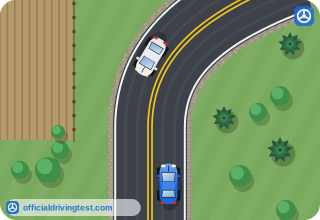
- Lift off the accelerator and apply the brakes
- Increase the steering angle and keep the speed
- Accelerate to pull the car through the turn
- Release the steering wheel and let the car straighten
Show answer
Correct answer: Lift off the accelerator and apply the brakes
The correct reaction is to lift off the accelerator and apply the brakes, which transfers more weight to the front tires to give them grip.
Source: Class D & E Driver’s Guide (Revised August 2025 (DPSMV2052 R08/25)), page 49 · Open this page in the manual (Manual page 49)
-
What happens when a driver instinctively increases the steering angle while the vehicle under steers?
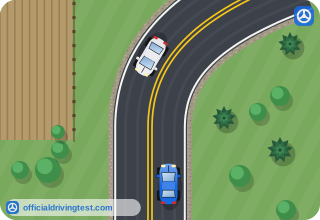
- The front tires regain their grip because the wheels point further around
- Weight transfers to the front tires, giving them more grip
- The cornering force increases and the front tires can lose traction completely
- The rear tires lose traction first and the car spins around
Show answer
Correct answer: The cornering force increases and the front tires can lose traction completely
Increasing the steering angle increases the cornering force, making the front tires lose traction completely.
Source: Class D & E Driver’s Guide (Revised August 2025 (DPSMV2052 R08/25)), page 49 · Open this page in the manual (Manual page 49)
-
What three parts is every corner made of?
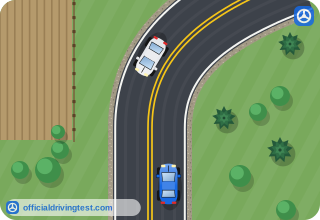
- The approach, the turn, and the recovery
- The entry, the apex, and the exit
- The entry, the curve, and the release
- The brake point, the apex, and the finish
Show answer
Correct answer: The entry, the apex, and the exit
The manual says every corner is made of three parts: the entry, the apex, and the exit.
Source: Class D & E Driver’s Guide (Revised August 2025 (DPSMV2052 R08/25)), page 50 · Open this page in the manual (Manual page 50)
-
In cornering, what is the apex?
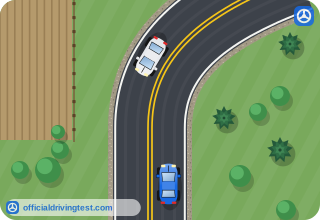
- The point where the driver first begins to turn the steering wheel
- The point where the driver should brake the hardest for the turn
- The point where the car begins to speed up for the straight road
- The point where the car reaches the furthest point on the inside of the turn
Show answer
Correct answer: The point where the car reaches the furthest point on the inside of the turn
The apex is the point where the car reaches the furthest point on the inside of the turn.
Source: Class D & E Driver’s Guide (Revised August 2025 (DPSMV2052 R08/25)), page 50 · Open this page in the manual (Manual page 50)
-
In cornering, the exit is the moment when what happens?
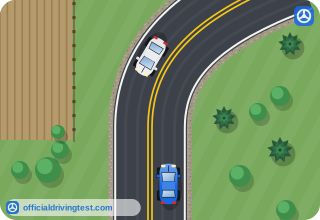
- The car is driving straight again
- The driver begins to slow for the bend
- The driver releases the brakes for the first time
- The steering wheel reaches its full turn
Show answer
Correct answer: The car is driving straight again
The manual says the exit is when the car is driving straight again.
Source: Class D & E Driver’s Guide (Revised August 2025 (DPSMV2052 R08/25)), page 50 · Open this page in the manual (Manual page 50)
-
In cornering, which part of the corner is where turning begins?
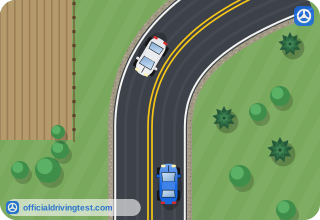
- The brake zone
- The approach
- The entry
- The run-out
Show answer
Correct answer: The entry
The manual says the entry is where turning begins.
Source: Class D & E Driver’s Guide (Revised August 2025 (DPSMV2052 R08/25)), page 50 · Open this page in the manual (Manual page 50)
-
According to the cornering plan, what is the main thing that steers a car?
- The driver's hands
- The driver's eyes
- The front tires
- The brake pedal
Show answer
Correct answer: The driver's eyes
The manual says eyes are the main thing that steers a car, not hands.
Source: Class D & E Driver’s Guide (Revised August 2025 (DPSMV2052 R08/25)), page 50 · Open this page in the manual (Manual page 50)
-
Why does the manual advise looking as far around the bend as possible?
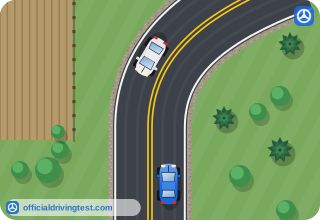
- It lets you take the corner at a higher speed than the posted limit
- It keeps both hands free to reposition on the wheel during the turn
- It allows you to stay closer to the center line through the bend
- You get more time to react to an obstacle, and the corner is smoother
Show answer
Correct answer: You get more time to react to an obstacle, and the corner is smoother
Looking as far ahead as possible gives more time to react if there is an obstacle ahead, and the process is much smoother.
Source: Class D & E Driver’s Guide (Revised August 2025 (DPSMV2052 R08/25)), page 50 · Open this page in the manual (Manual page 50)
-
On the open road, how should a driver approach a corner according to the judgment tip?
- Be conservative and use safety margins, however good you think you are
- Reduce safety margins once the driver has years of experience
- Use safety margins only on roads that have advisory speed signs
- Use safety margins only in rain, snow or fog on open roads
Show answer
Correct answer: Be conservative and use safety margins, however good you think you are
The manual says to be conservative and employ safety margins no matter how good you think you are.
Source: Class D & E Driver’s Guide (Revised August 2025 (DPSMV2052 R08/25)), page 50 · Open this page in the manual (Manual page 50)
-
According to the manual, doubling the speed in a corner generates how much cornering force?
- Twice
- Three times
- Four times
- Eight times
Show answer
Correct answer: Four times
Cornering load depends on speed squared, so doubling the speed generates four times the cornering force.
Source: Class D & E Driver’s Guide (Revised August 2025 (DPSMV2052 R08/25)), page 50 · Open this page in the manual (Manual page 50)
-
How should a driver enter a bend for the most efficient, smoothest way around it?
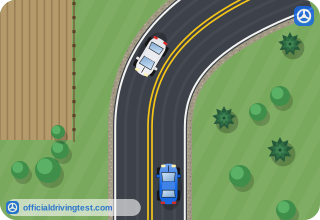
- At the same speed as on the straight road before it
- A little on the slow side
- Fast, then braking hard in the middle of the bend
- Slow enough to nearly stop in every case
Show answer
Correct answer: A little on the slow side
The most efficient, smoothest way around a bend is to enter it a little on the slow side.
Source: Class D & E Driver’s Guide (Revised August 2025 (DPSMV2052 R08/25)), page 50 · Open this page in the manual (Manual page 50)
-
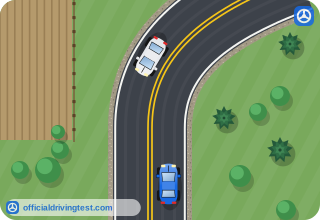
What may entering a bend too fast cause?
- Lower cornering force
- Better front tire grip
- Less need for steering
- A loss of control
Show answer
Correct answer: A loss of control
The manual warns that entering too fast may cause a loss of control.
Source: Class D & E Driver’s Guide (Revised August 2025 (DPSMV2052 R08/25)), page 50 · Open this page in the manual (Manual page 50)
-
Which kind of driving does the manual call a great way to lose control in a bend?
- Rough driving
- Smooth driving
- Careful driving
- Conservative driving
Show answer
Correct answer: Rough driving
The manual says smooth is safe and that rough driving is a great way to lose control.
Source: Class D & E Driver’s Guide (Revised August 2025 (DPSMV2052 R08/25)), page 50 · Open this page in the manual (Manual page 50)
-
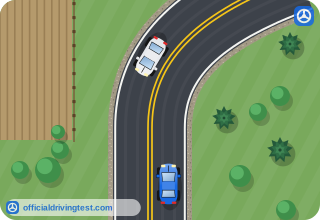
At the entry of a corner, what should the driver do with the accelerator?
- Add full acceleration to power into the turn
- Hold the accelerator steady and brake at the apex
- Ease off the gas as the car turns in
- Press the accelerator harder to unload the front wheels
Show answer
Correct answer: Ease off the gas as the car turns in
At entry the driver should ease off the gas as the car turns in.
Source: Class D & E Driver’s Guide (Revised August 2025 (DPSMV2052 R08/25)), page 50 · Open this page in the manual (Manual page 50)
-
Why does the manual say to ease off the gas as you turn into a corner?
- It shifts weight to the rear wheels so the car rotates more easily
- Weight transfers forward onto the front wheels, helping the steering grip
- It stops the cornering load from depending on the speed squared
- It gives the driver more time to look further around the bend
Show answer
Correct answer: Weight transfers forward onto the front wheels, helping the steering grip
Easing off the gas causes a little weight to transfer forwards, adding weight to the front wheels and helping the steering grip the road.
Source: Class D & E Driver’s Guide (Revised August 2025 (DPSMV2052 R08/25)), page 50 · Open this page in the manual (Manual page 50)
-
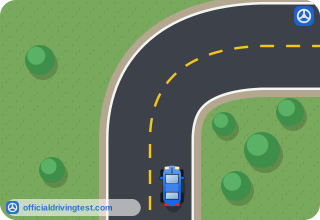
At the entry of a corner, why does the manual say to keep out wide?
- To keep the front tires from losing grip in the corner
- To reduce the cornering force on the car through the turn
- To see the exit of the corner sooner than otherwise
- To maintain a safety margin against wayward oncoming drivers
Show answer
Correct answer: To maintain a safety margin against wayward oncoming drivers
The manual says not to go over the center line and to keep out wide to maintain a safety margin against wayward oncoming drivers.
Source: Class D & E Driver’s Guide (Revised August 2025 (DPSMV2052 R08/25)), page 50 · Open this page in the manual (Manual page 50)
-
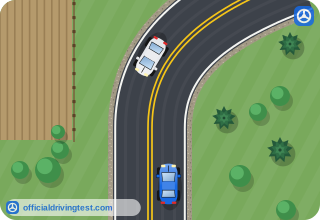
In the middle of a corner, how much acceleration does the manual say to add?
- A little, just enough to balance the car
- None; the driver should brake lightly
- Full acceleration to power through the apex
- Enough to speed up sharply
Show answer
Correct answer: A little, just enough to balance the car
At mid-corner the driver adds a little acceleration, not very much, just enough to balance the car up.
Source: Class D & E Driver’s Guide (Revised August 2025 (DPSMV2052 R08/25)), page 50 · Open this page in the manual (Manual page 50)
-
If the car starts to run a little wide in the middle of a corner, what should the driver do?
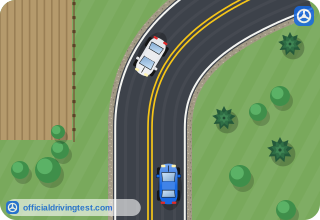
- Brake hard and hold the steering steady
- Accelerate and reduce the amount of steering
- Ease off the accelerator and add some steering
- Lift both hands off the wheel to let it self-center
Show answer
Correct answer: Ease off the accelerator and add some steering
If the car starts to run a little wide, the driver should ease off the accelerator and add some steering.
Source: Class D & E Driver’s Guide (Revised August 2025 (DPSMV2052 R08/25)), page 50 · Open this page in the manual (Manual page 50)
-
At the exit of a corner, when the road ahead opens up and goes straight, what should the driver do?
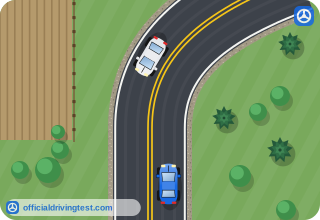
- Brake lightly and keep the steering turned all the way
- Add some acceleration gently and start unwinding the steering
- Ease off the gas and add more steering to stay in the lane
- Accelerate hard and straighten the wheel at the same time
Show answer
Correct answer: Add some acceleration gently and start unwinding the steering
As the corner opens up and straight road is ahead, the driver adds some acceleration gently and starts unwinding the steering.
Source: Class D & E Driver’s Guide (Revised August 2025 (DPSMV2052 R08/25)), page 50 · Open this page in the manual (Manual page 50)
-
When planning for a corner, what should a driver pay particular attention to balancing?
- The brake pressure with the road surface
- The steering angle with the weight of the car
- The gear selected with the engine speed
- The car's entry speed with the corner's severity
Show answer
Correct answer: The car's entry speed with the corner's severity
The manual says to pay particular attention to balancing the car's entry speed to the corner's severity.
Source: Class D & E Driver’s Guide (Revised August 2025 (DPSMV2052 R08/25)), page 50 · Open this page in the manual (Manual page 50)
-
According to the manual, why do most people get into trouble in corners?
- They get into the corner before they have sorted it out mentally
- They accelerate too early on the straight road before it
- They look too far around the bend
- They ease off the gas as they turn in
Show answer
Correct answer: They get into the corner before they have sorted it out mentally
Most people get into trouble in corners because they get into them before they sort them out mentally.
Source: Class D & E Driver’s Guide (Revised August 2025 (DPSMV2052 R08/25)), page 50 · Open this page in the manual (Manual page 50)
-
Why does the manual say to go around potholes if possible?
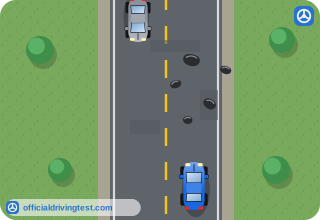
- They can throw your car's front end out of alignment
- They can drain the battery and weaken the brake lights
- They can lock the steering wheel and the ignition
- They can overheat the engine and burn the engine oil
Show answer
Correct answer: They can throw your car's front end out of alignment
Potholes can throw the car's front end out of alignment.
Source: Class D & E Driver’s Guide (Revised August 2025 (DPSMV2052 R08/25)), page 51 · Open this page in the manual (Manual page 51)
-
According to the spring tips, what can driving through large puddles do?
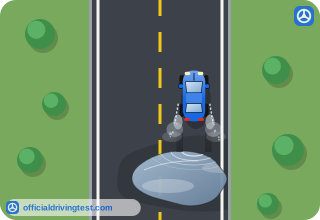
- Raise the temperature of the engine coolant
- Overheat the engine and the transmission
- Impair your brakes or cause you to hydroplane
- Loosen the lug nuts that hold the wheels
Show answer
Correct answer: Impair your brakes or cause you to hydroplane
The manual says large puddles can impair your brakes, dirty your windshield, or cause you to hydroplane.
Source: Class D & E Driver’s Guide (Revised August 2025 (DPSMV2052 R08/25)), page 51 · Open this page in the manual (Manual page 51)
-
In spring, what can keeping your tires properly inflated reduce?
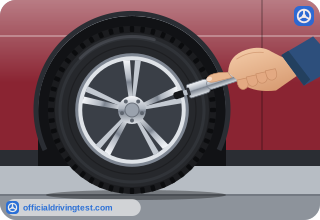
- The need to slow down on slick roads
- Damage from potholes and other road hazards
- The effect of seasonal allergies
- The effect of sun glare
Show answer
Correct answer: Damage from potholes and other road hazards
Keeping tires properly inflated can reduce damage from potholes and other road hazards.
Source: Class D & E Driver’s Guide (Revised August 2025 (DPSMV2052 R08/25)), page 51 · Open this page in the manual (Manual page 51)
-
Before heading out on the road in hot summer weather, what does the manual say to do with the car?
- Have it serviced and inspected for safety
- Inflate the tires above the normal level
- Remove the battery and store it
- Adjust the brakes yourself
Show answer
Correct answer: Have it serviced and inspected for safety
The manual says to have the car serviced and inspected for safety before heading out on the road.
Source: Class D & E Driver’s Guide (Revised August 2025 (DPSMV2052 R08/25)), page 51 · Open this page in the manual (Manual page 51)
-
Which fluid does the manual list among those to check in summer?
- Differential fluid
- Clutch fluid
- Power-steering fluid
- Fuel additive
Show answer
Correct answer: Power-steering fluid
The summer tips list oil, transmission, coolant, brake, power-steering, and windshield fluid levels.
Source: Class D & E Driver’s Guide (Revised August 2025 (DPSMV2052 R08/25)), page 51 · Open this page in the manual (Manual page 51)
-
Before a summer road trip, what does the manual say to share with family?
- Your insurance policy number
- Your itinerary
- Your vehicle's service records
- Your fuel receipts
Show answer
Correct answer: Your itinerary
The manual says to get up-to-date maps from a reliable source and to share your itinerary with family.
Source: Class D & E Driver’s Guide (Revised August 2025 (DPSMV2052 R08/25)), page 51 · Open this page in the manual (Manual page 51)
-
What does the manual say a car's payload capacity is?
- The maximum weight of cargo alone, not counting the passengers
- The weight of the empty vehicle when it has a full tank of fuel
- The maximum weight of a trailer that the vehicle can safely tow
- The maximum weight of cargo and passengers the vehicle can safely carry
Show answer
Correct answer: The maximum weight of cargo and passengers the vehicle can safely carry
Payload capacity is the maximum weight of all cargo and passengers that the vehicle can safely carry.
Source: Class D & E Driver’s Guide (Revised August 2025 (DPSMV2052 R08/25)), page 51 · Open this page in the manual (Manual page 51)
-
In hot summer months, for every 10-degree Fahrenheit increase in air temperature, tire pressure increases by approximately how much?
- One pound
- Five pounds
- Ten pounds
- Three pounds
Show answer
Correct answer: One pound
In hot summer months, tire pressure increases approximately one pound for every 10-degree Fahrenheit increase in air temperature.
Source: Class D & E Driver’s Guide (Revised August 2025 (DPSMV2052 R08/25)), page 51 · Open this page in the manual (Manual page 51)