Kentucky: Emergency vehicles and work zones
Yielding to emergency vehicles, Kentucky’s move-over law, police traffic stops, funeral processions and work zones. Split into 2 shorter tests so you're not stuck in one long quiz.
Independent educational site · not affiliated with any government agency or DMV
All 37 Emergency vehicles and work zones questions with answers
Choose a part above to take a practice test, or study every question and answer here.
Show the questions and answersHide the questions
-
What do work zone signs warn you about?
- Roads that are closed to all traffic for the season
- Work zones ahead where people are working on or near the roadway
- Areas where the speed limit is always 25 miles per hour
- Schools located near the roadway
Show answer
Correct answer: Work zones ahead where people are working on or near the roadway
Work zone signs alert you to work zones ahead and warn you that people are working on or near the roadway.
Source: Kentucky Driver Manual (Updated July 23, 2026), page 37 · Open this page in the manual (Manual page 37)
-
In a work zone, a person with a sign or flag is controlling traffic. What must you do?
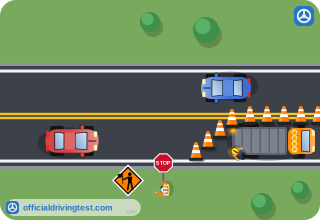
- Obey the posted speed limit and ignore the person
- Follow them only if a police officer is also present
- Follow them only if no cones are in place
- Follow their instructions
Show answer
Correct answer: Follow their instructions
Traffic may be controlled by a person with a sign or flag, and you must follow their instructions.
Source: Kentucky Driver Manual (Updated July 23, 2026), page 37 · Open this page in the manual (Manual page 37)
-
What are barriers such as drums, cones, and tubes (panels) used for in work zones?
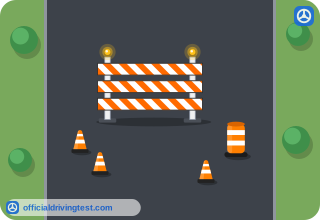
- To mark where parking is allowed
- To show where a school zone begins
- To show where the speed limit changes
- To keep traffic out of hazardous work zones
Show answer
Correct answer: To keep traffic out of hazardous work zones
Barriers such as drums, cones, and tubes (panels) are used to keep traffic out of hazardous work zones.
Source: Kentucky Driver Manual (Updated July 23, 2026), page 37 · Open this page in the manual (Manual page 37)
-
You are stopped by a temporary traffic signal in a work zone. Where should you stop?
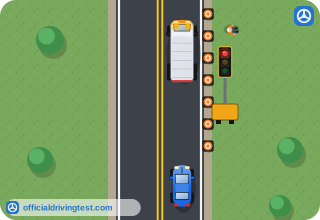
- At the far side of the signal
- At the white line, if present
- Beside the nearest barrel
- Beyond the first cone in the lane
Show answer
Correct answer: At the white line, if present
Temporary traffic signals may be used in work zones, and you stop at the white line, if present.
Source: Kentucky Driver Manual (Updated July 23, 2026), page 37 · Open this page in the manual (Manual page 37)
-
What happens to fines for speeding in a work zone?
- They are doubled
- They are tripled
- They are cut in half
- They stay the same as elsewhere
Show answer
Correct answer: They are doubled
The manual states that fines for speeding in a work zone are doubled.
Source: Kentucky Driver Manual (Updated July 23, 2026), page 38 · Open this page in the manual (Manual page 38)
-
What does the manual tell you to do in work zones to give construction workers a “brake”?
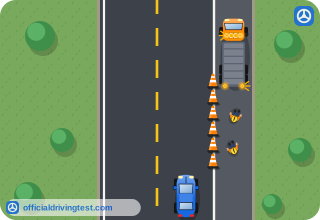
- Keep your speed steady and change lanes as early as you can
- Speed up so you pass through the work zone as quickly as possible
- Reduce your speed and be prepared to stop suddenly
- Stop completely before you enter every work zone you come to
Show answer
Correct answer: Reduce your speed and be prepared to stop suddenly
Drivers should reduce their speed in work zones and be prepared to stop suddenly.
Source: Kentucky Driver Manual (Updated July 23, 2026), page 38 · Open this page in the manual (Manual page 38)
-
How closely should you follow the vehicle ahead in a work zone?
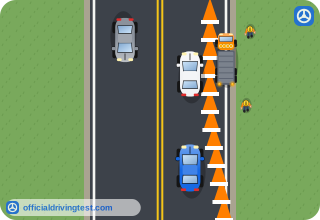
- Close enough to keep traffic moving
- Never so close that you are tailgating
- Close enough to read its license plate
- Bumper to bumper to avoid gaps
Show answer
Correct answer: Never so close that you are tailgating
The manual says not to tailgate in work zones.
Source: Kentucky Driver Manual (Updated July 23, 2026), page 38 · Open this page in the manual (Manual page 38)
-
Under Kentucky law, you must yield the right-of-way to any vehicle displaying what kind of light or sounding a siren?
- A flashing green or white light
- A flashing purple or white light
- A flashing red or blue light
- A flashing amber or green light
Show answer
Correct answer: A flashing red or blue light
Kentucky law specifically requires drivers to yield the right-of-way to any vehicle displaying a flashing red or blue light or sounding a siren.
Source: Kentucky Driver Manual (Updated July 23, 2026), page 64 · Open this page in the manual (Manual page 64)
-
What does the manual tell you to avoid when pulling over for an emergency vehicle?
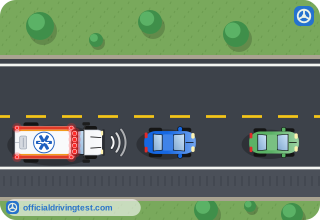
- Pulling to the edge of the road
- Blocking intersections
- Yielding the right-of-way
- Stopping until it has passed
Show answer
Correct answer: Blocking intersections
You must yield to an emergency vehicle by pulling over to the edge of the road, and you should avoid blocking intersections.
Source: Kentucky Driver Manual (Updated July 23, 2026), page 64 · Open this page in the manual (Manual page 64)
-
When you see a flashing red or blue light or hear a siren, where must you drive and stop?
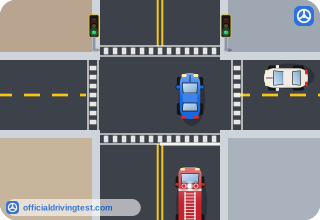
- To the right side of the road or the curb, clear of any intersection
- To the left side of the road, next to the median
- Into the nearest intersection, to leave the lane open
- To the right, but only after you pass the next intersection
Show answer
Correct answer: To the right side of the road or the curb, clear of any intersection
You must immediately drive to the right side of the road or to the curb, clear of any intersection, and stop.
Source: Kentucky Driver Manual (Updated July 23, 2026), page 65 · Open this page in the manual (Manual page 65)
-
After pulling over for an emergency vehicle, how long must you remain stopped?
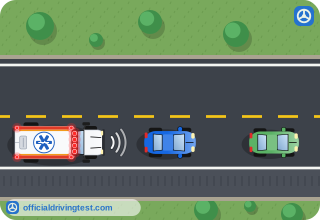
- Until its siren stops, even if the vehicle has not yet passed
- For at least one minute after the vehicle has passed you
- Until another driver behind you begins to move forward
- Until it has passed, unless a police officer or firefighter directs you
Show answer
Correct answer: Until it has passed, unless a police officer or firefighter directs you
You must remain stopped until the emergency vehicle has passed, unless you are directed by a police officer or a firefighter to move.
Source: Kentucky Driver Manual (Updated July 23, 2026), page 65 · Open this page in the manual (Manual page 65)
-
It is unlawful to follow any emergency vehicle closer than how far?
- 100 feet
- 200 feet
- 500 feet
- 1,000 feet
Show answer
Correct answer: 500 feet
It is unlawful to follow any emergency vehicle closer than 500 feet.
Source: Kentucky Driver Manual (Updated July 23, 2026), page 65 · Open this page in the manual (Manual page 65)
-
When police activate their lights and siren to pull you over, what should you NOT do?
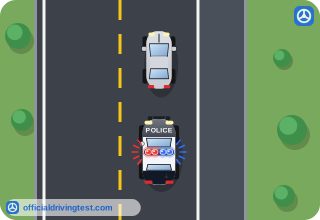
- Stay calm and wait for the officer to approach
- Turn off your engine once you have stopped
- Bring your vehicle to an abrupt stop on the roadway
- Pull over to a safe place off the travel lane
Show answer
Correct answer: Bring your vehicle to an abrupt stop on the roadway
You should stay calm and not bring your vehicle to an abrupt stop on the travel portion of the roadway.
Source: Kentucky Driver Manual (Updated July 23, 2026), page 65 · Open this page in the manual (Manual page 65)
-
What should you do with your engine when you are pulled over by law enforcement?
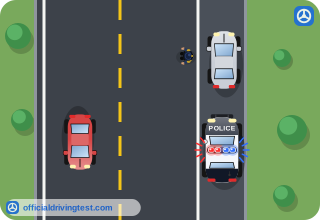
- Turn it off
- Leave it running
- Rev it to show you are ready to move
- Turn it off only if the officer asks
Show answer
Correct answer: Turn it off
The manual says to turn off your engine when pulled over by law enforcement.
Source: Kentucky Driver Manual (Updated July 23, 2026), page 65 · Open this page in the manual (Manual page 65)
-
At night, which lights should you turn on when pulled over to help the officer see that everything is in order inside the vehicle?
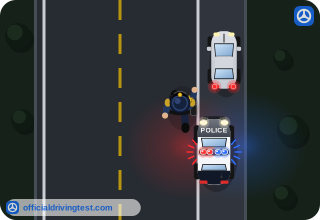
- Your high beams and fog lights
- Only your parking lights
- Your headlights flashing on and off
- Your hazard flashers and interior lights
Show answer
Correct answer: Your hazard flashers and interior lights
Turn on your hazard flashers and, if at night, your interior lights to help the officer see inside the vehicle.
Source: Kentucky Driver Manual (Updated July 23, 2026), page 65 · Open this page in the manual (Manual page 65)
-
What should you do with your window when you are pulled over by law enforcement?
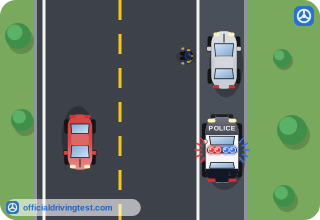
- Roll it down just a crack
- Completely roll it down
- Keep it up and wait for the officer to knock
- Roll it down only when asked for your license
Show answer
Correct answer: Completely roll it down
You should completely roll down your window so that you and the officer can communicate.
Source: Kentucky Driver Manual (Updated July 23, 2026), page 65 · Open this page in the manual (Manual page 65)
-
What should you do about safety belts when you are pulled over by law enforcement?
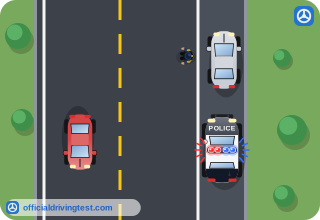
- Keep yours fastened and ask passengers to do the same
- Unfasten yours so you can reach your documents
- Unfasten yours and ask passengers to stay buckled
- Unfasten everyone’s so the officer can see inside
Show answer
Correct answer: Keep yours fastened and ask passengers to do the same
You should remain calm and keep your safety belt fastened, and ask your passengers to do so as well.
Source: Kentucky Driver Manual (Updated July 23, 2026), page 65 · Open this page in the manual (Manual page 65)
-
When you are pulled over, what should you do instead of starting to gather your license, registration, and insurance?
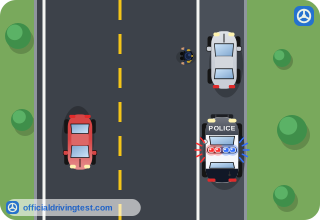
- Reach into the glove box so the papers are ready for the officer
- Get out and hand the papers to the officer at your window
- Keep your hands on the steering wheel and limit movements
- Put both hands on the dashboard where the officer can see them
Show answer
Correct answer: Keep your hands on the steering wheel and limit movements
Keeping your hands on the steering wheel and limiting movements keeps the officer from thinking you are hiding or searching for something.
Source: Kentucky Driver Manual (Updated July 23, 2026), page 65 · Open this page in the manual (Manual page 65)
-
Before reaching for your license, proof of insurance, and registration during a traffic stop, what should you do?
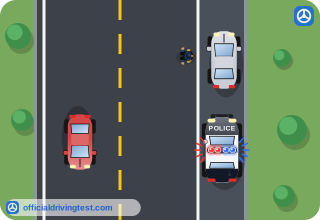
- Ask the officer to step back from the window
- Tell the officer where the documents are located
- Get out of the vehicle to reach them
- Turn off the interior lights first
Show answer
Correct answer: Tell the officer where the documents are located
You should first tell the officer where the documents are located, then reach for them slowly with one hand on the wheel.
Source: Kentucky Driver Manual (Updated July 23, 2026), page 65 · Open this page in the manual (Manual page 65)
-
During a traffic stop, what should you do about getting out of your vehicle?
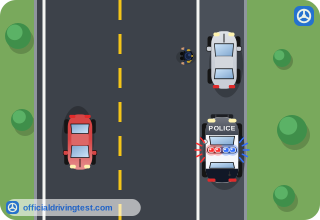
- Get out right away and meet the officer at the rear bumper
- Get out so the officer can see your hands
- Get out if you think the officer is taking too long
- Remain in the vehicle unless requested to get out
Show answer
Correct answer: Remain in the vehicle unless requested to get out
You should answer the officer’s questions fully and clearly and remain in the vehicle unless requested to get out.
Source: Kentucky Driver Manual (Updated July 23, 2026), page 65 · Open this page in the manual (Manual page 65)
-
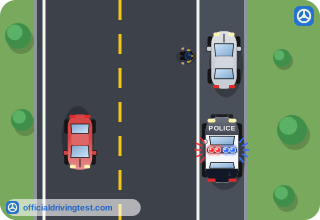
If you receive a citation at a traffic stop, what should you do?
- Explain why the citation is wrong
- State your complaint to the officer at the roadside
- Ask the officer to cancel the citation
- Remain calm and not argue with the officer
Show answer
Correct answer: Remain calm and not argue with the officer
Roadside traffic stops are not the proper or safe place to lodge complaints or resolve disputes.
Source: Kentucky Driver Manual (Updated July 23, 2026), page 65 · Open this page in the manual (Manual page 65)
-
Why should you never try to run from law enforcement?
- The officer will always radio ahead and set up a roadblock
- The consequences are often more severe than the initial citation
- It makes the traffic citation larger by a fixed amount
- It automatically ends your license for ten years
Show answer
Correct answer: The consequences are often more severe than the initial citation
Running is very dangerous, many fatal crashes occur from police chases, and the consequences are often more severe than the initial citation.
Source: Kentucky Driver Manual (Updated July 23, 2026), page 65 · Open this page in the manual (Manual page 65)
-
Once the officer has indicated the traffic stop is finished, what should you do first as you drive away?
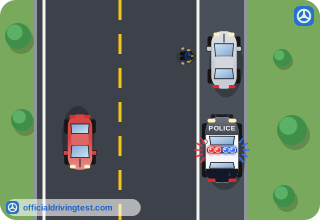
- Wait for the officer to return to the law enforcement vehicle
- Pull out immediately to clear the roadside for other traffic
- Get out and thank the officer for the courteous stop
- Turn off your hazard flashers and speed up to merge
Show answer
Correct answer: Wait for the officer to return to the law enforcement vehicle
The steps for driving away begin with waiting for the officer to return to the law enforcement vehicle.
Source: Kentucky Driver Manual (Updated July 23, 2026), page 65 · Open this page in the manual (Manual page 65)
-
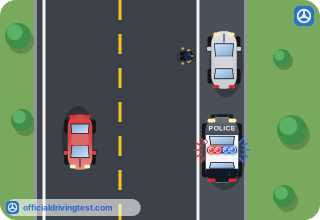
What should you use to reenter traffic after the officer has indicated the traffic stop is finished?
- Your horn
- Your high beams
- Your turn signal
- Your hazard flashers
Show answer
Correct answer: Your turn signal
One of the steps for driving away is to use your turn signal to reenter traffic and obey all traffic laws.
Source: Kentucky Driver Manual (Updated July 23, 2026), page 65 · Open this page in the manual (Manual page 65)
-
When you approach an authorized emergency vehicle stopped on the roadside, how should you yield the right-of-way if safety and traffic conditions permit?
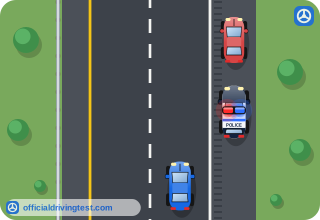
- By changing into a lane not next to the emergency vehicle
- By stopping in the lane next to the emergency vehicle
- By staying in your lane and sounding your horn
- By moving onto the shoulder behind the emergency vehicle
Show answer
Correct answer: By changing into a lane not next to the emergency vehicle
You should slow and yield by making a lane change into a lane not next to that of the authorized emergency vehicle if safety and traffic conditions permit.
Source: Kentucky Driver Manual (Updated July 23, 2026), page 66 · Open this page in the manual (Manual page 66)
-
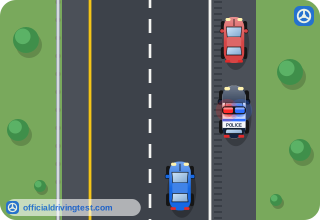
What should you do when approaching an authorized emergency vehicle stopped on the roadside if a lane change is unsafe?
- Stop completely until the emergency vehicle leaves
- Change lanes anyway and flash your headlights
- Speed up to get past it quickly
- Slow down and proceed with caution
Show answer
Correct answer: Slow down and proceed with caution
If a lane change is unsafe, you should slow down and proceed with caution while maintaining a safe speed for traffic conditions.
Source: Kentucky Driver Manual (Updated July 23, 2026), page 66 · Open this page in the manual (Manual page 66)
-
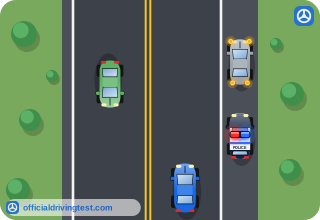
What does Kentucky law require when you approach police or other emergency vehicles stopped on the shoulder of the roadway?
- Come to a complete stop behind them
- Turn on your hazard flashers and pass
- Exercise due caution
- Pull onto the shoulder ahead of them
Show answer
Correct answer: Exercise due caution
Kentucky law requires drivers to exercise due caution when approaching police or other emergency vehicles stopped on the shoulder of the roadway.
Source: Kentucky Driver Manual (Updated July 23, 2026), page 66 · Open this page in the manual (Manual page 66)
-
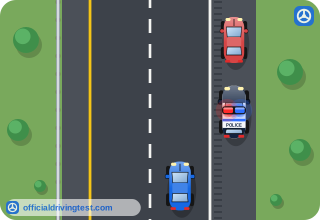
On a four-lane highway, what does Kentucky law say to do when approaching police or other emergency vehicles stopped on the shoulder?
- Approach slowly and move into the right lane if it is safe to do so
- Stop in the right lane until they leave
- Approach slowly and move into the left lane if it is safe to do so
- Speed up and move into the left lane
Show answer
Correct answer: Approach slowly and move into the left lane if it is safe to do so
On four-lane highways Kentucky law says to approach slowly and move into the left lane if it is safe to do so.
Source: Kentucky Driver Manual (Updated July 23, 2026), page 66 · Open this page in the manual (Manual page 66)
-
On a two-lane highway, what does Kentucky law say to do when approaching police or other emergency vehicles stopped on the shoulder?
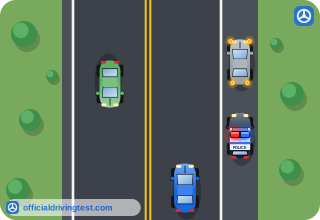
- Approach slowly and pass with caution
- Stop and wait until they leave
- Move into the left lane and speed up
- Pull onto the shoulder behind them
Show answer
Correct answer: Approach slowly and pass with caution
On two-lane highways Kentucky law says to approach slowly and pass with caution.
Source: Kentucky Driver Manual (Updated July 23, 2026), page 66 · Open this page in the manual (Manual page 66)
-
What should you do when you approach a work zone and see no workers?
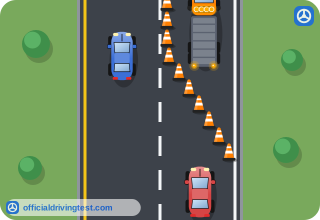
- Keep your normal speed
- Speed up to clear the area sooner
- Follow the vehicle ahead more closely
- Still reduce your speed
Show answer
Correct answer: Still reduce your speed
Speed should always be reduced in a work zone, even if there are no workers, because narrower lanes and rough pavement can create a hazard.
Source: Kentucky Driver Manual (Updated July 23, 2026), page 69 · Open this page in the manual (Manual page 69)
-
What should you do with your following distance in a work zone?
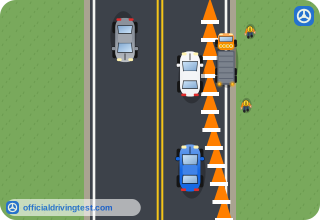
- Shorten it
- Increase it
- Keep it the same as on any road
- Ignore it when no workers are present
Show answer
Correct answer: Increase it
In a work zone you should reduce speed, increase following distance, watch the traffic around you, and be prepared to stop.
Source: Kentucky Driver Manual (Updated July 23, 2026), page 69 · Open this page in the manual (Manual page 69)
-
How much caution should you use when driving through a work zone at night?
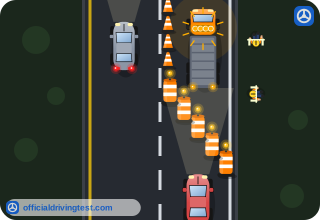
- Extreme caution, but only if workers are present
- Normal caution, because there is less traffic
- Extreme caution, whether workers are present or not
- Normal caution, if the work zone is lit
Show answer
Correct answer: Extreme caution, whether workers are present or not
The manual calls for extreme caution in a work zone at night whether workers are present or not.
Source: Kentucky Driver Manual (Updated July 23, 2026), page 69 · Open this page in the manual (Manual page 69)
-
Why should you adjust your lane position in a work zone?
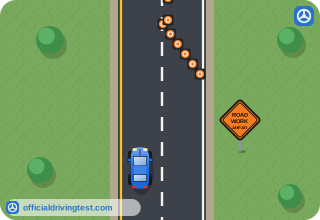
- To allow space for workers and construction vehicles
- To get around slower traffic more quickly and easily
- To keep your vehicle as close as possible to the cones
- To stay as near as you can to the oncoming lane
Show answer
Correct answer: To allow space for workers and construction vehicles
Lane position should be adjusted to allow space for workers and construction vehicles.
Source: Kentucky Driver Manual (Updated July 23, 2026), page 69 · Open this page in the manual (Manual page 69)
-
Until when should you observe the posted work zone signs?
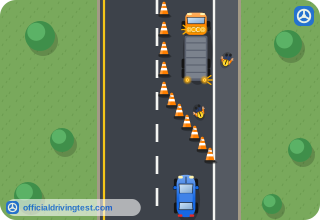
- Until you see “End Road Work.”
- Until you pass the last worker
- Until the speed limit sign changes
- Until you reach the next intersection
Show answer
Correct answer: Until you see “End Road Work.”
Posted work zone signs should be observed until you see “End Road Work.”
Source: Kentucky Driver Manual (Updated July 23, 2026), page 69 · Open this page in the manual (Manual page 69)
-
How does the manual say to plan for delays at work zones?
- Drive faster between work zones
- Follow closely to move through quickly
- Leave early to reach your destination on time
- Stop and wait for the delay to clear
Show answer
Correct answer: Leave early to reach your destination on time
Drivers should expect delays, plan for them, and leave early to reach their destination on time.
Source: Kentucky Driver Manual (Updated July 23, 2026), page 69 · Open this page in the manual (Manual page 69)
-
When you can, what should you do about work zones?
- Drive through them at night when traffic is lighter
- Use alternate routes and avoid them
- Pass through them in the lane farthest from workers
- Follow a large vehicle through them
Show answer
Correct answer: Use alternate routes and avoid them
Where possible, drivers should use alternate routes and avoid work zones.
Source: Kentucky Driver Manual (Updated July 23, 2026), page 69 · Open this page in the manual (Manual page 69)
-
What is a work zone?
- An area where only emergency vehicles may stop
- An area marked for parking construction equipment
- A highway section closed to all traffic
- An area where roadwork takes place
Show answer
Correct answer: An area where roadwork takes place
A work zone is an area where roadwork takes place and may involve lane closures, detours, and moving equipment.
Source: Kentucky Driver Manual (Updated July 23, 2026), page 69 · Open this page in the manual (Manual page 69)