Kansas: Speed and following distance — Part 4 Practice Test
Kansas speed limits, stopping distances, scanning ahead, space around your vehicle, night driving and driving in bad weather. — Part 4
Independent educational site · not affiliated with any government agency or DMV
Ready? Test yourself
- Instant feedback with an explanation
- Every answer cites its source in the manual
- Your best score is saved on this device
Questions are original and based on the official manual "Kansas Driving Handbook" (Revised February 2022), Kansas Department of Revenue, Division of Vehicles.
All 32 questions in this practice test
Take the test above first, then use this list to study. Tap “Show answer” to see the correct answer and explanation.
Show the questions and answersHide the questions
-
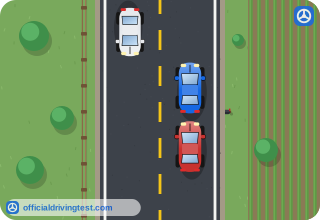
If your vehicle is being followed too closely, by how much should you increase your following distance?
- 5 to 6 seconds
- 1 second
- 2 to 3 seconds
- 8 to 10 seconds
Show answer
Correct answer: 2 to 3 seconds
Increasing your following distance by 2 to 3 seconds gives more time and space to stop and lessens the risk of being rear-ended.
Source: Kansas Driving Handbook (Revised February 2022), page 64
-
Which choice can reduce your chances of having a rollover crash?
- Obeying the posted speed limit and using extra caution in bad weather
- Swerving sharply to avoid every stopped vehicle in the road
- Driving faster so that you spend less time on the road
- Steering hard to get back onto the pavement as quickly as possible
Show answer
Correct answer: Obeying the posted speed limit and using extra caution in bad weather
Speed is a factor in rollovers that you control, so obeying the posted speed limit and being extra careful in bad weather can reduce your chances of a rollover.
Source: Kansas Driving Handbook (Revised February 2022), page 76
-
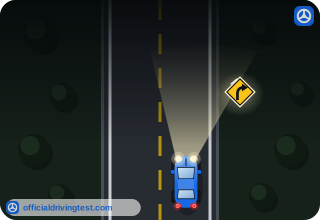
When driving at night, within what distance must you be able to stop?
- The distance you can see ahead with your headlights
- The distance to the next intersection ahead of you
- Fifty feet, whatever your speed happens to be
- The distance of one city block
Show answer
Correct answer: The distance you can see ahead with your headlights
At night you must be able to stop within the distance you can see ahead with your headlights.
Source: Kansas Driving Handbook (Revised February 2022), page 77
-
About how far ahead will your lower beam headlights let you see clearly?
- About 50 to 100 feet
- About 250 to 300 feet
- About 150 to 200 feet
- About 500 to 600 feet
Show answer
Correct answer: About 150 to 200 feet
Lower beam headlights let you see clearly about 150 to 200 feet ahead.
Source: Kansas Driving Handbook (Revised February 2022), page 77
-
About how far ahead will your high beam headlights let you see clearly?
- About 100 to 150 feet
- About 200 to 250 feet
- About 600 to 700 feet
- About 350 to 400 feet
Show answer
Correct answer: About 350 to 400 feet
High beam headlights let you see clearly about 350 to 400 feet ahead.
Source: Kansas Driving Handbook (Revised February 2022), page 77
-
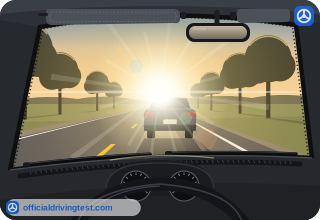
What can reduce glare when you are driving into the sun in the early morning or late afternoon?
- Wearing sunglasses, keeping windows clean, and using sun visors
- Turning on your high beam headlights as well
- Driving faster so that you leave the glare behind quickly
- Keeping the inside of the windshield tinted dark
Show answer
Correct answer: Wearing sunglasses, keeping windows clean, and using sun visors
Wearing sunglasses, keeping the windows clean, and using the vehicle sun visors can reduce glare from bright sunlight.
Source: Kansas Driving Handbook (Revised February 2022), page 77
-
If the sun is behind you, what should you be aware of?
- Your own mirrors will not work properly in the glare behind you
- Glare will make it harder for you to see the road ahead of you
- Oncoming drivers may not see your signals or vehicle because of glare
- Other drivers will see your vehicle more easily than usual
Show answer
Correct answer: Oncoming drivers may not see your signals or vehicle because of glare
With the sun behind you, glare may keep oncoming drivers from seeing your turn signals or your vehicle.
Source: Kansas Driving Handbook (Revised February 2022), page 77
-
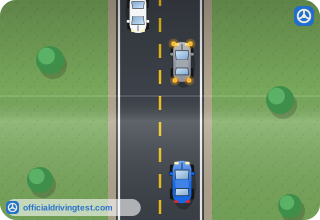
A vehicle may be stalled on the road just over a hill or around a curve. What must you be able to do?
- Stop or move around the problem
- Sound your horn and drive straight through
- Pass on the left shoulder at your normal speed
- Slow down only if you see brake lights
Show answer
Correct answer: Stop or move around the problem
You may not know what is over a hill or around a curve, so you must be able to stop or move around a stalled vehicle.
Source: Kansas Driving Handbook (Revised February 2022), page 77
-
What should you do when driving on a gravel or dirt road?
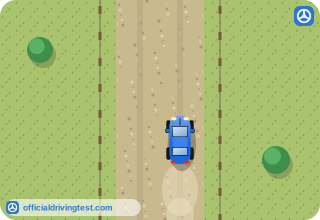
- Reduce your speed and increase your following distance
- Keep your usual speed and your usual following distance
- Increase your speed so the tires grip the surface better
- Keep your usual speed but brake earlier than normal
Show answer
Correct answer: Reduce your speed and increase your following distance
Vehicles have less traction on gravel or dirt, so you must slow down and leave more room because stopping takes much longer.
Source: Kansas Driving Handbook (Revised February 2022), page 90
-
What can a rough, rippled gravel or dirt road, formed where a series of potholes has developed, affect?
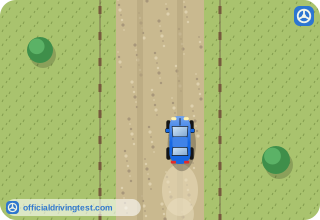
- Only the fuel economy of your vehicle
- Only the air pressure in your tires
- Steering and vehicle control
- The distance you can see ahead
Show answer
Correct answer: Steering and vehicle control
Gravel or dirt roads that become rough and rippled from a series of potholes can affect steering and vehicle control.
Source: Kansas Driving Handbook (Revised February 2022), page 90
-
On a narrow rural gravel or dirt road, what should you be prepared to do when you see a narrow bridge sign?
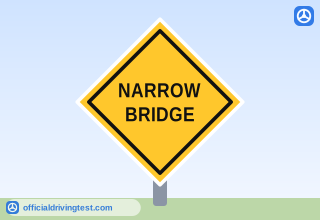
- Speed up to cross before traffic arrives
- Move onto the shoulder to let traffic pass
- Sound your horn and keep your speed
- Stop for oncoming traffic
Show answer
Correct answer: Stop for oncoming traffic
Narrow bridge signs warn that the roadway is tight, so you should be prepared to stop for oncoming traffic.
Source: Kansas Driving Handbook (Revised February 2022), page 90
-
Why should you reduce speed on open bridge gratings or steel bridges?
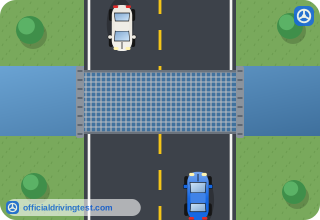
- Wind from the sides is usually stronger on them
- Vehicles ahead may stop without any warning there
- Their surface hides the lane lines from drivers
- Traction for braking and steering is reduced
Show answer
Correct answer: Traction for braking and steering is reduced
Open gratings and steel bridges reduce traction for braking and steering, so you should slow down, grip the wheel firmly and follow farther back.
Source: Kansas Driving Handbook (Revised February 2022), page 90
-
Which rural features does the manual say can create blind corners and limit your vision?
- Mailboxes and fences along the road shoulder
- Wooded areas, corn fields or other tall crops
- Open pastures and short grass fields
- Ditches and steep embankments beside the road
Show answer
Correct answer: Wooded areas, corn fields or other tall crops
Wooded areas, corn fields and other tall crops can hide what is around a corner on a rural road.
Source: Kansas Driving Handbook (Revised February 2022), page 90
-
On a rural road, what should you do before reaching the crest of a hill or before entering a curve?
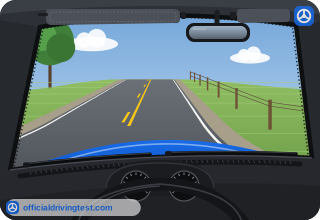
- Speed up slightly, stay near the center line and watch for oncoming vehicles
- Slow down, move toward the center of the road and sound your horn
- Slow down, move to the right side of the road and watch for oncoming vehicles
- Keep your speed, stay in the middle and flash your high beams
Show answer
Correct answer: Slow down, move to the right side of the road and watch for oncoming vehicles
Rural hills and curves are often steeper and sharper, so slow down, keep to the right and watch for oncoming vehicles.
Source: Kansas Driving Handbook (Revised February 2022), page 90
-
What does the manual say about driving on empty rural highways?
- It can be just as dangerous as driving in heavy city traffic
- It is much safer than driving in heavy city traffic
- It is safe as long as you stay on a paved road
- It becomes dangerous only after dark
Show answer
Correct answer: It can be just as dangerous as driving in heavy city traffic
It is easy to relax your attention on an empty rural highway and suddenly come upon something dangerous.
Source: Kansas Driving Handbook (Revised February 2022), page 90
-
What can looking directly into oncoming headlights cause?
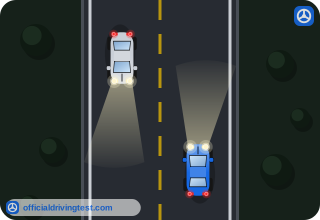
- A permanent loss of night vision
- Dizziness that lasts for several minutes
- Faster adjustment of your eyes to the dark
- Momentary blindness from the glare
Show answer
Correct answer: Momentary blindness from the glare
Looking directly into oncoming headlights can cause momentary blindness from the glare.
Source: Kansas Driving Handbook (Revised February 2022), page 91
-
When driving at night, what should you look for as you glance well ahead of your headlight beams?
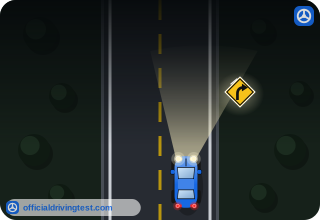
- Reflective strips on the shoulder
- Brake lights of vehicles far ahead
- Bright patches on the pavement
- Dark shapes on the roadway
Show answer
Correct answer: Dark shapes on the roadway
You should develop the ability to glance well ahead of your headlight beams, looking for dark shapes on the roadway.
Source: Kansas Driving Handbook (Revised February 2022), page 91
-
At night, why should you glance occasionally to the right and left?
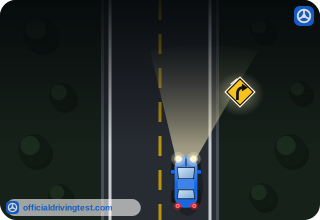
- To check the mirrors for vehicles that are following you
- To find the edge of the pavement and hazards coming from the sides
- To rest your eyes on long and straight roads
- To look for signs posted along the shoulder
Show answer
Correct answer: To find the edge of the pavement and hazards coming from the sides
Glancing right and left shows where the edge of the pavement is and any hazards that may come from the sides.
Source: Kansas Driving Handbook (Revised February 2022), page 91
-
Why should you not wear sunglasses or colored glasses when driving at night?
- They make oncoming headlights look brighter than they really are
- They make it hard to judge the distance to other vehicles ahead
- Colored lenses make your eyes adjust more slowly and can reduce vision
- They hide the glow of the dashboard lights from the driver
Show answer
Correct answer: Colored lenses make your eyes adjust more slowly and can reduce vision
Colored lenses cause your eyes to adjust even more slowly and can reduce your vision at night or on dark days.
Source: Kansas Driving Handbook (Revised February 2022), page 91
-
A safe gap when stopping behind another vehicle is to stop where you can see what?
- The license plate of the vehicle ahead
- The rear tires of the vehicle ahead
- Only the bumper of the vehicle ahead
- The brake lights of the second vehicle ahead
Show answer
Correct answer: The rear tires of the vehicle ahead
A safe gap behind another vehicle is to stop where you can see the rear tires of the vehicle ahead of you.
Source: Kansas Driving Handbook (Revised February 2022), page 104
-
During the urban part of the road test, what speed is expected?
- Drive 5 mph below the speed of traffic to stay safe
- Match the flow of traffic, even above the posted limit
- Stay well below the flow of traffic to avoid errors
- Keep up with traffic without exceeding the posted limit
Show answer
Correct answer: Keep up with traffic without exceeding the posted limit
You should keep up with the flow of traffic but not exceed the posted speed limit.
Source: Kansas Driving Handbook (Revised February 2022), page 105
-
Before entering a curve on the road test, what should you do?
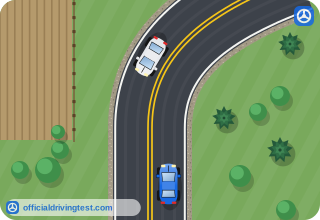
- Slow down so you need no further braking in the curve
- Brake hard in the middle of the curve to stay in lane
- Enter at the speed of traffic and brake inside the curve
- Move toward the center of the road for a wider line
Show answer
Correct answer: Slow down so you need no further braking in the curve
Before entering the curve you reduce your speed so further braking is not required in the curve.
Source: Kansas Driving Handbook (Revised February 2022), page 106
-
Which season does the manual call the most difficult driving season?
- Winter
- Spring
- Summer
- Fall
Show answer
Correct answer: Winter
Winter is the most difficult driving season because of snow and ice and fewer hours of daylight.
Source: Kansas Driving Handbook (Revised February 2022), page 109
-
When should you put snow tires on your vehicle?
- After the first snowfall
- Only once the roads become icy
- Before the first snowfall
- Once temperatures stay below freezing for a week
Show answer
Correct answer: Before the first snowfall
Make sure your vehicle has good snow tires and put them on before the first snowfall.
Source: Kansas Driving Handbook (Revised February 2022), page 109
-
On a front-wheel drive vehicle, where is it best to put snow tires or all-season tires?
- On the front wheels only
- On the rear wheels only
- On all four wheels
- On the front wheels and one rear wheel
Show answer
Correct answer: On all four wheels
On front-wheel drive vehicles, it is best to put snow tires or all-season tires on all four wheels, not just the front.
Source: Kansas Driving Handbook (Revised February 2022), page 109
-
When are studded snow tires legal?
- From November 1 through April 1
- From October 1 through March 1
- From December 1 through March 1
- From November 15 through April 15
Show answer
Correct answer: From November 1 through April 1
Studded snow tires are only legal from November 1 through April 1.
Source: Kansas Driving Handbook (Revised February 2022), page 109
-
During ice or snowstorms, especially when a weather advisory is issued, when should you drive?
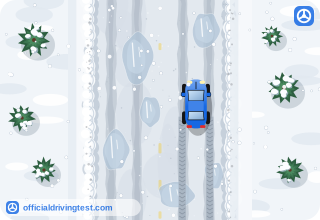
- Only during the hours of daylight
- Only at reduced speed on main roads
- Only after road crews have salted the roads
- Only when it is absolutely necessary
Show answer
Correct answer: Only when it is absolutely necessary
During ice or snowstorms, especially with a weather advisory, you should not drive unless it is absolutely necessary.
Source: Kansas Driving Handbook (Revised February 2022), page 109
-
If you must drive in an ice or snowstorm, what should you clear of ice and snow first?
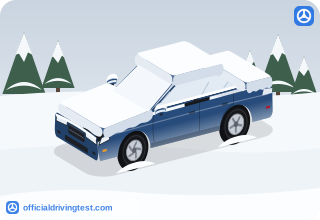
- Only the part of the windshield in front of the driver
- The headlights, taillights, wipers and all of the windows
- Only the windshield and the headlights of the vehicle
- Only the windshield and the rear window of the vehicle
Show answer
Correct answer: The headlights, taillights, wipers and all of the windows
You should first clear ice and snow from your vehicle, including the headlights and taillights, the wipers and all of the windows.
Source: Kansas Driving Handbook (Revised February 2022), page 109
-
What should you use for the windshield wipers in winter weather?
- A freeze-resistant cleaning solution in an adequately filled reservoir
- Plain water, since the reservoir does not need to be filled
- Plain water mixed with salt to keep the reservoir from freezing
- Antifreeze drained from the engine cooling system reservoir
Show answer
Correct answer: A freeze-resistant cleaning solution in an adequately filled reservoir
Use a freeze-resistant cleaning solution for the wipers and be sure the reservoir is filled adequately.
Source: Kansas Driving Handbook (Revised February 2022), page 109
-
In ice and snow, even if your vehicle has good traction, how should you drive?
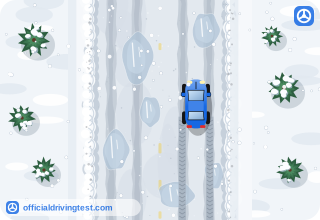
- At the posted speed, since good traction keeps you safe
- Faster than other drivers so you clear the storm sooner
- Slowly, because other drivers will be traveling with caution
- At normal speed in the left lane
Show answer
Correct answer: Slowly, because other drivers will be traveling with caution
Drive slowly and do not disrupt the flow of traffic by driving faster than everyone else drives.
Source: Kansas Driving Handbook (Revised February 2022), page 109
-
When sleet, freezing rain or snow starts to fall, which road surfaces are likely to freeze first?
- Long straight rural roads
- Bridges, ramps and overpasses
- Roads in open, sunny areas
- Roads with a raised curb
Show answer
Correct answer: Bridges, ramps and overpasses
Bridges, ramps and overpasses are likely to freeze first when sleet, freezing rain or snow starts to fall.
Source: Kansas Driving Handbook (Revised February 2022), page 109
-
What should you be aware of after road crews have cleared the roadways in winter?
- The road is safe at the normal speed
- Ice cannot form again until the next storm
- Snow tires are no longer needed
- Slippery spots may remain
Show answer
Correct answer: Slippery spots may remain
Slippery spots may remain after road crews have cleared the roadways.
Source: Kansas Driving Handbook (Revised February 2022), page 109