Kansas: Speed and following distance — Part 2 Practice Test
Kansas speed limits, stopping distances, scanning ahead, space around your vehicle, night driving and driving in bad weather. — Part 2
Independent educational site · not affiliated with any government agency or DMV
Ready? Test yourself
- Instant feedback with an explanation
- Every answer cites its source in the manual
- Your best score is saved on this device
Questions are original and based on the official manual "Kansas Driving Handbook" (Revised February 2022), Kansas Department of Revenue, Division of Vehicles.
All 33 questions in this practice test
Take the test above first, then use this list to study. Tap “Show answer” to see the correct answer and explanation.
Show the questions and answersHide the questions
-
At 50 mph on dry pavement with good brakes, about how far can braking distance be?
- 90 feet
- 210 feet
- 300 feet
- 158 feet
Show answer
Correct answer: 158 feet
At 50 mph on dry pavement with good brakes, braking can take about 158 feet.
Source: Kansas Driving Handbook (Revised February 2022), page 58
-
What does total stopping distance include?
- Perception distance, reaction distance and braking distance
- Reaction distance and braking distance only, with no perception distance
- Braking distance only, in ideal conditions with good brakes
- Perception distance and braking distance only, without reaction
Show answer
Correct answer: Perception distance, reaction distance and braking distance
Total stopping distance is the total minimum distance traveled with everything considered, including perception distance, reaction distance and braking distance.
Source: Kansas Driving Handbook (Revised February 2022), page 58
-
At 50 mph, what is the minimum total stopping distance in ideal conditions?
- 150 feet
- 190 feet
- 268 feet
- 358 feet
Show answer
Correct answer: 268 feet
At 50 mph your vehicle will travel a minimum of 268 feet before it can be brought to a complete stop.
Source: Kansas Driving Handbook (Revised February 2022), page 58
-
When you double your speed from 20 to 40 mph, how much greater is the impact in a crash?
- 2 times greater
- 4 times greater
- 3 times greater
- 6 times greater
Show answer
Correct answer: 4 times greater
Doubling speed from 20 to 40 mph makes the impact 4 times greater, and the braking distance is also 4 times longer.
Source: Kansas Driving Handbook (Revised February 2022), page 59
-
When you triple your speed from 20 to 60 mph, how much greater are the impact and braking distance?
- 3 times greater
- 6 times greater
- 12 times greater
- 9 times greater
Show answer
Correct answer: 9 times greater
Tripling speed from 20 to 60 mph makes the impact and braking distance 9 times greater.
Source: Kansas Driving Handbook (Revised February 2022), page 59
-
Compared with 20 mph, how much greater are the impact and braking distance at 80 mph?
- 16 times greater
- 4 times greater
- 8 times greater
- 12 times greater
Show answer
Correct answer: 16 times greater
Increasing speed to 80 mph makes the impact and braking distance 16 times greater than at 20 mph.
Source: Kansas Driving Handbook (Revised February 2022), page 59
-
At 60 mph, your stopping distance is greater than that of what?
- A basketball court
- A city bus
- A football field
- A swimming pool
Show answer
Correct answer: A football field
At 60 mph your stopping distance is greater than that of a football field.
Source: Kansas Driving Handbook (Revised February 2022), page 59
-
What does stopping suddenly usually mean, according to the manual?
- The vehicle ahead stopped without warning and gave you no time
- You are not paying attention to traffic flow or are following too closely
- Your brakes are too sensitive for the weight of your vehicle
- You are driving below the speed limit for the road you are on
Show answer
Correct answer: You are not paying attention to traffic flow or are following too closely
Stopping suddenly is dangerous and usually means you are not paying attention to the traffic flow or following others too closely.
Source: Kansas Driving Handbook (Revised February 2022), page 59
-
To avoid panic stops, how far ahead of your vehicle should you look at least?
- Two seconds
- Four seconds
- One block
- Ten seconds
Show answer
Correct answer: Ten seconds
Looking at least ten seconds ahead lets you see events and problems early, so you can slow down early or change lanes instead of making sudden stops.
Source: Kansas Driving Handbook (Revised February 2022), page 59
-
Which describes driving safely, according to the manual?
- Adjusting speed for roadway and traffic conditions
- Always driving at the maximum posted limit
- Matching the speed of the fastest vehicle nearby
- Following closely to keep traffic moving
Show answer
Correct answer: Adjusting speed for roadway and traffic conditions
Driving safely means adjusting your speed for roadway and traffic conditions, seeing well ahead, providing an adequate following interval and obeying the speed limits.
Source: Kansas Driving Handbook (Revised February 2022), page 59
-
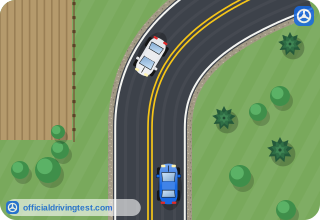
When should you reduce your speed for a curve?
- After reaching the middle of the curve
- Once the tires begin to slide
- Before entering the curve
- Only when a warning sign is posted
Show answer
Correct answer: Before entering the curve
You should always reduce speed before entering the curve to a safe speed.
Source: Kansas Driving Handbook (Revised February 2022), page 59
-
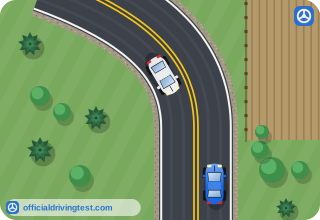
The manual describes a safe speed for a curve as a speed that allows you to do what?
- Brake firmly in the middle of the curve to hold your speed
- Apply slight and constant acceleration through the curve
- Coast through the curve with no pressure on any pedal
- Hold the steering wheel perfectly straight the whole way
Show answer
Correct answer: Apply slight and constant acceleration through the curve
A safe speed for a curve is one that allows you to apply slight and constant acceleration through the curve.
Source: Kansas Driving Handbook (Revised February 2022), page 59
-
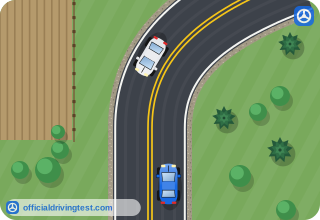
Why will your tires lose traction if you drive too fast in a curve?
- The road is always higher on the inside of the curve
- The tires heat up and grip more slowly in a curve
- The steering wheel locks up at high speeds
- The vehicle’s momentum wants to continue straight
Show answer
Correct answer: The vehicle’s momentum wants to continue straight
If you drive too fast in a curve, the vehicle’s momentum wants to continue straight (the inertia effect) and the tires lose traction.
Source: Kansas Driving Handbook (Revised February 2022), page 59
-
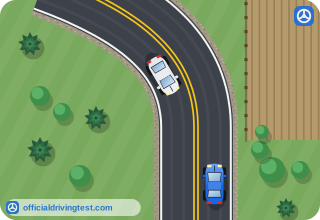
What could hard braking after the entry to a curve cause?
- The vehicle tires to lose traction
- The brakes to lock permanently
- The steering to become lighter
- The engine to stall
Show answer
Correct answer: The vehicle tires to lose traction
Hard braking after the entry to a curve could cause the vehicle tires to lose traction.
Source: Kansas Driving Handbook (Revised February 2022), page 59
-
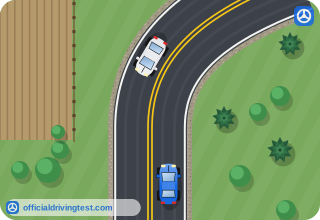
In which situation should you reduce your speed even more in a curve?
- When the pavement is dry and traction is good
- When no other vehicles are around
- When you cannot see the end of the curve
- When you are driving in daylight
Show answer
Correct answer: When you cannot see the end of the curve
You should reduce speed more in a curve when traction is poor, when following other vehicles or when you cannot see the end of the curve.
Source: Kansas Driving Handbook (Revised February 2022), page 59
-
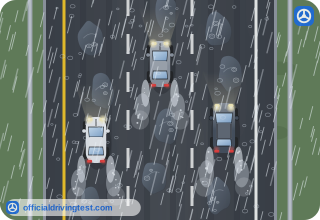
When should you reduce your speed because of rain, snow or sleet?
- Only after the road is covered
- At the first sign of it
- Only after your tires start to slip
- Only when visibility is under 100 feet
Show answer
Correct answer: At the first sign of it
You should reduce speed at the first sign of rain, snow or sleet.
Source: Kansas Driving Handbook (Revised February 2022), page 59
-
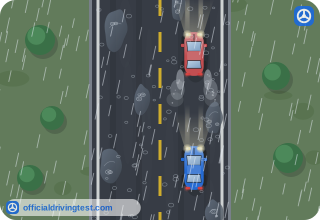
Why is the road more slippery when rain, snow or sleet first starts?
- The water freezes as soon as it touches the hot pavement
- Tires have much less tread when they are cold outside
- The pavement has just been washed clean of oil and dirt
- The water mixes with dirt, oil and other substances on the roadway
Show answer
Correct answer: The water mixes with dirt, oil and other substances on the roadway
Roadways are more slippery when it first starts to rain, snow or sleet because the water mixes with dirt, oil and other substances on the roadway.
Source: Kansas Driving Handbook (Revised February 2022), page 59
-
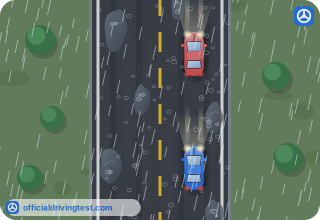
Why can a sudden rain on a hot day make the pavement very slippery for the first few minutes?
- Heat causes the oil in the asphalt to come to the top of the surface
- Heat makes the rain freeze as soon as it lands on the road
- Hot tires cannot grip wet pavement as well as cool ones
- Rain washes loose sand and gravel onto the roadway
Show answer
Correct answer: Heat causes the oil in the asphalt to come to the top of the surface
Heat causes the oil in the asphalt roadway to come to the top, so a sudden rain on a hot day makes the pavement very slippery until the oil is washed off.
Source: Kansas Driving Handbook (Revised February 2022), page 59
-
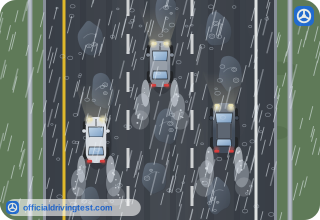
By about how much should you reduce your speed below recommended speeds on wet roadways?
- About 5 mph
- About 20 mph
- About 10 mph
- About 30 mph
Show answer
Correct answer: About 10 mph
On wet roadways you should reduce speed about 10 mph below recommended speeds to allow for extra stopping distance and possible traction loss while steering.
Source: Kansas Driving Handbook (Revised February 2022), page 59
-
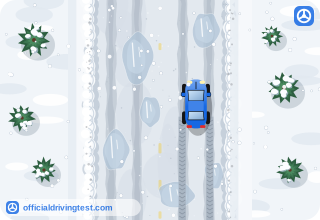
How much should you reduce your speed when there is packed snow on the road?
- By about 5 mph
- By half or more
- By about a quarter
- By about 15 mph
Show answer
Correct answer: By half or more
If there is packed snow on the road, you should reduce your speed by half or more.
Source: Kansas Driving Handbook (Revised February 2022), page 59
-
When may vehicles in Kansas be equipped with studded snow tires?
- From October 1st to March 1st each year
- From December 1st to March 1st each year
- At any time of the year
- From November 1st to April 1st each year
Show answer
Correct answer: From November 1st to April 1st each year
Vehicles in Kansas may be equipped with studded snow tires from November 1st to April 1st each year.
Source: Kansas Driving Handbook (Revised February 2022), page 59
-
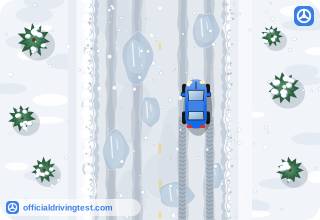
What does the manual say to do about ice-covered roadways if it is possible?
- Do not drive on them
- Drive on the highest part of the road
- Drive close to the guardrail
- Drive at the normal speed with your lights on
Show answer
Correct answer: Do not drive on them
Ice-covered roadways are especially dangerous, so if possible you should not drive on them.
Source: Kansas Driving Handbook (Revised February 2022), page 59
-
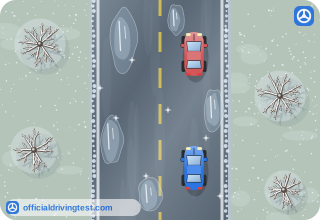
Why are ice-covered roadways especially dangerous because of the normal design for roadway drainage?
- They are flat, so water cannot drain away
- They are higher at the sides, so a skidding vehicle slides toward the center
- They are higher in the center and sloped to the side, so a skidding vehicle slides off
- They are sloped uphill, so a skidding vehicle rolls backward
Show answer
Correct answer: They are higher in the center and sloped to the side, so a skidding vehicle slides off
Roadways are higher in the center and sloped to the side, causing a skidding vehicle to slide off the roadway into a guardrail or drainage ditch.
Source: Kansas Driving Handbook (Revised February 2022), page 59
-
Why can shady spots be ice-covered on cold, wet days?
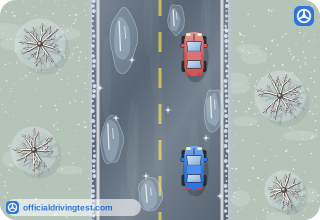
- Sunlight melts ice only on the shaded side of the road
- Shade-covered areas often freeze first and dry out last
- Shaded pavement is always much warmer
- Trees drop water that freezes only in daylight
Show answer
Correct answer: Shade-covered areas often freeze first and dry out last
Shady spots can be ice-covered on cold, wet days because shade-covered areas often freeze first and dry out last on the roadway.
Source: Kansas Driving Handbook (Revised February 2022), page 60
-
Why can bridges, overpasses and underpasses be ice-covered when other pavement is clear of ice?
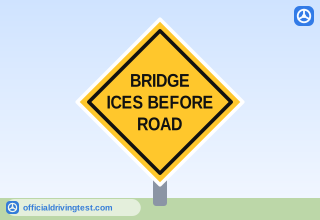
- They are built from a different kind of pavement that cannot be salted
- Traffic moves faster there and cools the surface
- They are always shaded by the road above
- They have no earth underneath to insulate them against the cold
Show answer
Correct answer: They have no earth underneath to insulate them against the cold
Bridges do not have earth underneath them to help insulate them against the cold, so they can be colder and more ice-covered than other roadways.
Source: Kansas Driving Handbook (Revised February 2022), page 60
-
When is ice more slippery?
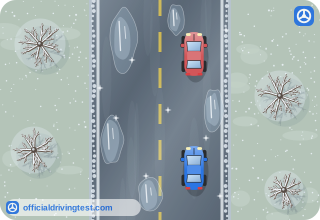
- When the temperature is near freezing and the ice is wet
- When it is well below freezing and the ice is dry
- When it is covered by a thin layer of dry snow
- When the road is in direct sunlight
Show answer
Correct answer: When the temperature is near freezing and the ice is wet
When the temperature is near the freezing point ice-covered areas can become wet, and water over ice is more slippery than ice at temperatures well below freezing.
Source: Kansas Driving Handbook (Revised February 2022), page 60
-
What is the loss of tire contact with the road on pooled water called?
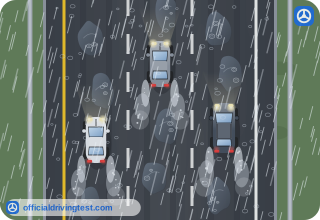
- The inertia effect
- Wheel fade
- Hydroplaning
- Tread lock
Show answer
Correct answer: Hydroplaning
The tire loss of roadway contact when steering tires ride up on pooled water is called hydroplaning.
Source: Kansas Driving Handbook (Revised February 2022), page 60
-
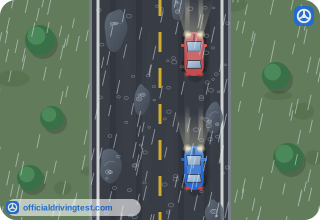
On a wet road, above what speed will the steering tires start to ride up on pooled water like water skis?
- Faster than 15 mph
- Faster than 35 mph
- Faster than 20 mph
- Faster than 55 mph
Show answer
Correct answer: Faster than 35 mph
As you go faster than 35 mph, the steering tires will start to ride up on any pooled water, similar to the action of water skis.
Source: Kansas Driving Handbook (Revised February 2022), page 60
-
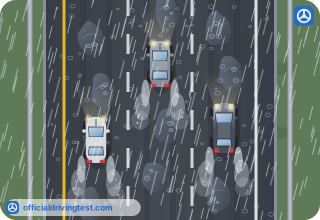
In a heavy rain, at what speed can your tires lose all traction with the road?
- 15-20 mph
- 60-65 mph
- 70-75 mph
- 45-50 mph
Show answer
Correct answer: 45-50 mph
In a heavy rain your tires can lose all traction at 45-50 mph because water pushes against the tires as the vehicle moves forward.
Source: Kansas Driving Handbook (Revised February 2022), page 60
-
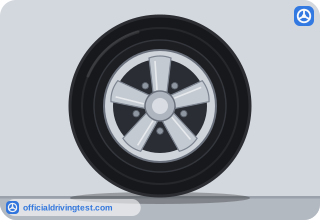
At what speeds will badly worn tires lose traction on a wet road?
- 25-30 mph
- 10-15 mph
- 55-60 mph
- 65-70 mph
Show answer
Correct answer: 25-30 mph
Badly worn tires will lose traction at much lower speeds, 25-30 mph.
Source: Kansas Driving Handbook (Revised February 2022), page 60
-
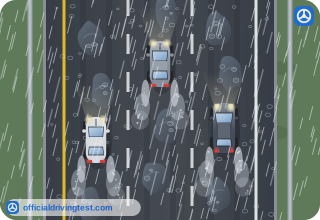
What is the best way to avoid traction loss from hydroplaning?
- Brake hard as soon as you feel the tires start to lift
- Steer sharply to keep your vehicle on the pavement
- Slow down in the rain or when the road has pooled water
- Drive in the center of the lane with both hands
Show answer
Correct answer: Slow down in the rain or when the road has pooled water
The best way to avoid traction loss from hydroplaning is to slow down in the rain or when the road is wet with pooled water or puddles.
Source: Kansas Driving Handbook (Revised February 2022), page 60
-
Crashes involving two or more vehicles often happen when drivers do what?
- Drive exactly at the posted speed limit in the right lane
- Move significantly faster or slower than other vehicles on the roadway
- Keep a long following distance behind the vehicle ahead
- Travel in the same direction at the same speed as the traffic
Show answer
Correct answer: Move significantly faster or slower than other vehicles on the roadway
Crashes involving two or more vehicles often happen when drivers move significantly faster or slower than other vehicles on the roadway.
Source: Kansas Driving Handbook (Revised February 2022), page 60
-
Vehicles moving in the same direction at the same speed cannot hit one another, provided what?
- They stay in the left lane of the roadway
- They use their turn signals all the time
- They keep their headlights on at all times
- They keep an adequate following distance
Show answer
Correct answer: They keep an adequate following distance
Vehicles moving in the same direction at the same speed with adequate following distance cannot hit one another.
Source: Kansas Driving Handbook (Revised February 2022), page 60