Kansas: Signals and vehicle controls — Part 3 Practice Test
Seat and mirror adjustment, starting, accelerating, stopping, steering methods, backing, turn signals, headlights, the horn and the pre-trip vehicle safety inspection. — Part 3
Independent educational site · not affiliated with any government agency or DMV
Ready? Test yourself
- Instant feedback with an explanation
- Every answer cites its source in the manual
- Your best score is saved on this device
Questions are original and based on the official manual "Kansas Driving Handbook" (Revised February 2022), Kansas Department of Revenue, Division of Vehicles.
All 33 questions in this practice test
Take the test above first, then use this list to study. Tap “Show answer” to see the correct answer and explanation.
Show the questions and answersHide the questions
-
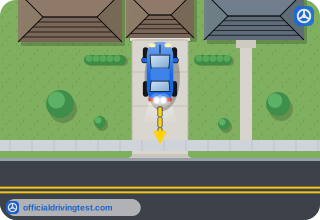
How long should you continue looking to the rear when backing?
- Until the vehicle reaches walking speed
- Until the front wheels are straight
- Until you have backed about one car length
- Until you come to a complete stop
Show answer
Correct answer: Until you come to a complete stop
You continue looking to the rear until coming to a complete stop.
Source: Kansas Driving Handbook (Revised February 2022), page 32
-
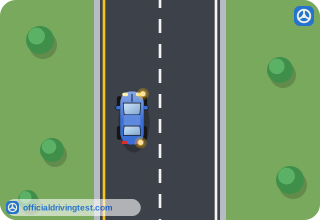
Before changing lanes, where must you check for traffic?
- Only in the lane you are leaving, not the new one
- Only ahead of your vehicle in your current lane
- In the lane you want to enter and behind your vehicle
- Only on the opposite side of the road from you
Show answer
Correct answer: In the lane you want to enter and behind your vehicle
Before changing lanes you must check for traffic in the lane you want to enter and behind your vehicle.
Source: Kansas Driving Handbook (Revised February 2022), page 58
-
Which of these does the manual include in changing lanes?
- Slowing down while staying in the same lane
- Entering the roadway from the curb or shoulder
- Stopping at a red light at an intersection
- Driving straight in your own lane at one speed
Show answer
Correct answer: Entering the roadway from the curb or shoulder
Changing lanes includes moving from one travel lane to another, merging from an entrance ramp, moving from a yield intersection, or entering the roadway from the curb or shoulder.
Source: Kansas Driving Handbook (Revised February 2022), page 58
-
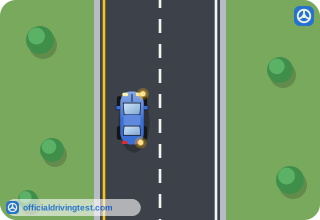
How do you check your blind spots before changing lanes?
- Adjust your rearview mirror and look into it twice before you move over
- Glance at your side mirrors only and then change lanes quickly
- Turn on your signal and wait for the other drivers to move over
- Turn your head and look over your shoulder in the direction you plan to move
Show answer
Correct answer: Turn your head and look over your shoulder in the direction you plan to move
You check blind spots by turning your head and looking over your shoulder in the direction you plan to move.
Source: Kansas Driving Handbook (Revised February 2022), page 58
-
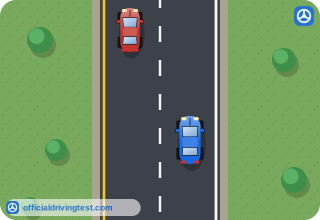
What are blind spots?
- Areas around your vehicle that you cannot see with your mirrors
- Parts of the road hidden by hills or sharp curves ahead
- Areas of the roadway beyond the reach of your headlights
- Spots on the windshield where the wipers cannot clean
Show answer
Correct answer: Areas around your vehicle that you cannot see with your mirrors
Blind spots are areas around your vehicle that you cannot see with your mirrors, so be sure no one is near the rear corners of your vehicle.
Source: Kansas Driving Handbook (Revised February 2022), page 58
-
Why should you look several times, rather than once for a long time, when checking the sides, rear or over your shoulder?
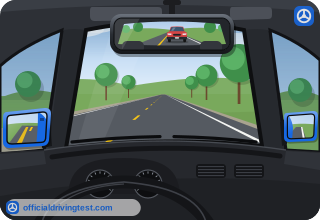
- Your mirrors need time to adjust
- The vehicle beside you may speed up
- Traffic ahead of you could stop suddenly
- Your turn signal takes time to start
Show answer
Correct answer: Traffic ahead of you could stop suddenly
Traffic ahead of you could stop suddenly while you are checking to the sides or rear, so look several times and avoid looking too long at any one time.
Source: Kansas Driving Handbook (Revised February 2022), page 58
-
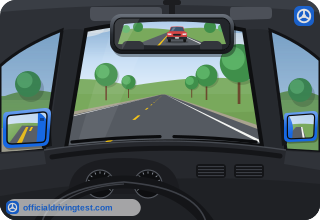
When should you use your mirrors to check behind your vehicle?
- Only when you stop
- Only when you change lanes
- Only when you drive on a highway
- Whenever you slow down
Show answer
Correct answer: Whenever you slow down
You should use your mirrors to check behind you whenever you slow down, especially when slowing quickly or where a following driver would not expect it, such as private driveways or parking spaces.
Source: Kansas Driving Handbook (Revised February 2022), page 58
-
What is an anti-lock braking system (ABS) designed to do?
- Lock the wheels quickly so the vehicle comes to a stop sooner
- Shorten the stopping distance on every kind of road surface
- Allow you to steer and brake at the same time without losing balance
- Keep the engine from stalling when you brake hard on a hill
Show answer
Correct answer: Allow you to steer and brake at the same time without losing balance
ABS is designed to allow steering and braking at the same time without losing vehicle balance.
Source: Kansas Driving Handbook (Revised February 2022), page 62
-
On which kind of surface does ABS generally shorten stopping distances?
- Dry pavement where tires already have good grip
- Straight, level roads with no traction loss
- Smooth roads with light traffic at low speed
- Wet surfaces where traction loss is a serious problem
Show answer
Correct answer: Wet surfaces where traction loss is a serious problem
ABS does not necessarily shorten stopping distances on dry pavement, but it generally does on wet surfaces where traction loss can be serious.
Source: Kansas Driving Handbook (Revised February 2022), page 62
-
In the ABS basics Search, Stomp, Steer, what do you do in the Stomp step?
- Tap the brake pedal repeatedly
- Press the brake pedal firmly
- Press the accelerator and steer
- Release the brake pedal gradually
Show answer
Correct answer: Press the brake pedal firmly
The ABS basics are to search for open space, stomp on the brake pedal firmly, and steer to the open space.
Source: Kansas Driving Handbook (Revised February 2022), page 62
-
How can you tell from your instrument panel whether your vehicle has ABS?
- A warning light stays on steadily the whole time you drive
- A dashboard gauge shows ABS pressure while you brake
- The ABS light comes on when you start the vehicle and then dims
- A light flashes every time you press the brake pedal
Show answer
Correct answer: The ABS light comes on when you start the vehicle and then dims
When you start a vehicle with ABS, the ABS light illuminates and then dims, so seeing the indicator light means you have ABS.
Source: Kansas Driving Handbook (Revised February 2022), page 62
-
If the ABS light stays lit after you start your vehicle, what does it mean?
- The ABS is not working correctly
- The ABS is working and ready for use
- The brakes have just been adjusted
- The ABS is switched off for dry roads
Show answer
Correct answer: The ABS is not working correctly
The ABS light should illuminate and then dim at start-up; if it stays lit, the ABS is not working correctly.
Source: Kansas Driving Handbook (Revised February 2022), page 62
-
What does ESP stand for?
- Electronic Stability Program
- Emergency Safety Procedure
- Engine Speed Protection
- Electronic Steering Pilot
Show answer
Correct answer: Electronic Stability Program
ESP stands for Electronic Stability Program, a system that monitors the traction available to the vehicle.
Source: Kansas Driving Handbook (Revised February 2022), page 62
-
What does ESP do when it senses a traction problem?
- Locks all four wheels at once to stop the vehicle quickly
- Increases engine power to help the vehicle pull out of a skid
- Selectively applies a vehicle brake to reduce the chance of a skid
- Steers the vehicle automatically back into its own lane
Show answer
Correct answer: Selectively applies a vehicle brake to reduce the chance of a skid
When ESP senses a traction problem it selectively applies any one of the vehicle brakes to reduce the possibility of a skid.
Source: Kansas Driving Handbook (Revised February 2022), page 62
-
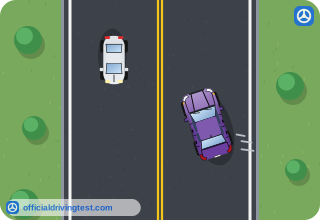
In a loss of traction in a vehicle with ESP, what should you do?
- Steer sharply away from the direction you are looking and brake hard
- Steer toward the direction you are looking and avoid abrupt steering
- Let go of the wheel and allow the ESP to steer for you
- Turn the wheel quickly back and forth to regain traction
Show answer
Correct answer: Steer toward the direction you are looking and avoid abrupt steering
With ESP in a traction loss, you should steer toward the direction you are looking and avoid abrupt steering.
Source: Kansas Driving Handbook (Revised February 2022), page 62
-
According to the manual, why do crashes often happen?
- Headlights are not bright enough to light the roadway ahead
- Roads are not wide enough for the number of vehicles
- Drivers do not know how fast other vehicles are going
- A driver fails to see another driver or does something unexpected
Show answer
Correct answer: A driver fails to see another driver or does something unexpected
Crashes often happen because one driver does not see another driver, or because one driver does something the other driver does not expect.
Source: Kansas Driving Handbook (Revised February 2022), page 67
-
What should you do if your vehicle is not equipped with daytime running lights?
- Turn on your headlights
- Turn on your hazard flashers
- Use only your parking lights
- Keep your headlights off during the day
Show answer
Correct answer: Turn on your headlights
Always turn your headlights on, and remember to turn them on if your vehicle has no daytime running light system.
Source: Kansas Driving Handbook (Revised February 2022), page 67
-
How can you alert other roadway users that your vehicle is there, if needed?
- Turn on your windshield wipers
- Open your driver's side window
- Flick your headlights
- Switch on the interior dome light
Show answer
Correct answer: Flick your headlights
The manual says that, if needed, you can flick your headlights to alert other roadway users that your vehicle is there.
Source: Kansas Driving Handbook (Revised February 2022), page 67
-
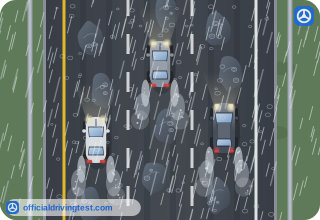
On rainy, snowy, or foggy days, what do headlights do?
- Allow you to drive at the same speed as in clear weather
- Replace the need to increase your following distance
- Are required to be set on high beam in these conditions
- Make your vehicle easier for other drivers to see
Show answer
Correct answer: Make your vehicle easier for other drivers to see
On rainy, snowy, or foggy days it is sometimes hard for other drivers to see your vehicle, and headlights make it easier to see.
Source: Kansas Driving Handbook (Revised February 2022), page 67
-
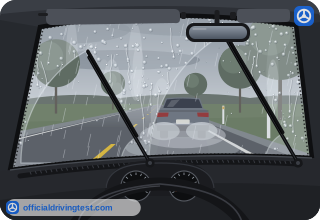
In Kansas, when are you required to turn on your headlights in relation to your windshield wipers?
- Only when you use the wipers during the nighttime
- Whenever the wipers are used on the vehicle
- Only when rain has been falling for ten minutes
- Only when the wipers are on their fastest setting
Show answer
Correct answer: Whenever the wipers are used on the vehicle
The manual says Kansas requires you to turn on your headlights whenever the wipers are used on the vehicle.
Source: Kansas Driving Handbook (Revised February 2022), page 67
-
You are driving away from a rising or setting sun. What does the manual tell you to do with your headlights?
- Turn them on, so drivers coming toward you can see your vehicle
- Leave them off, because the low sun already lights up your vehicle
- Turn them on only after it is completely dark
- Switch them to high beams only when a vehicle approaches
Show answer
Correct answer: Turn them on, so drivers coming toward you can see your vehicle
Drivers coming toward you may have trouble seeing your vehicle in that glare, and your headlights help them see it.
Source: Kansas Driving Handbook (Revised February 2022), page 68
-
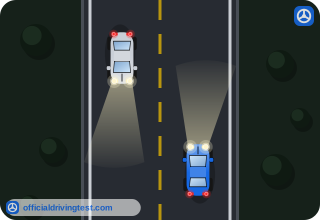
What can happen if your headlights are not properly adjusted?
- They will wear out much faster and need replacing every month
- They will switch off whenever you use the turn signal
- They will not give you a good view, and they can blind other drivers
- They will light only the shoulder and not the lane ahead
Show answer
Correct answer: They will not give you a good view, and they can blind other drivers
Headlights that are not adjusted properly do not give you a good view and can blind other drivers, so a qualified person should adjust them.
Source: Kansas Driving Handbook (Revised February 2022), page 68
-
Which situation calls for a SHARP BLAST of the horn rather than a light tap?
- You are approaching a steep hill that limits your view ahead
- You are driving around a sharp curve with limited visibility
- You are exiting a narrow alley
- Your vehicle is in danger of hitting another roadway user
Show answer
Correct answer: Your vehicle is in danger of hitting another roadway user
When there is danger, such as your vehicle about to hit another roadway user, you should not be afraid to use a sharp blast.
Source: Kansas Driving Handbook (Revised February 2022), page 68
-
On which occasion should you NOT use your horn?
- When a driver is not paying attention to your vehicle
- When you are passing a driver who starts to turn into your lane
- When you are near blind pedestrians
- When you are exiting a narrow alley with limited visibility
Show answer
Correct answer: When you are near blind pedestrians
Being near blind pedestrians is one of the occasions the manual lists for not using the horn.
Source: Kansas Driving Handbook (Revised February 2022), page 68
-
Which use of the horn is one of the occasions the manual says to avoid?
- Greeting a friend
- Warning a pedestrian who appears to be moving into your lane
- Getting the attention of a driver who may have trouble seeing you
- Warning another driver on a sharp curve with limited visibility
Show answer
Correct answer: Greeting a friend
Greeting a friend is one of the occasions listed for not using your horn.
Source: Kansas Driving Handbook (Revised February 2022), page 68
-
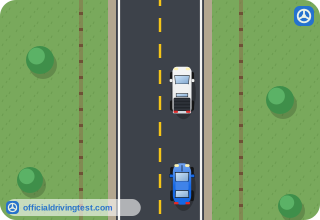
You are stuck behind a slow vehicle. Does the manual say to use your horn to move it along?
- Yes, one short honk is the proper way to ask a slower driver to move over
- Yes, but only if the vehicle is going more than 10 mph under the limit
- Yes, a sharp blast is the right way to tell a driver to get out of the way
- No, encouraging someone to get out of the way is a time not to use the horn
Show answer
Correct answer: No, encouraging someone to get out of the way is a time not to use the horn
The manual lists encouraging someone to drive faster or get out of the way as an occasion when you should not use your horn.
Source: Kansas Driving Handbook (Revised February 2022), page 68
-
You see another driver make an error. What does the manual say about using your horn?
- Give it a light tap so the driver knows what went wrong
- Do not use it to tell other drivers of an error
- Use a sharp blast so the driver does not repeat the error
- Use it twice, once as a warning and once as a reminder
Show answer
Correct answer: Do not use it to tell other drivers of an error
Telling other drivers of an error is one of the occasions listed for not using your horn.
Source: Kansas Driving Handbook (Revised February 2022), page 68
-
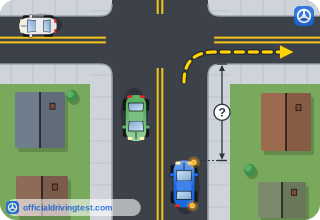
At speeds above 40 mph, how far before making a turn or a lane change should you signal?
- 200 feet
- 50 feet
- 300 feet
- 500 feet
Show answer
Correct answer: 200 feet
At speeds above 40 mph you signal 200 feet before making a turn or a lane change.
Source: Kansas Driving Handbook (Revised February 2022), page 69
-
You want to turn at an intersection, but a side street enters just before it. When should you signal?
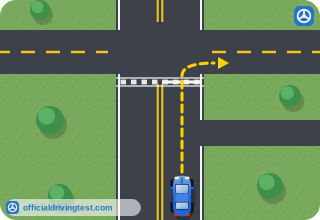
- As early as possible, before you reach the side street
- Only at the moment you begin to turn
- After you have passed the side street
- Before the side street, but with the horn tapped lightly
Show answer
Correct answer: After you have passed the side street
Waiting until you have passed the side street keeps a driver waiting there from pulling into your travel path.
Source: Kansas Driving Handbook (Revised February 2022), page 69
-
Which should you use before lane changes or merge areas?
- The emergency flashers, held on for a few seconds before moving over
- The lane change device, holding the signal device halfway up or down
- A light tap on the horn to warn the drivers beside you
- Three or four light taps on the brake pedal
Show answer
Correct answer: The lane change device, holding the signal device halfway up or down
Holding the signal device halfway up or down uses the lane change device, which signals the lane change or merge.
Source: Kansas Driving Handbook (Revised February 2022), page 69
-
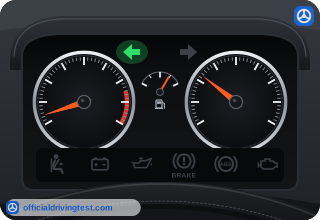
After you make a turn or lane change, the turn signal has not cancelled by itself. What must you do?
- Leave it on until your next turn
- Wait for the next intersection and cancel it there
- Flash your headlights so others know the signal is a mistake
- Cancel it yourself, so other roadway users do not become confused
Show answer
Correct answer: Cancel it yourself, so other roadway users do not become confused
Drivers must cancel the signal if it has not cancelled by itself, so other roadway users are not confused by an incorrect signal.
Source: Kansas Driving Handbook (Revised February 2022), page 70
-
You must stop or slow at a place where another driver may not expect it. How can you warn the drivers behind you?
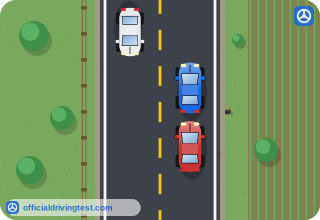
- Press the brake pedal firmly one time and release it
- Sound a sharp blast on the horn as you slow down
- Tap the brake pedal three or four times lightly
- Turn on your emergency flashers until you stop
Show answer
Correct answer: Tap the brake pedal three or four times lightly
Tapping the brake pedal three or four times lightly warns other roadway users that you are slowing down.
Source: Kansas Driving Handbook (Revised February 2022), page 70
-
How early should you reduce speed when you need to slow down?
- As early as it is safe to do so
- As late as possible, to keep traffic moving
- Only after the driver behind you honks
- Only after you can see the stopped traffic
Show answer
Correct answer: As early as it is safe to do so
The manual says to always reduce speed as early as it is safe to do so.
Source: Kansas Driving Handbook (Revised February 2022), page 70