Kansas: Sharing the road — Part 3 Practice Test
Bicyclists, motorcycles, large trucks and their No-Zones, buses, school buses, slow-moving vehicles and aggressive drivers. — Part 3
Independent educational site · not affiliated with any government agency or DMV
Ready? Test yourself
- Instant feedback with an explanation
- Every answer cites its source in the manual
- Your best score is saved on this device
Questions are original and based on the official manual "Kansas Driving Handbook" (Revised February 2022), Kansas Department of Revenue, Division of Vehicles.
All 35 questions in this practice test
Take the test above first, then use this list to study. Tap “Show answer” to see the correct answer and explanation.
Show the questions and answersHide the questions
-
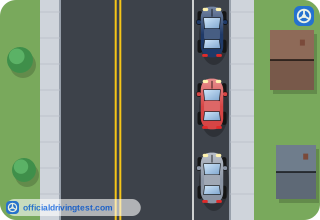
You are parked on the street. What should you check for before you open your vehicle door?
- Only vehicles in front of you
- Pedestrians on the sidewalk only
- Bicyclists to the sides and rear
- Nothing, if you are parked at a curb
Show answer
Correct answer: Bicyclists to the sides and rear
When parked on the street, check to the sides and rear for bicyclists before you open your door.
Source: Kansas Driving Handbook (Revised February 2022), page 82
-
In the "Dutch Reach" method of leaving your vehicle, which hand does the motorist use to pull the handle and open the door?
- Their left hand
- Their right hand
- Both hands together
- Whichever hand is nearer the door
Show answer
Correct answer: Their right hand
Using the right hand to open the door turns the body, giving better visibility of traffic approaching from the rear.
Source: Kansas Driving Handbook (Revised February 2022), page 82
-
Besides before opening your door, when else should you check for bicyclists in your path?
- Before turning on your headlights
- Before shifting into park
- Before adjusting your mirrors
- Before backing
Show answer
Correct answer: Before backing
You should check for bicyclists in your path before backing, especially near schools or residential areas.
Source: Kansas Driving Handbook (Revised February 2022), page 82
-
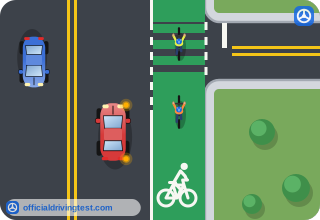
A bicyclist is in a bike lane. When may the bicyclist leave it?
- Whenever the lane has no other bicyclists
- To ride against oncoming traffic on a quiet neighborhood street
- To park in the traffic lane
- To go straight through an intersection or make a left-hand turn
Show answer
Correct answer: To go straight through an intersection or make a left-hand turn
A bike lane does not preclude the bicyclist from exiting it to proceed straight through an intersection and avoid a collision, as well as to make a left-hand turn.
Source: Kansas Driving Handbook (Revised February 2022), page 82
-
What are bikeways or bike routes?
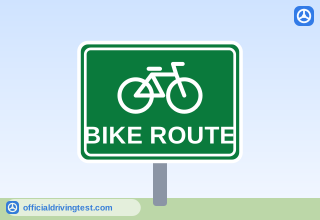
- Roads with lower traffic volumes recommended for use by bicycles
- Lanes marked with solid white lines along the right side
- Roads that are closed to all motor vehicle traffic
- Roads with the highest traffic volumes
Show answer
Correct answer: Roads with lower traffic volumes recommended for use by bicycles
Bikeways or bike routes are roads with lower traffic volumes that are recommended for bicycles because of the lower potential for collisions and greater ease of use.
Source: Kansas Driving Handbook (Revised February 2022), page 83
-
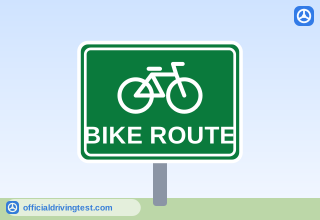
Which kinds of roads are commonly used as bike routes?
- Freeway shoulders
- Major highways and high-speed roads
- Side roads and neighborhood roads
- Roads inside parking lots
Show answer
Correct answer: Side roads and neighborhood roads
Bike routes are commonly side roads and neighborhood roads.
Source: Kansas Driving Handbook (Revised February 2022), page 83
-
How do the rights and responsibilities of motorcyclists, scooter riders, and moped riders compare with other drivers?
- They have the same rights and responsibilities
- They have fewer rights on multi-lane roads
- They have additional rights at intersections
- They have no right to a full lane
Show answer
Correct answer: They have the same rights and responsibilities
Motorcyclists, scooter riders, and moped riders have the same rights and responsibilities as other drivers, but they are harder to see and their actions harder to predict.
Source: Kansas Driving Handbook (Revised February 2022), page 83
-
How much of a traffic lane do motorcycle, scooter, and moped operators have the right to use?
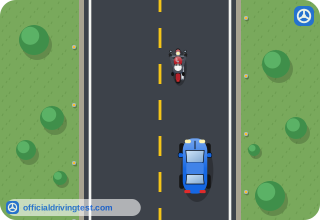
- Only the center of the lane
- Only the left half of the lane
- A complete traffic lane
- Only the right half of the lane
Show answer
Correct answer: A complete traffic lane
Operators have the right to use a complete traffic lane, and two of them may share a lane.
Source: Kansas Driving Handbook (Revised February 2022), page 83
-
What should you not do to a motorcycle, scooter, or moped traveling in a lane?
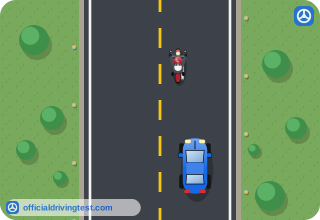
- Check your blind spot
- Pass it in the same lane
- Slow down behind it
- Give it space to react to other traffic
Show answer
Correct answer: Pass it in the same lane
Do not pass a motorcycle, scooter, or moped in the same lane; it needs space to react to other traffic.
Source: Kansas Driving Handbook (Revised February 2022), page 83
-
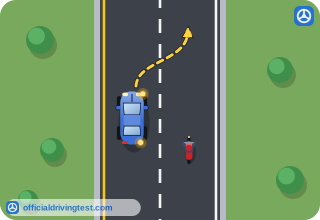
Why should you check mirrors and blind spots, turning your head to look, for motorcycles, scooters, and mopeds?
- They always travel faster than the rest of the traffic
- They have no lights on the front
- They cannot use the left lane
- Their small size lets them duck easily into your blind spot
Show answer
Correct answer: Their small size lets them duck easily into your blind spot
Motorcycles, scooters, and mopeds are small and can duck easily into your blind spot, so check mirrors and blind spots before entering or leaving a lane and at intersections.
Source: Kansas Driving Handbook (Revised February 2022), page 83
-
How many wheels may a motorized bicycle or moped have under the definition in the manual?
- Four wheels in a square pattern
- Exactly four wheels
- Two tandem wheels or three wheels
- Only two wheels
Show answer
Correct answer: Two tandem wheels or three wheels
A motorized bicycle or moped is a device having two tandem wheels or three wheels.
Source: Kansas Driving Handbook (Revised February 2022), page 83
-
Under the definition, a motorized bicycle or moped has a motor that produces not more than how much brake horsepower?
- 3.5
- 2
- 5
- 7.5
Show answer
Correct answer: 3.5
The motor of a motorized bicycle or moped produces not more than 3.5 brake horsepower.
Source: Kansas Driving Handbook (Revised February 2022), page 83
-
Under the definition, a motorized bicycle or moped has a cylinder capacity of not more than how many cubic centimeters?
- 50
- 250
- 500
- 130
Show answer
Correct answer: 130
A motorized bicycle or moped has a cylinder capacity of not more than 130 cubic centimeters.
Source: Kansas Driving Handbook (Revised February 2022), page 83
-
What kind of transmission does a motorized bicycle or moped have under the definition?
- A manual transmission
- An automatic transmission
- A two-speed manual gearbox
- No transmission
Show answer
Correct answer: An automatic transmission
The definition requires an automatic transmission.
Source: Kansas Driving Handbook (Revised February 2022), page 83
-
Under the definition, a motorized bicycle or moped has a maximum design speed of no more than what?
- 20 mph
- 30 mph
- 45 mph
- 55 mph
Show answer
Correct answer: 30 mph
A motorized bicycle or moped has the capability of a maximum design speed of no more than 30 mph.
Source: Kansas Driving Handbook (Revised February 2022), page 83
-
A motorcycle ahead of you has its turn signal flashing. What should you do before pulling out in front of it?
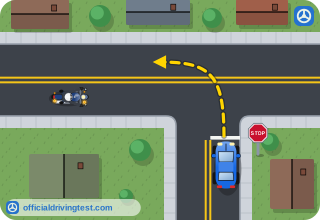
- Wait until you see that it is beginning to turn
- Assume it is turning and pull out at once
- Honk to warn the rider to turn
- Pull out as long as it is slowing down
Show answer
Correct answer: Wait until you see that it is beginning to turn
Motorcycle turn signals may not self-cancel, and the rider may have forgotten to turn them off. Do not pull out in front of a motorcycle until you see that it is beginning to turn.
Source: Kansas Driving Handbook (Revised February 2022), page 84
-
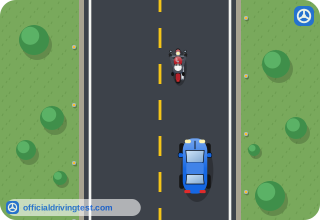
Because motorcycles, scooters and mopeds may not have turn signals, what is important when you are near one?
- Staying close behind so you can see its brake light
- Flashing your headlights to tell the rider to turn
- Leaving enough space for the rider to maneuver
- Passing it quickly before it reaches an intersection
Show answer
Correct answer: Leaving enough space for the rider to maneuver
Motorcycles, scooters and mopeds may not have turn signals, so it is important to leave enough space for the rider to maneuver.
Source: Kansas Driving Handbook (Revised February 2022), page 84
-
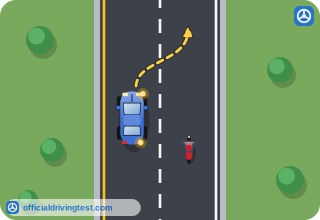
What does signaling before you change lanes or merge allow a motorcyclist to do?
- Pull onto the shoulder so that you can merge ahead of them
- Anticipate traffic flow and find a safe lane position
- Speed up to close the space beside your vehicle
- Stop at once and wait until your lane change is finished
Show answer
Correct answer: Anticipate traffic flow and find a safe lane position
Signaling your intentions lets the motorcyclist anticipate traffic flow and find a safe lane position.
Source: Kansas Driving Handbook (Revised February 2022), page 84
-
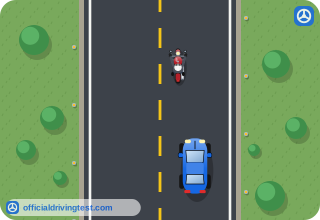
Why may a motorcyclist suddenly change lanes or speed?
- To warn drivers behind that the motorcycle will turn soon
- Because motorcycles cannot hold a lane position for long
- To make room for cars that are about to pass them
- To avoid a road hazard such as gravel, potholes or pavement seams
Show answer
Correct answer: To avoid a road hazard such as gravel, potholes or pavement seams
Conditions that are minor to a car driver, such as potholes, gravel, wet surfaces and pavement seams, can be deadly to a motorcyclist, who may change lanes or speed to avoid them.
Source: Kansas Driving Handbook (Revised February 2022), page 84
-
What following distance should you allow when following a motorcyclist, scooter or moped?
- 3 to 4 seconds
- 1 second
- 1 to 2 seconds
- 2 seconds
Show answer
Correct answer: 3 to 4 seconds
The manual says to allow a 3 to 4 second following distance, or more in wet conditions, when following a motorcycle, scooter or moped.
Source: Kansas Driving Handbook (Revised February 2022), page 84
-
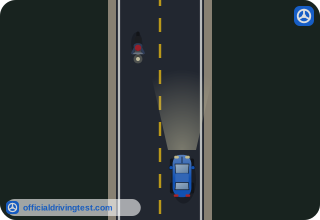
Why should you always dim your headlights when approaching a motorcycle, scooter or moped?
- The rider's own headlight is too dim to be seen near high beams
- High beams make a motorcycle's engine sound harder to hear
- The blinding effect of high beams is far more dangerous to the rider
- Motorcycle riders are not able to see dimmed headlights
Show answer
Correct answer: The blinding effect of high beams is far more dangerous to the rider
Because of their vulnerability, the blinding effect of high beams can be far more dangerous to riders of motorcycles, scooters and mopeds than to drivers of motor vehicles.
Source: Kansas Driving Handbook (Revised February 2022), page 84
-
How does the speed of scooters and mopeds compare with that of motorcycles?
- They travel at much higher speeds
- They travel at about the same speeds
- Their speeds always match the traffic around them
- They travel at much lower speeds
Show answer
Correct answer: They travel at much lower speeds
Scooters and mopeds travel at much lower speeds than motorcycles.
Source: Kansas Driving Handbook (Revised February 2022), page 84
-
Because of their weight, how do large vehicles compare with cars?
- They need longer distances to stop and accelerate and more room to turn
- They stop in a shorter distance because their brakes are larger
- They accelerate faster because their engines are more powerful
- They need less room to turn because the driver sits higher
Show answer
Correct answer: They need longer distances to stop and accelerate and more room to turn
Because of their weight, large vehicles have longer stopping and accelerating distances and need more room to turn.
Source: Kansas Driving Handbook (Revised February 2022), page 85
-
How do the blind spots of large vehicles compare with those of cars?
- Smaller, because the driver sits much higher than a car driver
- About the same, because large vehicles have more mirrors
- Much larger, even though the driver sits much higher
- Smaller, because large vehicles have larger mirrors
Show answer
Correct answer: Much larger, even though the driver sits much higher
Large vehicles have much larger blind spots than cars even though their drivers sit much higher than car drivers.
Source: Kansas Driving Handbook (Revised February 2022), page 85
-
How maneuverable are large vehicles compared with a car?
- More maneuverable
- Less maneuverable
- Equally maneuverable
- More maneuverable at low speeds only
Show answer
Correct answer: Less maneuverable
Large vehicles are less maneuverable than a car.
Source: Kansas Driving Handbook (Revised February 2022), page 85
-
What is the No-Zone around a large truck or bus?
- The marked area where passing a large vehicle is not allowed
- The space in front of a bus where drivers must yield to pedestrians
- The distance a loaded truck needs to come to a complete stop
- Areas where vehicles disappear from the commercial driver's view
Show answer
Correct answer: Areas where vehicles disappear from the commercial driver's view
The No-Zone is the area around large trucks or buses where vehicles disappear from the commercial driver's view into blind spots.
Source: Kansas Driving Handbook (Revised February 2022), page 86
-
On which parts of a large truck or bus are the No-Zone blind spots located?
- Both sides, the rear and the front
- Only the right side and the rear
- Only the rear and the front
- Only the rear of the vehicle
Show answer
Correct answer: Both sides, the rear and the front
The blind spots of a large truck or bus are on its sides, rear and front.
Source: Kansas Driving Handbook (Revised February 2022), page 86
-
Which side of a truck has the larger blind spot?
- The left side, starting at the front bumper
- Both sides, which are exactly the same size
- The right side, starting behind the cab
- Neither side, since trucks have mirrors on both sides
Show answer
Correct answer: The right side, starting behind the cab
Trucks have a larger blind spot on their right side, starting behind the cab and extending up to the length of the truck.
Source: Kansas Driving Handbook (Revised February 2022), page 86
-
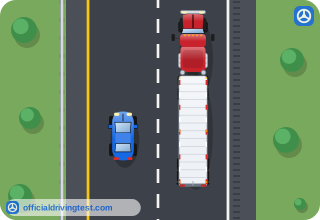
If you cannot see a truck driver's face in the side view mirror, what does that mean?
- The driver is signaling you to pass
- The driver cannot see you
- The driver has stopped to let you go by
- The driver can see you only in the rear mirror
Show answer
Correct answer: The driver cannot see you
If you cannot see the driver's face in the side view mirror, the driver cannot see you.
Source: Kansas Driving Handbook (Revised February 2022), page 86
-
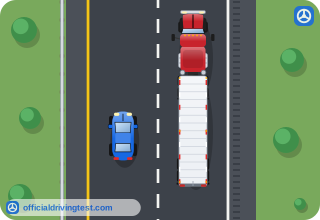
How long should you drive alongside a large vehicle?
- Long enough to check the driver's mirrors
- Until the driver signals you to pass
- As long as the lane beside it is clear
- No longer than required
Show answer
Correct answer: No longer than required
Avoid driving alongside a large vehicle for any longer than required under any circumstances, since a swerve or lane change greatly increases the chance of a collision.
Source: Kansas Driving Handbook (Revised February 2022), page 86
-
Under ideal conditions, a loaded truck with good tires and properly adjusted brakes traveling at 55 mph needs at least how many feet to stop?
- 335 feet
- 150 feet
- 225 feet
- 500 feet
Show answer
Correct answer: 335 feet
Under ideal conditions a loaded truck traveling at 55 mph requires a minimum of 335 feet before coming to a complete stop.
Source: Kansas Driving Handbook (Revised February 2022), page 86
-
Under ideal conditions, how does the stopping distance of a loaded truck at 55 mph compare with that of a car?
- About the same as a car
- About half as long as a car
- Greater than 1 1/2 times as long
- Slightly shorter than a car
Show answer
Correct answer: Greater than 1 1/2 times as long
A loaded truck's stopping distance at 55 mph is greater than 1 1/2 times the stopping distance of a car.
Source: Kansas Driving Handbook (Revised February 2022), page 86
-
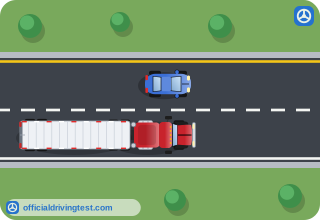
Why is it essential not to enter a roadway or change lanes in front of a large vehicle?
- Its driver sits too low to see the road ahead
- It takes longer than a car to stop
- It accelerates faster than a car and may hit you
- Its horn will startle you into a crash
Show answer
Correct answer: It takes longer than a car to stop
Because of a large vehicle's size and weight, it takes longer to stop than a car, so you should not enter a roadway or change lanes in front of it.
Source: Kansas Driving Handbook (Revised February 2022), page 86
-
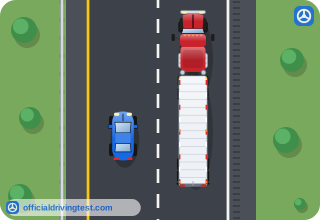
When passing a large vehicle, when should you pull in front of it?
- As soon as your car is level with the cab of the vehicle
- As soon as its driver flashes the headlights at you
- Once the rear of its trailer is level with your front bumper
- After you can see the whole front of it in your rear-view mirror
Show answer
Correct answer: After you can see the whole front of it in your rear-view mirror
When passing a large vehicle, look for the whole front of the vehicle in your rear-view mirror before pulling in front and maintaining speed.
Source: Kansas Driving Handbook (Revised February 2022), page 86
-
How far behind a large vehicle can its rear blind spot extend?
- Up to 200 feet
- Up to 50 feet
- Up to 100 feet
- Up to 500 feet
Show answer
Correct answer: Up to 200 feet
Large vehicles have huge blind spots directly behind them that extend up to 200 feet.
Source: Kansas Driving Handbook (Revised February 2022), page 86