Kansas: Seat belts and child safety
Safety belts, air bags and the passenger air bag switch. Split into 2 shorter tests so you're not stuck in one long quiz.
Independent educational site · not affiliated with any government agency or DMV
Choose a part
Seat belts and child safety — Part 1
Questions in this part include: “What does it mean that seatbelt use is a "Primary Violation" in Kansas?”
StartSeat belts and child safety — Part 2
Questions in this part include: “Which vehicles usually have a passenger air bag on-off switch as standard equipment?”
StartAll 35 Seat belts and child safety questions with answers
Choose a part above to take a practice test, or study every question and answer here.
Show the questions and answersHide the questions
-
What does it mean that seatbelt use is a "Primary Violation" in Kansas?
- A vehicle can be stopped solely for an unrestrained adult in front or a child anywhere
- An officer may cite it only after stopping the vehicle for another violation
- Only the driver can be cited, and the passengers can never be cited
- It applies only to drivers and passengers who are under 21 years old
Show answer
Correct answer: A vehicle can be stopped solely for an unrestrained adult in front or a child anywhere
Because seatbelt use is a primary violation, a vehicle can be stopped solely for an unrestrained adult in a front seat or an unrestrained child anywhere in the vehicle.
Source: Kansas Driving Handbook (Revised February 2022), page 16
-
Who is responsible for making sure all children in a Kansas passenger car are properly protected with the appropriate restraints?
- The oldest passenger
- The vehicle's owner, even if not in the car
- The driver
- The parent of each child, only if in the car
Show answer
Correct answer: The driver
The driver of a passenger car is responsible for ensuring that all children in the vehicle are properly protected with the appropriate occupant restraints.
Source: Kansas Driving Handbook (Revised February 2022), page 16
-
In the Kansas child restraint rules, what is a "passenger car"?
- Any vehicle designed to carry fewer than 5 passengers
- Any vehicle with two or four doors
- Any vehicle that weighs less than 5,000 pounds
- Any vehicle designed to carry fewer than 10 passengers
Show answer
Correct answer: Any vehicle designed to carry fewer than 10 passengers
The manual defines a passenger car as any vehicle designed to carry fewer than 10 passengers.
Source: Kansas Driving Handbook (Revised February 2022), page 16
-
How must a child under the age of 4 be restrained in a Kansas passenger car?
- In a booster seat or with a seatbelt
- In a federally approved child safety seat
- With a seatbelt in the back seat
- On an adult's lap in the back seat
Show answer
Correct answer: In a federally approved child safety seat
All children under the age of 4 must be restrained in a federally approved child safety seat.
Source: Kansas Driving Handbook (Revised February 2022), page 16
-
According to the manual, what is the safest position for a child safety seat?
- The middle of the backseat
- The front passenger seat
- Behind the driver's seat
- Behind the front passenger seat
Show answer
Correct answer: The middle of the backseat
The manual states that the safest position to place a safety seat is in the middle of the backseat.
Source: Kansas Driving Handbook (Revised February 2022), page 17
-
If children are in the vehicle, what should you do about the doors before you drive away?
- Leave the doors unlocked so children can leave quickly
- Lock the doors and turn on the childproof locks
- Lock the doors but leave the childproof locks off
- Open the rear windows instead of locking the doors
Show answer
Correct answer: Lock the doors and turn on the childproof locks
The manual says to lock the vehicle's doors and turn on the childproof locks if children are in the vehicle.
Source: Kansas Driving Handbook (Revised February 2022), page 27
-
How do safety belts help a driver keep control of the vehicle?
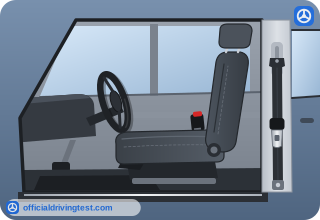
- They keep you behind the wheel if you are struck from the side or make a quick turn
- They lock the steering wheel in place whenever the vehicle turns too fast
- They slow the vehicle automatically in a sudden turn
- They keep the steering wheel from moving in a crash
Show answer
Correct answer: They keep you behind the wheel if you are struck from the side or make a quick turn
If you are struck from the side or make a quick turn, the force could push you sideways, and you cannot steer if you are not behind the wheel; a belt keeps you there.
Source: Kansas Driving Handbook (Revised February 2022), page 27
-
What do safety belts do when a crash occurs?
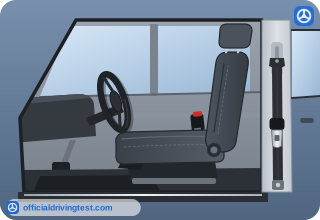
- They tighten and pull you back into the seat only at high speed
- They release automatically so you can get out
- They move with you and lock up
- They stay loose to let you reach the steering wheel
Show answer
Correct answer: They move with you and lock up
Safety belts move with you and lock up if a crash occurs, keeping you from being thrown from the vehicle.
Source: Kansas Driving Handbook (Revised February 2022), page 27
-
How should a shoulder harness be worn?
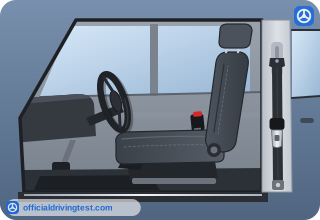
- Under the arm and across the lap, with a little slack
- Across the shoulder and chest with minimal if any slack
- Behind the back with the lap belt worn snug and low
- Across the stomach and hips, loosely
Show answer
Correct answer: Across the shoulder and chest with minimal if any slack
A shoulder harness is worn across the shoulder and chest with minimal if any slack, not under the arm or behind the back.
Source: Kansas Driving Handbook (Revised February 2022), page 27
-
What could wearing the shoulder harness the wrong way cause in a crash?
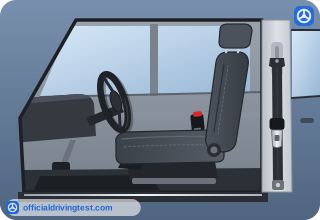
- Broken windows
- A jammed door latch
- Failure of the lap belt
- Serious internal injuries
Show answer
Correct answer: Serious internal injuries
Wearing the harness the wrong way, such as under the arm or behind the back, could cause serious internal injuries in a crash.
Source: Kansas Driving Handbook (Revised February 2022), page 27
-
How should the lap belt be adjusted?
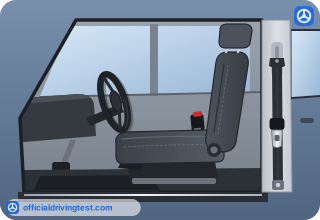
- Snug and low across your hips
- Loose and low across your thighs
- Snug and high across your ribs
- Loose across your stomach
Show answer
Correct answer: Snug and low across your hips
The lap belt should be snug and lie low across your hips after fastening.
Source: Kansas Driving Handbook (Revised February 2022), page 27
-
If your vehicle has an automatic shoulder belt, what else should you do?
- Nothing, because the automatic belt is enough
- Wear the shoulder belt under your arm
- Buckle your lap belt as well
- Move your seat back as far as possible
Show answer
Correct answer: Buckle your lap belt as well
You must buckle the lap belt too, otherwise in a collision you could slide out of the belt and be hurt or killed.
Source: Kansas Driving Handbook (Revised February 2022), page 27
-
What is the correct seating position when you wear a safety belt?
- Slightly reclined, with your back a few inches from the seat
- Upright, with your back against the seat and your feet on the floor
- Slouched low, with one foot resting on the seat
- Leaning forward, with your feet on the dashboard
Show answer
Correct answer: Upright, with your back against the seat and your feet on the floor
You should be seated upright with your back against the seat and your feet on the floor; slouching or putting your feet on the dashboard reduces the restraint system's effectiveness.
Source: Kansas Driving Handbook (Revised February 2022), page 27
-
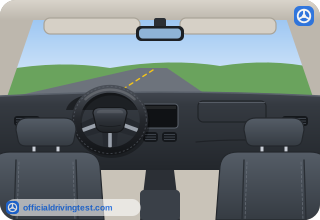
Why should safety belts be worn even if the vehicle is equipped with air bags?
- Air bags are designed to deploy only in side and rear collisions, not in frontal ones
- Air bags protect only front-seat passengers and never the driver
- Air bags stay inflated for a long time and block the driver's view
- Air bags do not protect you if you are hit from the side or rear or the vehicle rolls over
Show answer
Correct answer: Air bags do not protect you if you are hit from the side or rear or the vehicle rolls over
Air bags protect against hitting the steering wheel, dashboard or windshield, but not in a side or rear hit or a rollover, and they will not keep you behind the wheel.
Source: Kansas Driving Handbook (Revised February 2022), page 27
-
How does the manual describe air bags?
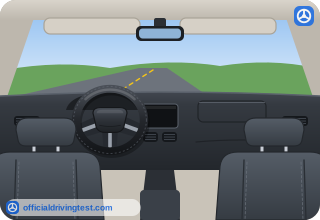
- Supplemental restraints designed to work best in combination with safety belts
- Full replacements for safety belts in modern vehicles
- Restraints designed to work best without safety belts
- Optional equipment that makes belts unnecessary at low speeds in town
Show answer
Correct answer: Supplemental restraints designed to work best in combination with safety belts
Air bags are supplemental restraints designed to work best together with safety belts, so belts should always be worn.
Source: Kansas Driving Handbook (Revised February 2022), page 27
-
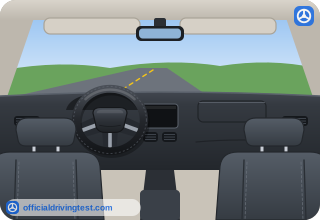
Why will an air bag not help during a secondary collision?
- It deploys only in side impacts and never in a second crash
- It must be reset by a mechanic after the first impact
- It deploys only once and deflates quickly after impact
- It stays inflated and blocks the driver's view
Show answer
Correct answer: It deploys only once and deflates quickly after impact
Air bags deploy only once and deflate quickly after impact, so they are not helpful during a secondary collision.
Source: Kansas Driving Handbook (Revised February 2022), page 27
-
In which crashes are front air bags designed to deploy?
- Side impact crashes only
- Frontal and near-frontal collisions
- Rear impact crashes and rollovers
- Any crash at any speed
Show answer
Correct answer: Frontal and near-frontal collisions
Front air bags deploy in frontal and near-frontal collisions, not in side impact, rear impact or rollover crashes.
Source: Kansas Driving Handbook (Revised February 2022), page 28
-
What kind of injuries from a deploying air bag are typical when they occur?
- Serious head injuries
- Broken ribs and collarbones
- Neck fractures
- Minor abrasions or burns
Show answer
Correct answer: Minor abrasions or burns
Air bag injuries, when they occur, are typically minor abrasions or burns; more serious injuries are rare.
Source: Kansas Driving Handbook (Revised February 2022), page 28
-
When can serious or even fatal injuries occur from a deploying air bag?
- When someone is very close to, or in direct contact with, the air bag
- When the occupant is wearing a snug lap belt and shoulder harness
- When the air bag deploys more than once in the same crash
- When the occupant sits in the rear seat behind the driver
Show answer
Correct answer: When someone is very close to, or in direct contact with, the air bag
Serious or fatal injuries can occur when someone is very close to, or in direct contact with, an air bag when it deploys.
Source: Kansas Driving Handbook (Revised February 2022), page 28
-
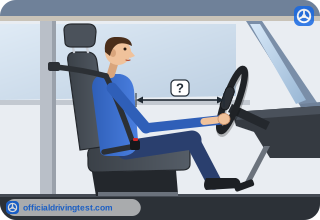
In most vehicles, how far should the center of your chest be from the center of the steering wheel?
- At least 3 inches
- At least 6 inches
- At least 10 inches
- At least 14 inches
Show answer
Correct answer: At least 10 inches
In most vehicles you should adjust your seat so at least 10 inches is between the center of your chest and the center of the steering wheel.
Source: Kansas Driving Handbook (Revised February 2022), page 28
-
How can you direct the air bag at your chest instead of your face?
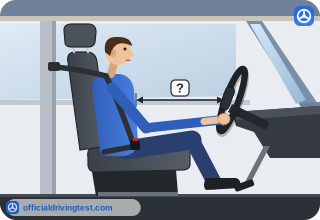
- Lower your seat as far as possible and tilt the steering wheel upward
- Raise your seat or use a cushion and/or adjust the steering wheel downward
- Recline your seat and move it back as far as possible
- Sit closer to the wheel and hold it at the top
Show answer
Correct answer: Raise your seat or use a cushion and/or adjust the steering wheel downward
To direct the air bag at your chest instead of your face, raise your seat or use a cushion and/or adjust the steering wheel downward.
Source: Kansas Driving Handbook (Revised February 2022), page 28
-
Where should your hands never be placed on the steering wheel because of the air bag?
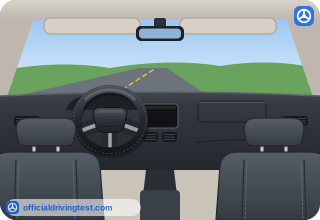
- On the outside of the steering wheel on opposite sides
- On opposite sides of the wheel rim
- Along the rim with your thumbs up
- Across the steering wheel where the air bag deploys
Show answer
Correct answer: Across the steering wheel where the air bag deploys
Your hands belong on the outside of the steering wheel, never across the wheel where the air bag deploys.
Source: Kansas Driving Handbook (Revised February 2022), page 28
-
What does a passenger air bag on-off switch do when it is in the off position?
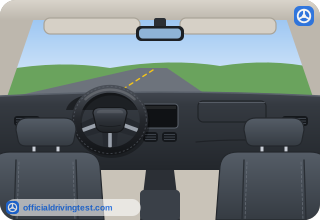
- It disables the front passenger air bag
- It disables the driver's air bag
- It disables the side impact air bags
- It disables the safety belt warning
Show answer
Correct answer: It disables the front passenger air bag
In the off position, the passenger air bag on-off switch disables the front passenger air bag.
Source: Kansas Driving Handbook (Revised February 2022), page 28
-
Which vehicles usually have a passenger air bag on-off switch as standard equipment?
- Vehicles with large rear seats and side air bags
- Only vehicles used to tow trailers
- Most vehicles without rear seats or with small rear seats
- Only vehicles that have no front air bags
Show answer
Correct answer: Most vehicles without rear seats or with small rear seats
Most vehicles without rear seats or with small rear seats, such as pickup trucks or sports cars, have the switch as standard equipment.
Source: Kansas Driving Handbook (Revised February 2022), page 28
-
Where should a rear-facing child safety seat never be placed?
- In the back seat behind the front passenger
- In front of an active passenger air bag
- In the back seat of a vehicle with side air bags
- In any seat that has a safety belt
Show answer
Correct answer: In front of an active passenger air bag
A rear-facing child safety seat is never placed in front of an active passenger air bag.
Source: Kansas Driving Handbook (Revised February 2022), page 28
-
What can happen if a child safety seat is not used correctly and installed properly?
- It may make the vehicle's air bags fail
- It may lock the doors by itself
- It may be illegal to drive until it is replaced
- It may not protect the child in a crash
Show answer
Correct answer: It may not protect the child in a crash
A child safety seat may not protect a child in a crash if it is not used correctly and installed properly.
Source: Kansas Driving Handbook (Revised February 2022), page 28
-
How long should infants ride in a rear-facing infant seat in the back seat?
- From birth to at least age one and until they weigh at least 20 pounds
- From birth to at least six months and until they weigh 10 pounds
- From birth to at least age two and until they weigh 30 pounds
- From birth to at least age three and until they weigh 40 pounds
Show answer
Correct answer: From birth to at least age one and until they weigh at least 20 pounds
Infants should ride in a properly installed rear-facing infant seat in the back seat from birth to at least age one and until they are at least 20 pounds.
Source: Kansas Driving Handbook (Revised February 2022), page 28
-
Where should a toddler over one year old who weighs at least 20 pounds ride?
- In the front seat on the lap of an adult passenger wearing a belt
- In the back seat secured by the lap belt alone
- In the back seat in a properly installed, forward-facing child safety seat
- In the back seat in a rear-facing infant seat only
Show answer
Correct answer: In the back seat in a properly installed, forward-facing child safety seat
Toddlers over one year old and at least 20 pounds should ride in the back seat in a properly installed, forward-facing child safety seat.
Source: Kansas Driving Handbook (Revised February 2022), page 28
-
Under the responsibilities of driving, who should always wear seatbelts?
- You and your passengers
- Only the driver
- Only passengers in the front seat
- Only drivers on highways
Show answer
Correct answer: You and your passengers
The manual says you and your passenger(s) should always wear seatbelts.
Source: Kansas Driving Handbook (Revised February 2022), page 70
-
How can wearing a safety belt help you when you steer quickly to avoid a collision?
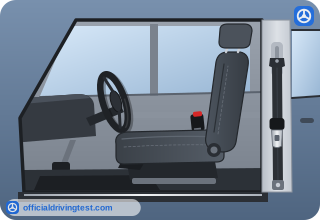
- It makes the vehicle turn faster when you steer quickly
- It keeps you in the seat behind the steering wheel to maintain control
- It takes the place of looking in the mirrors before you steer
- It lets you take your hands off the steering wheel safely
Show answer
Correct answer: It keeps you in the seat behind the steering wheel to maintain control
A safety belt keeps you in the seat behind the steering wheel, which helps you maintain control of your vehicle.
Source: Kansas Driving Handbook (Revised February 2022), page 73
-
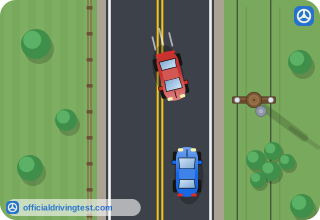
If you cannot avoid a collision, what is the most important thing you can do to lessen injuries?
- Turn off the engine
- Use your safety belt
- Take your hands off the wheel
- Open the windows
Show answer
Correct answer: Use your safety belt
The most important thing you can do to lessen injuries in a crash is to use your safety belt.
Source: Kansas Driving Handbook (Revised February 2022), page 74
-
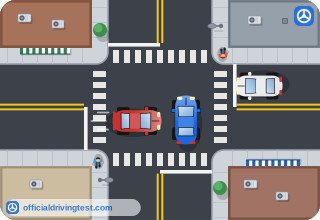
Your vehicle is hit from the side. What helps keep you behind the wheel?
- The head restraint behind you
- The frontal air bag in the wheel
- The parking brake handle
- Your lap and shoulder belts
Show answer
Correct answer: Your lap and shoulder belts
Your body is thrown toward the side that is hit, and lap and shoulder belts help keep you behind the wheel.
Source: Kansas Driving Handbook (Revised February 2022), page 74
-
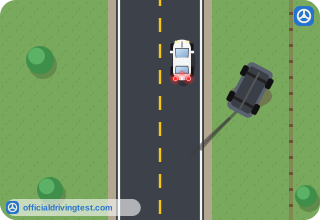
What is the most effective way to reduce the risk of injury or death in a rollover?
- Drive with the windows open
- Use your safety belt
- Sit as far back from the wheel as possible
- Brace yourself against the dashboard
Show answer
Correct answer: Use your safety belt
Without safety belts, occupants of vehicles that roll can be thrown from the vehicle, which greatly increases the risk of serious injury or death.
Source: Kansas Driving Handbook (Revised February 2022), page 76
-
What can side airbags triggered by rollover sensors help prevent?
- The vehicle from leaving the pavement in the first place
- The need to wear a safety belt while you are driving
- Upper body contact with the ground or complete occupant ejection
- Tires from losing contact with the road surface
Show answer
Correct answer: Upper body contact with the ground or complete occupant ejection
Side airbags triggered by rollover sensors can keep the upper body from being exposed to contact with the ground or even complete occupant ejection.
Source: Kansas Driving Handbook (Revised February 2022), page 77
-
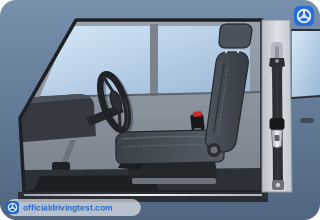
How should you place the safety belt during the pre-trip inspection?
- Across your stomach and neck
- Across your hips and shoulder
- Across your waist only, under the arm
- Across your chest only
Show answer
Correct answer: Across your hips and shoulder
The inspection says to place the safety belt across your hips and shoulder, and the belt must not be ripped or frayed.
Source: Kansas Driving Handbook (Revised February 2022), page 97